Whatever Weds. Red-tailed Hawk Immature

Copyright ©2021 Deborah M. Zajac. ALL RIGHTS RESERVED

Red-tailed Hawks are the most common hawk in North America and certainly the one I see most often. While birding with the birding group a few weeks ago another lady and I veered away from the group a few minutes to check out another path and saw this Red-tail perched with its back to us. It stayed for a good bit then turned and flew right over our heads. That’s when I got this shot. It’s probably a 1st year since it doesn’t have its red tail feathers yet.

Fun Facts- gleaned from allaboutbirds.org

  • The Red-tailed Hawk has a thrilling, raspy scream that sounds exactly like a raptor should sound. At least, that’s what Hollywood directors seem to think. Whenever a hawk or eagle appears onscreen, no matter what species, the shrill cry on the soundtrack is almost always a Red-tailed Hawk.
  • Birds are amazingly adapted for life in the air. The Red-tailed Hawk is one of the largest birds you’ll see in North America, yet even the biggest females weigh in at only about 3 pounds. A similar-sized small dog might weigh 10 times that.
  • The “Harlan’s Hawk” breeds in Alaska and northwestern Canada, and winters on the southern Great Plains. This very dark form of the Red-tailed Hawk has a marbled white, brown, and gray tail instead of a red one. It’s so distinctive that it was once considered a separate species, until ornithologists discovered many individuals that were intermediate between Harlan’s and more typical Red-tailed Hawks.
  • Courting Red-tailed Hawks put on a display in which they soar in wide circles at a great height. The male dives steeply, then shoots up again at an angle nearly as steep. After several of these swoops he approaches the female from above, extends his legs, and touches her briefly. Sometimes, the pair grab onto one other, clasp talons, and plummet in spirals toward the ground before pulling away.
  • Red-tailed Hawks have been seen hunting as a pair, guarding opposite sides of the same tree to catch tree squirrels.
  • The oldest known wild Red-tailed Hawk was at least 30 years, 8 months old when it was found in Michigan in 2011, the same state where it had been banded in 1981.

The Scrub Jays here mimic the Red-tail Hawk’s call and has been fooling me a lot lately! I’ve been listening to calls so I’m not so easily fooled next time. Ha!!😂

After the group broke up I headed east in search of another bird, but had no joy finding it but, the river was pretty. I saw a few mallards, and Yellow-rumped Warblers and people so headed home for lunch.

Truckee River Bend

The image of the Red-tail looks so bad here on WordPress! I’m beyond frustrated with this happening all the time. I haven’t changed the way I process and resize my images in a decade so it must be WordPress! I need a tutorial! Any help or pointers would be greatly appreciated.

My images look fine and the way I want them to on flickr. Here’s the link to the same image of the Red-tail. https://www.flickr.com/photos/dmzajac2004/51529739409/in/dateposted/

See what I mean? I’m really not happy with WordPress at the moment! Any ideas for a not savvy computer person to fix it?

Fuji X-T3| Fujinon 100-400mm| PS CC 22.5| iPhone 7Plus

more to come…
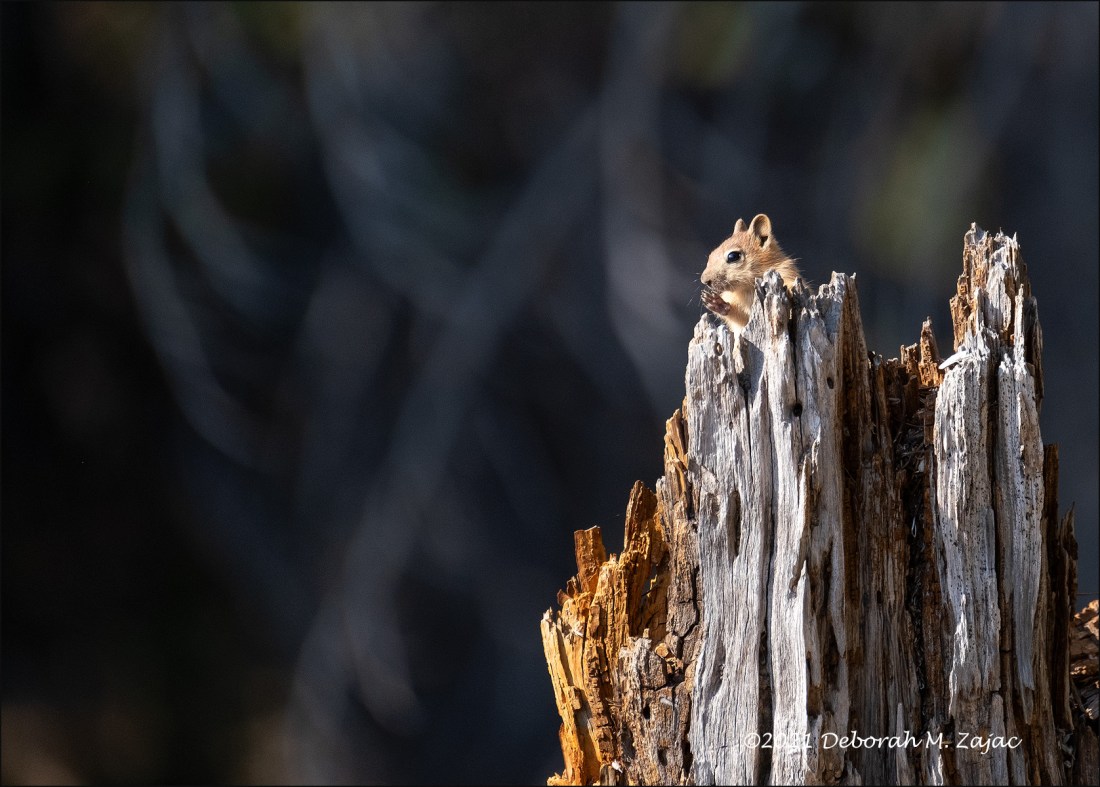
Wordless Weds. Little Red Squirrel-I think!

Copyright ©2021 Deborah M. Zajac. ALL RIGHTS RESERVED

The cutest little thing just popped up and started munching. Birding in the Carson Range 2021

Fuji X-T3| Fuji 100-400mm| PS CC 22.5

more to come…

Sunspots

Copyright ©2021 Deborah M. Zajac ALL RIGHTS RESERVED

Have you heard about the huge sunspots that are facing Earth now? It’s been some years since there’s been some HUGE ones…big enough to fit Jupiter in them HUGE! I got excited and thought I’d dig out my solar filter and photograph the Sun since I haven’t in a long time.

I made this image September 9th in the morning just a little after the sun crested the mountains.

Sun on September 9, 2021

The biggest sunspot is AR2866, and the other big one one above it is AR2868. There are couple of little ones there too.

The big sunspots can produce big flares or CME’s – Coronal Mass Ejections so the space folks will be watching for those. CME’s can weaken the magnetosphere and they can produce blackouts. Hopefully that doesn’t happen.

It’s been some time since we could see so many sunspots on the Sun and that was at the tail end of Cycle 24 back in 2017. I find it so fascinating and thought I’d share my image with you in case you do too.

Have a lovely week-end everyone!

Fuji X-T3| Fuji 100-400mm @400mm| Orion Solar filter| PS CC 22.5

more to come…

Thursday Doors- Picnic find

Copyright ©2021 Deborah M. Zajac. ALL RIGHTS RESERVED

On the way to Baby Girl’s last week we stopped to pick up some lunch from a burger joint and took it across the road to eat in the park for an impromptu picnic. (Sorry, no burger pic this time) I forgot to take a picture!

It’s at the park that I saw this little Free Library and loved the pink doors. Sadly, there were no children’s books in it. I’m going to get some to add to it since it’s likely we’ll be stopping for burgers and fries and eat in this park again.

Little Free Library Hwy 88

Dan Antion’s blog No Facilities hosts Thursday Doors. Click here to get to his blog to see many other doors from all over the world that other door lovers have shared this week.

iPhone 7Plus| PS CC 22.5

more to come…

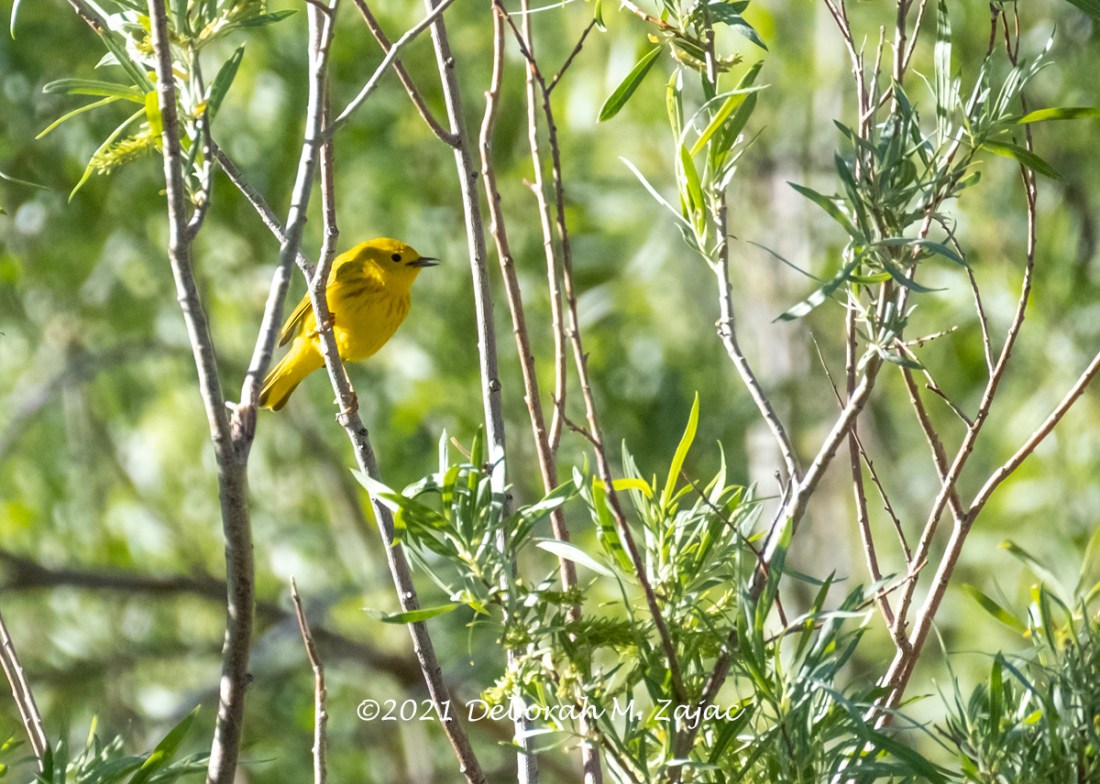
Friday’s Feathered Friends-Yellow Warbler

Copyright ©2021 Deborah M. Zajac. ALL RIGHTS RESERVED

Isn’t he cheerful? This was the second time I’ve ever seen this bird. There are more than 50 species of Warblers but few are as brilliant yellow as he is. The females aren’t as bright and lack the rich chestnut streaking, but do have the black eyes, and warm yellow tones.

Yellow Warbler

Fun Facts:

  • In addition to the migratory form of the Yellow Warbler that breeds in North America, several other resident forms can be found in Mexico, Central America, and the Caribbean. Males in these populations can have chestnut caps or even chestnut covering the entire head.
  • The nests of the Yellow Warbler are frequently parasitized by the Brown-headed Cowbird. The warbler often builds a new nest directly on top of the parasitized one, sometimes resulting in nests with up to six tiers.
  • Life can be dangerous for a small bird. Yellow Warblers have occasionally been found caught in the strands of an orb weaver spider’s web.
  • The oldest-known Yellow Warbler was a female, and was at least 11 years old when she was recaught and rereleased during banding operations in New York.~allaboutbirds.org

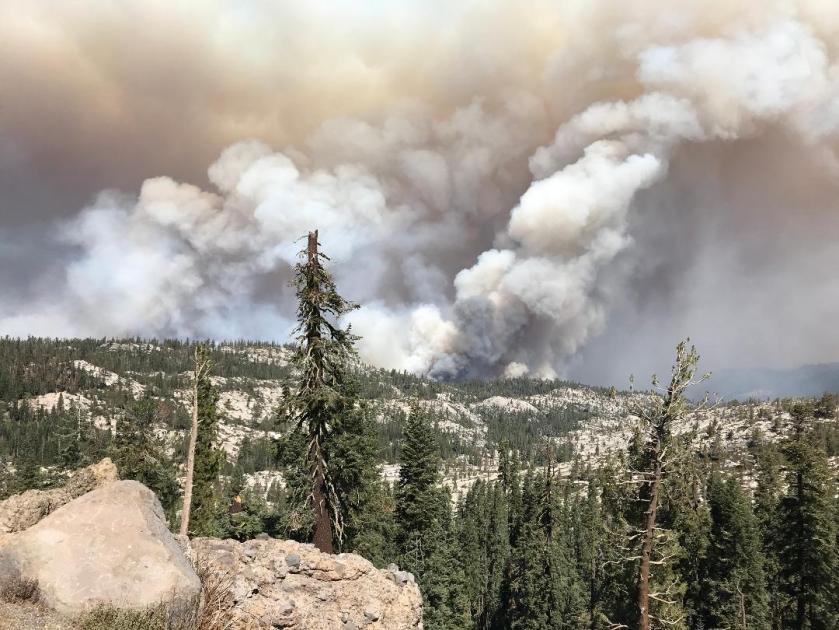
Sunday we drove over the mountains to go visit Baby Girl, The Handsome Surveyor, and the boys. Along the way we stopped at Maiden’s Grave pullout to view the horrible smoke plume from the Caldor Fire burning in the El Dorado National forest.

View from Maiden’s Grave, SR 88, CA.

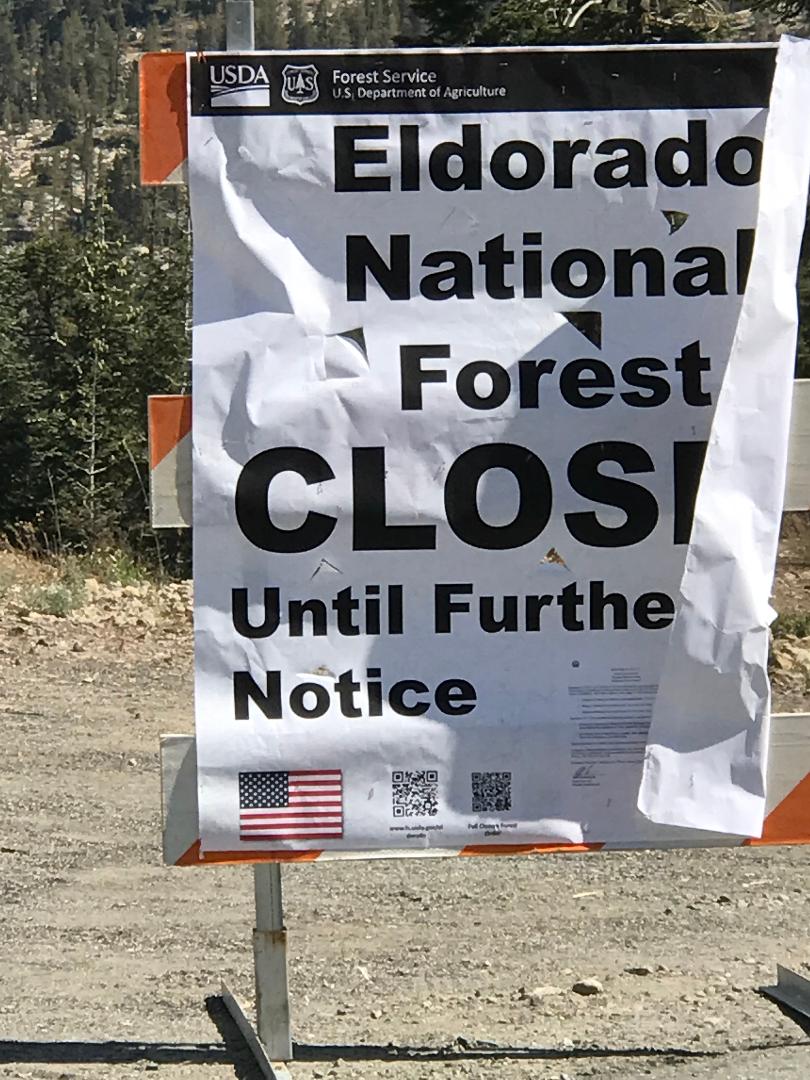
All through the forest we kept seeing these signs- Every campground, and park is closed. 😭

Forest Closed Sign

The reports on the fire are somewhat better today. They’re allowing some residents to return their homes in South Lake Tahoe, and the cooler temperatures, and less wind in the week-end forecast is promising and should help the firefighters with the fight.

The smoke is still in the unhealthy range here, but the sun is trying to burn through it today so I’m feeling a wee bit more positive today on the fire front.

We haven’t any week-end plans since we’ve been gone a lot these last two weeks visiting our kids and grandkids. What about you any plans? Whatever your plans I hope you have a good week-end!

Fuji X-T3| Fuji 100-400mm| and iPhone 7Plus| PS CC 22.5

more to come…

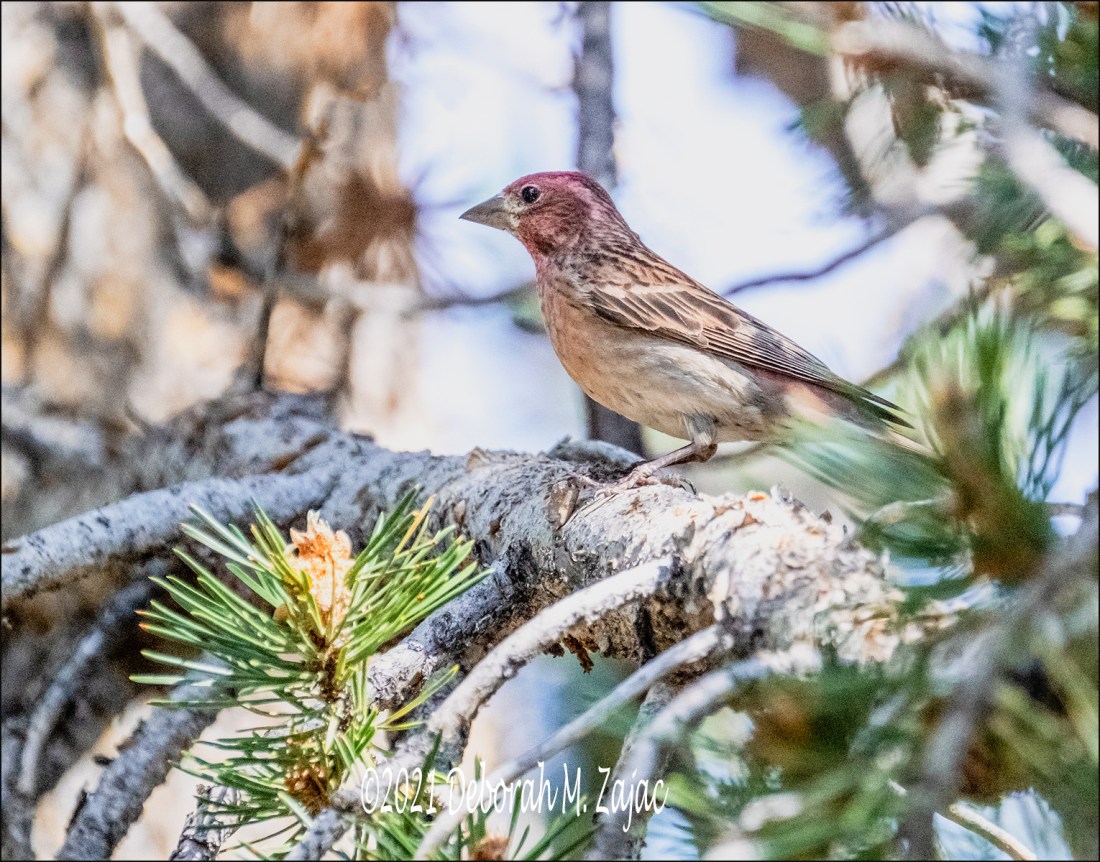
Friday Feathered Friends-Cassin’s Finch

Copyright ©2021 Deborah M. Zajac. ALL RIGHTS RESERVED

Back in July I saw this beauty, he was my 7th Lifer for the year!

Cassin’s Finch-Male

They live in the mountains of western North America. I am really surprised that it took me so long to spot one, but it did.

Fun Facts: gleaned from allaboutbirds.org

The Cassin’s Finch was first collected on an 1850s expedition to the southwestern mountains by the Pacific Railroad Survey. The eminent ornithologist John Cassin, who created illustrations for the survey, called the pink-tinged finch the “greatest bird in the lot.” Cassin asked his friend and colleague Spencer Baird to name the new species after him.

Male Cassin’s Finches have red crown feathers thanks to carotenoid pigments, which they acquire when they swallow colorful foods like the orange berries of firethorn plants.

Male Cassin’s Finches remain brownish and look like females during their first breeding season. During this time they sing, and this may give the false impression that both sexes sing. These young males may group into “bachelor flocks” during that first breeding season.

The Cassin’s Finch is an accomplished mimic, often adding the calls of other species into its own songs.

The Cassin’s Finch breeds semicolonially, with nests on average 80 feet apart. Nests are sometimes as close as 3 feet apart—this usually causes a fight between males until one of the pair gives up. If the first nest is substantially earlier than the other, however, such close nesting may be tolerated.

The Cassin’s Finch craves salt, and is often found visiting mineral deposits on the ground.

The oldest recorded Cassin’s Finch was a male, and at least seven years old when he was recaptured and released during banding operations in Oregon in 1979. He had been banded in the same state in 1974. ~ allaboutbirds.com

We’re still dealing with a lot of smoke from the two biggest fires in California.

As I type this on Thursday our AQI is bad, but not as awful as it was on Monday when we flew into Reno on our way home from visiting Big Baby Boy, and the Dark Haired Beauty. Monday the AQI was a whopping 398!

I saw the pilots on the way out of the plane and said, “I sure am glad you were able to see to land, because I couldn’t see a thing!” One of the pilots replied, ” We had one eye opened and hoped for the best.” 🤣😜

I’m glad it was the good eye!

He-Man said he was thinking about the scene in the movie Airplane. Flying on instruments LOL!!

I hope you all have a great week-end!!

Fuji X-T3| Fujinon 100-400mm| PS CC 22.5.0

more to come…