“A good snapshot keeps a moment from running away.” ― Eudora Welty
Author: circadianreflections
My name is Deborah Zajac. I'm a photographer living in Nevada at the base of the Eastern Sierras. I am a passionate nature, landscape, night/astro photographer. I shoot predominately in color and use Nikon Digital Cameras, and lenses.
I hope you enjoy seeing some of the photos I've taken while on my travels.
Please feel free to leave a comment I'd love to hear from you.
It was the first time I’ve seen the White-Lined Sphinx. Some people call it the Hummingbird Moth because it looks and acts like a Hummingbird. It was so cool seeing it fly and hover over these flowers feeding.
Hum, I don’t know what’s happening but my images look soft in WP lately. Sigh. Any ideas?
I had company last week-end then we went over the mountains to see the boys, Baby Girl, and The Handsome Surveyor for a couple of days so I am behind, but I’ll catch up with you in a tick!
A friend came up for the week-end and we birded, and admired wildflowers, and hiked. He-Man even joined us on the longest hike which was just over 6 miles, and we climbed 640ft in the Eastern Sierras.
We also had the pleasure of seeing several butterflies. Here are two.
I think this is a Fritillary maybe a Meadow Fritillary? If you know what it is I’d love to know for sure.
Fritillary? Wildflower?
This one I was able to identify as the Western White Butterfly.
Western White Butterfly
This one is a first for me!
The wildflowers in the high country are in full bloom and gorgeous, and I’ve picked up a few new to me birds! I’ll be sharing those in future posts…after I have nailed down their identities. I’m still not quite certain on two of them.
Merlin my bird app isn’t giving me a definitive answer so, I’m still trying to figure them out.
The smoke here seems to get better, then it gets worse. The Tamarack Fire is still burning and when I last checked it was still 0% contained and the winds in the afternoon have been very gusty not helping the fire crews at. all!
I am hopeful that fire crews will be able to get it under control sooner rather than later.
That’s about it from here. I hope your week is going well.
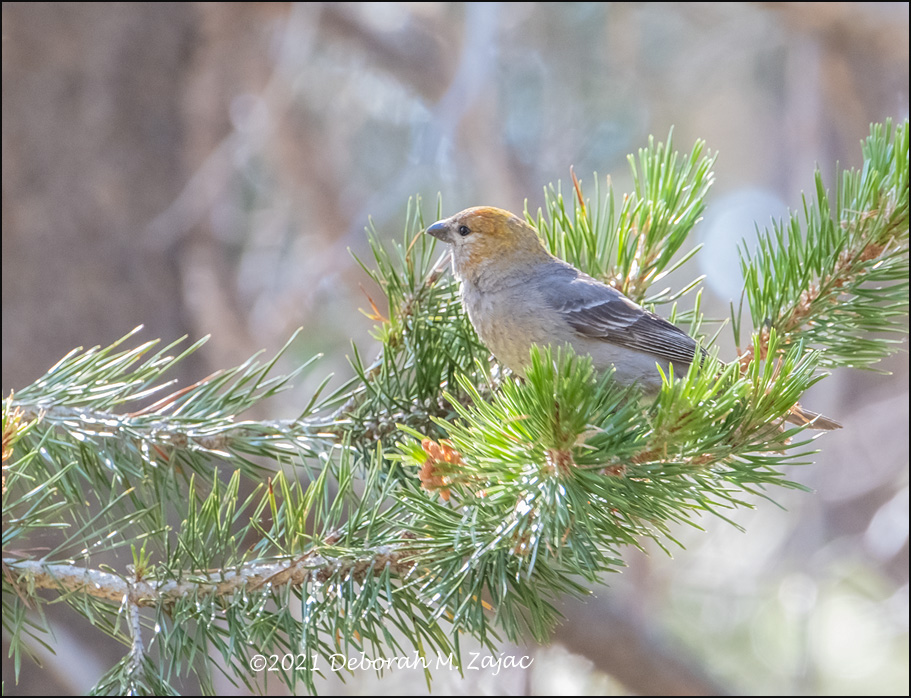
Last week I went birding with the Audubon Group and we were treated to a sighting that not only was a new to me bird, but a rare bird to this area too. Lifer number 6 for 2021 is the Pine Grosbeak. This is a female.
This was a “lifer” for about half the group and there were only 9 of us birding that morning. It was quite exciting!
Pine Grosbeaks eat a lot of plants, but it can be tough for their nestlings to eat and digest all that vegetation. Instead of feeding plants directly to their nestlings, they regurgitate a paste of insects and vegetable matter that they store in pouches at the lower part of their jaw on either side of their tongues.
Not all Pine Grosbeaks are the same. Not only do they differ in the amount and intensity of red across their range, they are also different sizes. Body size and wing and tail length generally increase from Newfoundland westward to the Yukon Territory. But birds on Haida Gwaii (Queen Charlotte Island) in British Columbia, Canada, and in California are among the smallest of all Pine Grosbeaks. Wings and tails of birds on Haida Gwaii are around a half inch smaller than birds in Alaska.
Pine Grosbeaks aren’t just in North America. They also breed in subalpine evergreen forests from eastern Asia to Scandinavia.
The tameness and slow-moving behavior of the Pine Grosbeak prompted locals in Newfoundland to affectionately call it a “mope.”
Winter flocks may stay near a tree with abundant fruit until all of it is consumed.
The oldest recorded Pine Grosbeak was a male, and at least 9 years, 9 months old when he was found in Quebec in 1970. He was first captured and banded in Connecticut in 1961.




 Circadianreflections Blog
You must be logged in to post a comment.