Mono Lake: Morning Civil Twilight

Copyright © 2015 Deborah M. Zajac. ALL RIGHTS RESERVED

I spent the week-end in the Eastern Sierras photographing Sunrises, Sunset, and Fall Color.  I left my home in Silicon Valley at 4PM on Friday to meet a new friend/member in the Photography Group I was going with.  Anyone living in Silicon Valley knows leaving after 3PM is a nightmare! Traffic is awful.  It’s congested with get-away travelers and commuters. Unfortunately, even in mid-October that’s true! It took me over an hour to travel 11 miles to meet her!  Cindy parked on a residential street hoping her car would be fine for the week-end b/c my house was out of the way, and me going to meet her would have beem backtracking and mean we’d lose 1-2 hours in traffic.

I picked her up, and we got back on the freeway where we crawled at about 30 mph for 2 hours. Finally the road opened up and we were off and onto the Eastern Sierras. We arrived at our Motel just about Midnight. After checking in we both unpacked the bare necessities then fell into our beds knowing the alarm would be ringing in just 4 hours!

We were meeting the rest of our group at 6AM. We had a 30 minute drive from our Motel to the meeting spot. That meant a 4:40AM wake up call for me! I had a quick shower, and we managed to get out the door at 5:20am and arrived at the meeting spot 5 minutes early.

We were a group of 20 in all. We drove to Mono Lake ( Moe-Noh) and found the parking lot was already full of cars! Fall in the Eastern Sierras is getting more and more crowded. There was a faint light in the East signaling the Sun was in a hurry to greet the Northern Hemisphere so, we gathered our gear, and walked-ran to find our spots as quickly as we could.

We went left away from the horde of other photographers; I found a place I thought made a good composition, but I sank ankle deep in the muck to get there.

Experienced Photographers have a good feel for the outcome of the sunrise or sunset, but I’ve never bet on it.  Mother Nature has fooled me a few times! Okay, I won’t lie more than a few times! This morning however, had great potential, and fortunately, The Belt of Venus showed up and lent the morning a beautiful pink hue.

These formations you are seeing are salt and mineral deposits that formed over thousands of years. They’re called Tufas (too-fahs).

Years ago the lake water was re-routed to the south to give water to Southern California’s agriculture belt and residents.

As the lake got lower, and lower these remarkable formations were exposed.

A couple of decades ago a conservation group was successful in their appeals to let Mono Lake (Moe-Noh) return to its natural state. They are no longer diverting water from this basin which means one day all this will be under water again.

Each time I visit this lake I am acutely aware that I am seeing something wonderful, beautiful, and unique. I hope this image is able to convey just a hint of that wonder and beauty.
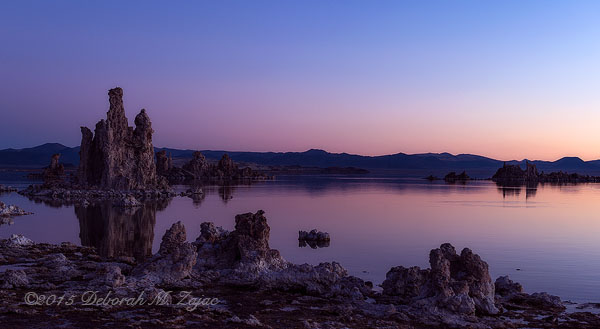
Morning Twilight Civil Mono Lake

In desperate need of a caffeinated drink, and food we headed for breakfast right after the light went flat.

For more information about Mono (Mo-noh) Lake click here.

I’m really behind on all your posts. I will get caught up this week!

Nikon Df| AF Nikkor 24-70mm| Hoodman STEEL Ultra High Speed Digital Film| Tripod| Developed in Photoshop CS6

More to come…
Maple Lear in Watercolor

Copyright © 2015 Deborah M. Zajac. ALL RIGHTS RESERVED

A couple of weeks ago I spotted what might be a Maple Tree while driving home from the hardware store.

After dropping off my packages I walked back to the tree and plucked a single leaf off a low branch with the intention of using it as a model for a watercolor painting.  I sketched it out that same afternoon then worked on a Kumquat leaf, and a landscape instead.  Today I was able to spend quite a bit of time working on the Maple Leaf painting, but it was super dried out, and crumbly and the color had changed from a vibrant red to a brownish red which I tried to capture, but perhaps I missed the mark and this is closer to an Ash in the fall or winter.

Here’s the final painting.

Maple Leaf in Watercolor

I bought a new set of Turner watercolor paints not long ago so, I used those to paint this on Arches 140lb Cold Press watercolor paper. I also purchased a new brush that I’ve been using almost exclusively since it arrived.

It’s Creative Mark’s Mimic Kolinsky No.12 Round.   It’s faux mink but, feels and acts like a real fur brush. I’m loving it, and the new paints. The brush comes to a lovely fine point and hasn’t shed at all. It holds a lot of water, and cleans up in a cinch.  The paints have a nice pigment, there are 18 colors in the set so, I’m getting to try some new colors, and I’m using less paint than I was using with my Cotman paints. Or it feels that way to me.

Is this a Maple Leaf? I hope I can find another one that’s still red soon!

Lumix FZ200| Lexar Professional Digital Film| Hand-held

More to come…

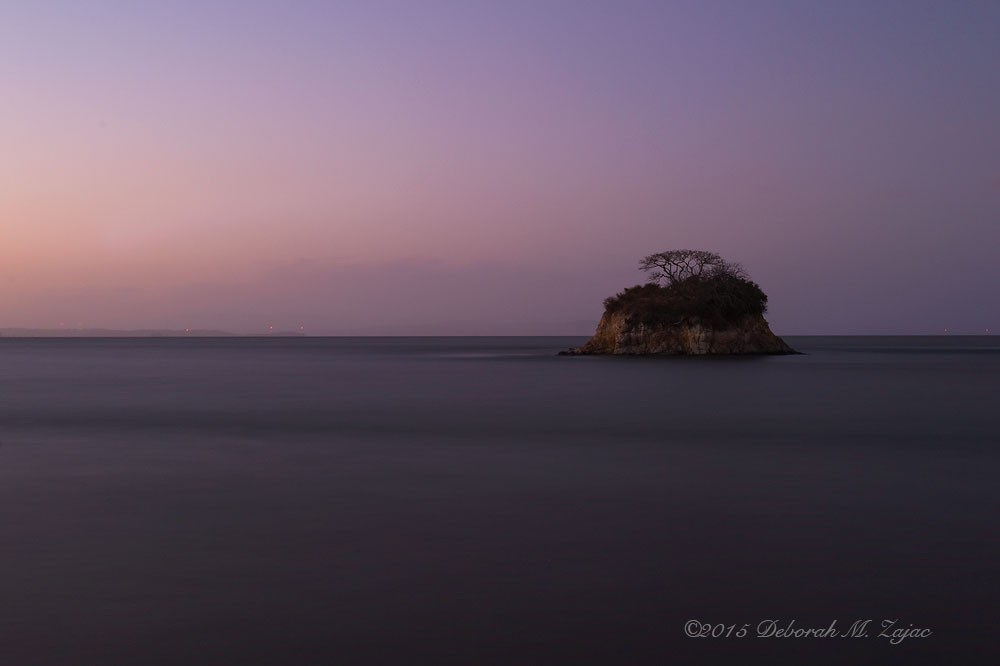
Amethyst Evening Rat Rock Island

Copyright ©2015 Deborah M. Zajac. ALL RIGHTS RESERVED

I went out last evening with a small group of Photographer’s to Rat Rock Island for Sunset. The Belt of Venus was lovely and lent a beautiful hue to the sea and sky.

This was my last image of the evening.  I was using my 6 stop Neutral Density filter to slow down the water and create a dreamier scape. This is a 2 minute exposure.

Amethyst Evening at Rat Rock Island

Nikon Df| AF-S Nikkor 24-70mm| Hoodman STEEL Ultra High Speed Digital Film| Tripod| B+W 6stop ND Filter| CS6| On1

More to come…

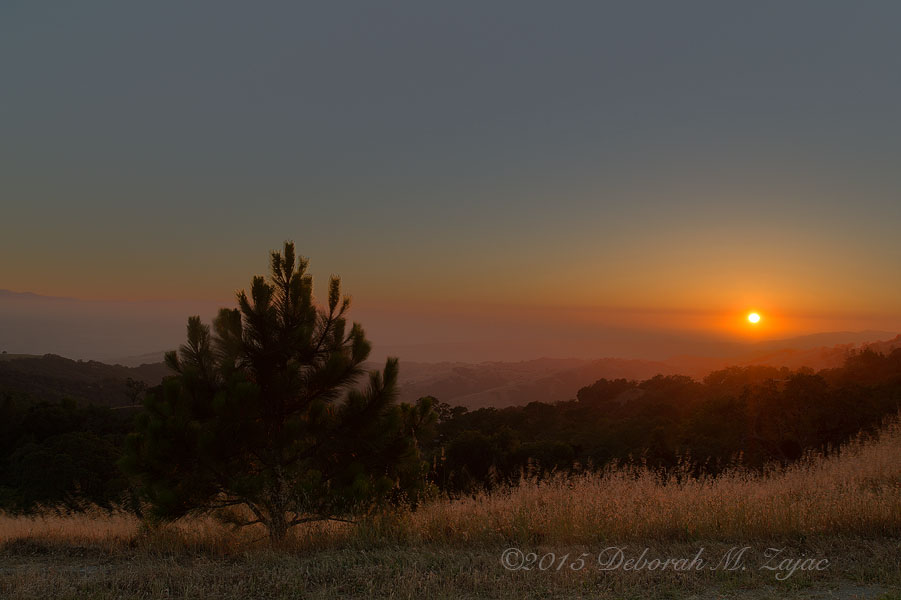
Sunset over Santa Clara County Hills

Copyright © 2015 Deborah M. Zajac. ALL RIGHTS RESERVED

Another little tree alone on a hill.  This is an image I made a couple of weeks ago.  It was a lovely evening: warm, with a cool breeze, and the color glowed in the sky for hours; until well after dark. A rare thing around here.

Sunset over Santa Clara County

This image is a composite made from two frames blended in Photoshop CS6.

Nikon Df| AF-S Nikkor 17-35@30mm| ISO 100| Manual Priority| Tripod| Singh-Ray 2 stop Reverse Grad ND + 3 stop Grad ND filters

More to come…

Under Scorpio’s Light

Copyright © 2015 Deborah M. Zajac. ALL RIGHTS RESERVED

In 2012 I shot my very first Milky Way Pano. I’ve not yet posted it…it is still a work in progress.   Since then I’ve been wanting to improve on the techniques I used in 2012 which was…I won’t lie, ” flying by the seat of my pants”.

One of the things I want to improve is getting better stitching. Even using a tripod,  and generous overlapping I wasn’t happy with the stitching.  I hoped that by calibrating my lens to find the Nodal Point, or No Parallax Point I would get better stitching results.  What is the Nodal Point and why does it matter you ask?  Do this. Hold up your thumb or pen in front of your face at arm’s length, and move your head from left to right. Notice how the background moved on one side more than the other? That’s Parallax. If you were to take two images one from the left and one from the right side and merge them the line would not be straight.  You need to either have the point of view of the pen or the background.

For a great explanation to solve this issue I turn to John Houghton, ” Ideally, therefore, when taking the photographs for a stitched panorama you need to take all the shots from a single viewpoint so that near objects don’t change their position against the background in successive shots.  This will greatly ease the task of  joining the images seamlessly to form a perfect panorama image.  Hence, the “eye” of the camera needs to be kept in a constant position when the camera is rotated to point in a different direction for each shot. “~ John Houghton

Yesterday afternoon I figured out the Nodal Point, or No Parallax Point for my 24mm f/2.8 lens.  I mounted my camera  on my macro rail, and a tripod. Making sure that tripod was level, next making sure my camera/macro rail were level,  then I lined my tripod rig up with a light stand placed a few feet away from the tripod, and a pole I have in the backyard which is further away from the light stand.

Loosening my panning knob on the ball-head I moved the camera/micro rail left and right and could see the furthest pole on both sides of the light stand I had parallax. Then I moved my camera back to the center point moved my camera back using the macro rail adjustment knob. I locked it down and moved my camera right and left again…the parallax got worse telling me I needed to make my adjustment on the rail in the other direction. I loosened the rail and moved the other direction a bit then moved the camera from left to right, and saw I was getting there; I only saw a little bit of the further pole behind the light stand now.   One more small adjustment and Voila! I didn’t see the further pole behind the light stand when panning the camera left and right.   I found the Nodal Point, or No Parallax Point of that lens!

My rail has centimeter, and millimeter marks so I made a note of the number that 24mm f/2.8 lines up with to be able to quickly set up a panorama shot with that lens again.

Now that I had found the Nodal/No Parallax Point I was anxious to test it out. The sky was supposed to be clear so I met a friend at a favorite Night Sky spot to shoot the Milky Way. My goal was to make a Vertorama/Panorama using my new measurement of the Nodal Point.

In the Light of Scorpius

I made 7 images from left to right making sure my tripod was level, my camera/macro rail were level, and that I had a lot of overlap when panning from shot to shot. Then I returned to the same place I started and panned up a bit to get more of the sky in the frame making sure I had plenty of overlap then moving left to right using the same amount of movement as before I made 7 more images ending exactly at the same place as before. (Note- When I composed the shot  I noted the degree marking on my ball-head to find my starting place and I noted the degree mark for my ending place, so I knew where to start and end for the second row. )

The clouds moved in and when they hit the city lights below they really lit up! I’ve cropped off a bit from that right side.  It was a fairly early night due to the clouds.

It’s important to note that each lens has its own Nodal/ No Parallax Point! Prime lenses are easier to figure out because you only need to make one measurement, but if you’re using a Zoom lens you’ll need to figure out the Nodal/No Parallax Point for each focal length you’ll use.

For example, I use my 17-35mm AF-S Nikkor wide-angle lens a lot so I’ll be spending some time this afternoon finding the Nodal/No Parallax Point for that lens at 17mm, 20mm, 24mm, and 35mm. I’ll also find the Nodal/No Parallax Point for my 16mm fisheye lens.

I’ll write down each measurement for each lens on my cell phone’s notepad, along with which camera was used, and I’ll upload that information to my computer so I have it there as a back-up as well.

Initial development of the images was done using LR5. Then I stitched this image in Photoshop CS6. Due to the light variation I had some seams showing. I clicked on each layer and using the clone brush fixed those.

All in all I think a very successful endeavor.  I hope next week-end has a clear night so I can get out and do this again.

14 Frames w/ Nikon Df| AF-D Nikkor 24mm f/2.8 @ f/2.8| 15 seconds| ISO 6400| Manual Priority| Mirror Up| Tripod| Cable Release

Gung hay fat choy!

Copyright © 2015 Deborah M. Zajac. ALL RIGHTS RESERVED

It’s Chinese New Year today and a new Conjunction! The New Moon, Mars, and Venus shine in the Western Sky tonight.  If not for my friend Andy I probably wouldn’t have remembered this! Check him out here.  Thank you Andy!!!

I wasn’t able to venture further than my front yard to photograph it so, here you have it.  Mars is the teenie tiny red dot between the Moon and Venus.

Gung hay fat choy!
For those interested… The Year of the Sheep:
Chinese: 羊 yáng
Sheep (goat, or ram) is among the animals that people like most. It is gentle and calm. Since ancient times, people have learned to use its fleece to make writing brushes and skin to keep warm. The white cute creature often reminds people of beautiful things.

Earthly Branch of Birth Year: wei
Wu Xing (The Five Elements): tu (earth)
Yin Yang: yin

Lucky Signs for Sheep:
Lucky Numbers: 3, 4, 9
Lucky Colors: green, red, purple
Lucky Flowers: carnation, primrose, Alice flower
Lucky Directions: east, southeast, south
~http://www.travelchinaguide.com/intro/social_customs/zodiac/sheep.htm

Years of the Sheep
  • 02/01/1919-02/19/1920
  • 02/17/1931-02/05/1932
  • 02/05/1943-01/24/1944
  • 01/24/1955-02/11/1956
  • 02/09/1967-01/29/1968
  • 01/28/1979-02/15/1980
  • 02/15/1991-02/03/1992
  • 02/01/2003-01/21/2004
  • 02/19/2015-02/07/2016
  • 02/06/2027-01/25/2028

Nikon Df| AF-D Nikkor 80-200mm| Tripod| Hoodman STEEL Ultra High Speed Digital Film| Northern Hemisphere, USA

More to come…