Gung hay fat choy!

Copyright © 2015 Deborah M. Zajac. ALL RIGHTS RESERVED

It’s Chinese New Year today and a new Conjunction! The New Moon, Mars, and Venus shine in the Western Sky tonight.  If not for my friend Andy I probably wouldn’t have remembered this! Check him out here.  Thank you Andy!!!

I wasn’t able to venture further than my front yard to photograph it so, here you have it.  Mars is the teenie tiny red dot between the Moon and Venus.

Gung hay fat choy!
For those interested… The Year of the Sheep:
Chinese: 羊 yáng
Sheep (goat, or ram) is among the animals that people like most. It is gentle and calm. Since ancient times, people have learned to use its fleece to make writing brushes and skin to keep warm. The white cute creature often reminds people of beautiful things.

Earthly Branch of Birth Year: wei
Wu Xing (The Five Elements): tu (earth)
Yin Yang: yin

Lucky Signs for Sheep:
Lucky Numbers: 3, 4, 9
Lucky Colors: green, red, purple
Lucky Flowers: carnation, primrose, Alice flower
Lucky Directions: east, southeast, south
~http://www.travelchinaguide.com/intro/social_customs/zodiac/sheep.htm

Years of the Sheep
  • 02/01/1919-02/19/1920
  • 02/17/1931-02/05/1932
  • 02/05/1943-01/24/1944
  • 01/24/1955-02/11/1956
  • 02/09/1967-01/29/1968
  • 01/28/1979-02/15/1980
  • 02/15/1991-02/03/1992
  • 02/01/2003-01/21/2004
  • 02/19/2015-02/07/2016
  • 02/06/2027-01/25/2028

Nikon Df| AF-D Nikkor 80-200mm| Tripod| Hoodman STEEL Ultra High Speed Digital Film| Northern Hemisphere, USA

More to come…

January Morning Sun

Copyright © 2015 Deborah M. Zajac. ALL RIGHTS RESERVED

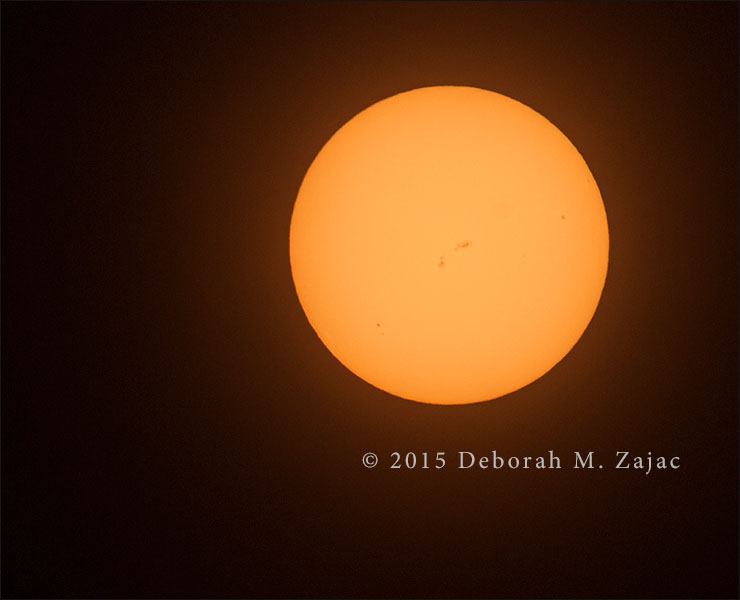
My first Sun image of the year!

There’s a large active sunspot AR2253 in the center of the sun. NOAA says there’s a 50% chance of M-Class Flare today Jan. 5, 2015 from this Sunspot region.

Solar flares are classified by their x-ray brightness in wavelength range 1-8 Angstroms.
” There are 3 categories: X-Class flares are big; these can trigger radio blackouts around the planet and long lasting radiation storms. M-Class flares are medium sized; they can cause brief radio blackouts that effect Earth’s Polar regions. Minor radiation storms sometimes follow M-Class flares. Compared to X-Class and M-Class Flare events, C-Class flares are small with few noticeable consequences here on Earth.”~ Spaceweater.com

January Morning Sun

Nikon D700| AF-S Nikkor 300mm f/4| AF-S Nikkor 14eII TC| Orion Solar Filter|Tripod

More to come…

P52 43/52 Partial Solar Eclipse

Copyright © 2014 Deborah M. Zajac. ALL RIGHTS RESERVED

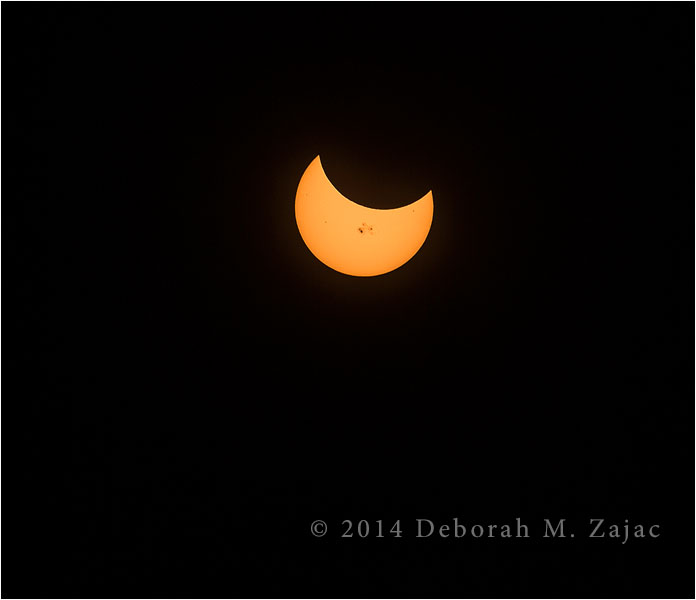
This is the Eclipse at its maximum in my area of Northern California. I cropped in about 30% so it looks larger than it really was.

P52 43 of 52 Partial Solar Eclipse

Nikon Df| AF-S Nikkor 300mm f/4 + Nikkor 14eII Teleconverter| Orion Solar Filter|Tripod| Hoodman STEEL Ultra High Speed Digital Film

Polaris over the Charcoal Kilns Death Valley National Monument

Copyright © 2013 Deborah M Zajac. All Rights Reserved.

A year or two ago I saw my friend Rick Whitacre’s photograph of the Charcoal Kilns with Star-trails and loved it so much I hoped to photograph it myself on my next trip to Death Valley.  The first two nights of my recent visit to Death Valley National Monument I had clouds or partial cloudy skies, but the last night the sky was clear so He-Man and I headed to the Wildrose Charcoal Kilns so I could make a photograph of the kilns with star-trails.
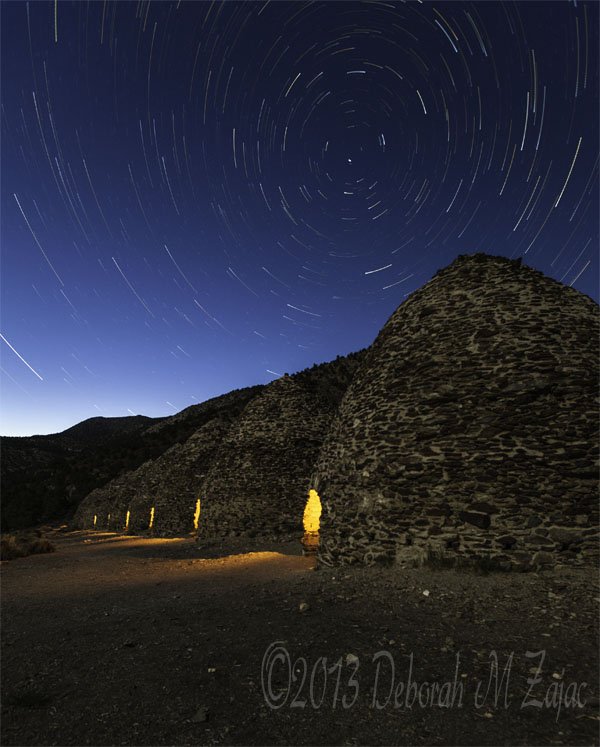
Star Trails over the Charcoal Kilns Death Valley CaliforniaHe-Man and I drove out the Charcoal Kilns arriving just before sunset.  I got my gear out and started planning and plotting my composition. Once I found my composition I started thinking about lighting the kiln doors.  I went inside several of the kilns to check out the size of the opening, and where the best place to stand might be. I’m glad we arrived here while it was light enough to see inside each kiln. If I had arrived in the dark I would have been a little apprehensive about critters sleeping inside the kilns, but they were empty.  On a side note: They’re huge inside!

He-Man was going to light the doors for me so we did a timed test-run to see if he would be able to get all the doors lit in one 2 minute exposure. I had purchased a Brinkman light (thanks Marsha for the model info!) I also brought my Rogue Gels along to use to change the light from white to an orange-yellow  to look like there was fire in the kilns, but  when it got dark enough to start shooting we did another trail run using the light, and it wasn’t quite as bright as I had hoped for. Thinking that might happen I also packed my Nikon SB600 Speedlight. I taught He-Man how to set the flash off then we did another trial run. Loving what I saw using the Speedlight I made my final test shots for my star trails then set up my Intervelometer to begin my series.

It was quite a bit cooler up here than it was down in the valley so I needed my jacket before I wrapped up for the night. There was a Hoot Owl in the trees behind me softly hooting, and there were crickets chirping, but no other sounds. He-Man had gone to the car to read and wait for me.  It was peaceful. I found my “happy place” here.
Thank you He-Man for lighting each door so well and for going with me! I’m really happy with this photo.

Nikon D700| Nikkor 17-35@17mm| f4| 30 frames stacked in CS6| 121 seconds| ISO 200| Manual Priority| Tripod

A couple of my friends have also traveled to Death Valley and made their own photo here please take a look!

Phil McGrew- Startrails over Wildrose Kilns

Alex Baranda- Stars and Kilns

For the History Buffs-

Wildrose Charcoal Kilns

“In 1877 construction on the kilns was completed. The produced charcoal that was used as fuel for two silver-lead smelters  that George Hearst had in the Argus Range 25 miles away.  The kilns operated until 1878 when the Argus mines shut down.

There are 10 kilns which stand 25ft tall, and have an approximate circumference of 30ft. Each kiln held 42 cords of pinyon pine logs, and would burn for a week producing 2,000 bushels of charcoal.” ~Digital Desert.com  http://digital-desert.com/death-valley-history/wildrose-kilns.html

February’s Full Moon over the South Tower of the Golden Gate Bridge

Via Flickr:
Copyright © 2013 Deborah M Zajac. All Rights Reserved

I met a group of Photographers early this morning to photograph the Moonset and I hoped I’d get my timing right so I could get this shot lined up.
It’s been really, really great the last week having clear skies in the city.

Nikon D300s| Nikkor 80-200 + Tamron 1.4x 280mm| f11| 1/3s| ISO 320| Manual Priority| Tripod| Singh Ray 2 stop GND


3,186 seconds under Heaven

3186 seconds under Heaven, originally uploaded by dmzajac2004-.

Via Flickr:
Copyright © 2012 Deborah M. Zajac. All Rights Reserved.

That little bit of mist on the lake was cool. It would come and go all the while my companions and I shot here. While shooting on the other side of the lake an hour before we heard a pack of coyotes howling and yipping in the distance. While shooting these star trails something caught my eye moving just to the left on the shore. I thought it was a coyote and in the dark you know how your eyes play tricks on you right…well thankfully it was a only a lone Doe walking by.
I wondered why she was alone and not already fast asleep safely in her den at that hour.
Her belly looked a little large so my thought was she was pregnant. I couldn’t get a shot of her it was too dark… and I admit it I darted behind Enrico when I first caught sight of her in the dark. 🙂 Yes, my instinct is flight not fight.

Nikon D700| Nikkor 24mm @ 3.2| 54 frames at 59 s 1 frame 33s| ISO 320| Manual Priority| Tripod

The Moon and Martian Triangle


Via Flickr:
Copyright © 2012 Deborah M. Zajac. All Rights Reserved.

I had to be up rather early for work so I didn’t stray farther than the end of my driveway to take a photograph of the Martian Triangle with the Moon before it set.
If I’m not mistaken above the Moon is Spica,  to the right of the Moon is Mars.  Above Mars is Saturn. Please tell me if I got that mixed up. Thank you Jackie for telling me about my error. It’s corrected now!

Nikon D700| Nikkor 18mm @f8| 23 seconds| ISO 2000| Manual Priority| Tripod