Thursday Doors-Ottawa Co. Courthouse

Copyright ©2025 Deborah M. Zajac. ALL RIGHTS RESERVED.

PLEASE DO NOT USE MY IMAGES WITHOUT EXPRESSED WRITTEN PERMISSION.

One evening after dinner in Port Clinton, Ohio while we were walking back to the car I spied a clock tower rising above city, so I said to He-Man I wanted to go check it out…he knew I was thinking Thursday Doors.

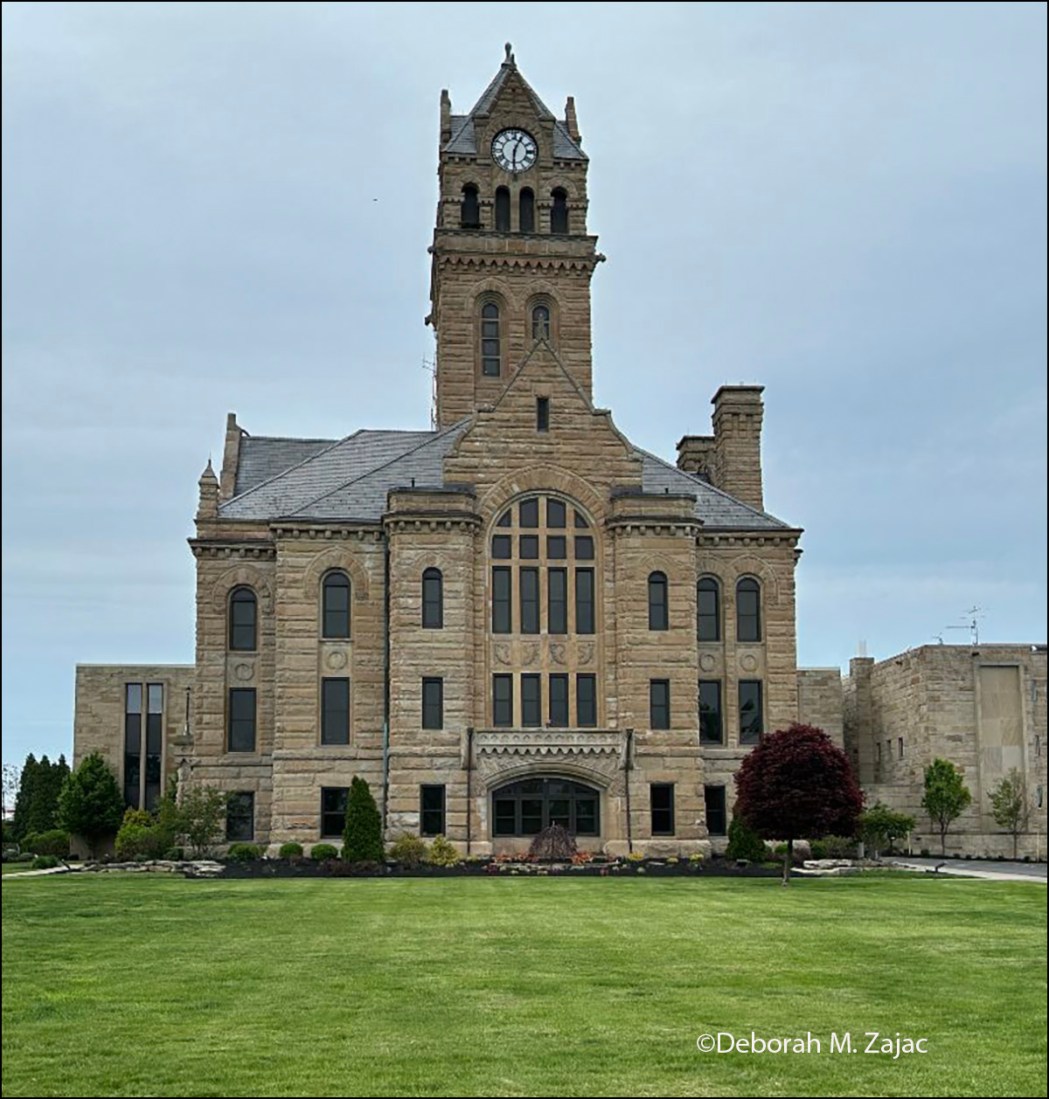
I was expecting to see a church, but it’s Ottawa County Courthouse, officially Ottawa County Court of Common Pleas. It’s beautiful. I loved the stone, the grounds, and especially the clock tower. Built in 1898-1901 in the Richardsonian Romanesque style by architect Wing & Mahurin and contractor was Caldwell & Drake Construction of Columbus, Indiana.
©Deborah M. Zajac | http//:circadianreflections.com Image

From the website of American Courthouses the description says:

“The building faces west and is a three story brown colored sandstone and concrete structure. The building is located on spacious landscaped grounds in the center of Port Clinton. The building has North Amherst Sandstone and pink colored Tennessee marble. The square tower, located in the center of the roof, rises to 132 feet above the ground. The top of the tower contains a belfry for the clock chimes, and the clock faces are located in gables similar to, but smaller than, those below. In the interior, the building is constructed around the central stairwell that rises to the second floor and forms a vault. Four scenes depicting Ottawa County are painted on the walls outside the courtroom: “Quarrying,” “Farming,” “Fishing,” and “Fruit Growing.”  These four original industries of the county also define in large measure the significant immigrant groups that settled here.  The French were the fishermen, the Danes were the farmers, the Germans were the fruit growers, and the Slavic peoples worked the quarries. The chandelier, hanging from the middle, was taken from the courtroom when it was remodeled and the ceiling lowered. The building houses the County Court of Common Pleas – General, Domestic Relations, Juvenile and Probate.”

It was closed by the time we arrived, but I did peek in through the doors and saw the staircase and chandelier, They looked lovely.

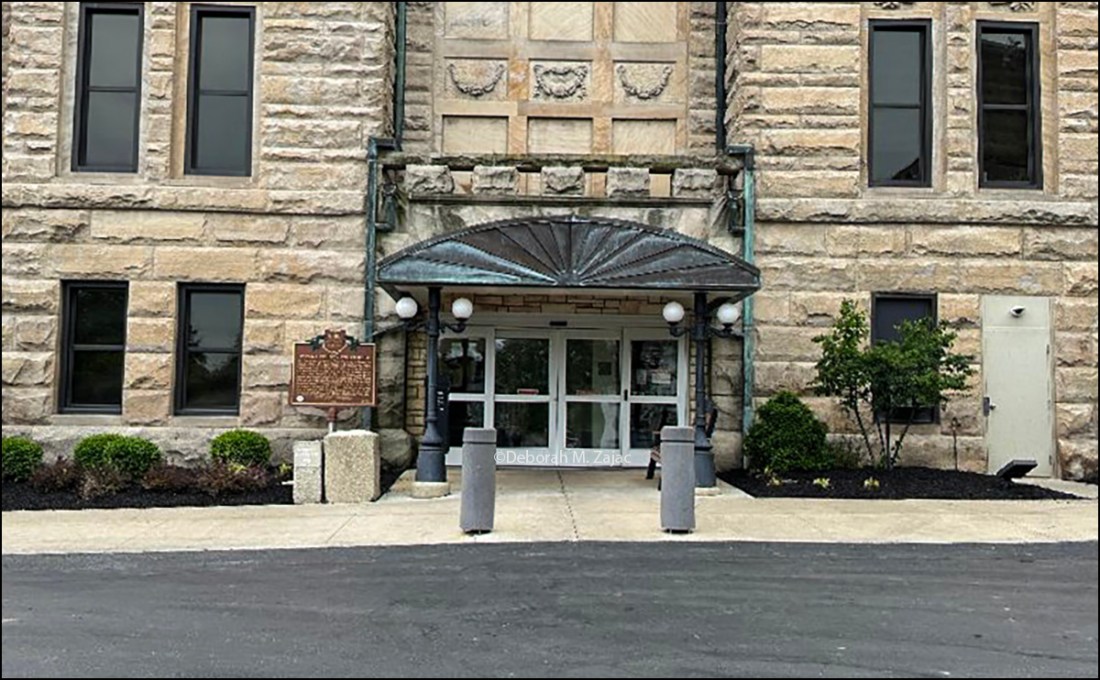
I think these are the front doors. I loved that entrance cover. I think it’s copper by the way its patina is coloring.
©Deborah M. Zajac | http//:circadianreflections.com Image

Here’s the east side closer look at the doors, arch, and windows.

©Deborah M. Zajac | http//:circadianreflections.com Image

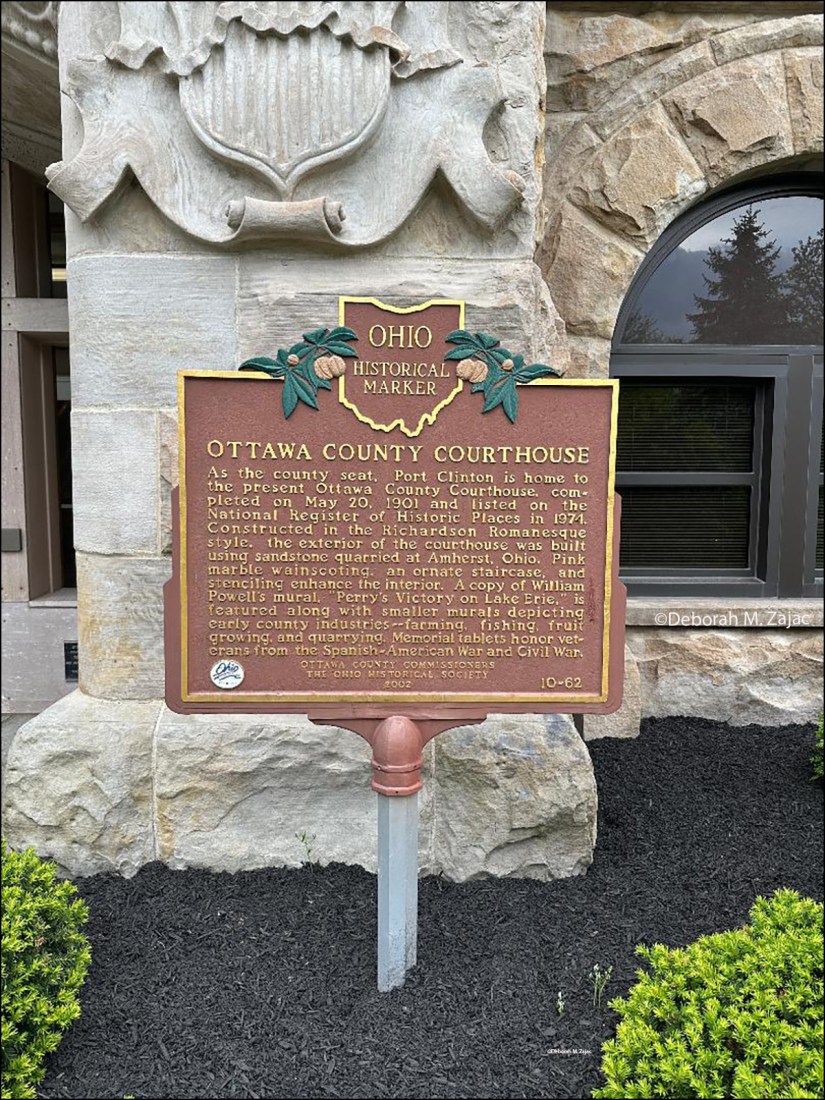
There’s a plaque at both entrances.

©Deborah M. Zajac | http//:circadianreflections.com Image

For more information about the history of the county seat visit https://www.ottawacocpcourt.com/history/

This post is part of the weekly challenge Thursday Doors hosted by Dan Antion over at https://nofacilities.com/2025/05/29/misc-iowa-doors/

Head on over there to see more doors from around the world or join the craze and add a door or two of your own. 😊

more to come…
Whatever Weds.- Riding High

Copyright ©2025 Deborah M. Zajac. ALL RIGHTS RESERVED.

PLEASE DO NOT USE MY IMAGES WITHOUT EXPRESSED WRITTEN PERMISSION.

©Deborah M. Zajac | http//:circadianreflections.com
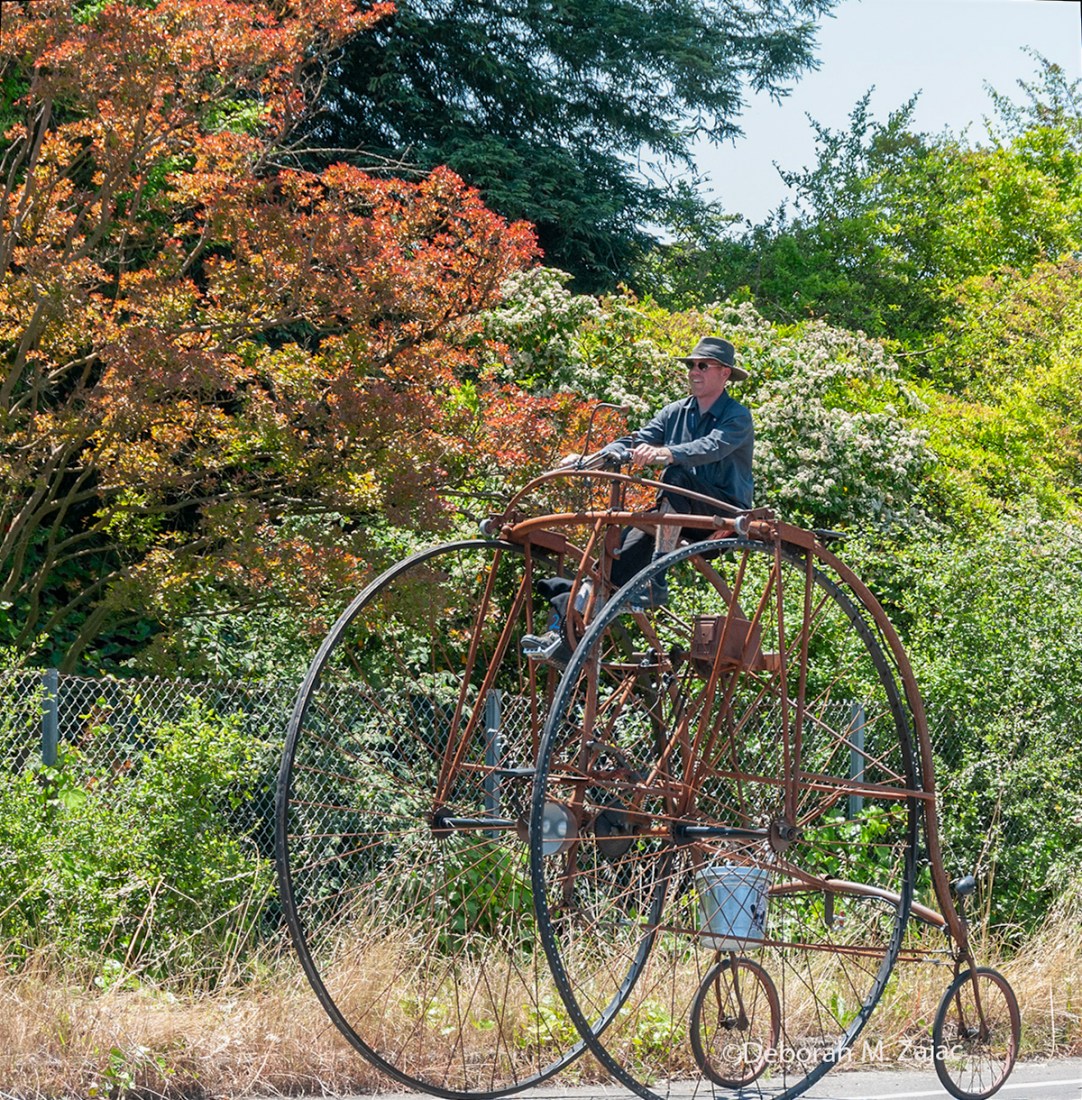
Penny-farthing

This bicycle was popular between 1874-1886.

They’re fun to see ridden but, they were fast, and dangerous. With the exception of the railways nothing was faster on the roads.

They were dangerous because the risk of falling was great. Heading over the handlebars was problematic. So makers tried making the handlebars so riders knees could clear them. They had design changes that included reversing the large and small wheels but, that proved dangerous as well by being thrown off the bike backwards when going uphill.

It got its name from the size of its wheels-the front was large like the British penny, the smaller back wheel was the farthing.

The Penny-farthing fell out of favor when the safety bicycle was invented in the 1890’s.

I saw this bicycle and a few other odd ones in Sonoma, CA back in 2011.

more to come…

Friday’s Feathered Friends-Eastern Phoebe

Copyright ©2025 Deborah M. Zajac. ALL RIGHTS RESERVED.

PLEASE DO NOT USE MY IMAGES WITHOUT EXPRESSED WRITTEN PERMISSION.

With this sighting of the Eastern Phoebe on May 13th while birding in Ohio I have now seen all 3 Phoebe’s that reside in the Unites States.

©Deborah M. Zajac | http//:circadianreflections.com Image

The Eastern Phoebe can be found throughout the eastern half of the continent from the Northwest Territories all the way down to Mexico.

The other two Phoebes are found in the Western regions of North America. They are the Say’s Phoebe, and the Black Phoebe.

Fun Facts:

  • In 1804, the Eastern Phoebe became the first banded bird in North America. John James Audubon attached silvered thread to an Eastern Phoebe’s leg to track its return in successive years.
  • The use of buildings and bridges for nest sites has allowed the Eastern Phoebe to tolerate the landscape changes made by humans and even expand its range. However, it still uses natural nest sites when they are available.
  • Unlike most birds, Eastern Phoebes often reuse nests in subsequent years—and sometimes Barn Swallows use them in between. In turn, Eastern Phoebes may renovate and use old American Robin or Barn Swallow nests themselves.
  • The Eastern Phoebe is a loner, rarely coming in contact with other phoebes. Even members of a mated pair do not spend much time together. They may roost together early in pair formation, but even during egg laying the female frequently chases the male away from her.
  • The oldest known Eastern Phoebe was at least 10 years, 4 months old. It had been banded in Iowa in 1979 and was found in 1989 in Alberta.
  • Fun facts gleaned as always from allaboutbirds.org

I hope you all have a lovely week-end!

more to come…

Friday’s Feathered Friends- Yellow Warbler

Copyright ©2025 Deborah M. Zajac. ALL RIGHTS RESERVED.

PLEASE DO NOT USE MY IMAGES WITHOUT EXPRESSED WRITTEN PERMISSION.

Myself and He-Man went to Ohio for several days of birding Wood Warblers. I hoped to see some I didn’t see last year and see those I did see last year again. It was a great trip. Not only did I see a number of the Warblers I saw last year, I also saw some new species of Warblers plus a couple of other birds. 14 new to me birds or in birder speak ” Lifers”. On Monday the 12th (my birthday) I saw 7 Lifers! What a gift!!

I have thousands of images to cull but, I’m hoping I have a few good images to share in upcoming posts.

In the meantime here’s a cheerful Yellow Warbler I saw while there. These guys were everywhere on May 11th. They were singing and filling up on insects in all the trees in bloom getting ready for their over night migration to get to their breeding grounds in the USA, and some flew over the 26 miles of Lake Erie to get to Canada where their breeding grounds are.

On May 12th their numbers at the marsh were remarkably lower than the day before. I only saw a few.

©Deborah M. Zajac | http//:circadianreflections.com Image

I’m catching up with mail, email, bills, of course the laundry, and your blogs.

I hope you have a lovely week-end.

Fun facts:

  • In addition to the migratory form of the Yellow Warbler that breeds in North America, several other resident forms can be found in Mexico, Central America, and the Caribbean. Males in these populations can have chestnut caps or even chestnut covering the entire head.
  • The nests of the Yellow Warbler are frequently parasitized by the Brown-headed Cowbird. The warbler often builds a new nest directly on top of the parasitized one, sometimes resulting in nests with up to six tiers.
  • Life can be dangerous for a small bird. Yellow Warblers have occasionally been found caught in the strands of an orb weaver spider’s web.
  • The oldest-known Yellow Warbler was a female and was at least 11 years old when she was recaught and rereleased during banding operations in New York. ~https://www.allaboutbirds.org/guide/Yellow_Warbler

more to come…

Friday’s Feathered Friends- Common Yellowthroat

Copyright ©2025 Deborah M. Zajac. ALL RIGHTS RESERVED.

PLEASE DO NOT USE MY IMAGES WITHOUT EXPRESSED WRITTEN PERMISSION.

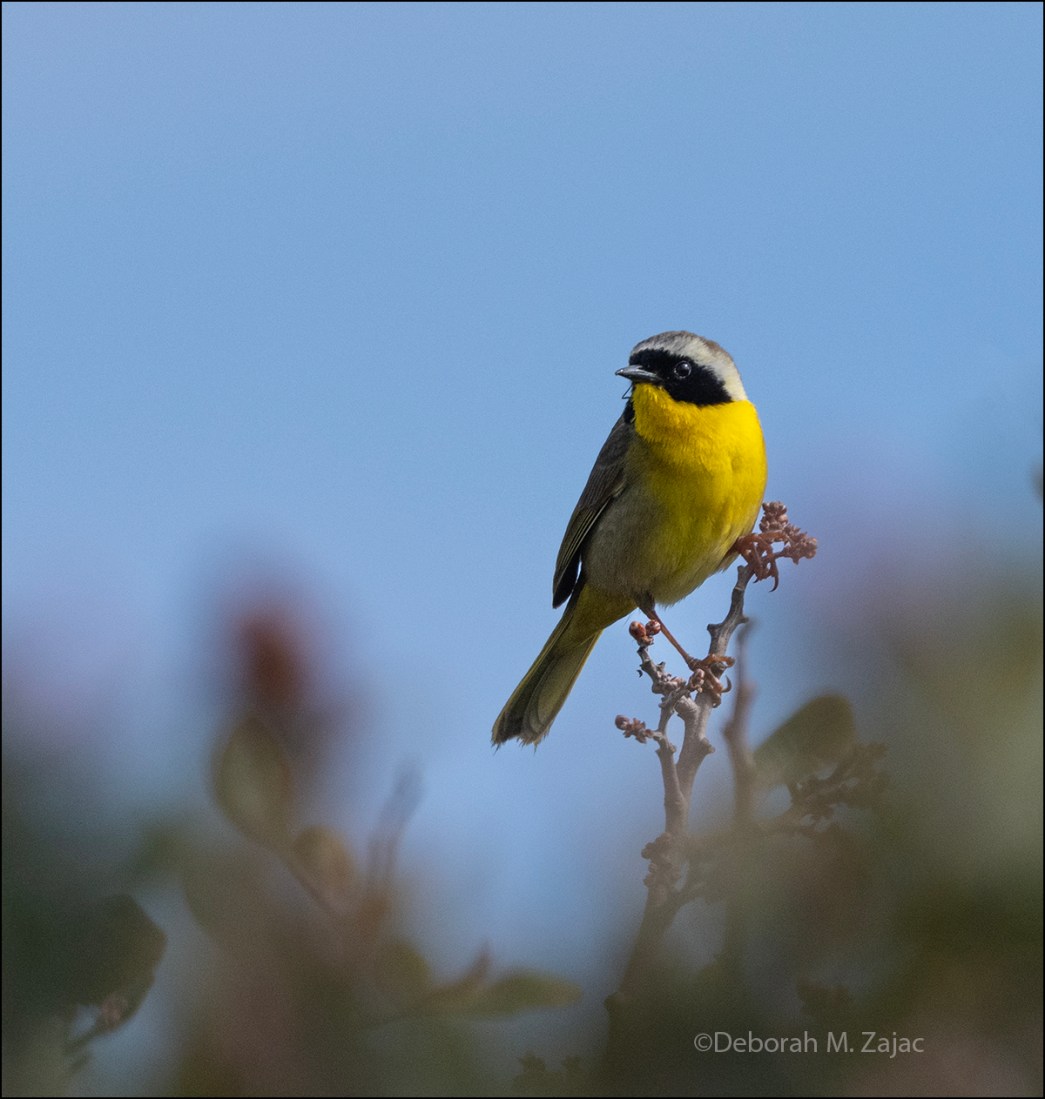
Looking through my posts I see that I haven’t shared an image of this cheerful Yellow Warbler since 2013 when I saw one for the first time.

In truth I rarely see one. The most common Warbler we have here is the Yellow-rump Warbler which I see just about every time I go birding.

When He-Man and I were in Santa Barbara last month we took a wander around Goleta Beach heading north into the University of Santa Barbara Campus up to Beach Point then around the Lagoon. It was while on the trail on the west side of the lagoon I heard and saw this Common Yellowthroat.

©Deborah M. Zajac | http//:circadianreflections.com Image

It was a treat to see, and he wasn’t skittish. He sat there while snapped a few images then he continued on with his morning song.

I might be much slower getting to your blogs over the next several days. Janet from https://wordpress.com/reader/users/sustainabilitea is arriving today for a visit so if the weather is good I’ll be sharing my little corner of the world with her. We have rain forecasted this week-end though. I hope it’s not a lot so we can get outdoors.

I hope you have a lovely week-end and fair weather!

more to come…

Thursday Doors- Jensen Mansion

Copyright ©2025 Deborah M. Zajac. ALL RIGHTS RESERVED.

PLEASE DO NOT USE MY IMAGES WITHOUT EXPRESSED WRITTEN PERMISSION.

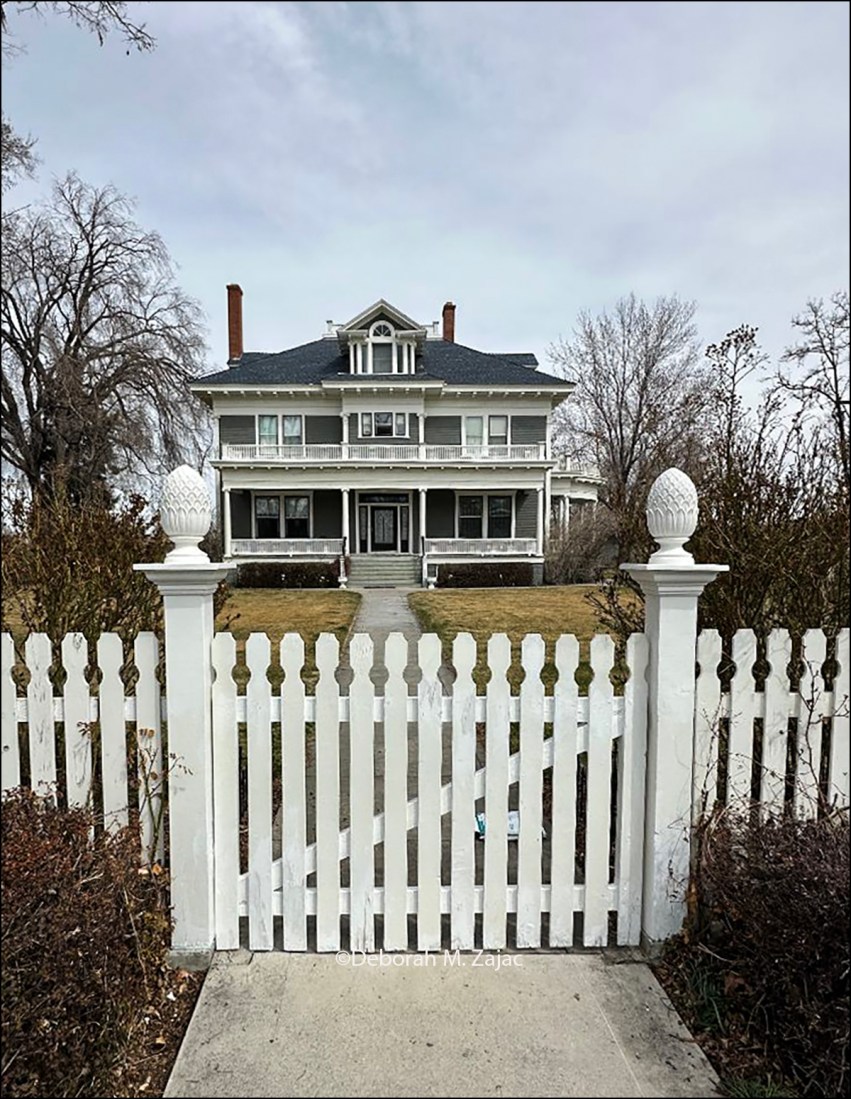
This week I’m sharing a house with a pretty door that I’ve wanted to photograph for ages. While shopping in downtown Gardnerville, NV a few weeks back I finally turned down Ezell Street to make a few photos of the Jensen Mansion.

©Deborah M. Zajac | http//:circadianreflections.com Image

This mansion was built by Arendt Jensen back in 1910. In the year 1887 when he was just 28 he arrived in Gardnerville, NV. There were just two houses in town.

There’s a plaque on the tree out front telling us a little about him and the house.

©Deborah M. Zajac | http//:circadianreflections.com Image

The Plaque says,” Arendt Jensen had this beautiful mansion constructed for his family in 1910. Mr. Jensen owned a general merchandise store in Gardnerville that became very prosperous. He later established the first bank in Carson Valley. The Douglas County Farmer’s Bank.

An advertisement in the Record Courier newspaper in 1906 stated at the “A. Jensen store you can buy anything at prices that are right.”

Meticulously restored, the Jensen Mansion has been a bed and breakfast in the recent past. The home and grounds also appeared in the movie “The Wizard” staring Fred Savage, and Beau Bridges. The home was listed on the National Register of Historic Places in 1989.”

I found this website while doing a bit more research about the man and house. https://www.clairitage.com/2017/12/29/gardnerville-jensen-mansion/

There’s some interesting information on the Clairitage site. There’s a photo of the brick Mercantile building that Jensen built there, and the 3 arched building is still in town. The 3 arched building is a huge antique store that I love to poke around in. My last stop in I scored a lovely duck decoy that now lives in my bedroom. 😊 Okay let’s get back on topic. The door!

Here’s a somewhat closer look at the front door.

©Deborah M. Zajac | http//:circadianreflections.com Image

I like the privacy lace curtains over the door, and the pineapples at the gate.

The side patio and large front patio, and the widow’s walk are all nice too.

I think it’s a private residence again so I wasn’t able to walk around the grounds or get a peek inside. Maybe one day.

This post is part of the weekly challenge Thursday Doors hosted by Dan Antion over at:

https://nofacilities.com/2025/04/17/mt-washington-pittsburgh-doors/

Hop on over there to see more doors from around the world or join the craze and add a door or two of your own. 😊

more to come…