Whatever Weds. Comet Lemmon

Copyright ©2025 Deborah M. Zajac. ALL RIGHTS RESERVED.

PLEASE DO NOT USE MY IMAGES WITHOUT EXPRESSED WRITTEN PERMISSION.

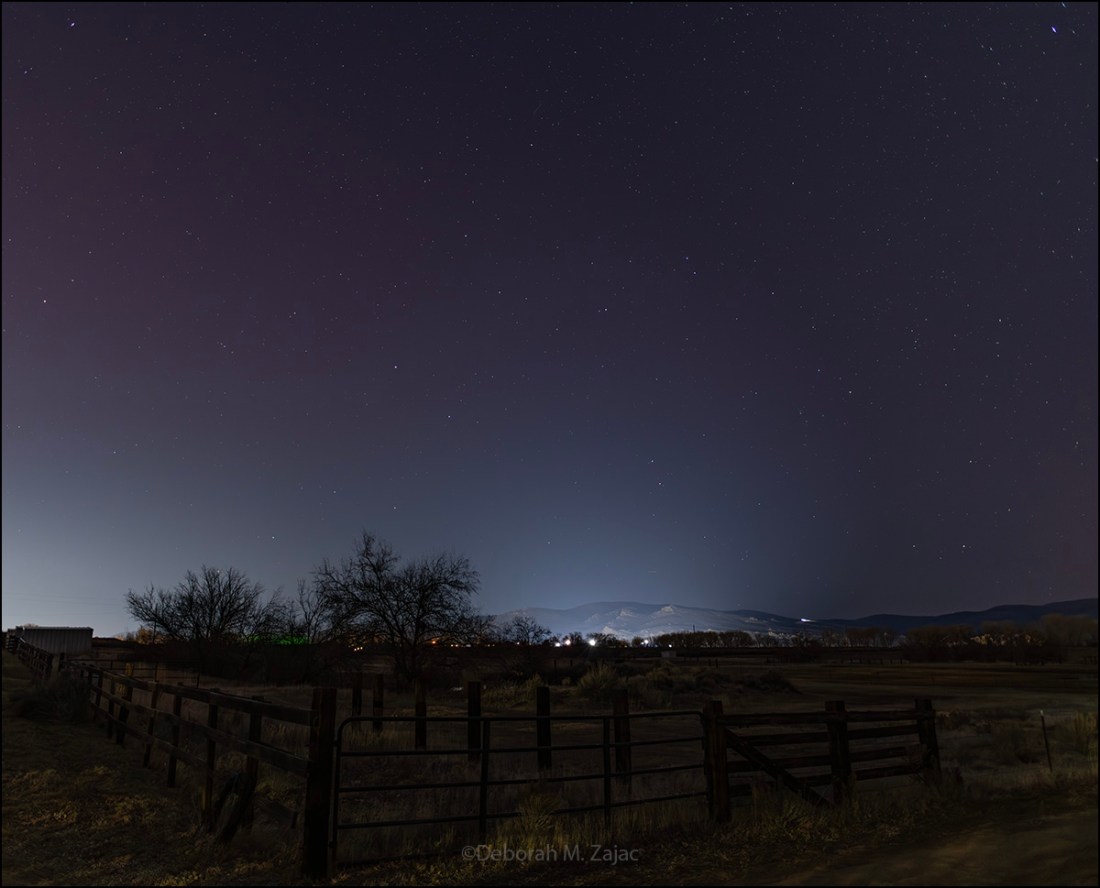
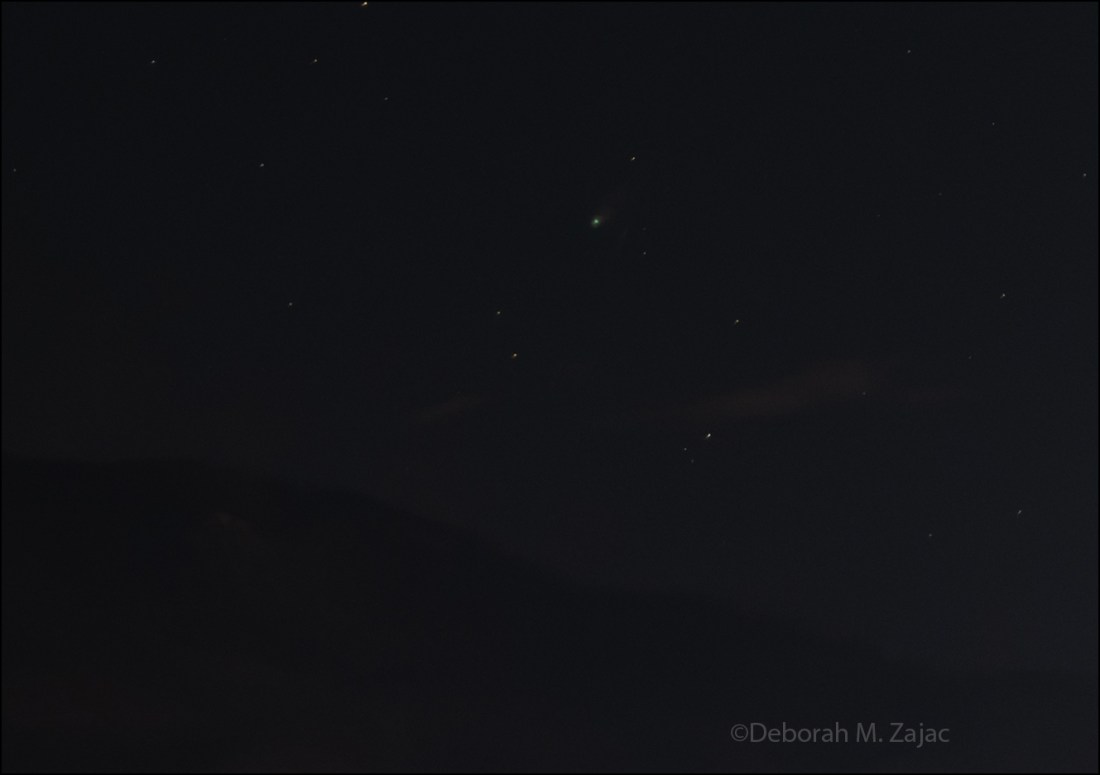
I went out with a friend to try to see if I could find and photograph C/2025 A6 Comet (Lemmon) on October 19th. I didn’t go too far from home just up into the Pinenut Mountains a little bit. l took my 50mm lens so I would be able to see a wide space of the sky and hopefully see it. I never saw it with my eyes or binoculars, but when I got home and uploaded my images I was happy to see my camera had seen it. It’s the tiny green dot upper center of the image.

It’s tiny at 50mm but, I cropped this in a bit for a better look.

©Deborah M. Zajac | http//:circadianreflections.com
Comet Lemmon Nikon D850| Nikkor 50mm

The next night I went back to the same spot with my old 80-200mm lens but, I wasn’t able to see it at all. I believe it was too low and behind the hills opposite.

So last night a friend and I went north to a spot I know that had more open sky. It took us a while to find it but, we did. My old lens had a bit of trouble focusing on my newish bigger sensor D810 but, once I uploaded my images I found I had several decent shots of the comet with a hint of its tail too.

©Deborah M. Zajac | http//:circadianreflections.com
Comet Lemmon| Nikon D810| Nikkor 80-200mmD| October 21, 2025

It’s always exciting to see a comet and this one is pretty cool. It was 55 million miles from Earth last night and it won’t be back again until the year 3175! Do you think my images will survive for my future family members to see my images made with probably antiquated photography methods and gear? Somewhere between 33 and 46 generations will pass before C/2025 A6 (Lemmon) comes our way again. It boggles my mind.

Did you see it?

more to come…

Something for Sunday-Northern Lights

Copyright ©2024 Deborah M. Zajac. ALL RIGHTS RESERVED.

PLEASE DO NOT USE MY IMAGES WITHOUT EXPRESSED WRITTEN PERMISSION.

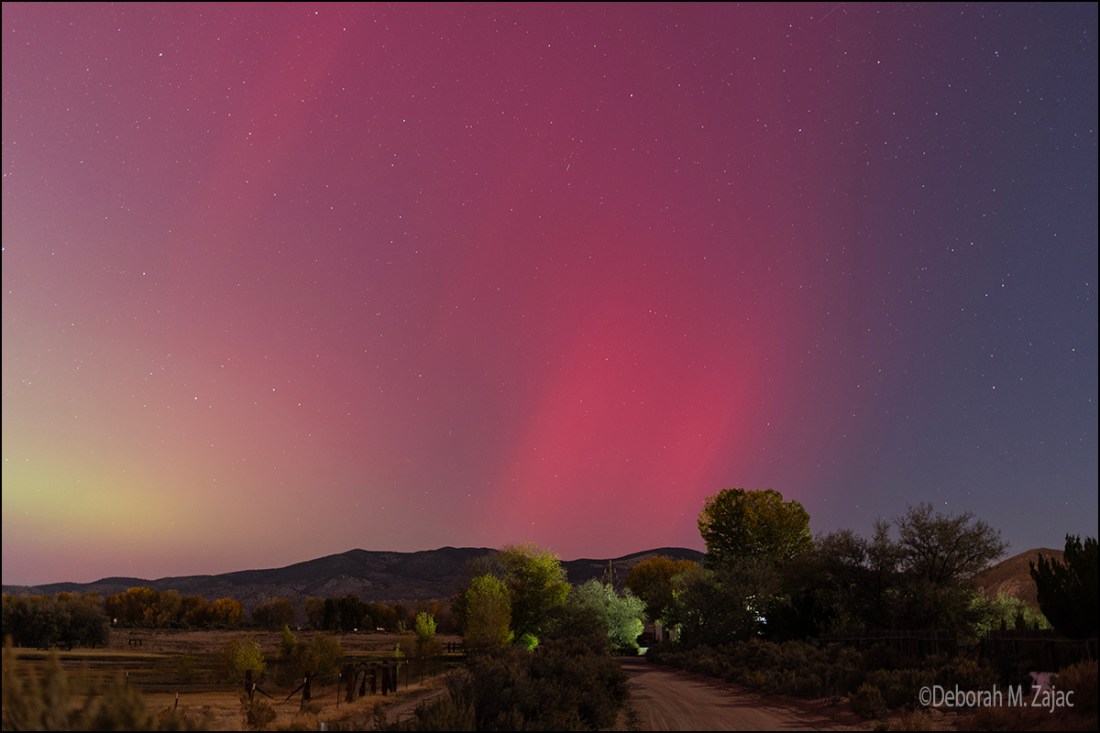
With the all the intense Solar activity in the way of flares, and CME’s there have been Auroras are as low as Northern Nevada! I got an alert telling me the aurora was in my town and the KP rating was 8. Nine is the highest rating so I looked out the back door and I could see it so, I grabbed my camera, tripod, and cellphone, slipped into my shoes without tightening up my laces and dashed out the door. I didn’t grab a jacket, or my headlamp I was so excited. Here’s one of the many images I made.

©Deborah M. Zajac | http//circadianreflections.com Image

I’ve wanted to see the northern lights since I first learned about them as a kid. I always thought I’d have to travel way up north in the winter to have the best chance of seeing them.

Why is it pink? What causes the colors? I had to look it up because the Northern Lights (aurora borealis), here have been bright pink with some blues and purples, and very little green.

They are created when energized particles from the sun slam into Earth’s upper atmosphere at speeds up to 45 million mph (72 million kph). Our planets magnetic field protects us from the onslaught.

Earth’s magnetic field redirects those particles towards the poles transforming that energy into the dazzling display we call the Northern Lights or in the Southern Hemisphere the Southern Lights (aurora australis).

Most Northern Lights are green but when there’s been intense solar activity the color can be red, pink, blue, or purple.

Here’s a linkhttps://sciencenotes.org/aurora-colors-explained-southern-and-northern-lights/ to Science Notes that explains the Aurora colors in more detail.

I’m hearing and reading that it’s been seen all over the country. That’s so exciting!

Nikon D850| Nikkor 35mm f/1.8g| PS CC 2024

Whatever Weds. A Starlit Night

Copyright ©2024 Deborah M. Zajac. ALL RIGHTS RESERVED.

PLEASE DO NOT USE MY IMAGES WITHOUT EXPRESSED WRITTEN PERMISSION.

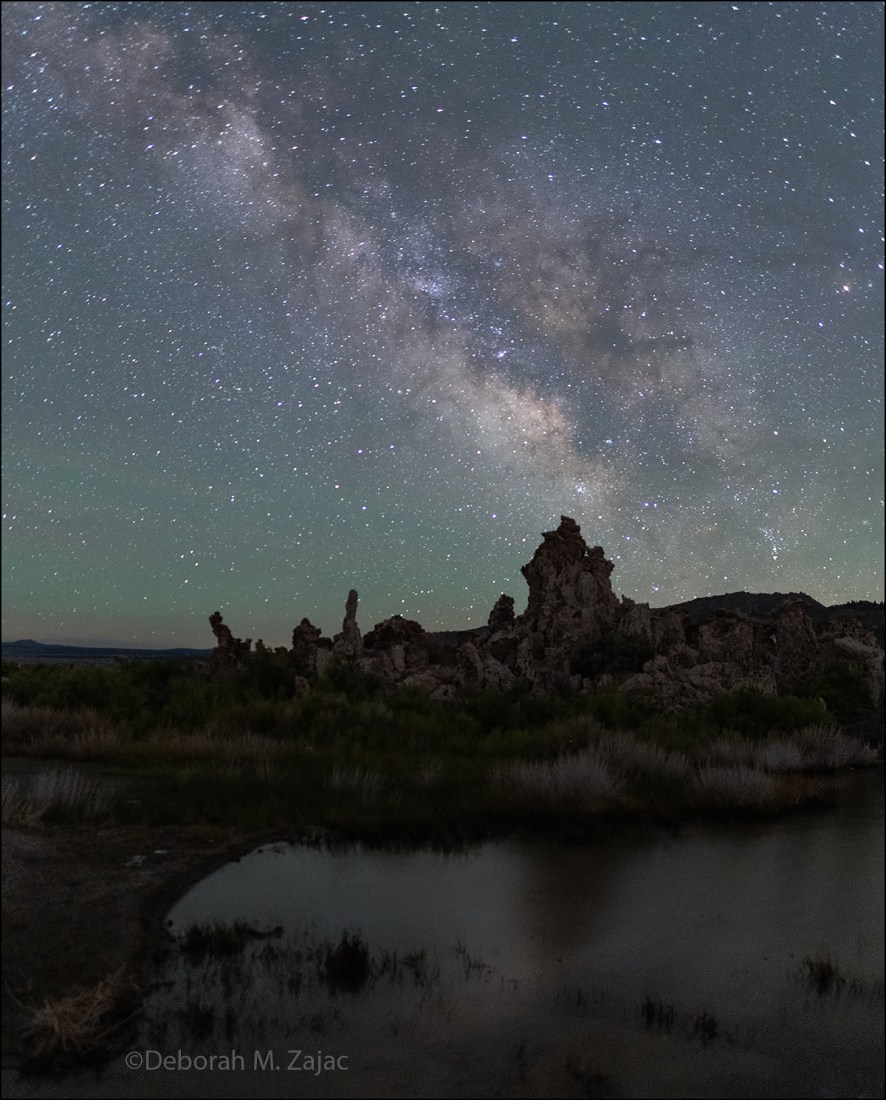
It’s that time of year when I yearn to be out imaging and gazing at the night sky. A friend and I went back down to Mono Lake to do just that. Thankfully, we didn’t have any clouds to worry about.

Milky Way the Great River in the Sky

The lake is really high eliminating a lot of the beach area we learned from our camping trip last month so, we knew to take our tall boots because standing in the lake might be our best bet for imaging. We scouted in the afternoon and found this spot. When we were leaving for dinner we ran into a Ranger who told us she would be giving a talk on the summer sky and constellations that evening on the beach and invited us back to attend it. We said we’d be there. The talk was a fast 2 hours. It was great hearing the stories the Native Americans tell about the stars and how they named the constellations and how to find them . The talk ended just after 10PM which was perfect as the Milky Way was already visible and we had some time to get to our spot in time for the Galactic Center to rise. The Galactic Center is the central region of our galaxy. The best months to photograph the Milky Way in the Northern Hemisphere are from May to August when the Galactic Center is highest in the sky and the weather is usually better in the warmer months.

We were standing in water to photograph this scene, but it wasn’t very deep, and the waves were gentle so we didn’t have to worry about a big one coming along and getting into our boots. 😊

I got home about lunch time yesterday, unpacked, got the car washed, and then started getting ready for a visit with my son and daughter-in-law. I’ll be on and offline for a bit. I hope your week and summer are going well.

Nikon D850|Nikkor 20mm F1.8G|

more to come…

Whatever Weds- The Stars have It

Copyright ©2024 Deborah M. Zajac. ALL RIGHTS RESERVED. 

PLEASE DO NOT USE MY IMAGES WITHOUT EXPRESSED WRITTEN PERMISSION.

Last week He-Man and I had a little get-away for our 43rd anniversary. We didn’t go too far just up to Sparks, NV.

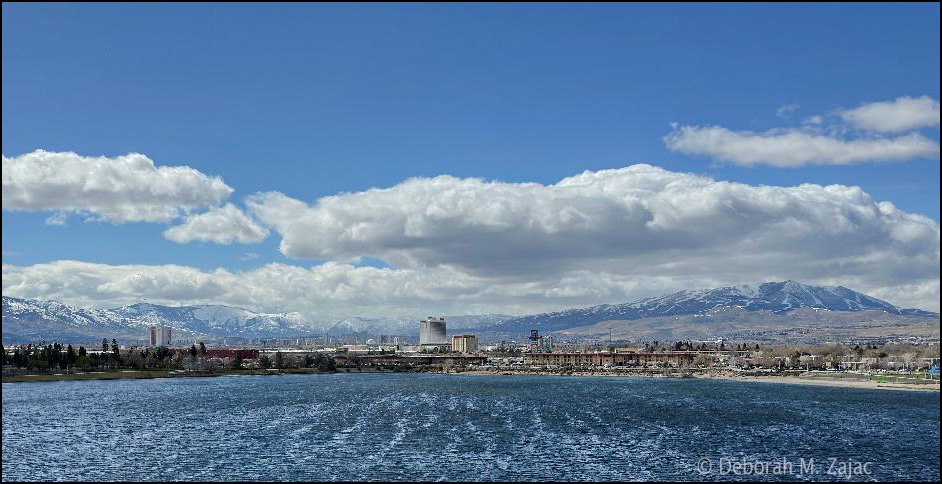
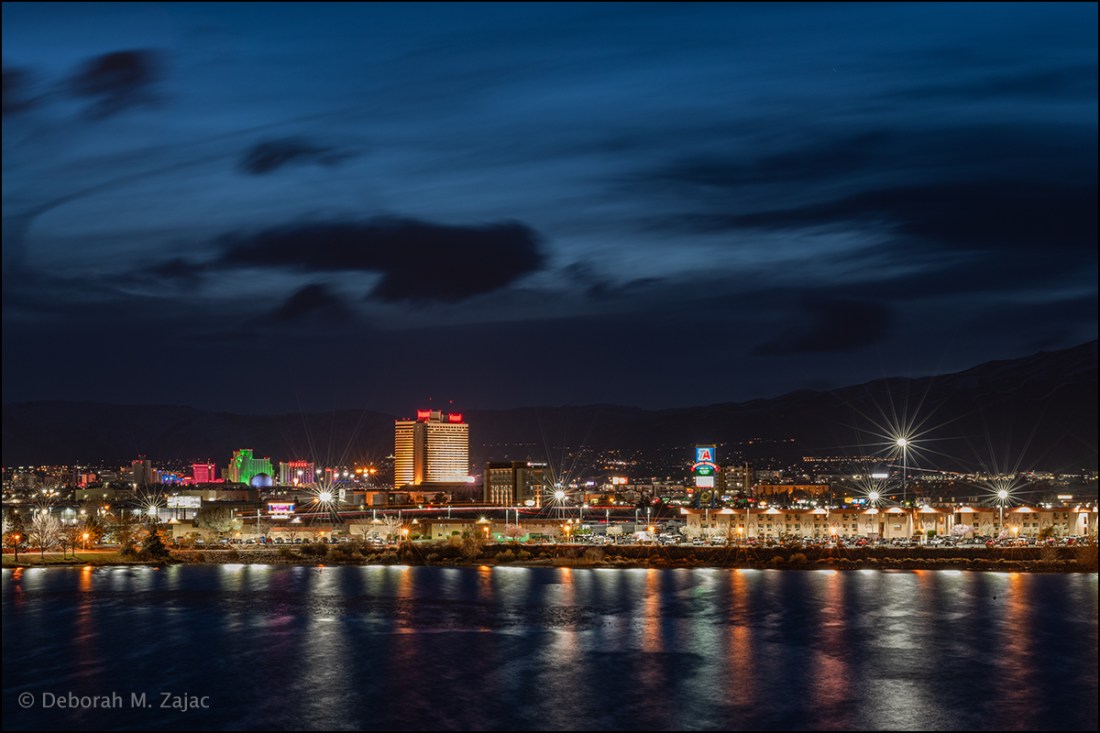
We booked a balcony suite at Hampton Inn & Suites at the marina for the view of Helms Lake, and view of Reno’s skyline. This lake has an interesting beginning.

“The site was once a gravel pit owned by the Helms Construction Corp. (1968-1995) The pit is 100 feet deep. They found petroleum and solvent contamination seeping into the pit in 1987 so it was declared a Super Toxic Sight and clean up began. In 1996 it was declared free of petrochemicals and the site was turned over to the city of Sparks.

Millions of dollars of spill mitigation money was made available to the city, which they used to construct the park and make the pit a recreational pond. They had planned to fill the pit to 30 feet, but in January 1997 the Truckee River overflowed its banks and filled the Helms Pit creating what is now Richard Helms Lake or Sparks Marina Pond.” You can read a little more about how it stays filled at the link. https://www.ndow.org/waters/sparks-marina/

Now for our view-

Our day-time balcony view

It was pretty windy the day we were up there as you can see by the water.

Our Evening View

We both really enjoyed having this evening view when the lights in the city came on.

I had hoped our 4th floor balcony room would afford a great view of the sky so I could also try to photograph Comet 12P/Pons-Brooks, but alas we had a storm rolling in and cloud cover.

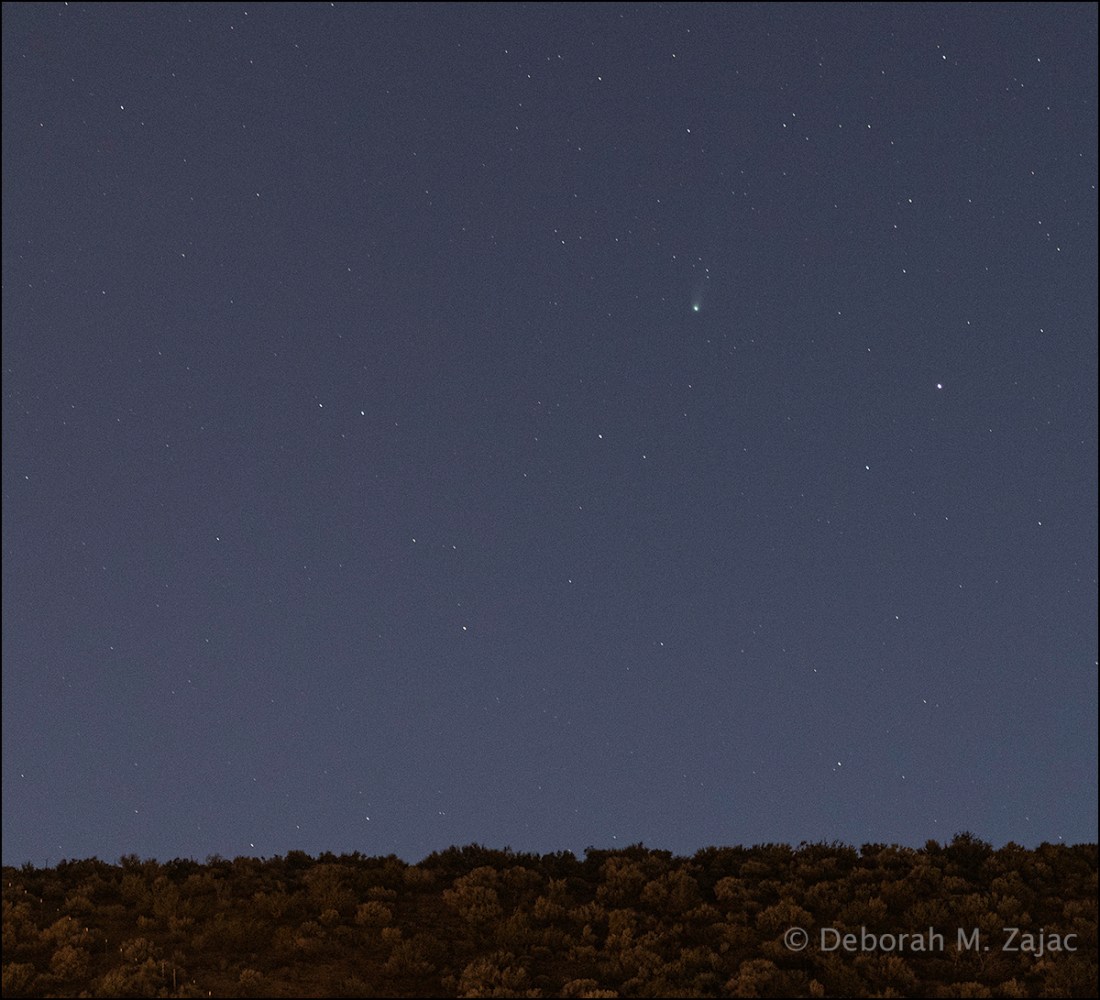
Finally, Monday night April 1st…no joke! We had a clear night so I went out to my front yard and spied the Comet.

Comet 12P/Pons-Brooks with faint tail.
Green Comet 12P/Pons-Brooks cropped in.
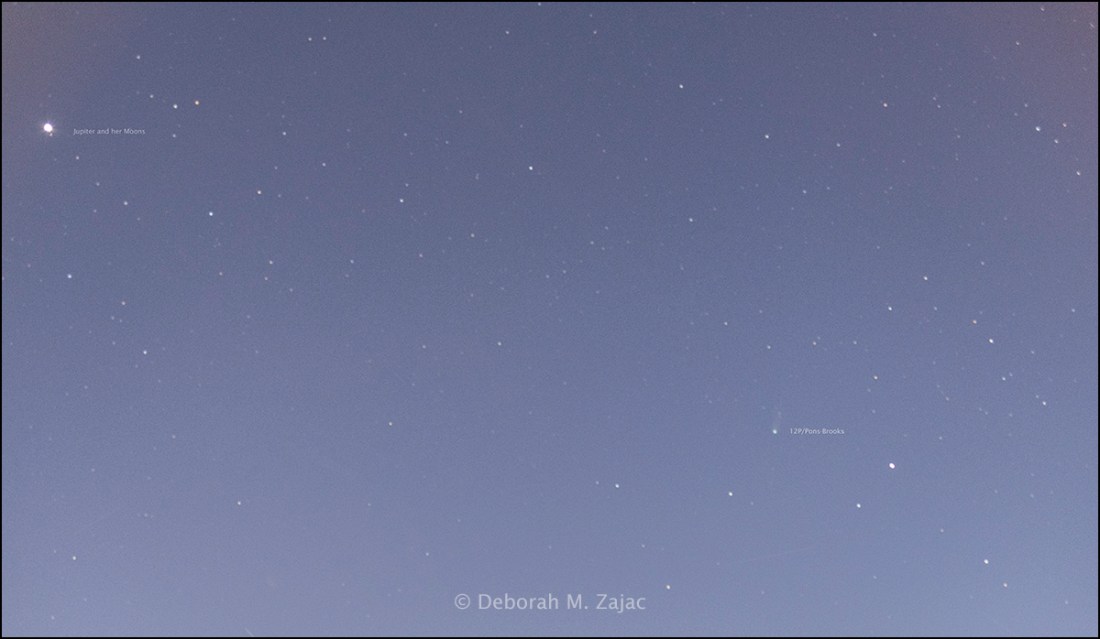
Dialing in my focus I got Jupiter and her Moons too.

We had a lovely anniversary walking around the lake both days, and we found a new Indian place we liked a lot for dinner so, we’ll make the drive up for that again when we’re craving Indian food, and we’ll be staying there again when the weather is warmer and we’ll take our kayak up for a paddle around the lake.

I hope the stars have lined up a fantastic week for you.

Nikon D850| Nikkor 80-200mm| iPhone 14 Pro| PS CC 25.5.1

more to come…

Whatever Weds. Occultation of Antares

Copyright ©2024 Deborah M. Zajac. ALL RIGHTS RESERVED. 

PLEASE DO NOT USE MY IMAGES WITHOUT EXPRESSED WRITTEN PERMISSION.

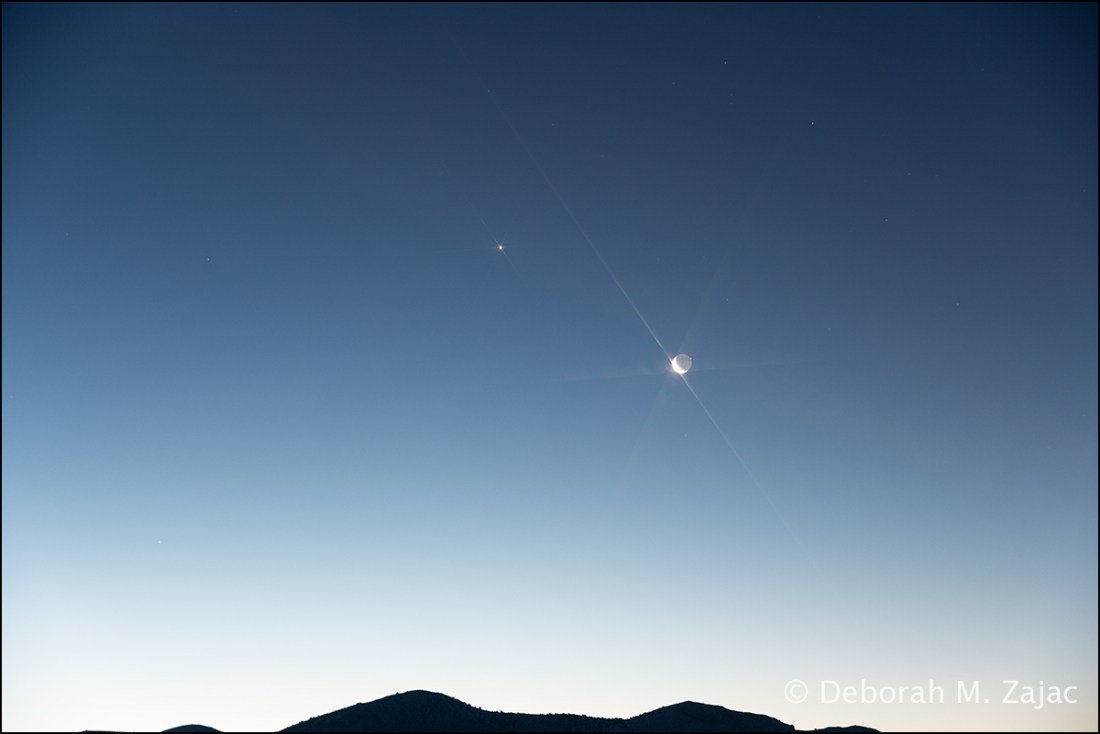
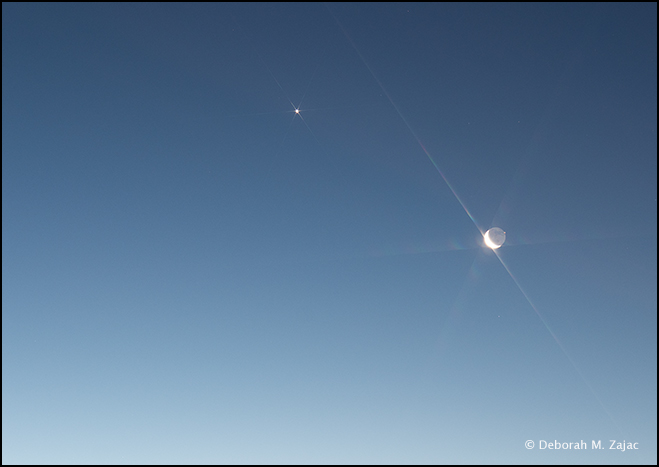
January 8th just at dawn I photographed my first celestial event of the year. The Occultation of the crescent moon and Antares the brightest star in the constellation of Scorpius.

The tiny dot of light on the Earthshine side of the crescent moon is Antares right before it slipped behind the Moon. Venus the morning star shines brightly above and to the left of the Moon.

I give you three views, one with my star filter on my lens, one with my ultra wide angle lens, and one deeply cropped to show Antares slipping behind the Moon.

20mm view of the Crescent Moon, Venus, and Antares.

Crescent Moon, Antares, Venus dawn January 8, 2024

Venus above and left of the Crescent Moon, Antares a tiny dot of light on the Earthshine side of the Crescent Moon just before it disappeared behind the Moon.

I was in a bit of a rush putting on my star filter so it went on askew so some of the star lines aren’t clean, and worse it’s now stuck. It’s on too tight for me to unscrew it, and I broke my filter wrench some time ago removing a ND (neutral density) filter, and failed to replace it. DOH! I have ordered a new one…and not a plastic one this time. It should arrive today.

We had our first big snow drop that stuck on Sat/Sun. It required shoveling. My neighbor bought a new cordless snow-blower and did our driveway twice! I just shoveled the clean up and the road below our driveway. She’s a jewel! She said it took just 12 minutes to do the driveway. We’ve made a deal. She’ll do the snow-blower and I do the clean up shoveling on 3 driveways and sidewalks. I told her I’d spring for the Hot Cocoa with marshmallows!

We have another big storm coming this weekend which is going to mess up my plans to meet friends, and do some birding at one of our favorite California refuges. It’s going to snow here, and in the mountains I’d need to cross, and it’s got rain on the forecast for there. It’s always a risk in the winter though isn’t it. Looks like I’ll be cancelling my plans.

Hopefully, we can meetup in February.

That’s me all caught up. How’s it going for you? Were any of you up and notice the tiny reddish star right beside the moon Monday morning?

Nikon D810| Nikkor 24-120mm & Nikkor 20mmG| PS CC 25.3.1

more to come…

Whatever Weds. Venus and the Beehive Cluster

Copyright ©2023 Deborah M. Zajac. ALL RIGHTS RESERVED. 

PLEASE DO NOT USE MY IMAGES WITHOUT EXPRESSED WRITTEN PERMISSION.

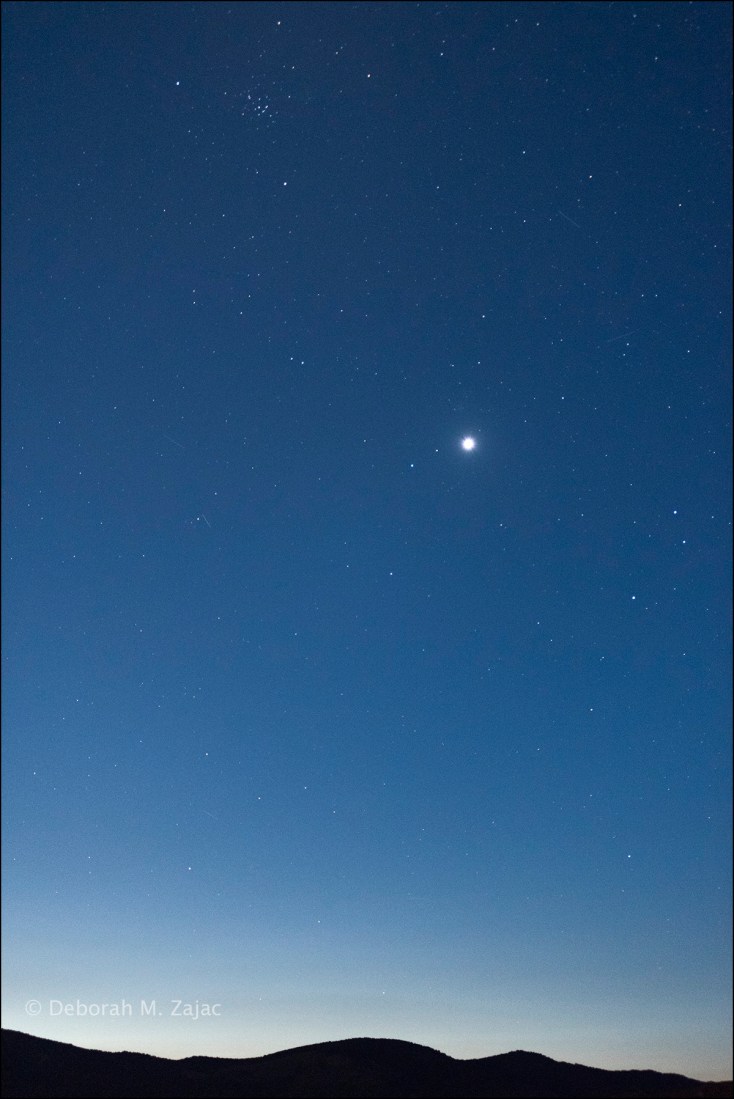
Venus shines bright in the eastern morning sky. The star cluster near the top of the image is the Beehive Cluster. This cluster is in the constellation of Cancer and contains 1000 stars. You can find more information about this cluster and how to see it here.

Venus and the Beehive Cluster over the Pinenut Mountains

Nikon D810| Nikkor 80-200mm @80mm| PS CC 24.6.0|

more to come…

Whatever Weds.- Dream

Copyright ©2023 Deborah M. Zajac. ALL RIGHTS RESERVED. 

PLEASE DO NOT USE MY IMAGES WITHOUT EXPRESSED WRITTEN PERMISSION.

“For my part, I know nothing with any certainty but the sight of the stars makes me dream.”

– Vincent Van Gogh

Milky Way

Nikon D810| Nikkor 20mm G| PS 24.6| Single Frame

more to come...