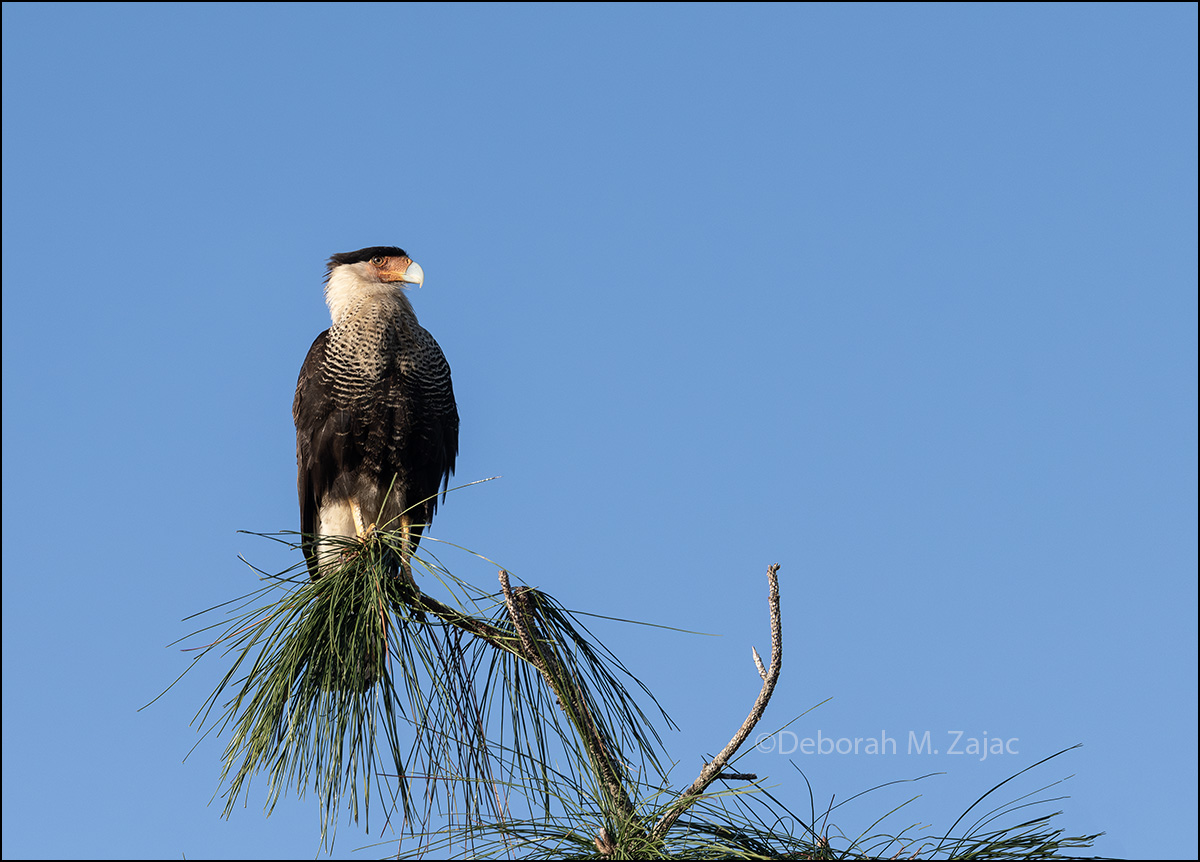
The Crested Caracara looks like a hawk with its sharp beak and talons, behaves like a vulture, and is technically a large tropical black-and-white falcon. It is instantly recognizable standing tall on long yellow-orange legs with a sharp black cap set against a white neck and yellow-orange face. The Crested Caracara is a bird of open country and reaches only a few states in the southern U.S. It flies low on flat wings, and routinely walks on the ground.
A common subject of folklore and legends throughout Central and South America, the Crested Caracara is sometimes called the “Mexican eagle.”
Although it looks like a long-legged hawk the Crested Caracara is actually a falcon.
The Crested Caracara is the only falcon that collects material to build a nest. Other falcons lay their eggs in an old nest built by another species or in a scrape on the ground.
The oldest recorded Crested Caracara was at least 21 years, 9 months old when it was identified by its band in 2015 in Florida. It was originally banded in the same state in 1994.
PLEASE DO NOT USE MY IMAGES WITHOUT EXPRESSED WRITTEN PERMISSION.
Saturday morning after I’d finished Wordle and Strands I shared my results with my sister. We trade results and talk about where we struggled or where we felt it was easy. We talked for a bit and then I got up to make a second cup of tea this was about 7A.M. I just caught out the corner of my eye out back a Coyote streaking by. I moved to the backdoor to see where it was going and here came another one streaking by following the first one! That was neat. I thought they were probably heading back to the den since the sun was up already.
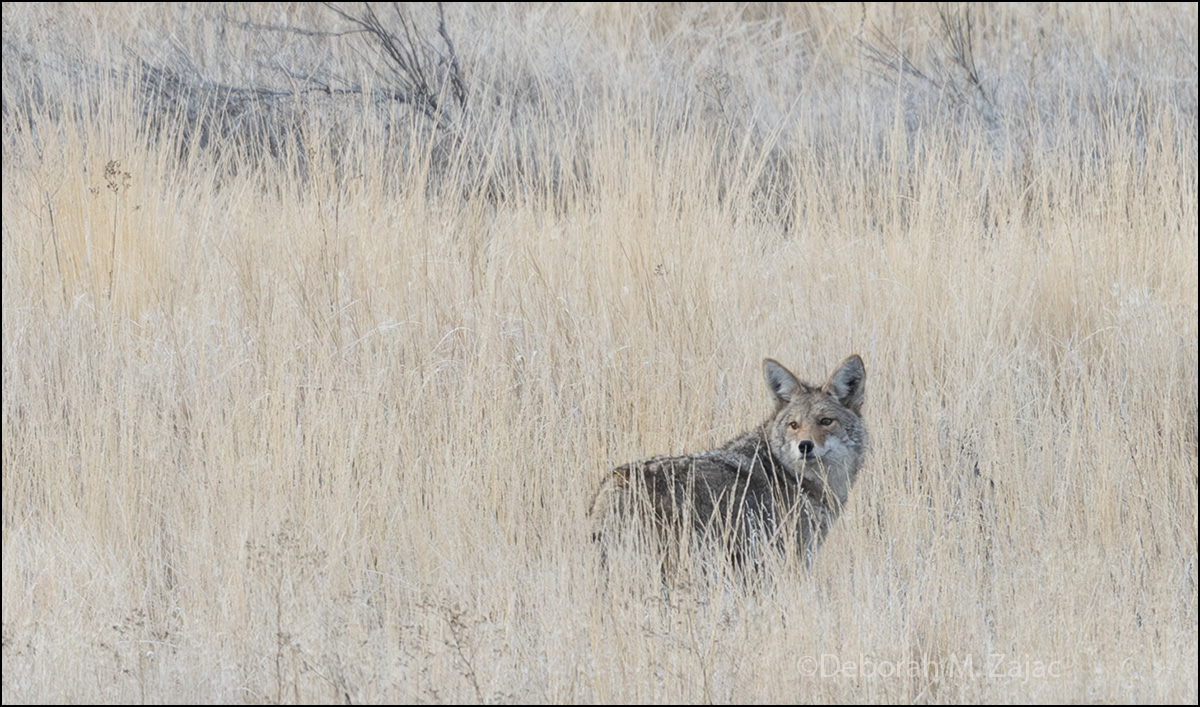
Fast forward 50 minutes and when I looked up from reading there out at the edge of the golf course was a Coyote with its back to me gazing out across the flood plain. Oh! I raced to get my camera that was in my retreat. I wished as I was racing that it would still be there when I got back. It was!
As I opened the sliding glass door and screen it heard me and turned to see what the noise was. It soon realized I was no threat so turned its gaze back to the field. Above is exactly what I saw that had me run for my camera.
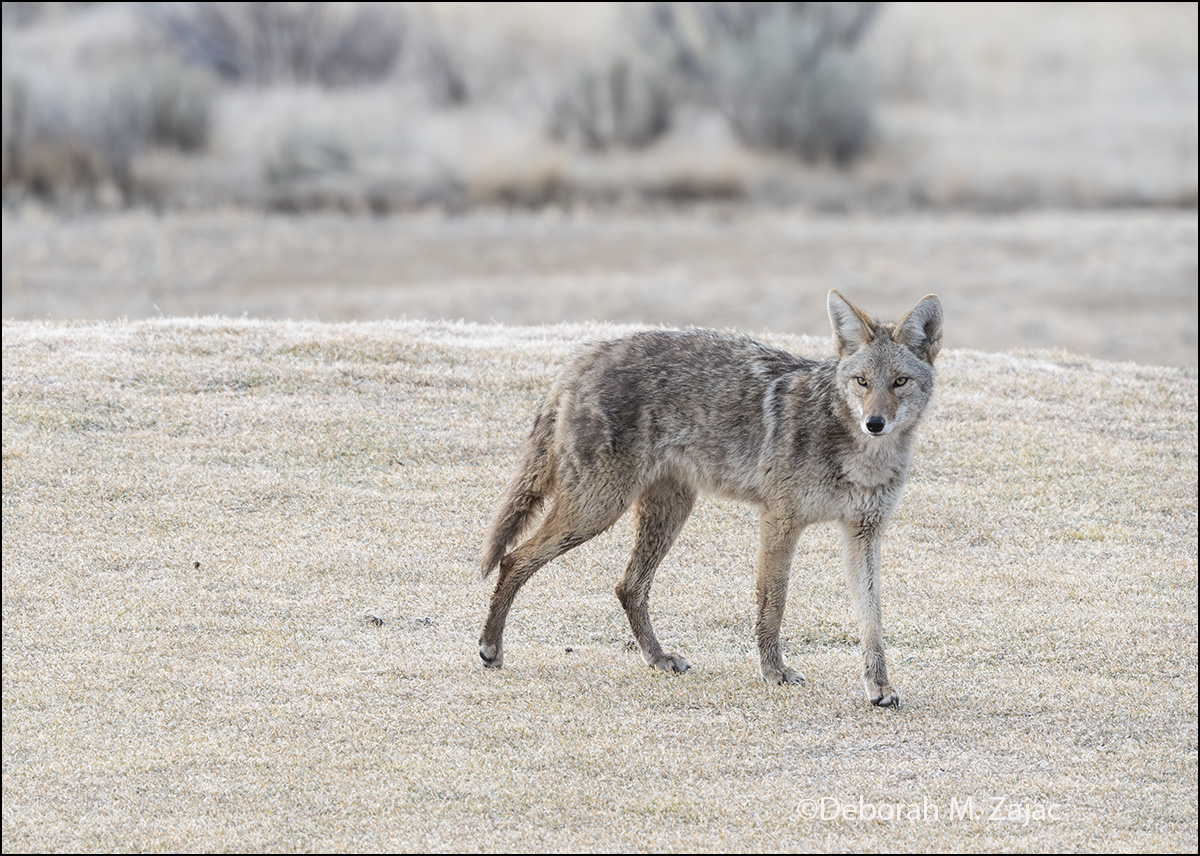
After a few minutes something caught its attention out in the field and it got up to look. I looked too. Oh! There out in the field further west was another Coyote! Perhaps these two were the two I had seen running by an hour before?
Here’s Number Two out in the field looking back at Number One. This is cropped in a bit.
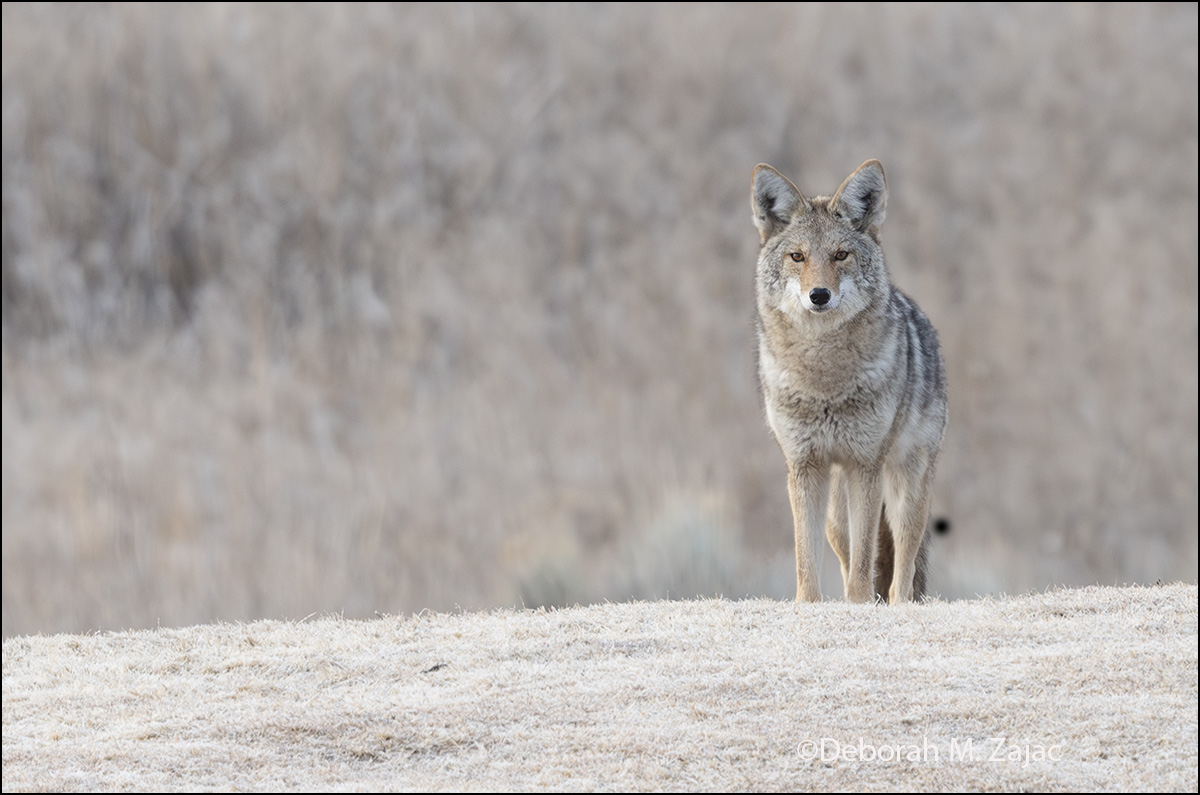
Coyote Number One got to the bottom of the hill below me but, I couldn’t see him anymore. Then he started up the golf cart path headed east and soon was out of sight.
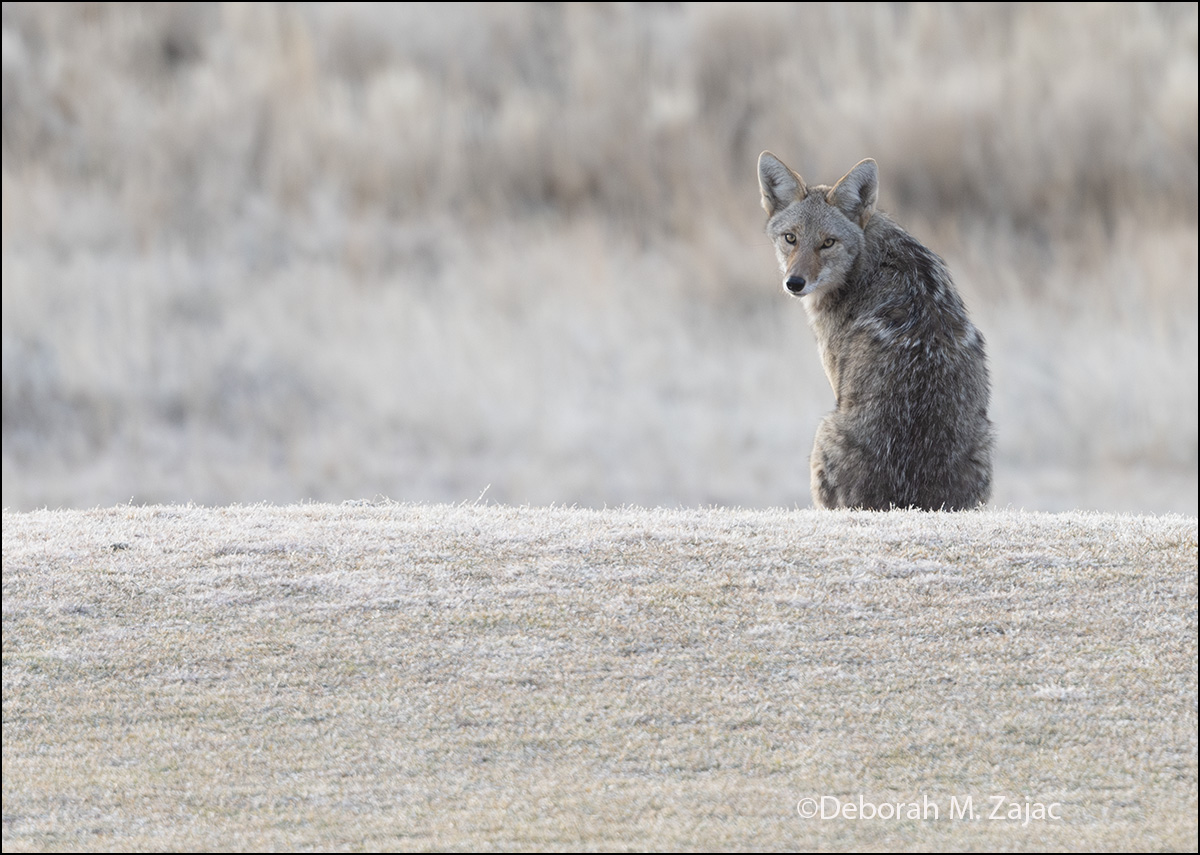
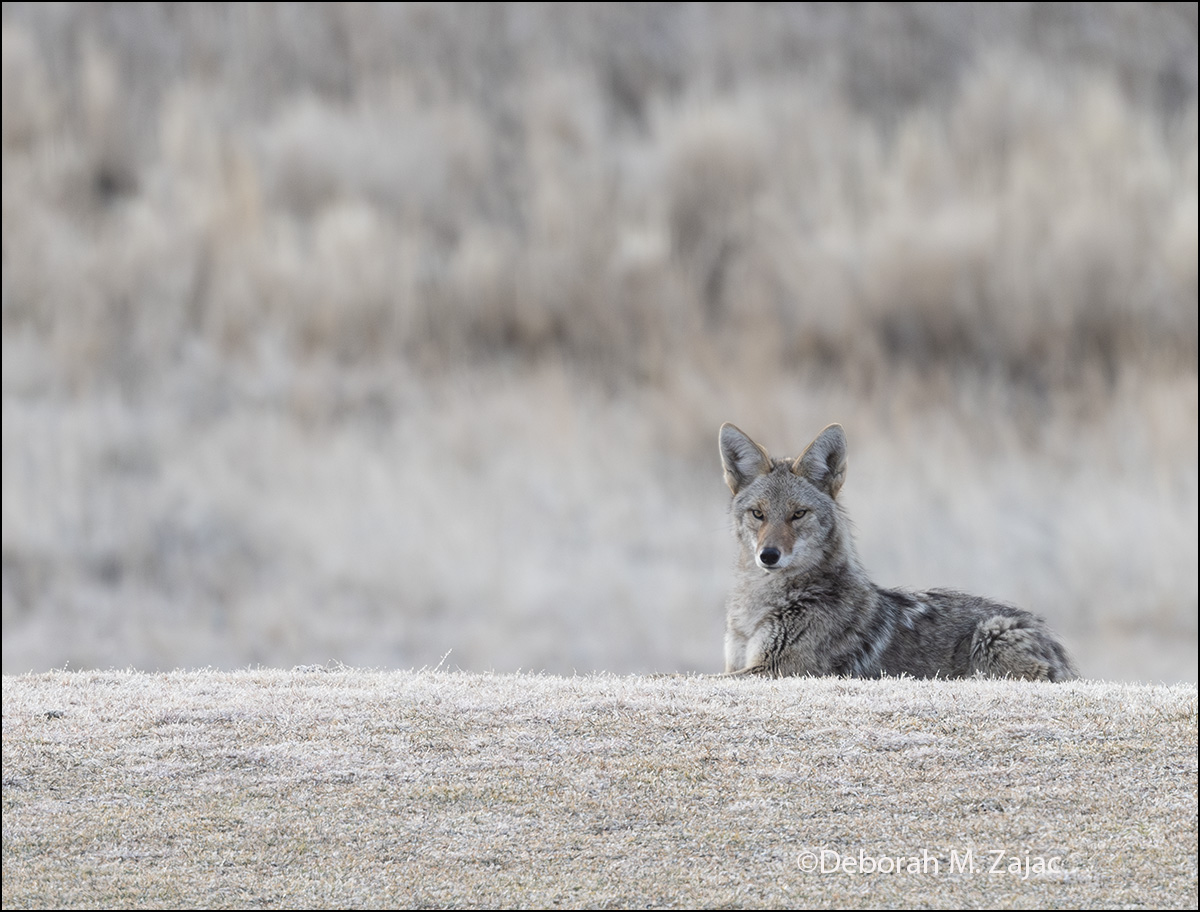
Number Two couldn’t see Number One I think, so came up to the edge of the course. It spotted me. Our eyes met. Then it turned to look east after its buddy, and off it went after it head down on the scent.
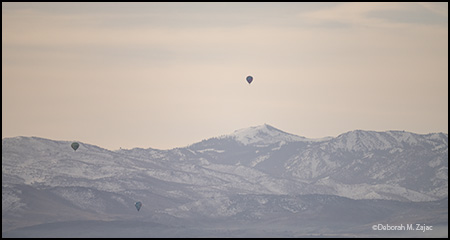
I watched it until it was out of sight then looked up and there out in the distance were 3 Hot Air Balloons rising. I hoped they’d float my way, but they never do. Prevailing winds tend to head east. This morning was no different they all floated east behind the mountains out into the great Nevada desert.
I watched until the last balloon slid behind the mountains and out of view. It was my turn to turn away from the view. I went to get my forgotten cup of tea now cold then headed to the kitchen to make a fresh cup. Happy with the way my day started and counting my blessings. I was thinking how wonderful it is to have all this nature and wildlife here and I was very thankful to be home Saturday morning to see it all.
PLEASE DO NOT USE MY IMAGES WITHOUT EXPRESSED WRITTEN PERMISSION.
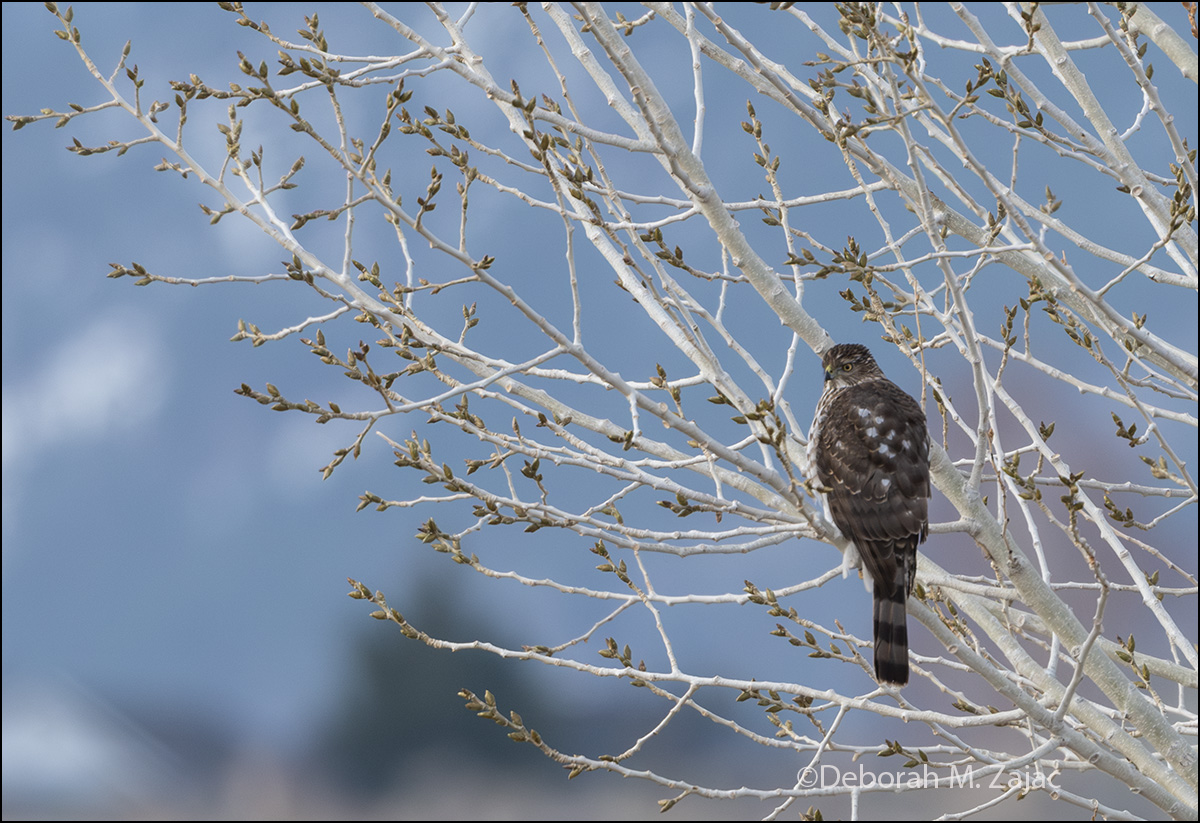
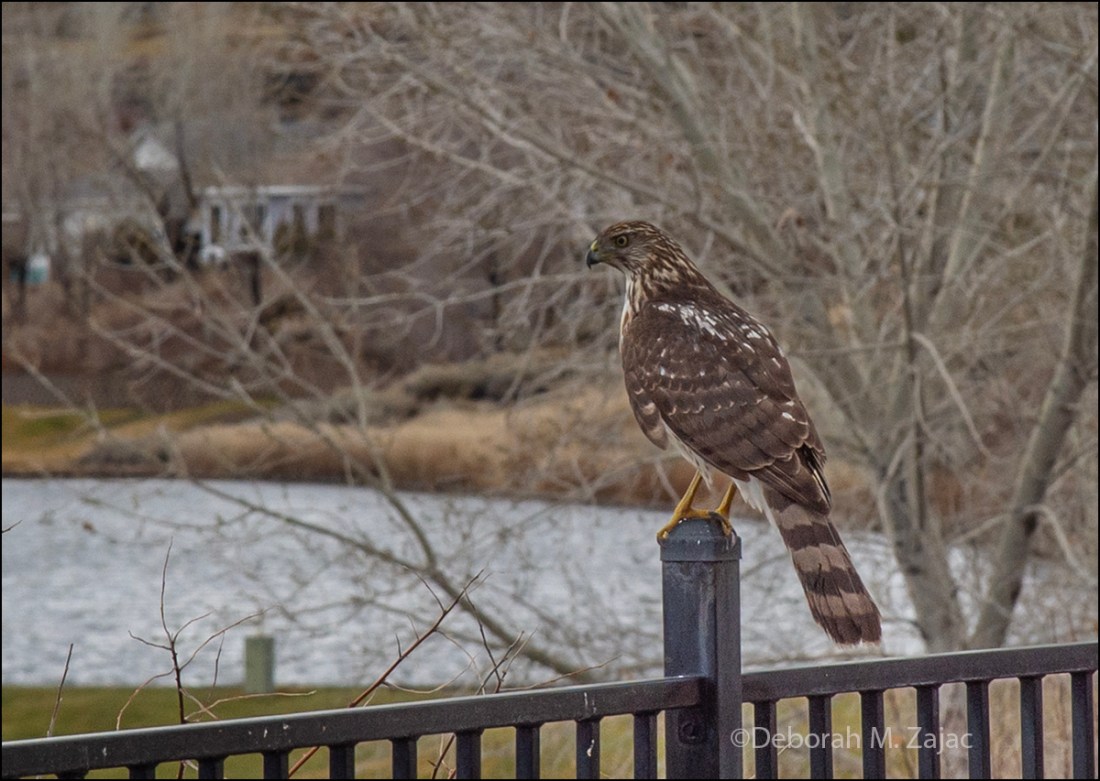
January 2nd a Cooper’s Hawk came to look for breakfast at my neighbor’s house. I quietly opened the back door and grabbed what are the first Hawk images of 2026. Here’s one.
I’m taking that as a sign that it’s going to be a good year of birding.
This winter has started off a bit bumpy on the home-front. Our heater went out just after Christmas on a Sunday. Fortunately, we were able to have our preferred heating and air company come out that afternoon and fix it.
Then I discovered we have a leak in the garage. We had a roofer out and they found several broken tiles. Errant golf balls no doubt. Our house gets hit a lot. I wish they…the golfers would learn to hit toward their other right!
The roofers sealed up the cracks and we’re scheduled to have the tiles replaced at the end of the month. I welcome the rain and snow, but not the leaky roof.
We’ve had several storms so I haven’t been out birding, but today the weather looks cold, but sunny so I’ll be birding with the group this morning. I’ll be late getting to your blogs and comments.
Fun Facts:
Dashing through vegetation to catch birds is a dangerous lifestyle. In a study of more than 300 Cooper’s Hawk skeletons, 23 percent showed old, healed-over fractures in the bones of the chest, especially of the furcula, or wishbone.
A Cooper’s Hawk captures a bird with its feet and kills it by repeated squeezing. Falcons tend to kill their prey by biting it, but Cooper’s Hawks hold their catch away from the body until it dies. They’ve even been known to drown their prey, holding a bird underwater until it stopped moving.
Once thought averse to towns and cities, Cooper’s Hawks are now fairly common urban and suburban birds. Some studies show their numbers are actually higher in towns than in their natural habitat, forests. Cities provide plenty of Rock Pigeon and Mourning Dove prey. Though one study in Arizona found a downside to the high-dove diet: Cooper’s Hawk nestlings suffered from a parasitic disease they acquired from eating dove meat.
Life is tricky for male Cooper’s Hawks. As in most hawks, males are significantly smaller than their mates. The danger is that female Cooper’s Hawks specialize in eating medium-sized birds. Males tend to be submissive to females and to listen out for reassuring call notes the females make when they’re willing to be approached. Males build the nest, then provide nearly all the food to females and young over the next 90 days before the young fledge.
The oldest recorded Cooper’s Hawk was a male and at least 20 years, 4 months old. He was banded in California in 1986, and found in Washington in 2006.
PLEASE DO NOT USE MY IMAGES WITHOUT EXPRESSED WRITTEN PERMISSION.
This is a bird I don’t think I’ve shared often as they’re very elusive and shy.
Last month while birding up in Washoe County we were thrilled to see this one come out of the reeds to forage in the shallow end of the lake. This one is a juvenile which is why it was foraging in the open for sometime. There was another one behind in the reeds tut-tutting…probably an adult.
A secretive bird of freshwater marshes, the Virginia Rail often remains hidden in dense vegetation, but its loud grunting may give away its presence. As it slowly pokes its way through the marsh, you might get a glimpse of its reddish bill, black-and-white barred sides, and its twitching tail, showing off white tail feathers beneath. It possesses many adaptations for moving through its nearly impenetrable habitat, including a laterally compressed body, long toes, and flexible vertebrae.
The forehead feathers of Virginia Rails are adapted to withstand wear and tear that results from pushing through dense and often sharp marsh vegetation.
The Virginia Rail is more adept at walking on soft mud than swimming, but it occasionally swims across wetlands and even dives underwater, propelling itself with its wings.
As a group, rails have the highest ratio of leg muscles to flight muscles of any bird, which may explain their propensity to walk rather than fly.
The Virginia Rail builds numerous “dummy nests” in addition to the one where eggs are actually laid.
PLEASE DO NOT USE MY IMAGES WITHOUT EXPRESSED WRITTEN PERMISSION.
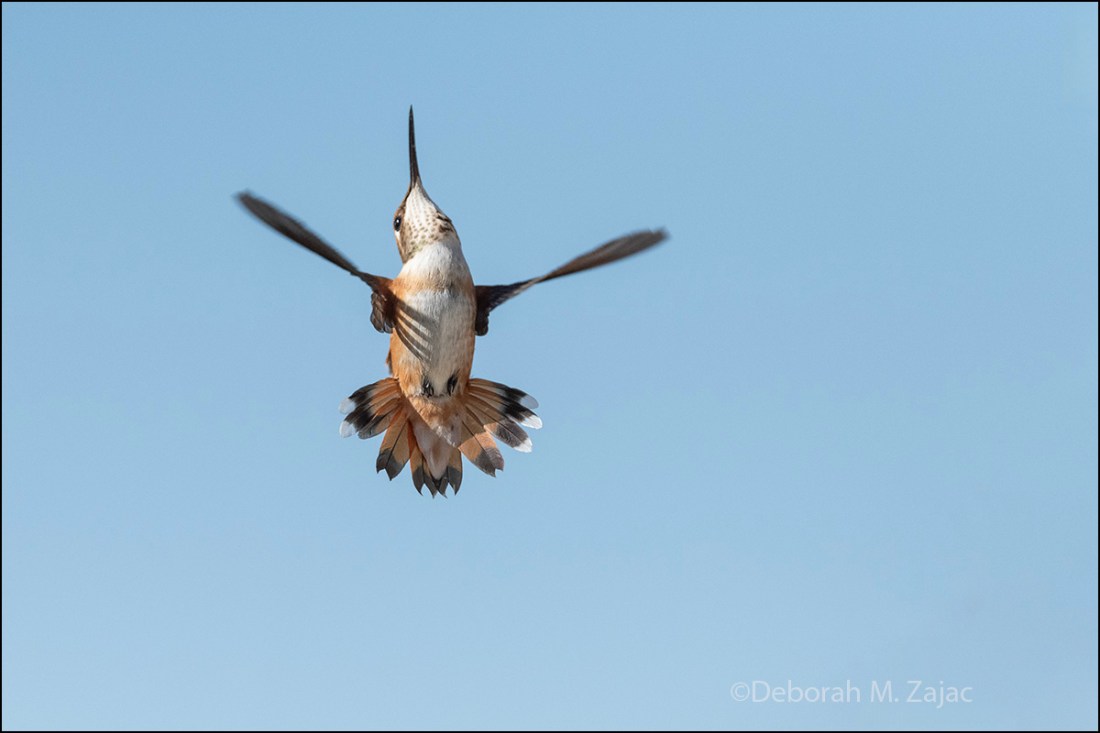
A few weeks ago a pair of Rufous Hummingbirds returned to my backyard feeder. They’ve been chasing off the Black-chinned and having skirmishes all day everyday since their return.
I’m beginning to think I need to add another Shepard’s hook and feeder so the territorial squabbling gets better.
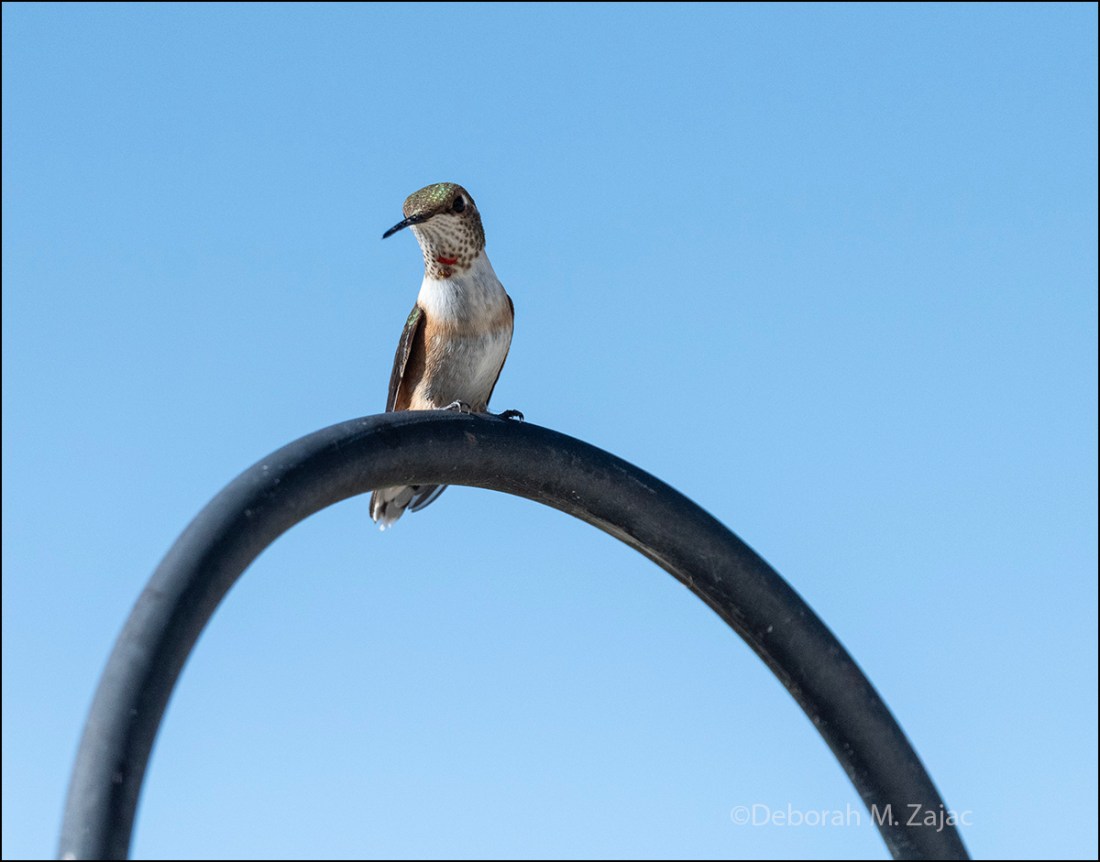
Here’s what I think is a female perched on top of the hook claiming possession. She lands here on and off all day long letting the other Hummingbirds know this is her feeder. You can see a little bit of her Gorget on her throat.
I could be wrong about her sex as it could also be an immature female/ male. If you know which it is please let me know.
Fun Facts:
The Rufous Hummingbird is a common visitor to hummingbird feeders. It is extremely territorial at all times of year, attacking any visiting hummingbird, including much larger species. They’ve been seen chasing chipmunks away from their nests.
The Rufous Hummingbird makes one of the longest migratory journeys of any bird in the world, as measured by body size. At just over 3 inches long, its roughly 3,900-mile movement (one-way) from Alaska to Mexico is equivalent to 78,470,000 body lengths. In comparison, the 13-inch-long Arctic Tern’s one-way flight of about 11,185 mi is only 51,430,000 body lengths. (AAB)
During their long migrations, Rufous Hummingbirds make a clockwise circuit of western North America each year. They move up the Pacific Coast in late winter and spring, reaching Washington and British Columbia by May. As early as July they may start south again, traveling down the chain of the Rocky Mountains. People first realized this pattern after examining detailed field notes and specimens, noting the birds’ characteristic dates of arrival on each part of the circuit.
The Rufous Hummingbird has an excellent memory for location, no doubt helping it find flowers from day to day, or even year to year. Some birds have been seen returning from migration and investigating where a feeder had been the previous year, even though it had since been moved.
The Rufous Hummingbird breeds as far north as southeastern Alaska – the northernmost breeding range of any hummingbird in the world. Of the western hummingbirds that occasionally show up in the east, the Rufous Hummingbird is the most frequent.
Rufous Hummingbirds, like most other hummingbirds, beat their wings extremely fast to be able to hover in place. The wingbeat frequency of Rufous Hummingbirds has been recorded at 52–62 wingbeats per second.
The Rufous Hummingbird is not a colonially nesting species; however, there have been reports from Washington state that have 20 or more Rufous Hummingbird nests only a few yards apart in the same tree. (From the BNA)
Hummingbirds are hard to catch, but there are records of Rufous Hummingbirds being caught by a large flycatcher (Brown-crested Flycatcher) and by a frog.
The oldest recorded Rufous Hummingbird was a female, and at least 8 years, 11 months old when she was recaught and rereleased during banding operations in British Columbia in 2004.
I’ve been slower to your blogs this week as I’m visiting with family, and I will be for the next several days, but I’ll catch up!
The Eastern Phoebe can be found throughout the eastern half of the continent from the Northwest Territories all the way down to Mexico.
The other two Phoebes are found in the Western regions of North America. They are the Say’s Phoebe, and the Black Phoebe.
Fun Facts:
In 1804, the Eastern Phoebe became the first banded bird in North America. John James Audubon attached silvered thread to an Eastern Phoebe’s leg to track its return in successive years.
The use of buildings and bridges for nest sites has allowed the Eastern Phoebe to tolerate the landscape changes made by humans and even expand its range. However, it still uses natural nest sites when they are available.
Unlike most birds, Eastern Phoebes often reuse nests in subsequent years—and sometimes Barn Swallows use them in between. In turn, Eastern Phoebes may renovate and use old American Robin or Barn Swallow nests themselves.
The Eastern Phoebe is a loner, rarely coming in contact with other phoebes. Even members of a mated pair do not spend much time together. They may roost together early in pair formation, but even during egg laying the female frequently chases the male away from her.
The oldest known Eastern Phoebe was at least 10 years, 4 months old. It had been banded in Iowa in 1979 and was found in 1989 in Alberta.


 Circadianreflections Blog
You must be logged in to post a comment.