Whatever Weds. Comet Lemmon

Copyright ©2025 Deborah M. Zajac. ALL RIGHTS RESERVED.

PLEASE DO NOT USE MY IMAGES WITHOUT EXPRESSED WRITTEN PERMISSION.

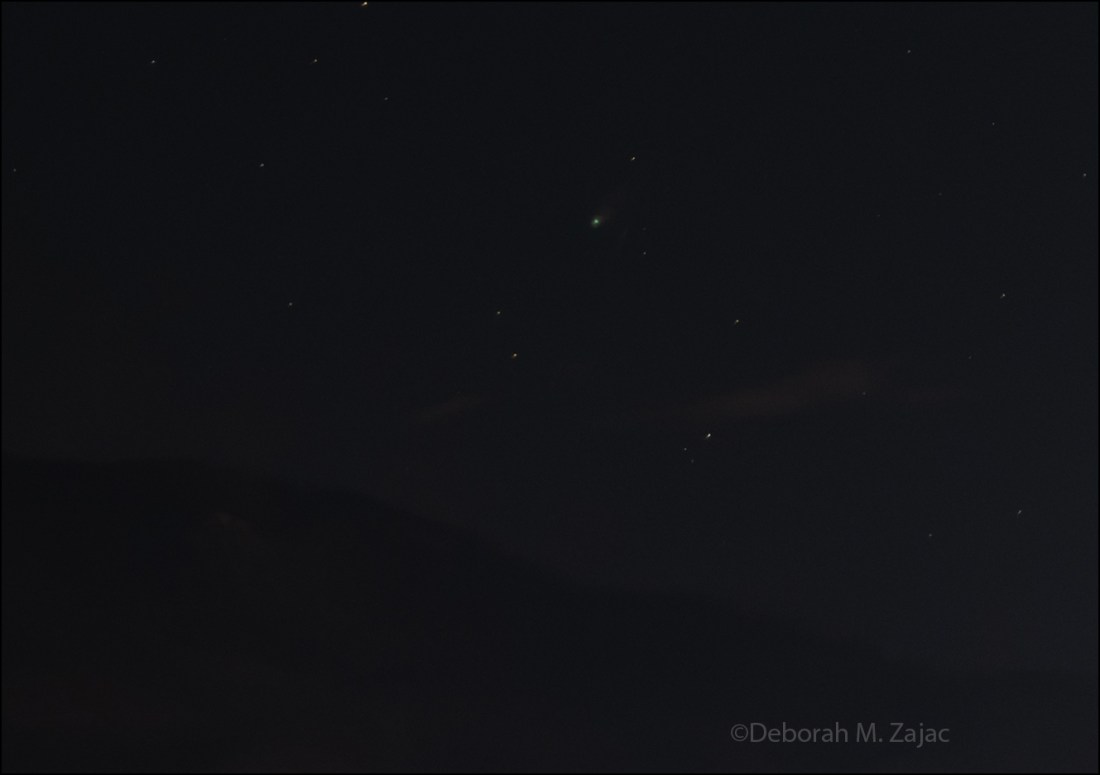
I went out with a friend to try to see if I could find and photograph C/2025 A6 Comet (Lemmon) on October 19th. I didn’t go too far from home just up into the Pinenut Mountains a little bit. l took my 50mm lens so I would be able to see a wide space of the sky and hopefully see it. I never saw it with my eyes or binoculars, but when I got home and uploaded my images I was happy to see my camera had seen it. It’s the tiny green dot upper center of the image.

It’s tiny at 50mm but, I cropped this in a bit for a better look.
©Deborah M. Zajac | http//:circadianreflections.com
Comet Lemmon Nikon D850| Nikkor 50mm

The next night I went back to the same spot with my old 80-200mm lens but, I wasn’t able to see it at all. I believe it was too low and behind the hills opposite.

So last night a friend and I went north to a spot I know that had more open sky. It took us a while to find it but, we did. My old lens had a bit of trouble focusing on my newish bigger sensor D810 but, once I uploaded my images I found I had several decent shots of the comet with a hint of its tail too.

©Deborah M. Zajac | http//:circadianreflections.com
Comet Lemmon| Nikon D810| Nikkor 80-200mmD| October 21, 2025

It’s always exciting to see a comet and this one is pretty cool. It was 55 million miles from Earth last night and it won’t be back again until the year 3175! Do you think my images will survive for my future family members to see my images made with probably antiquated photography methods and gear? Somewhere between 33 and 46 generations will pass before C/2025 A6 (Lemmon) comes our way again. It boggles my mind.

Did you see it?

more to come…
Wordless Weds. The Star Stop

Copyright © 2021 Deborah M. Zajac. ALL RIGHTS RESERVED

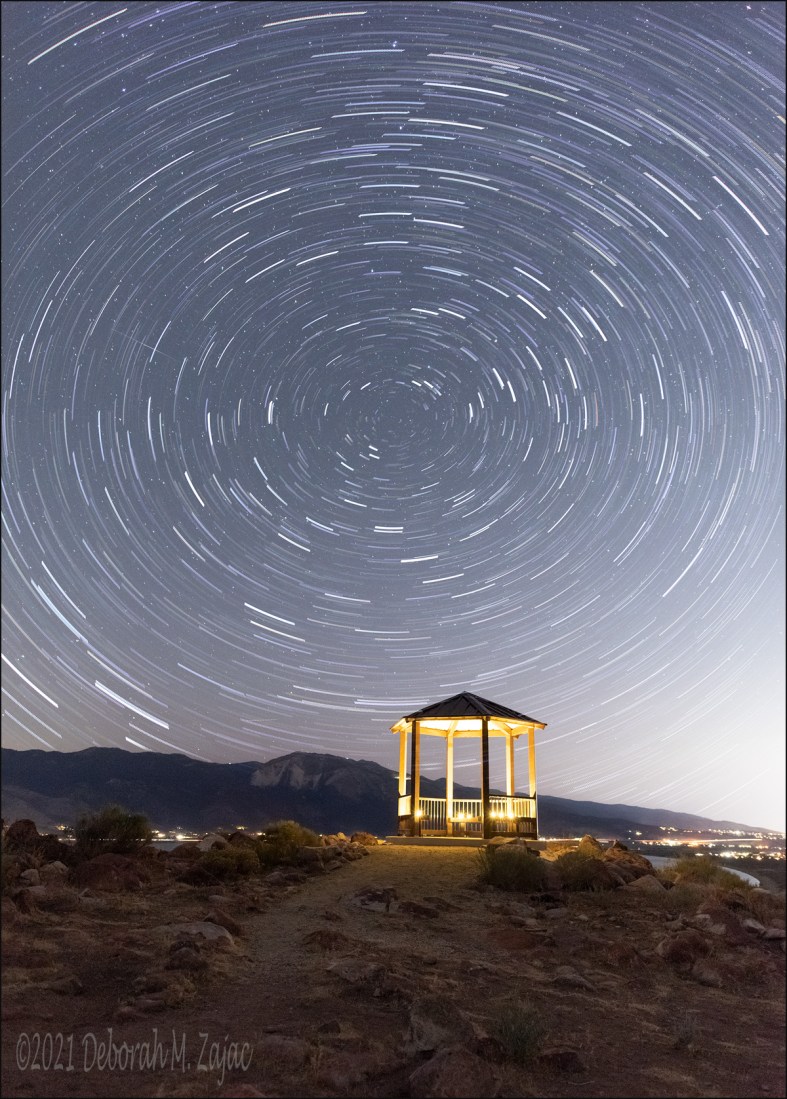
Composite image:

Sky- Nikon D300s| 17mm| f90 secs| f/5.6| ISO 400 52 frames stacked in Photoshop

Foreground-Nikon D810|15 secs.|20mm| f/2.2| ISO 2000

I lit up the gazebo with 14 little tea lights. All the elements were blended in Photoshop CC 22.4.2

more to come…

Whatever Weds.- O’Dark Thirty

Copyright © 2020 Deborah M. Zajac.  ALL RIGHTS RESERVED

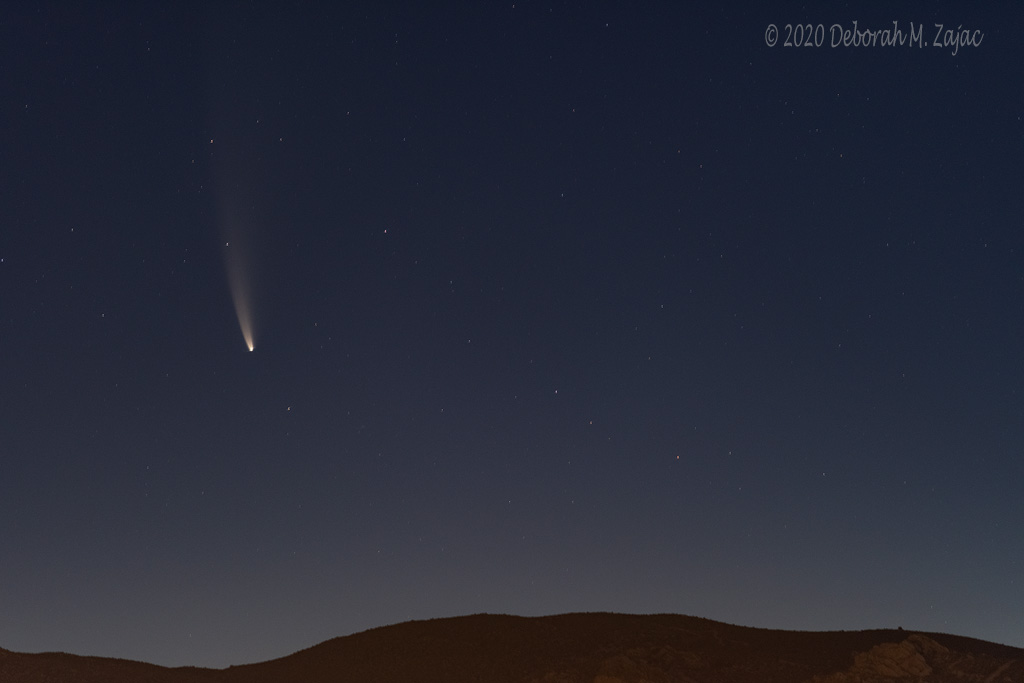
Did you hear about the new Comet that was discovered in March of this year? It’s called C/2020 F3 “Neowise”.  Some…okay a lot of astronomers thought it would be burned up when it made its close encounter to the Sun, but a few thought it would make it past that, and we who were paying attention held our breath and waited and watched…

It made it past the sun! Two Comets I was watching this year didn’t make it past their close encounter with the Sun so this is huge!

On July 10th I rose at an UnGodly hour 4:00 A.M. brushed my teeth put on some pants and shoes and grabbed my gear then headed out not too far from home on foot to see if I could see this new Comet C/2020 F3 “Neowise”.  I did not see it.  I knew where to look so made 13 images around the area hoping my camera could see what I could not.  IT DID NOT.  I was too late. The Sun’s light was already hiding the Comet. I needed to get up earlier.

July 11th. I rose at 3:15am put some pants on, brushed my teeth, put on my shoes, and grabbed my gear bag and headed out the door on foot to my spot.  My compass for the morning was Venus with Alderan under it and Capella off to the north of Venus. They would guide me to Comet C/2020 F3 ” Neowise”.  I also took my binoculars just in case I couldn’t spot with my eyes.  I located Capella with my binocs and began scanning the area below it where I knew the comet would be.  THERE IT WAS! I did a little happy dance I won’t lie!  There’s just something about the stars, planets, and comets that excites me.

I set up my camera and dialed in my exposer and hoped I was in focus. Focusing in the dark isn’t always easy.

Here’s my best frame from the morning.

Comet Neowise C/2020 F3 7.11.2020

As I was shooting there was a pack of Coyotes singing their song just up the trail and behind me just far enough away to keep me looking to my right. Greeting the morning or healding their catch of the night I don’t know, but they stirred up all the coyotes in the valley and kept me watching my right.

When I walked up the path toward the fence I needed to hop to get home I kept looking over my shoulder making sure the Coyotes weren’t following me!  They’re sneaky those coyotes. In my head, I had this song. It’s my favorite Coyote song evah. And they go…

Who yip , who yip, who…


Nikon D810| Nikkor 180mm F/2.8| CS PP 21.2


more to come…


The Sun and Sunspot AR2665

Copyright ©2017 Deborah M. Zajac. ALL RIGHTS RESERVED

I read at Spaceweather.com over the week-end that the latest sunspot AR2665 was HUGE, and the biggest sunspot of 2017 so, not having photographed the Sun for sometime I thought it would be interesting to make an image of this Sunspot on the Sun.  I dug out my solar filter then Monday morning set up my camera in the backyard and waited for the morning sun to climb above the mountain tops.   I cropped this image in 25% so we can see the spot a bit better.

Sun July 10, 2017 with Sunspot AR2665

“Sunspot AR2665 has grown into a behemoth almost as wide as the planet Jupiter: Stretching more than 125,000 km from end to end and containing dozens of dark cores, the active region is an now easy target for backyard solar telescopes. Sunspot AR2665 has a ‘beta-gamma’ magnetic field that harbors energy for M-class solar flares.. “~http://spaceweather.com/

I’ll add you can see it with a Telephoto lens, and Solar filter.  Caveat: Don’t ever attempt to photograph the sun without a Solar Filter. You can permanently damage your eyes, and your camera’s sensor.

M-Class Solar Flares are Medium sized flares. They can cause brief radio blackouts that affect Earth’s polar regions.

I use an Orion 4.10″ ID Full Aperture Solar Filter. It fits snugly over my lens allowing me to look directly at the sun and photograph it by blocking  99.999% of incoming sunlight for safe observation and astrophotography.  I’ve had this filter for several years and it’s worked perfectly, and is easy to use.  It fits my 300mm f/4 perfectly. It slides over my 200-500mm’s 82mm front end element, but not so far that I’m able to secure it with the screws so, to make sure it wouldn’t fall off I taped it to my lens barrel.  Gaffers tape or Painters tape works.

I linked to the filter so you can check it out if you’re interested. I am not affiliated with Orion and do not receive any compensation or products for using their products or mentioning them.  

Nikon Df| Nikkor 200-500mm @500mm| SanDisk Digital Film| PS CC 2017

more to come…


Trailhead to the Stars

Copyright ©2016 Deborah M. Zajac. ALL RIGHTS RESERVED

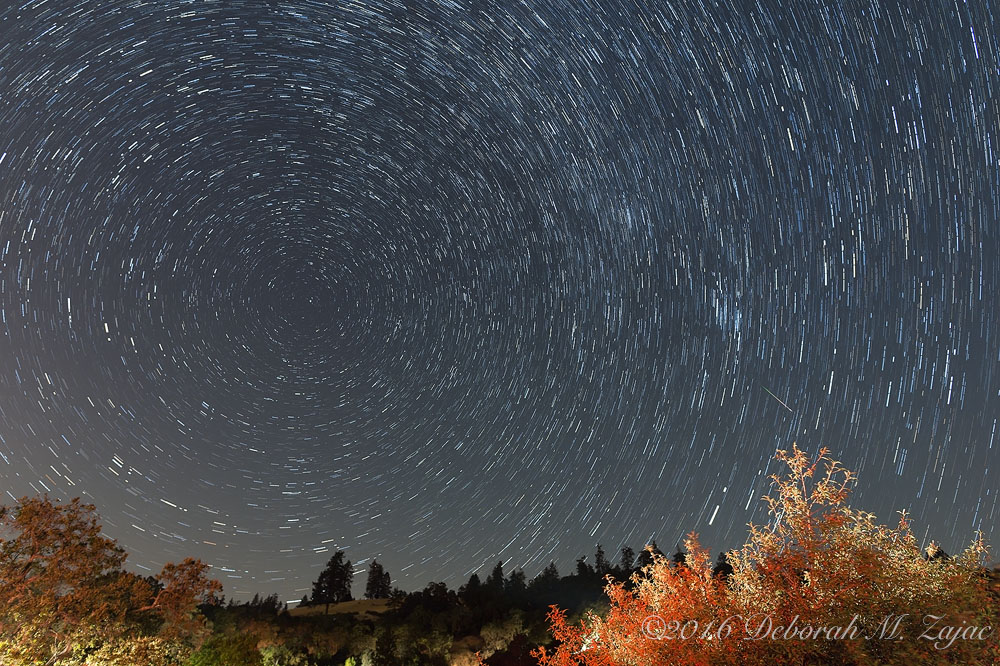
Last night I met Gordon, and some other friends in a Meet-Up group we’re in up on Mt. Tamilpias in Marin County to photograph the sunset, and then image the night sky.

There was an Astrology lecture in the Amphitheater so the park was open much later than it normally is which allowed us to stay late. YEAH! Normally the park closes a bit after sunset.

This is 74 frames stacked in PS CC 2015.5.

My settings were f2.2| 30seconds ea.| ISO 320| Manual Priority| Tripod|

Star Trails

4 planes, and one shooting star flew through the sky while I was imaging. I didn’t see the shooting star at the time as I was looking away helping a friend with her settings and intervalometer. I was thrilled to see I caught it on film though.

It was a lovely night, not windy, or cold, and the company was great!

Nikon Df| Nikkor 20mm f/1.8G| Delkin Digital Film

More to come…


“Dwell on the beauty of life. Watch the stars, and see yourself running with them.” ― Marcus Aurelius, Meditations

Copyright ©2016 Deborah M. Zajac. ALL RIGHTS RESERVED

While watching the night sky for Perseid Meteors Friday night I shot just under 300 frames. In all those frames I only managed to photograph 3 meteors! The rest that I saw were over my head or just out of the frame.

What to do with all those frames of stars? Stack them to make a Star Trail image is one thing.

Passing car headlights, other star gazers using their flashlights, and headlamps…maybe my own red headlamp too unintentionally light painted the trees, and foreground bushes for me.

Star Trails with Perseid Meteor

If I get a chance to photograph the Perseids or any other meteor showers this year or next I’ll use my 16mm Fisheye lens to get more sky in my frame.

Nikon Df| Nikkor 20mm f/1.8G| composite of 24 frames @ f/2.8| 26seconds ea| ISO 1600| Delkin Digital Film| PS CC 2015.5

more to come…


2016 Perseids

Copyright ©2016 Deborah M. Zajac. ALL RIGHTS RESERVED

I went out Friday night/Saturday morning star gazing hoping to photograph a meteor or two of the Perseid meteor shower.  The Perseid Meteor shower is an annual event occurring from mid July to mid August as the Earth crosses the orbital path of Comet Swift-Tuttle; the parent of the Perseid meteor shower.  Debris from the comet litters its orbital path, but we don’t get into the dense part of it until the first week of August.  It’s this debris that slams into Earth’s upper atmosphere at 130,000 mile per hour lighting up the night sky with streaking Perseid meteors.

This year was to be particularly good for viewing more meteors because of our position in the debris path.

I saw a few really great meteors with wonderful balls of fire streaking through the sky, but the best image I made in 4 hours of sky watching was of this little meteor with some red at the head and a green tail.  It’s a first time I’ve photographed the green tail.

Perseid Meteor 2016


There’s some of the Milky Way in there too, but faint, but there were oh, so many stars!

It was a wonderful night for star gazing.

Nikon Df| Nikkor 20mm f/1.8G @ f/2.8| ISO 1600| 26s  single frame| Delkin Digital Film|PS CC 2015.5

Source-Earthsky.org

more to come…