Women’s Fashion of the Times…Dickens Time that is

Copyright © 2012 Deborah M. Zajac. All Rights Reserved.

I was fascinated with the women’s hats, dresses, and hair styles that I saw at the Dickens Fair. There were several different styles of dresses, and bonnets, and the hair styles were either pinned up at the back in a chignon with a loose ringlet or two framing the face, or curled in ringlets and pinned up with the ringlets hanging freely at the back of the head from the crown to the nape of the neck.

Hats, hairstyles, and dresses in the early Victorian era changed at a much slower pace than we’re used today. Unlike today’s seasonal fashion changes, hats and hairstyles only changed about every decade during the Victorian Era.

Black and white feather bonnet

In the late 1830’s the “Great hat” gave way to smaller brimmed bonnets,

Woman in Blue Bonnet

and over time more ornate trim like ribbons, feathers, and flowers were added…

Woman in the Red Ornate Bonnet

Ornately trimmed bonnets stayed in vogue for 50 years, but by 1890 were not worn much.

Women’s dresses changed at about the same pace. Skirts got much bigger requiring more petticoats, and hoops, the sleeves got slimmer, and women wore corsets with boning to keep the bodice from folding horizontally, and to emphasize a small waist.
Unique Corsetry

In the 1840’s the shawl made a comeback;  it was larger and could be used as shoulder wrap.

Woman in Black Bonnet with Shawl

In 1856 The Crinoline Cage Frame was patented by W.S. Thompson.  At least 6 petticoats were needed to hold the wide skirts out.  Petticoats were made of cotton, flannel or wool, and could weigh up to 14 pounds! Can you imagine wearing that much fabric in the summer?

Women sitting full skirt lace cap

Another big advancement in 1856 was the discovery by William Perkin of Coal Tar Aniline Dyes.

While experimenting with coal tar extracts he discovered Mauveine. It’s a bright purple dye. Once in the lab and synthesized it radically changed the textile industry. New colors of dyes like magenta and brilliant blue were soon on the market.

The majority of fashions I saw while at the Dickens Fair were from the decades of 1830-1850 I believe.

Here’s a few more Bonnets and head coverings I saw…

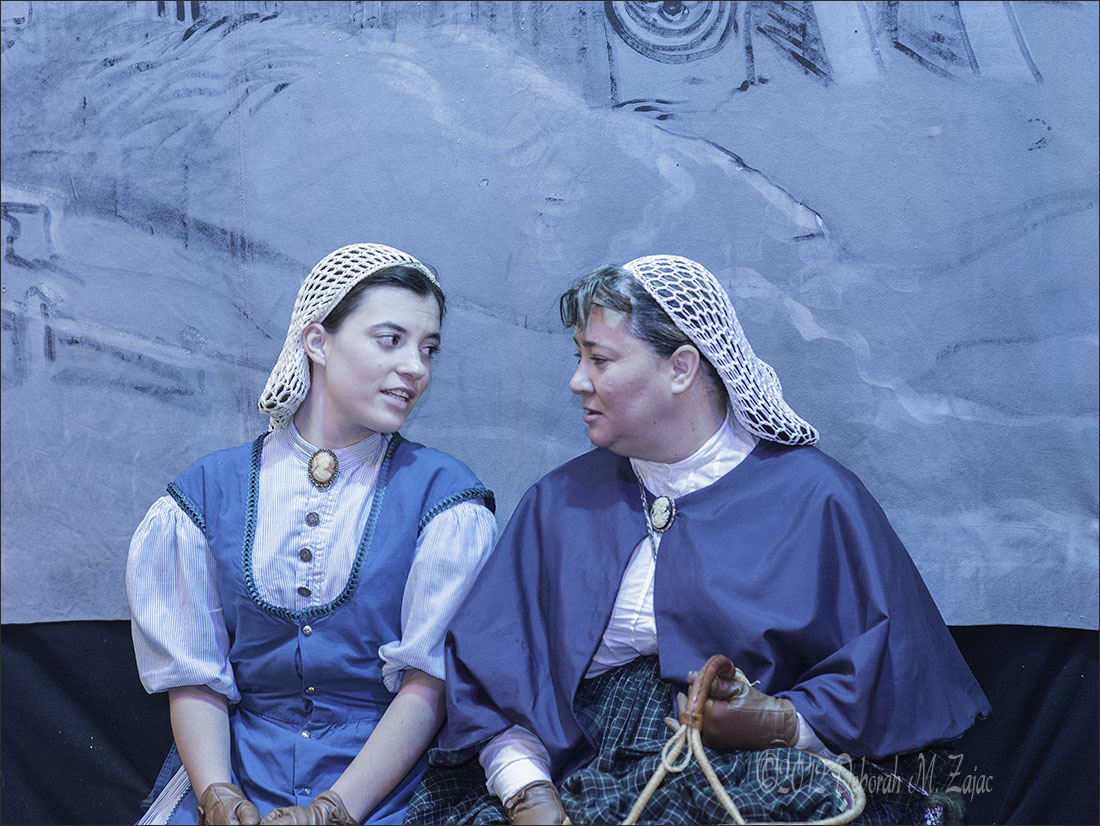
I think these two were in a more ordinary mode of dress…dressed for work perhaps, or for running errands, and they have a foreign look about them.
Women in Knit caps

In work attire, and cap,

In the Bakery… a widow, or Dowager perhaps,

Woman in Black Bonnet

… I should have asked her what she does for a living in Dickens London.

She was just chillin

http://www.fashion-era.com/mid-late_victorian_fashion.htm

Related articles

The Dicken’s Fair

Copyright © 2012 Deborah M. Zajac. All Rights Reserved.

The Great Dickens Fair

I had the pleasure of spending the day with several friends at the Dickens Fair in Daly City, CA yesterday. We arrived when it opened and stayed until closing time.

The Chimney Sweep above is one of the first characters we saw after we checked in our coats, and umbrellas.  He and his colleague  were very funny, friendly, and lovely.

Isn’t his costume terrific!

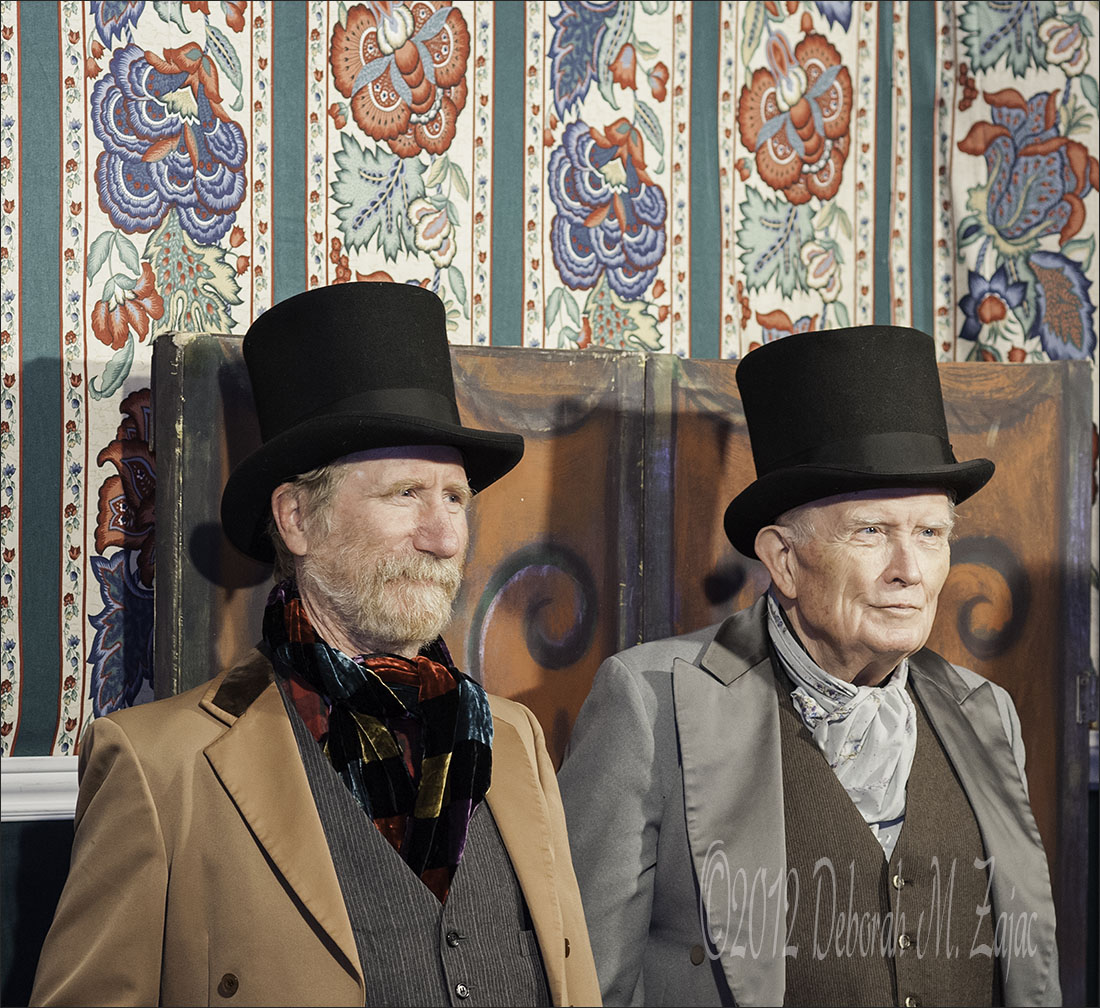
The two gents below were in a Portrait studio having their photo taken when I spied them through the window. They didn’t smile for the camera back then.

Two Gents posing

There were plenty of shops carrying Art, crafts, and wares throughout the streets of Dickens London…Whispers from the Past,

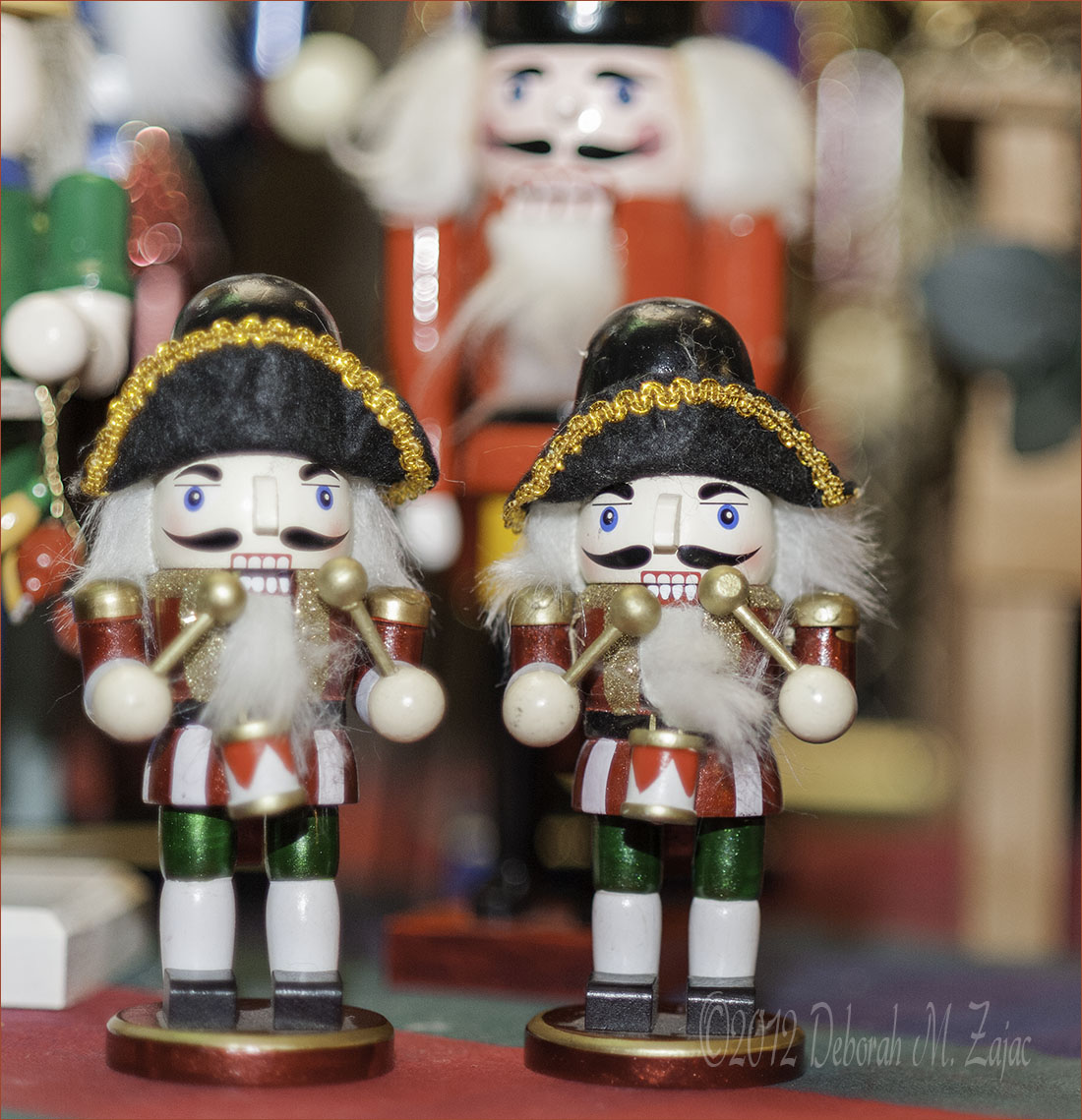
Whispers from the PastNutcrackers,

NutcrackersGlitz and Glamor-High fashion

Womens Head Dress

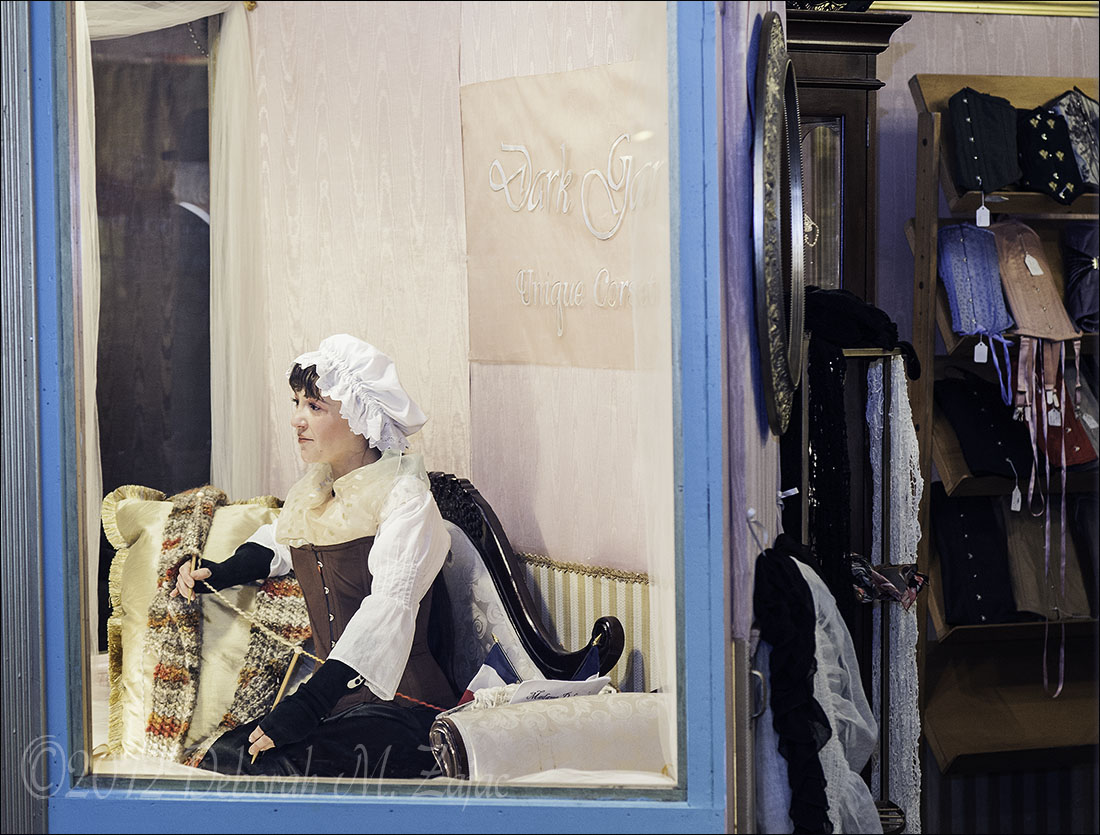
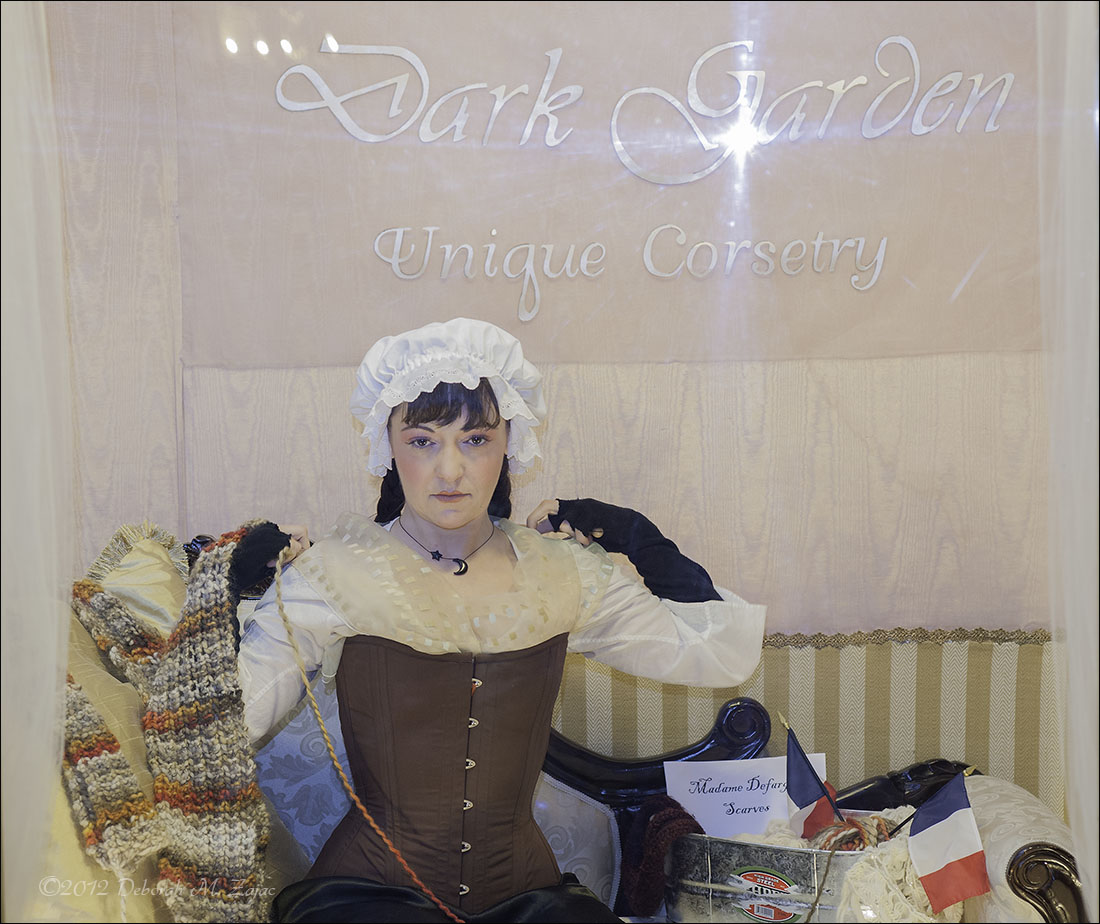
Undergarments… These are Live Mannequins. Each lady posed for 30 minutes then was replaced by a new live mannequin.

Live Mannequin Window Display

Corsets on display at Dark Garden

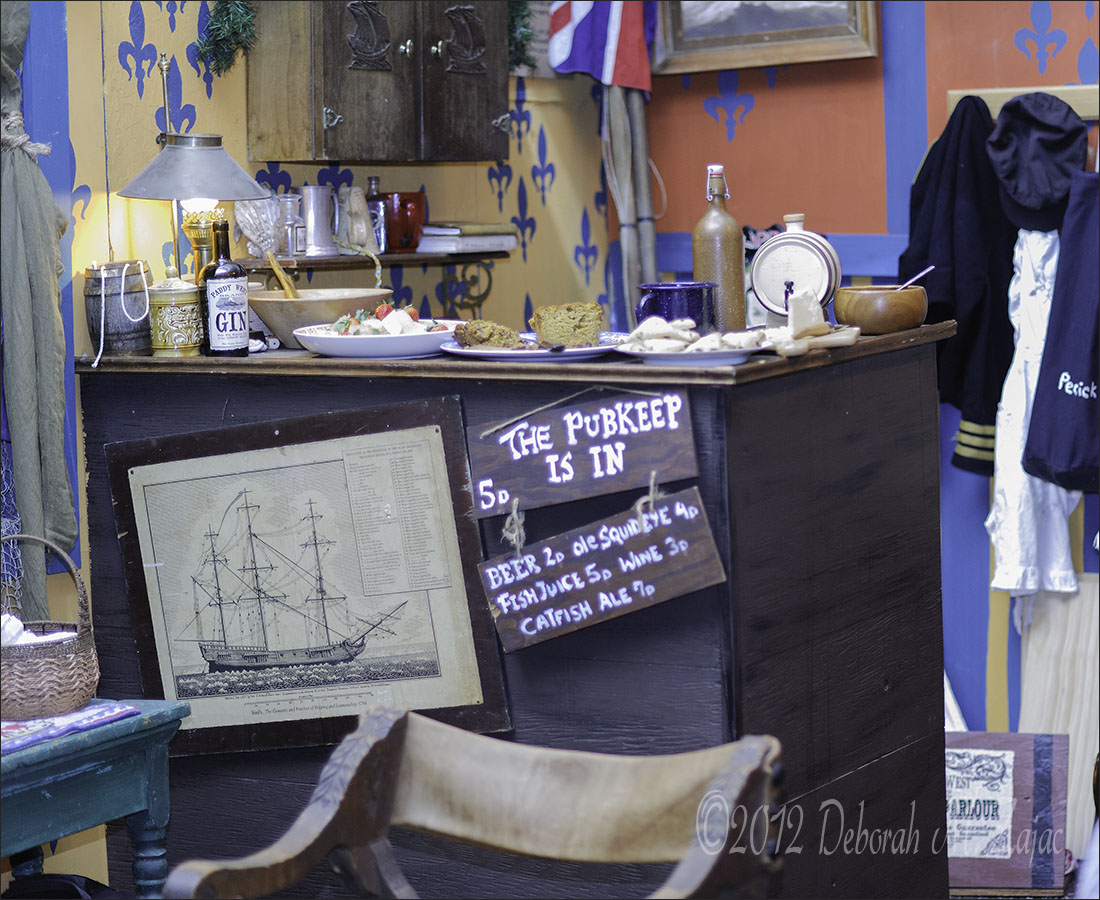
…and a Food & Drink. At the Pub of course!

Pub
Pub

It was a lovely way to spend a rainy, and windy Saturday. The shows were all beautifully performed and were hilarious. I have a lot more photos to go through, and more keepers than I thought I’d have. The venue was very poorly lit  from a photographers point of view, and made it quite challenging getting a sharp, well-lit photo.

If you haven’t been to the Dickens Fair I recommend it.  I have to thank my friend May for getting a group of us together to go. Thanks May! ( I hope you can see May’s  Dickens Fair photos, they’re really good. Click the link! )

Nikon D700| Nikkor 85mm f1.8 AF-D| Nikon SB600


Moonrise Yosemite National Park

Via Flickr:
Copyright © 2012 Deborah M. Zajac. All Rights Reserved.

I’ve switched to Birding photography mode of late and forgot about this photo shoot until Lori Hibbett asked me about my photo.

Last year several friends and I went up to Yosemite to try to capture the Moonrise behind Half Dome, but at the 11th hour the clouds moved in and obscured the top of Half Dome and dashed our hopes of making that shot.
A few of us tried it again this year with better weather. Thanks to the brilliant calculations of our friend Rico we knew when the Moon would be rising and where, unfortunately he wasn’t able to join us for this attempt. So here’s a big shout out to Rico: THANK YOU RICO for the brain work, and for sharing your findings. Also, a shout out to Dali for driving. Thank you for getting us there and back again safely!
Steven– as always your company and conversation is fun and interesting!

Single frame; Nikon D700: Nikkor 80-200mm @200mm| f10| 1/200 sec| ISO200| Manual Priority| Tripod w/cable release


“The Soul becomes dyed with the colors of its thoughts.” ~Marcus Aurelius

Copyright © 2012 Deborah M. Zajac.  All Rights Reserved.

A group of friends from a Meet-Up group I’m in spent one night at May Lake specifically to photograph the evening and night sky.  My friend Michael and I drove up together.  Along the way we stopped at the Old Priest Grade Station Cafe for a late breakfast to help fuel our bodies for the hike to the Lake.   Michael and I split an Egg scramble skillet loaded with goodies, and a short stack of flapjacks.  The coffee was welcome and good, and the food delicious.   We talked with some folks who were traveling from Maine who were visiting Yosemite for the first time. They were pressed for time and wanted to know what they should see. I suggested Tunnel View as their “do not miss” place in the park. I wish I got their email to find what they saw and how  they liked the park. Hindsight is always better isn’t it. [sigh] What would you have suggested they see on very little time in the park?

We made good time from the Cafe to the May Lake turnoff and we found a great parking spot near the trail-head. While we were getting everything out of the car and ready to do the hike up  to May Lake we met a lovely family from San Francisco; Regina, and Jesse with whom we chatted about backpacking, hiking, and gear. They were having lunch and getting their gear ready for the hike up while their two little ones were having nap time.

We took our time hiking up to the lake enjoying the views and talking to passersby.  Regina, and Jesse with their two little ones caught up with us even. They each carried a child in their backpacks plus their camping gear! There wasn’t much further to go to reach the lake by this point.

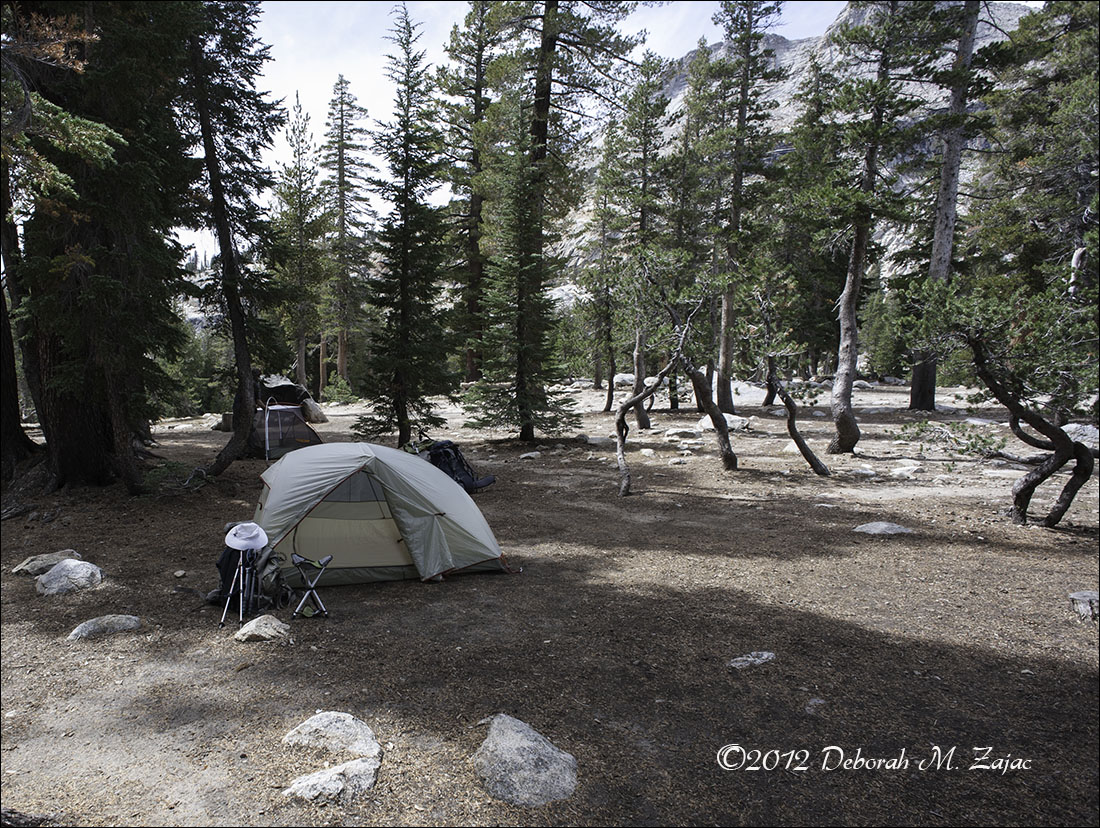
It turned out we were first of the group to arrive, and there weren’t many backpackers at the lake so we had lots of choice spots to choose from to set up our tents.

Home Sweet Home…for the night

It was a nice flat space and moderately sheltered from the wind. It was breezy and got windy during the night I heard from Michael in the morning, but I slept through it. Michael set up behind me.

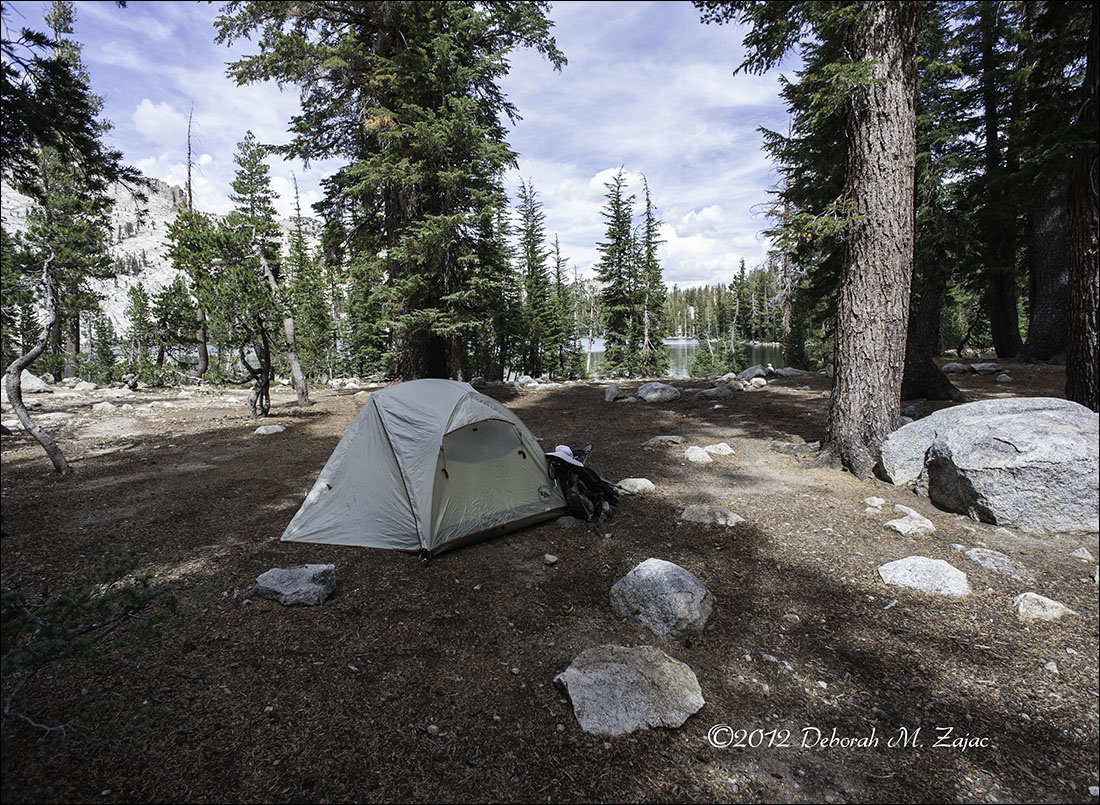
The view from my spot:

Once both Michael and I had our camps set up we did a little scouting; looking for possible sunrise and night sky locations. Here’s a look at Mount Hoffman and Hoffman Peak which rises above May Lake. The stats for May Lake are:

Elevation at trailhead:  8,710 feet (2,655 meters)
May Lake Elevation:  9,270 feet (2,825 meters)
Mt. Hoffmann Elevation:  10,845 feet (3,305 meters)

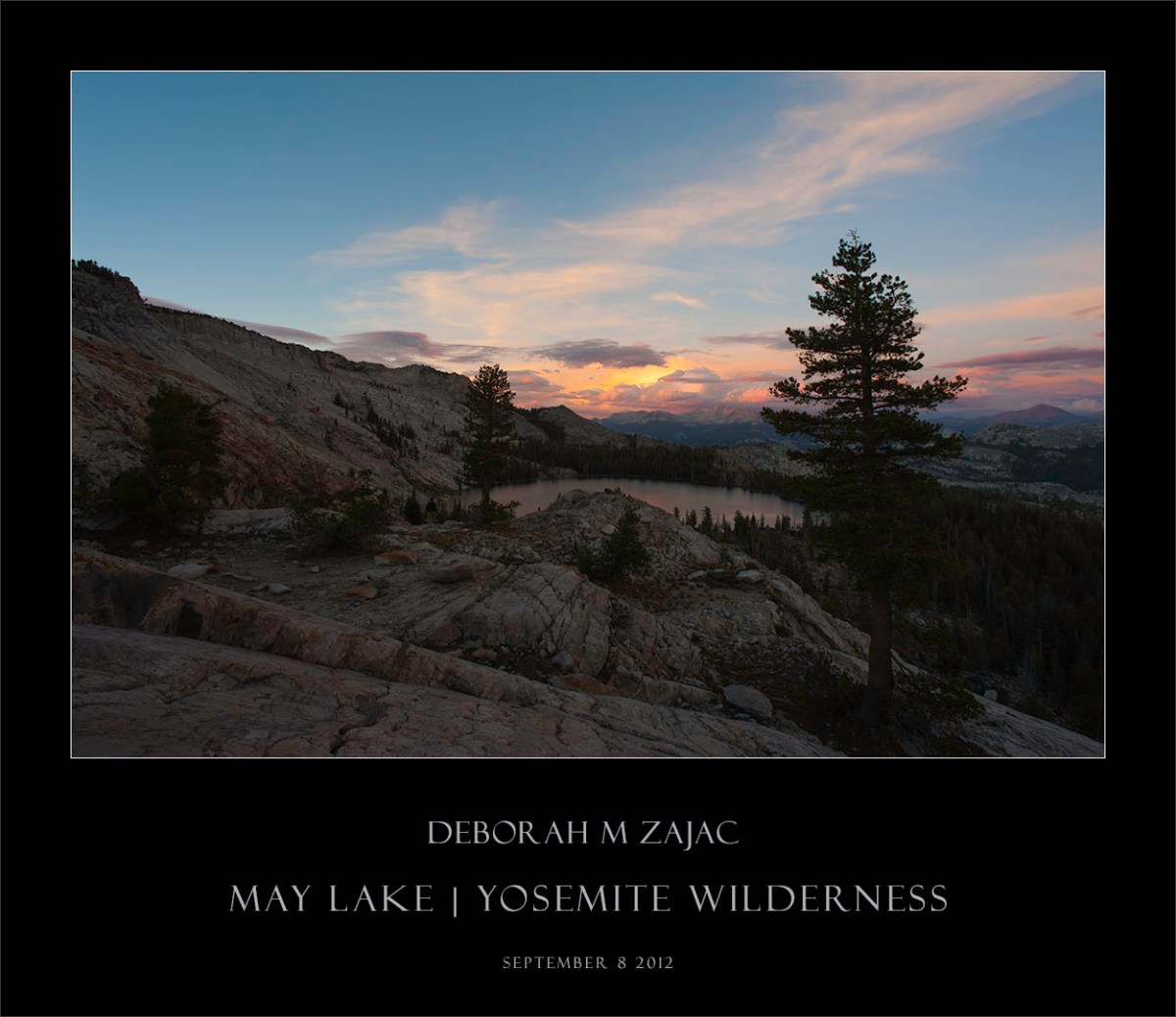
After the rest of the group arrived and set up their camps we headed up the May Lake trail to the granite plateaus to find a nice viewing location to shoot the sunset. Sunset was absolutely stunning (first photograph). The colors in the sky were so vivid,  and beautiful, it made the hike up with its steep and gnarly trail to that plateau, and beyond for further night photography, and the treacherous return trek down in the dark of night with head-lamps, and torches of course well worth it.

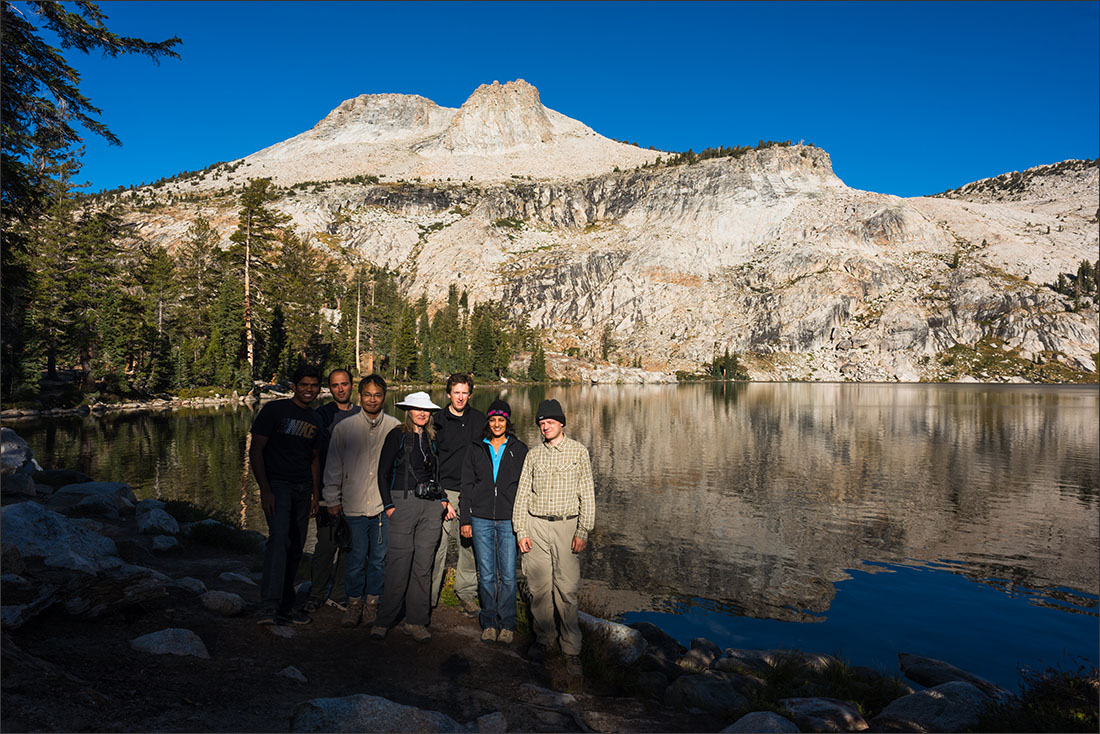
I have to give a huge “SHOUT OUT!” to Enrico who set up, and coordinated this Meet-up. Without him and the group I wouldn’t have gone, as I’m not brave enough to do this alone. Thank you Enrico for setting up another terrific backpacking adventure!  Here’s a photo of the group courtesy of Enrico.

  Left to Right- Tulasi, Milad, Wayne, Me, Michael, Sarita, and Enrico.

3,186 seconds under Heaven

3186 seconds under Heaven, originally uploaded by dmzajac2004-.

Via Flickr:
Copyright © 2012 Deborah M. Zajac. All Rights Reserved.

That little bit of mist on the lake was cool. It would come and go all the while my companions and I shot here. While shooting on the other side of the lake an hour before we heard a pack of coyotes howling and yipping in the distance. While shooting these star trails something caught my eye moving just to the left on the shore. I thought it was a coyote and in the dark you know how your eyes play tricks on you right…well thankfully it was a only a lone Doe walking by.
I wondered why she was alone and not already fast asleep safely in her den at that hour.
Her belly looked a little large so my thought was she was pregnant. I couldn’t get a shot of her it was too dark… and I admit it I darted behind Enrico when I first caught sight of her in the dark. 🙂 Yes, my instinct is flight not fight.

Nikon D700| Nikkor 24mm @ 3.2| 54 frames at 59 s 1 frame 33s| ISO 320| Manual Priority| Tripod

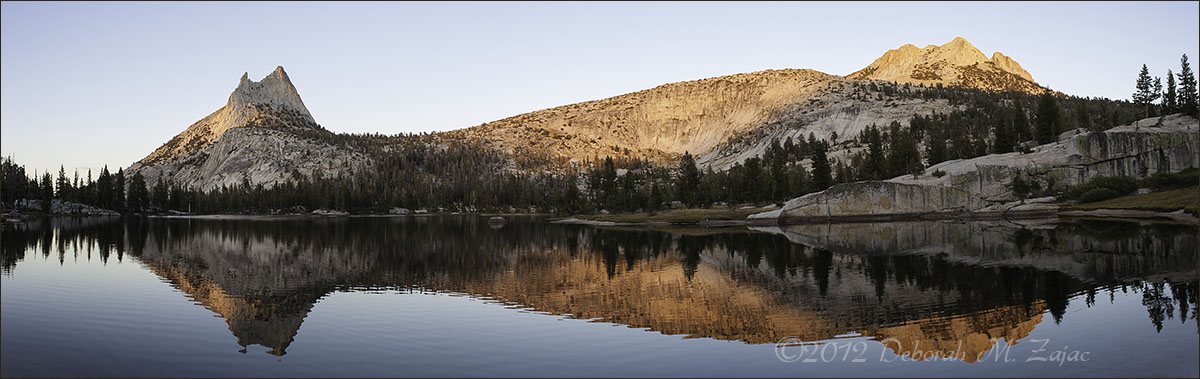
Alpine Glow on Cathedral Peaks and Echo Peaks

Copyright © 2012 Deborah M. Zajac. All Rights Reserved.


Myself and 7 other members of a Meet-up group I’m in backpacked to Upper Cathedral Lake in Yosemite Wilderness. for an overnight photography adventure.  It’s a 3.5 mile hike starting at 8500 ft, and topping out at 9500ft. I took my Garmin for the stats, but haven’t uploaded it yet.
My legs are dead tired after hauling my body plus 20+ pound pack up there, but it was so worth it!
It’s gorgeous up here. We lucked out it was too cool for mosquitoes. I didn’t get eaten alive at all. There were only a few other campers up here making it really enjoyable considering it was a major holiday week-end in the United States, and the valley was packed with people.


After picking a site to set up our base camp we set up our tents then grabbed our camera equipment  and trekked over to the south side of the lake to shoot the sunset. We didn’t get any color in the sky as it stayed flat all afternoon and evening, but the Alpine Glow on the mountain peaks was lovely.

Nikon D700| Nikkor 24mm @f9| 1/20s| ISO 200| Manual Priority| Tripod| 5 frame panorama

Crater Lake in early May


Crater Lake in early May, originally uploaded by dmzajac2004-.

Via Flickr:
Copyright © 2012 Deborah M. Zajac. All Rights Reserved.

While in OR this past May we were only an 1.5 hours drive from Crater Lake so we spent our last afternoon and evening here. The weather and scenery didn’t disappoint.

Nikon D700| Nikkor 24mm @f16| 1/125second| ISO 200| Manual Priority| Tripod| 4 frame Pano stitched in CS6

For the historians:
The lake was formed after the collapse of an ancient volcano, posthumously named Mount Mazama. This volcano violently erupted approximately 7,700 years ago. That eruption was 42 times as powerful as the 1980 eruption of Mt. St. Helens. The basin or caldera was formed after the top 5,000 feet of the volcano collapsed. Subsequent lava flows sealed the bottom, allowing the caldera to fill with approximately 4.6 trillion gallons of water from rainfall and snow melt, to create the seventh deepest lake in the world at 1,932 feet.

Rolling mountains, volcanic peaks, and evergreen forests surround this enormous, high Cascade Range lake, recognized worldwide as a scenic wonder. On summer days, neither words or photographs can capture Crater Lake’s remarkable blueness. For much of the year, usually October to July at higher elevations, a thick blanket of snow encircles the lake. Snowfall provides most of the park’s annual 66 inches of precipitation.

Crater Lake rarely freezes over completely; it last did in 1949. Heat from the summer sun stored in the immense body of water retards ice formation throughout the winter. On the earth clock, natural forces only recently constructed this landscape. Lava flows first formed a high plateau base on which explosive eruptions then built the Cascade volcanoes. Humans probably witnessed the cataclysmic eruption of Mount Mazama about 7,700 years ago.
~Crater Lake National Park Service