Whatever Weds. American Kestrel

Copyright ©2023 Deborah M. Zajac. ALL RIGHTS RESERVED. 

PLEASE DO NOT USE MY IMAGES WITHOUT EXPRESSED WRITTEN PERMISSION.

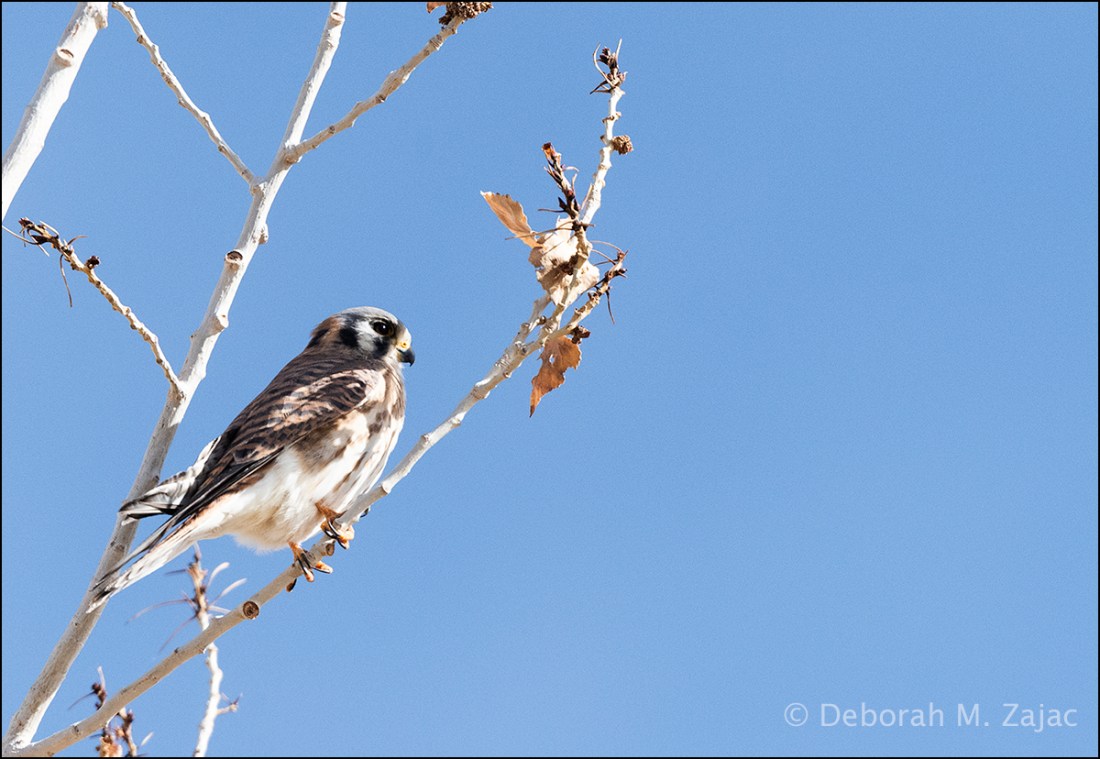
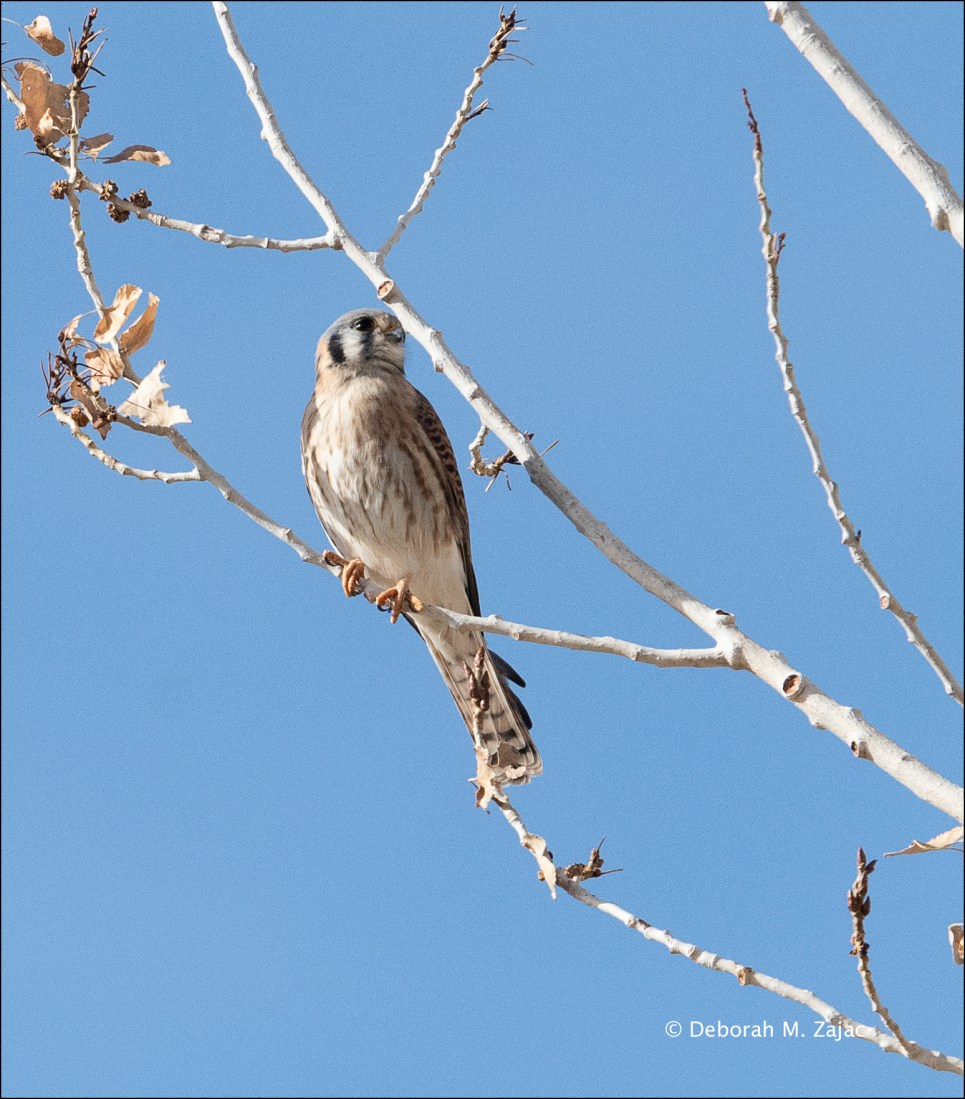
This is a Kestrel I saw in December. I’ll show her from the two sides I got to observe her from. It’s a treat to actually get two side views of a bird.

When I first spotted her high in a Cottonwood tree-

Female American Kestrel

They’re one of the smallest birds of prey, but so cute.

Here she is from the other side, with her chest showing.

American Kestrel Female

Fun Facts:

    • Sports fans in some cities get an extra show during night games: kestrels perching on light standards or foul poles, tracking moths and other insects in the powerful stadium light beams and catching these snacks on the wing. Some of their hunting flights have even made it onto TV sports coverage.
    • When nature calls, nestling kestrels back up, raise their tails, and squirt feces onto the walls of the nest cavity. The feces dry on the cavity walls and stay off the nestlings. The nest gets to be a smelly place, with feces on the walls and uneaten parts of small animals on the floor.
    • It can be tough being one of the smallest birds of prey. Despite their fierce lifestyle, American Kestrels end up as prey for larger birds such as Northern Goshawks, Red-tailed Hawks, Barn Owls, American Crows, and Sharp-shinned and Cooper’s Hawks, as well as rat snakes, corn snakes, and even fire ants.
    • In winter in many southern parts of the range, female and male American Kestrels use different habitats. Females use the typical open habitat, and males use areas with more trees. This situation appears to be the result of the females migrating south first and establishing winter territories, leaving males to the more wooded areas.
    • Unlike humans, birds can see ultraviolet light. This enables kestrels to make out the trails of urine that voles, a common prey mammal, leave as they run along the ground. Like neon diner signs, these bright paths may highlight the way to a meal—as has been observed in the Eurasian Kestrel, a close relative.
    • Kestrels hide surplus kills in grass clumps, tree roots, bushes, fence posts, tree limbs, and cavities, to save the food for lean times or to hide it from thieves.
    • The oldest American Kestrel was a male and at least 14 years, 8 months old when he was found in Utah in 2001. He was banded in the same state in 1987.

“Like neon diner signs”! 😂 I loved that description.

Fun facts gleaned from allaboutbirds.org

Happy New Year to all my blogging friends, and visitors!

Nikon D810| Nikkor 500mm| PS CC 25.3.1

more to come…

What Ever Weds. Silver Fox

Copyright ©2023 Deborah M. Zajac. ALL RIGHTS RESERVED. 

PLEASE DO NOT USE MY IMAGES WITHOUT EXPRESSED WRITTEN PERMISSION.

I don’t have much in new content so, I’m reaching into my archives. This image was from a trip to a safari zoo here in Nevada during a time #1 Grandson was here on a visit.

Silver Fox at rest

I love its eyes! Not looking at me but, very aware of my camera and presence. Very keen and crafty for sure!!

I hope your week is going well. We’re halfway through it!

Fuji X-T3| Fujinon 100-400mm| PS CC

more to come…

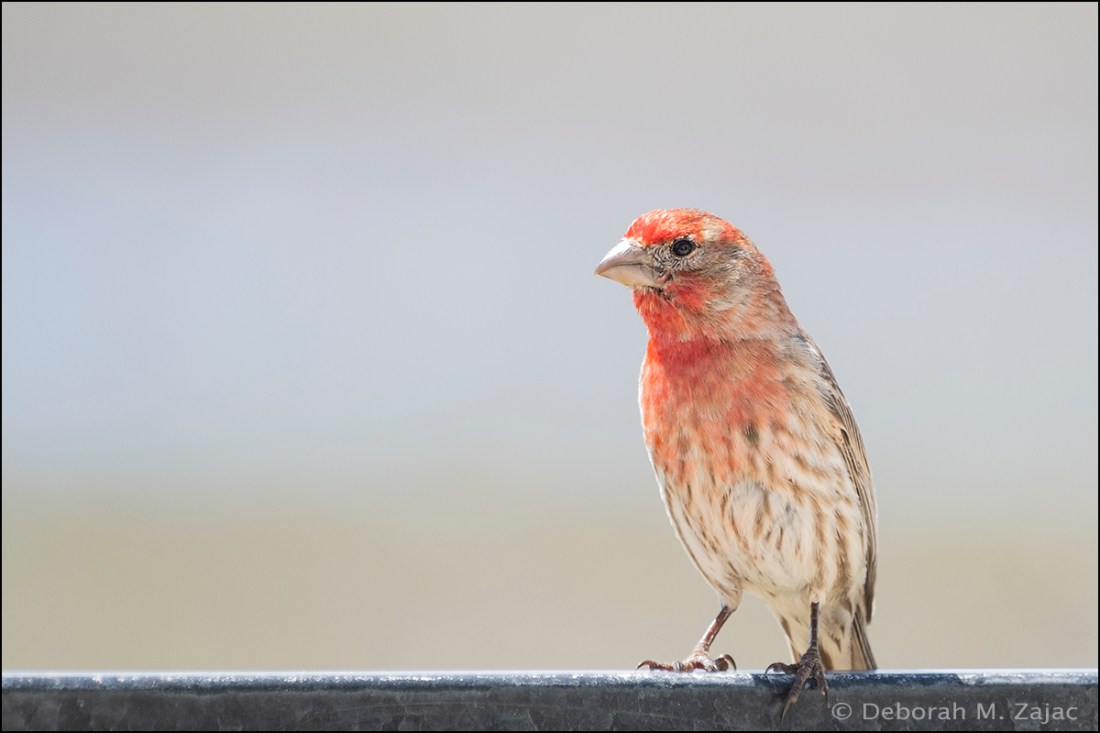
Whatever Weds. House Finch

Copyright ©2023 Deborah M. Zajac. ALL RIGHTS RESERVED. 

PLEASE DO NOT USE MY IMAGES WITHOUT EXPRESSED WRITTEN PERMISSION.

I’ve been MIA again and I’ll probably be on and off again for awhile. A family member is having some medical issues we’re working through.

Copyright ©2023 Deborah M. Zajac. ALL RIGHTS RESERVED. 

PLEASE DO NOT USE MY IMAGES WITHOUT EXPRESSED WRITTEN PERMISSION.

House Finch Male

I’ll catch up with you all soon. Stay well!

Fuji X-T3| Fujinon 100-400mm| PS CC 24.6

more to come…

Whatever Weds. Venus and the Beehive Cluster

Copyright ©2023 Deborah M. Zajac. ALL RIGHTS RESERVED. 

PLEASE DO NOT USE MY IMAGES WITHOUT EXPRESSED WRITTEN PERMISSION.

Venus shines bright in the eastern morning sky. The star cluster near the top of the image is the Beehive Cluster. This cluster is in the constellation of Cancer and contains 1000 stars. You can find more information about this cluster and how to see it here.

Venus and the Beehive Cluster over the Pinenut Mountains

Nikon D810| Nikkor 80-200mm @80mm| PS CC 24.6.0|

more to come…

Whatever Weds. Black-chinned Hummingbird

Copyright ©2023 Deborah M. Zajac. ALL RIGHTS RESERVED. 

PLEASE DO NOT USE MY IMAGES WITHOUT EXPRESSED WRITTEN PERMISSION.

We’ve had two female, and one male Black-chinned Hummingbird regularly visiting my feeder. I like to think the females are mother and daughter, and the male is the father. However, all is not peaceful around the feeder oh no, they’re fighting for territorial rights! The two females have no problem drinking together, but the male has sharing issues.

When I first put the feeder up it was only the male coming by, but then a female found it, and now a second female started coming by about 2 weeks ago. I think I’ll need a second feeder soon. I’m refilling the feeder every 4-5 days.

Here’s a still one of the females on approach. She’s so tiny!

Female Black-chinned Hummingbird

I love seeing them coming by on and off all day.

We have had #1 Grandson for an extra week which has been wonderful, but, it’s about to come to an end… really he’s going home this week-end. School starts up soon for him.

I hope your week is going well, and your week-end is wonderful.

Nikon D810| Nikkor 500mm PF-e| PS CC 24.6.0

more to come…

Whatever Weds. This and That June 2023

Copyright ©2023 Deborah M. Zajac. ALL RIGHTS RESERVED. 

PLEASE DO NOT USE MY IMAGES WITHOUT EXPRESSED WRITTEN PERMISSION.

Peek-a- Boo!

Here are several images of things that have caught my eye since my last post. Oh, and I bought a new lens so, I’ve been using it exclusively to make sure it’s a good copy. The last time I took my 300mm lens out it was hunting an awful lot…like it was doing many years ago when the Auto-Focus motor was going out which did quit working soon after. I had it repaired/replaced then, but the lens is so old now it’s not worth repairing so it has become a bookend and, I upgraded to a newer, longer lens.

Cliff Swallow
European Starling
Bee Wasp
Western Fence Lizard aka Blue Belly Lizard
Black-chinned Hummingbird-First sighting of the year!

So, what do you think…the lens looks like a keeper? I love that it doesn’t weight a ton. It’s a little lighter than the 300mm it’s replaced!

#1 Grandson is here. He’s been here just over a week. We’ve been to the lake several times do some kayaking. We’re not sure how much longer he’s staying. He says another week. We’ll see. I think he’ll be missing his mom and littlest too much before then, but he can stay as long as he likes. 😍

I hope your week is going well, and your slide into the week-end is smooth and easy.

Nikon D810| Nikkor 500mm Pf-E| PS CC 24.5.0

more to come…

Whatever Weds. June Moons

Copyright ©2023 Deborah M. Zajac. ALL RIGHTS RESERVED. 

PLEASE DO NOT USE MY IMAGES WITHOUT EXPRESSED WRITTEN PERMISSION.

We’ve been having thunderstorms with lightening almost every day lately so I wasn’t sure I’d be able to see or photograph this month’s full Moon. The day before the full Moon we had storm clouds rolling in all afternoon, but then it cleared up about an hour before Moonrise so, I thought I’d photograph it in case the following night was too overcast to photograph it.

While waiting for the moon to rise enough to get past the mountains I saw a couple of people in Motorized-gliders flying around the mountain where the moon would rise. I hoped they were going to stay long enough for the moon to rise, and fingers crossed one or both would do a moon fly-by. One did!!

Waxing Gibbous 98.5%

It looks like a big bug doesn’t it? The sun was still up so the moon is really faded/washed out.

The following night there were enough breaks in the clouds that I was able to photograph the Full Moon. This is a two frame composite image.

One frame exposed for the sky and foreground and the other exposed for the Moon. I blended the frames in Photoshop.

Strawberry Moon

June’s full moon gets one of its names from the wild strawberries that begin to ripen during the early summer and be gathered by Native American tribes.

Other names for June’s Full Moon are:

Rose Moon, Hot Moon, and Mead Moon.

Yesterday the wind really picked up tossing two patio chairs across the patio, one cushion was blow across the entire patio, and a planter tipped over. The Zephyr wind wins again!😂 We also had some thunder and a little lightening, but both were several miles away.

Saturday #1 Grandson is coming to visit for a week or two for summer. We have plans to hit the grocery store and library straight-away. We hope the weather improves so we can go to the lake and take him paddling.

That’s all from here. I hope you’re having a good week!

Nikon D810| Nikkor 300mmf/4| PS CC 24.5.0