Friday’s Feathered Friends-Virginia Rail

Copyright ©2025 Deborah M. Zajac. ALL RIGHTS RESERVED.

PLEASE DO NOT USE MY IMAGES WITHOUT EXPRESSED WRITTEN PERMISSION.

This is a bird I don’t think I’ve shared often as they’re very elusive and shy.

Last month while birding up in Washoe County we were thrilled to see this one come out of the reeds to forage in the shallow end of the lake. This one is a juvenile which is why it was foraging in the open for sometime. There was another one behind in the reeds tut-tutting…probably an adult.

©Deborah M. Zajac | http//:circadianreflections.com
Virginia Rail

Fun Facts:

A secretive bird of freshwater marshes, the Virginia Rail often remains hidden in dense vegetation, but its loud grunting may give away its presence. As it slowly pokes its way through the marsh, you might get a glimpse of its reddish bill, black-and-white barred sides, and its twitching tail, showing off white tail feathers beneath. It possesses many adaptations for moving through its nearly impenetrable habitat, including a laterally compressed body, long toes, and flexible vertebrae.

  • The forehead feathers of Virginia Rails are adapted to withstand wear and tear that results from pushing through dense and often sharp marsh vegetation.
  • The Virginia Rail is more adept at walking on soft mud than swimming, but it occasionally swims across wetlands and even dives underwater, propelling itself with its wings.
  • As a group, rails have the highest ratio of leg muscles to flight muscles of any bird, which may explain their propensity to walk rather than fly.
  • The Virginia Rail builds numerous “dummy nests” in addition to the one where eggs are actually laid.

Fun Facts gleaned from https://www.allaboutbirds.org/guide/Virginia_Rail/overview

I’m birding this morning so will be late to your blogs and comments. I hope you all have a Happy Halloween, and great week-end.

more to come…
Friday’s Feathered Friends- Cedar Waxing

Copyright ©2024 Deborah M. Zajac. ALL RIGHTS RESERVED. 

PLEASE DO NOT USE MY IMAGES WITHOUT EXPRESSED WRITTEN PERMISSION.

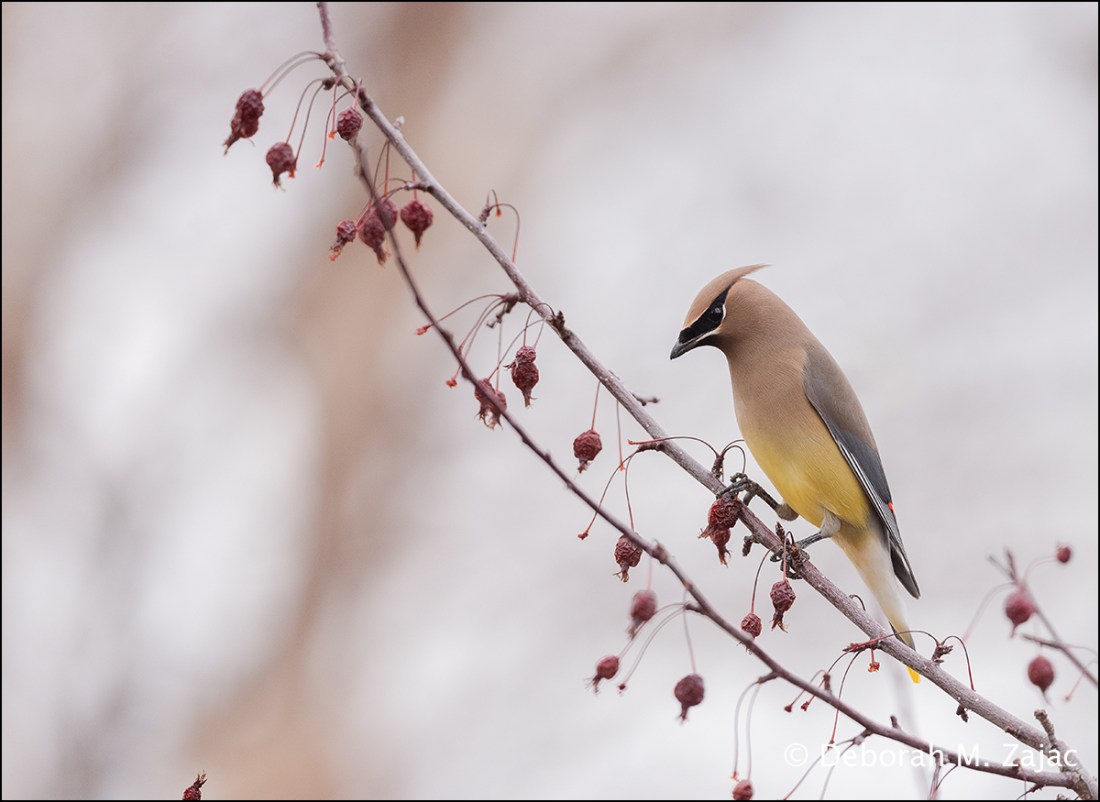
Last week while birding I saw so many Cedar Waxwings at 2 places I visited. There were about 120 in all! At one of the places they were gorging on ripe, plump red berries.

I was doing my happy dance to see that!

“I think this one looks yummy”
Gulp!

It was a great birdy day.

Fun Facts:

  • The name “waxwing” comes from the waxy red secretions found on the tips of the secondaries of some birds. The exact function of these tips is not known, but they may help attract mates.
  • Cedar Waxwings with orange instead of yellow tail tips began appearing in the northeastern U.S. and southeastern Canada in the 1960s. The orange color is the result of a red pigment picked up from the berries of an introduced species of honeysuckle. If a waxwing eats enough of the berries while it is growing a tail feather, the tip of the feather will be orange.
  • The Cedar Waxwing is one of the few North American birds that specializes in eating fruit. It can survive on fruit alone for several months. Brown-headed Cowbirds that are raised in Cedar Waxwing nests typically don’t survive, in part because the cowbird chicks can’t develop on such a high-fruit diet.
  • Many birds that eat a lot of fruit separate out the seeds and regurgitate them, but the Cedar Waxwing lets them pass right through. Scientists have used this trait to estimate how fast waxwings can digest fruits.
  • Because they eat so much fruit, Cedar Waxwings occasionally become intoxicated or even die when they run across overripe berries that have started to ferment and produce alcohol.
  • Building a nest takes a female Cedar Waxwing 5 to 6 days and may require more than 2,500 individual trips to the nest. They occasionally save time by taking nest materials from other birds’ nests, including nests of Eastern Kingbirds, Yellow-throated Vireos, orioles, robins, and Yellow Warblers.
  • The oldest recorded Cedar Waxwing was a male and at least 7 years, 1 month old when he was recaptured and rereleased during banding operations in Maryland in 2014. He was originally banded in the same state in 2008.

Fun facts gleaned from https://www.allaboutbirds.org/guide/Cedar_Waxwing

It’s snowing as I type this but, supposed to be sunny but cold on Saturday. I hope to go out birding for a bit if that forecast holds. I hope you all have a grand week-end!

more to come…

Something for Sat. Ruby Crowned-Kinglet

Copyright ©2024 Deborah M. Zajac. ALL RIGHTS RESERVED. 

PLEASE DO NOT USE MY IMAGES WITHOUT EXPRESSED WRITTEN PERMISSION.

I don’t want the week to go by without a post so here we have me posting on a rare Saturday.

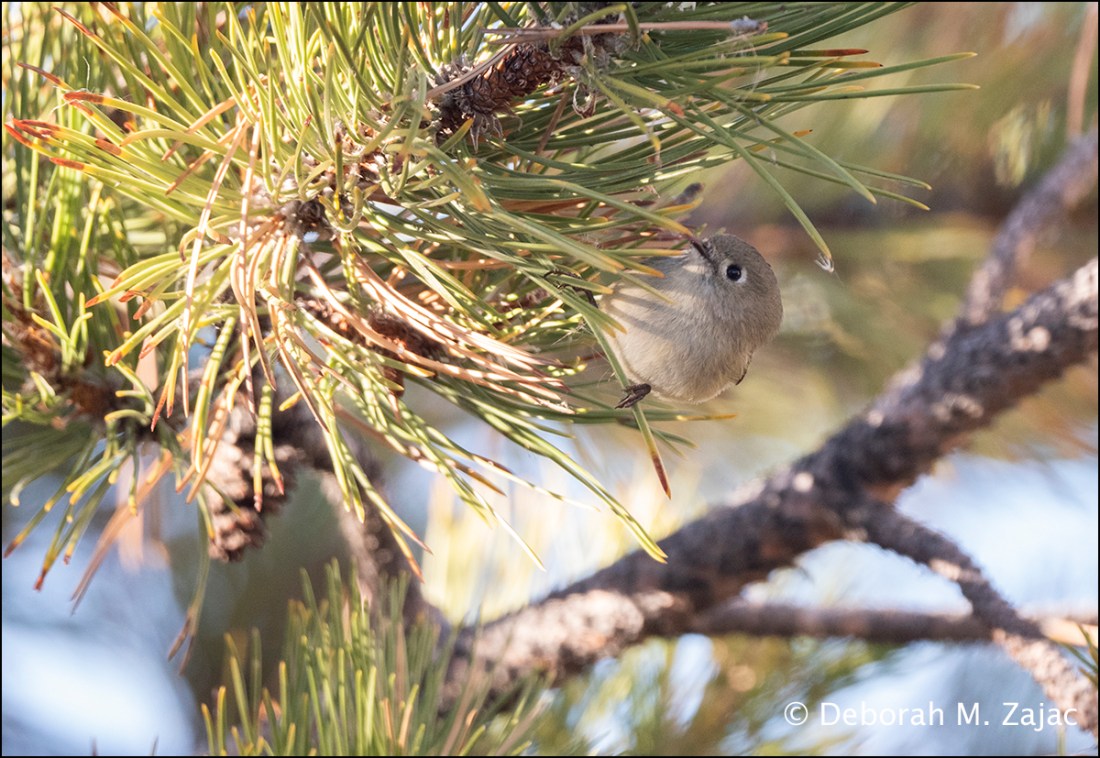
This little Kinglet is so cute, but very flitty normally but, on this day earlier this month I was able to get quite a few good looks at this one.

They’re a small bird being only 3.5-4.3 inches in length, and weigh 0.2-0.3 ounces.

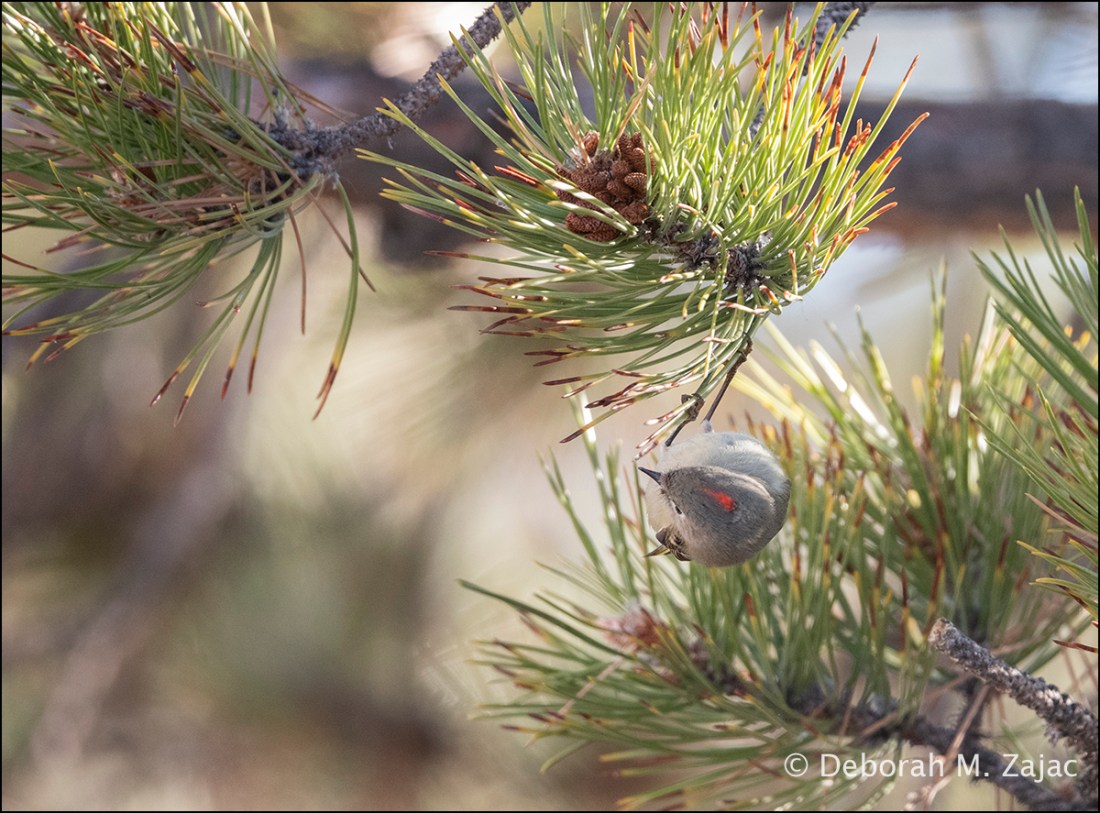
They get their name from a Ruby spot on their crown.

I have yet to see it flared, but here’s a look at the top of its head showing the Ruby spot.

This one is busy being an acrobat which afforded me a good look at its Ruby Spot which was a treat. Just look at how light they are it’s holding onto those pine needles and they aren’t bending!

Fun Facts:

  • The Ruby-crowned Kinglet is a tiny bird that lays a very large clutch of eggs—there can be up to 12 in a single nest. Although the eggs themselves weigh only about a fiftieth of an ounce, an entire clutch can weigh as much as the female herself.
  • Ruby-crowned Kinglets seem nervous as they flit through the foliage, flicking their wings nearly constantly. Keeping an eye out for this habit can be a useful aid to identifying kinglets.
  • Metabolic studies on Ruby-crowned Kinglets suggest that these tiny birds use only about 10 calories (technically, kilocalories) per day.
  • The oldest known Ruby-crowned Kinglet was a female, and at least 8 years, 8 months old, when she was recaptured and rereleased during banding operations in Texas in 2017. She was banded in the same state in 2008.

Fun facts gleaned from allaboutbirds.orghttps://www.allaboutbirds.org/guide/Ruby-crowned_Kinglet/overview

I hope you all have a great week-end!

Nikon D810| Nikkor 500mm PF-e| PS CC 25.3.1

more to come…

Whatever Weds. Yellowlegs

Copyright ©2023 Deborah M. Zajac. ALL RIGHTS RESERVED. 

PLEASE DO NOT USE MY IMAGES WITHOUT EXPRESSED WRITTEN PERMISSION.

I saw this one foraging in a shallow pond earlier in the month. I think it’s a Lesser Yellowlegs, but if I’m wrong let me know! It’s so hard to tell it apart from the Greater Yellowlegs. I’m going on the bill not being too much longer than its head.

I don’t see this type of bird too often so it’s pretty neat when I do. It’s either passing through or hanging out for winter migration.

Yellowlegs

Fun Facts:

    • Despite their very similar appearance, Greater and Lesser Yellowlegs are not each other’s closest relatives. Lesser Yellowlegs is more closely related to the much larger Willet.
    • Lesser Yellowlegs are known for their steadfast defense of their eggs and chicks. Biologist William Rowan once noted, “they will be perched there as though the safety of the entire universe depended on the amount of noise they made.”
    • Both the male and female Lesser Yellowlegs provide parental care to the young, but the female tends to leave the breeding area before the chicks can fly, thus leaving the male to defend the young until fledging.
    • The Lesser Yellowlegs saw significant declines due to market hunting for the fashion trade. The species’ tendency to return and hover above wounded flock mates made them easy targets. Populations rebounded when market hunting was banned in the U.S and Canada in the early 20th century.
    • The oldest recorded Lesser Yellowlegs was at least 4 years, 11 months old when it was found in South Dakota in 1965. It had been banded in the Lesser Antilles in 1960.

more to come…

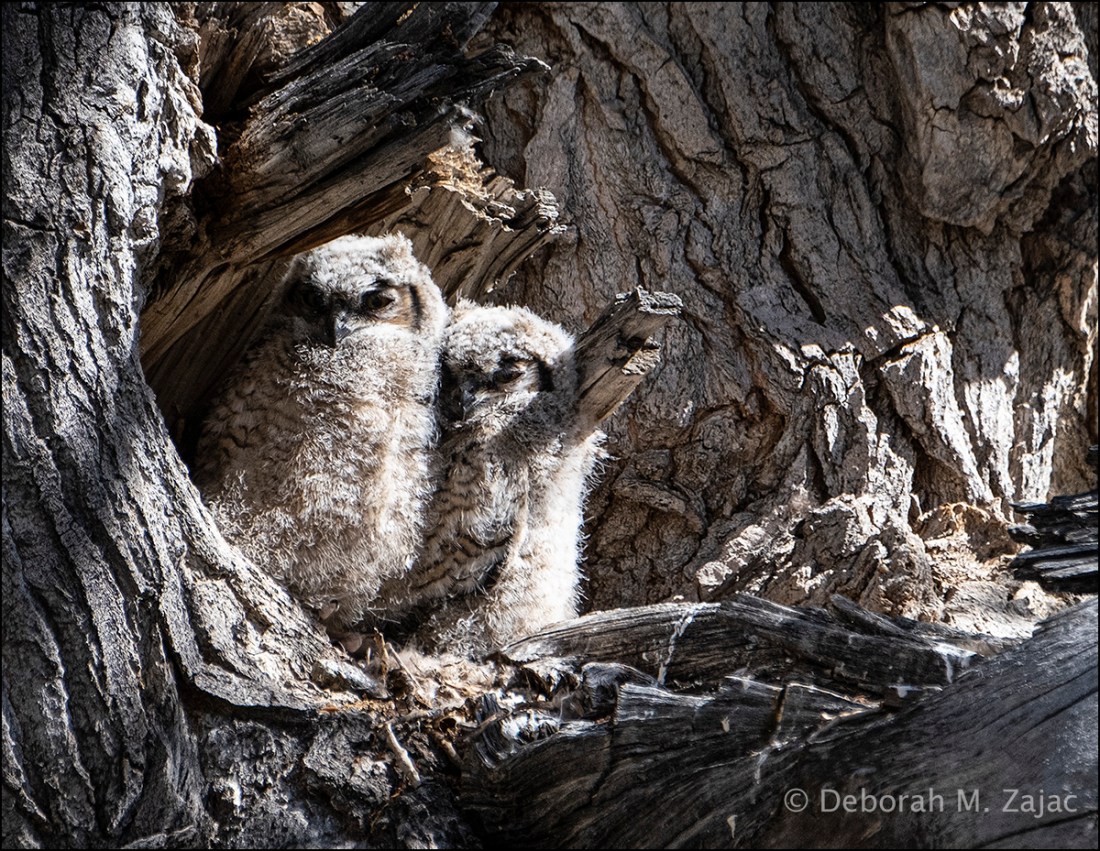
Wordless Weds. Great Horned Owlets!

Copyright ©2023 Deborah M. Zajac. ALL RIGHTS RESERVED. 

PLEASE DO NOT USE MY IMAGES WITHOUT EXPRESSED WRITTEN PERMISSION.

Great Horned Owlets

Fuji X-T3|Fujinon 100-400mm@400mm| PS CC 24.4.1

more to come…

Friday’s Feathered Friends-Pine Grosbeak

Copyright ©2021 Deborah M. Zajac. ALL RIGHTS RESERVED

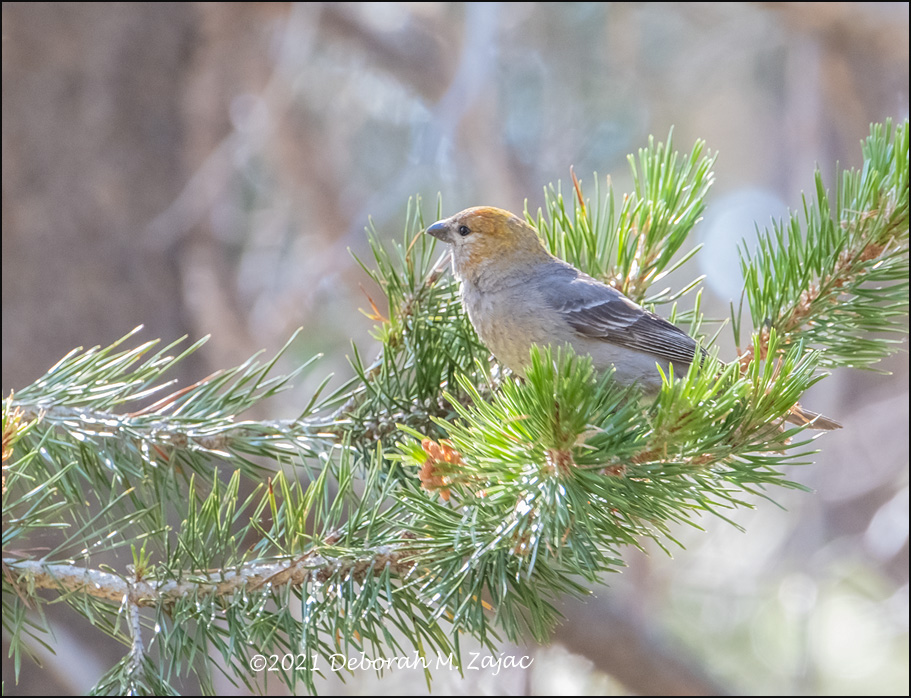
Last week I went birding with the Audubon Group and we were treated to a sighting that not only was a new to me bird, but a rare bird to this area too. Lifer number 6 for 2021 is the Pine Grosbeak. This is a female.

This was a “lifer” for about half the group and there were only 9 of us birding that morning. It was quite exciting!

Fun Facts-gleaned from allaboutbirds.org

  • Pine Grosbeaks eat a lot of plants, but it can be tough for their nestlings to eat and digest all that vegetation. Instead of feeding plants directly to their nestlings, they regurgitate a paste of insects and vegetable matter that they store in pouches at the lower part of their jaw on either side of their tongues.
  • Not all Pine Grosbeaks are the same. Not only do they differ in the amount and intensity of red across their range, they are also different sizes. Body size and wing and tail length generally increase from Newfoundland westward to the Yukon Territory. But birds on Haida Gwaii (Queen Charlotte Island) in British Columbia, Canada, and in California are among the smallest of all Pine Grosbeaks. Wings and tails of birds on Haida Gwaii are around a half inch smaller than birds in Alaska.
  • Pine Grosbeaks aren’t just in North America. They also breed in subalpine evergreen forests from eastern Asia to Scandinavia.
  • The tameness and slow-moving behavior of the Pine Grosbeak prompted locals in Newfoundland to affectionately call it a “mope.”
  • Winter flocks may stay near a tree with abundant fruit until all of it is consumed.
  • The oldest recorded Pine Grosbeak was a male, and at least 9 years, 9 months old when he was found in Quebec in 1970. He was first captured and banded in Connecticut in 1961.

I hope you all have a wonderful week-end!

Fuji X-T3| Fuji 100-400mm| PS CC 22.4.2

more to come…

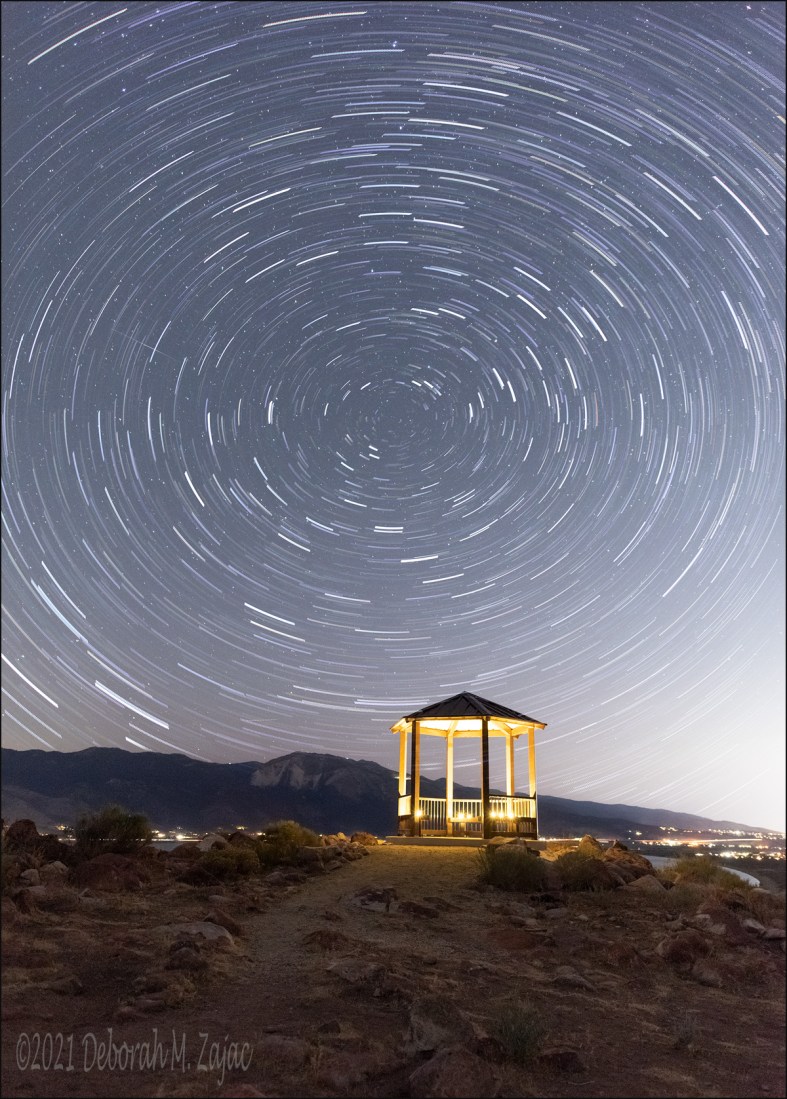
Wordless Weds. The Star Stop

Copyright © 2021 Deborah M. Zajac. ALL RIGHTS RESERVED

Composite image:

Sky- Nikon D300s| 17mm| f90 secs| f/5.6| ISO 400 52 frames stacked in Photoshop

Foreground-Nikon D810|15 secs.|20mm| f/2.2| ISO 2000

I lit up the gazebo with 14 little tea lights. All the elements were blended in Photoshop CC 22.4.2

more to come…