Achim Sack a fan of time lapse photography and tinkering has created and revised his Intervalometer. For those who like to hack and tinker this might be right up your street.
Features:
No power supply needed: The circuit “steals” in the operating current (only 10µA at 5V and 2.5µA at 3.3V) from the signal lines of the camera
Interval adjustable from 0.4 seconds to about 18 minutes
No controls, setting of the intervall via “teach-in” from the camera
Ultra-portable: the circuitry fits into the housing of a 2.5mm stereo plug
Update: Reader Stargazer 95050 emails,
The link to that cheap timelapse controller was fascinating. $2 for that !! It sounds too good to be true — tough technically he is right. !!
There is a catch of course : http://www.flickr.com/photos/sharpshutter/5918737334/
If you’re looking for software that will handle your new Nikon camera’s RAW files take a look at Nikon’s very own Capture NX2! It will read your RAW files perfectly.
Choose your region and download the free trial here.
Looking for a free option to convert your RAW files with limited editing options download Nikon’s ViewNX
Update: Reader Andy emails, ” Regarding Capture NX2 — I think it has several unique features worth mentioning.
The noise reduction is excellent.
Also the dust-off and spot healing are very helpful if you forgot to clean your sensor
Reading all camera parameters instead of just a few
Changes are stored in the original RAW file but can be reversed, and you can have several post-processing versions stored in the same file
The downside — no one else but Nikon can read thos PP changes made to the NEF file”
Independence Day in the United States is just around the corner. On July 4th families and friends will get together to celebrate this holiday. Plans are being made for pick-up games of baseball, volleyball, or swimming. There will be picnics, and barbeques will be fired up. Dads all over will be grilling hot dogs, and burgers, watermelons will be split, seed spitting contests will ensue, and the colors of the day will be Red, White, and Blue.
When the sun drops beyond the horizon the celebrating doesn’t stop. Countless cities and towns will put on a great show of fireworks, and many families and friends will be gathered in their favorite viewing spot to watch the show. Many of us will want to photograph these.
Steven Christenson an avid night, and astro-photographer who is a longtime resident of the San Francisco Bay Area shares with us one of his experiences about photographing fireworks, and gives us some tips on how we can capture these stars bursting in air .
Rain on Golden Palms
Photograph by Steven Christenson
Q. Tell us about this location.
Steven: Oyster Point Marina in San Francisco, CA. It was a local radio station KFOG event called Kaboom. An annual outdoor concert held in May. In addition to the concert there is a Fireworks show which is synchronized to a soundtrack broadcasted by the station.
The reasons for choosing this location were twofold: 1. Get far enough away to be able to fill the frame and ideally somewhere that we could be sure to have an unobstructed view (nobody could get in front of us without getting wet!), and 2. Get reflections in the water. HOWEVER, to get good reflections, you really need to be well above water level and it helps if the water is calm. We had roaring wind that day!
And it doesn’t hurt to make it a social occasion! I had set up a Photography Meet-up event around this KFOG event. Anne De Lemos, a photographer in our group would have become a Popsicle if people hadn’t brought extra blankets.
Q. What time of day?
Steven: Just after dark at 9:20 P.M.
Q. How difficult was this to capture?
Steven: Fireworks are always challenging, especially if you’re a first timer at taking them on. Fortunately, I had cut my teeth on several prior fireworks events, including the KFOG Kaboom event the prior year. Manual exposure is the only way to go, and I sometimes fiddle slightly with the settings after chimping a few shots (i.e. looking at the histograms).
Q. What camera and lens did you use for this shot?
Steven: A Canon EOS 40D with a 70-200mm f4L IS USM lens
Q. How did you expose for this shot?
Steven: 121mm, f11, 2.5 seconds, ISO 200, Manual Mode
I learned that two things are important:
1) A relatively small aperture – this increases the contrast since the fireworks are very bright,
2) A reasonably short exposure (1-6 seconds).
The not too long exposure allows enough time for the firework to bloom, but not so much time that later fireworks or overall glow weaken the contrast in the shot. I usually fire the shutter as soon as I see the burst. The lag time between when I see the burst and when I press the cable release button is just about perfect to get the firework bloom just as it has expanded enough to be noticeable, but is not completely formed. Another shooting strategy is to continuously expose 2-4 second shots. Sooner or later a few good ones result. On this night I used two cameras and both shooting tactics. This image was from my human actuated shutter, however.
Use a sturdy tripod, and a remote cable release or remote to trigger your shutter to avoid shake.
This looks better Large. Click the photo for a larger view.
Waiting for the Moon to get into a slightly better position I walked over to the Marina.
It was so quiet and peaceful. I didn’t hear any creaking boats, or bells softly ringing. The water was so still!
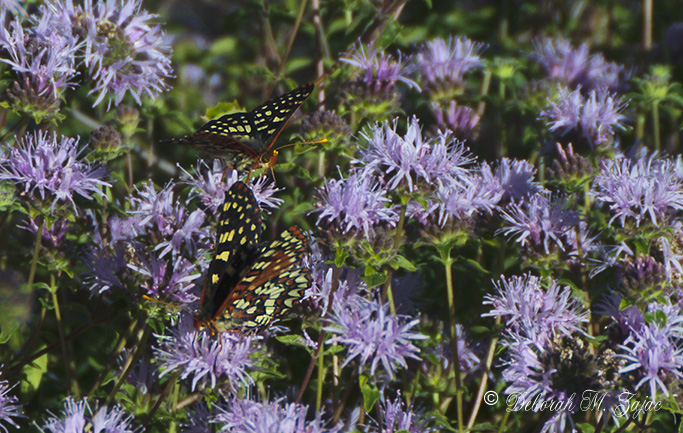
My morning hike up to Vista Point this morning was lovely. There were butterflies flitting around the wildflowers lining the trail, and about 2 miles from the top there was a plant with several butterflies warming their wings. I think the flowers are Globe Gilia, and the butterflies Variable Checkerspots.
Photo by Deborah M. Zajac
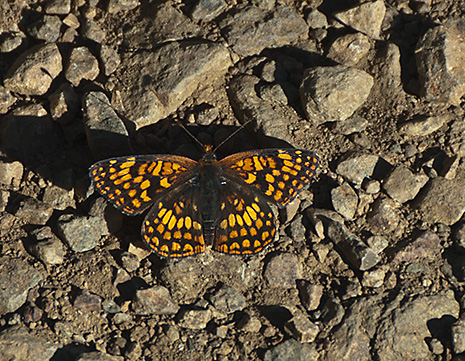
This one must have been cold. It didn’t move when I approached it. It was right in the middle of the trail.
Photo by Deborah M. Zajac
and further up the trail was this lizard warming itself in the morning sun.
Photo by Deborah M. Zajac
Summer temperatures have arrived in Silicon Valley. The last two days it’s been hot. This morning at 6:30am it was warm. The canopy felt wonderfully cool this morning.
The view from Vista Point was marred by fog and smog laying across the valley like a veil, but above it you can see the Diablo Mountain Range. Over there on the right are Mt. Allison, and Mission Peak rising above the haze, and in the valley below are the large hangers of Moffet Field Naval Station.
Photo by Deborah M. Zajac
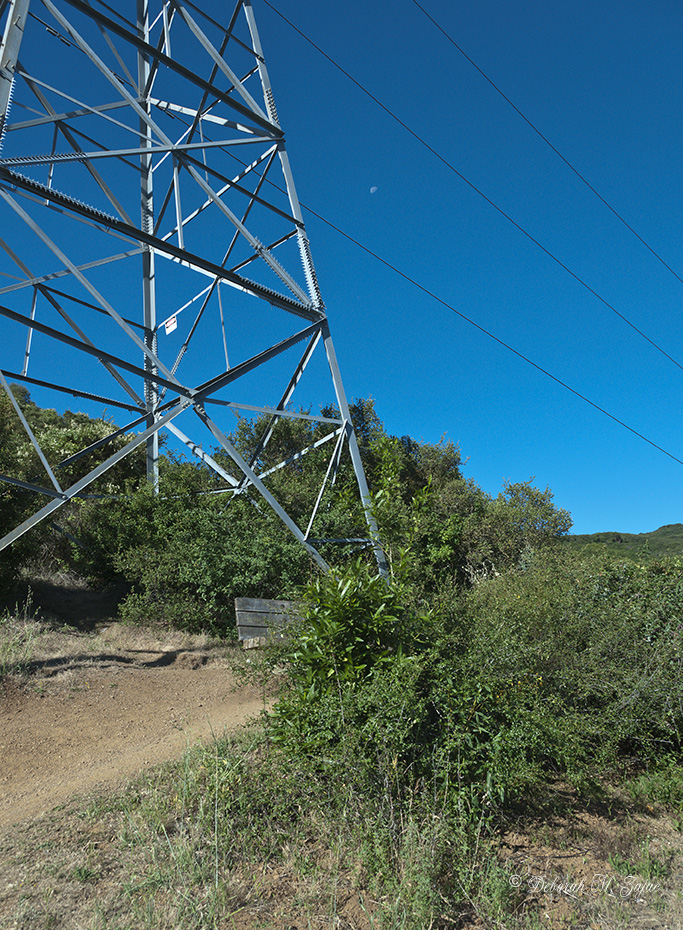
I walked over to the bench today, and looked back. I loved the blue sky and Moon looking down on me.
Time is running out to upgrade your D3 buffer if you haven’t done it already. Nikon announced it will stop the service in July 2011. Read the whole thing here.




 Circadianreflections Blog
You must be logged in to post a comment.