Friday’s Feathered Friends-Golden-crowned Sparrow

Copyright ©2024 Deborah M. Zajac. ALL RIGHTS RESERVED. 

PLEASE DO NOT USE MY IMAGES WITHOUT EXPRESSED WRITTEN PERMISSION.

I last shared this Sparrow in 2015. I don’t see many of them and I only see them during the Winter migration hanging out with the White-crowned Sparrows, but sadly, never at my feeder. Last week I saw this one.

Male Golden-crowned Sparrow

He was pretty skittish. Every time I tried getting closer he flew further away so these are pretty well cropped.
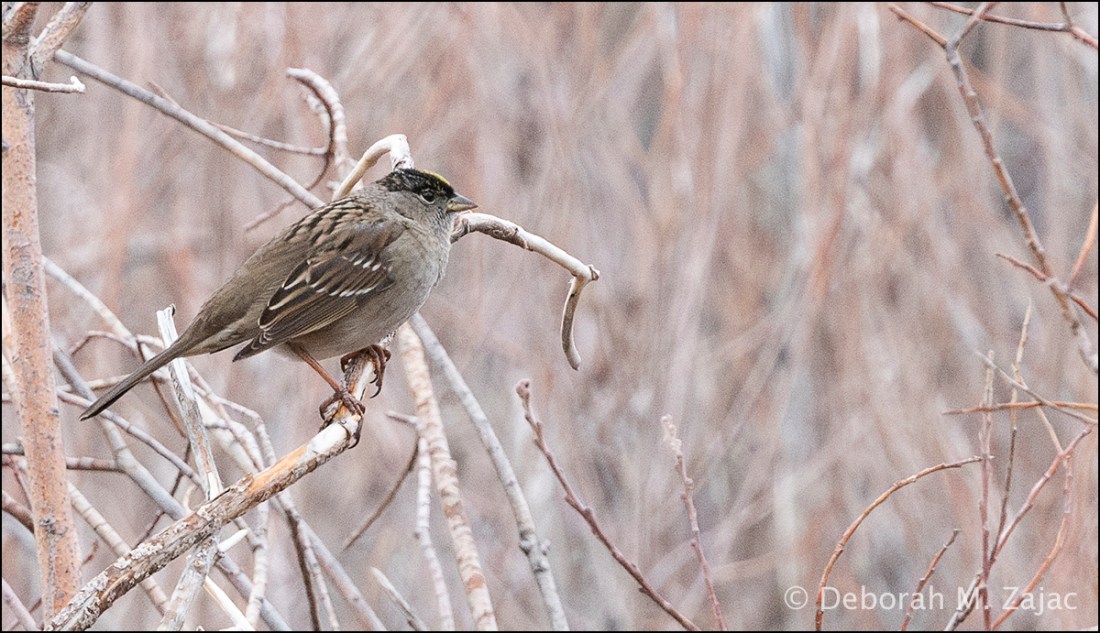
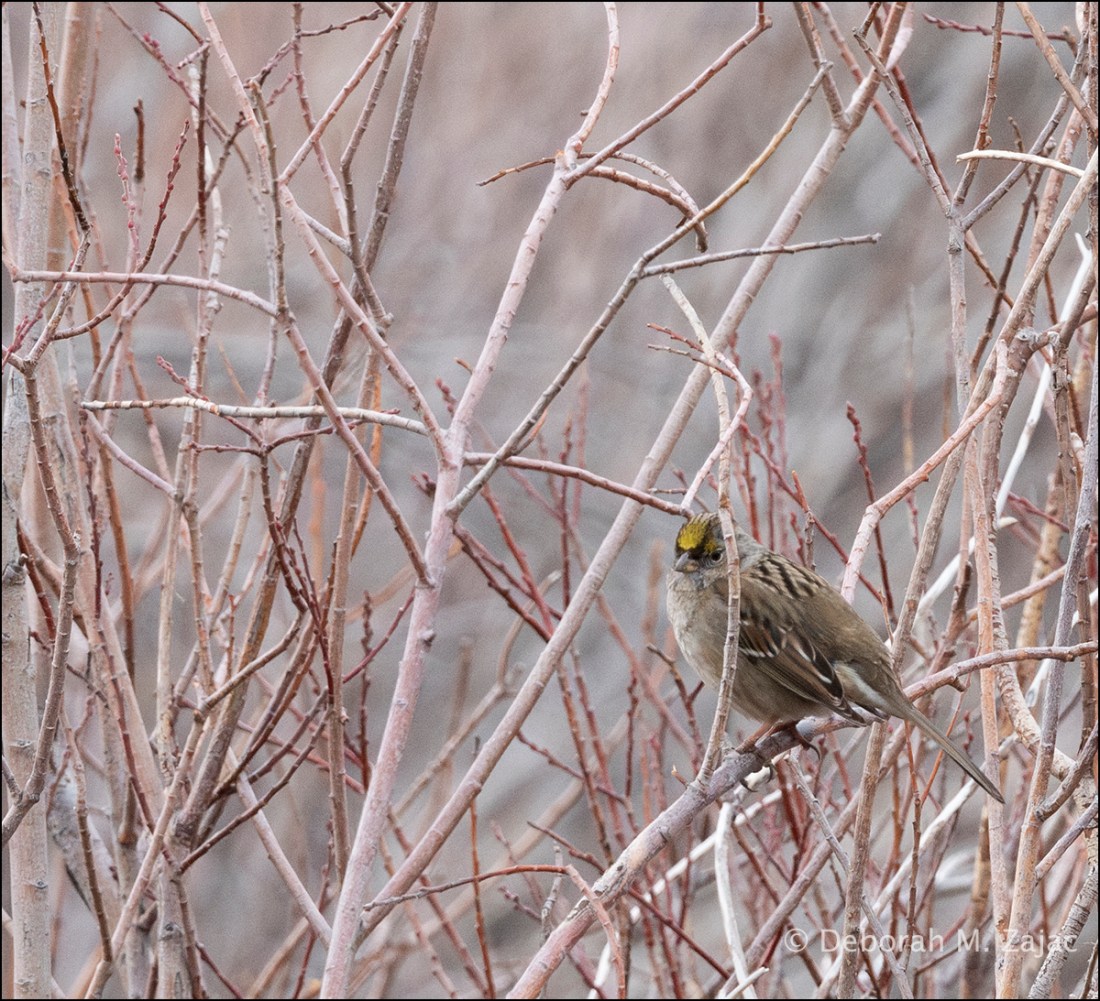
Fun Facts:

    • This sparrow is one of the least known of our songbirds, particularly on its northern breeding grounds. It has been the subject of only a few laboratory and field studies, so most of what we know about it comes from scattered notes in scientific journals.
    • Miners in the Yukon at the turn of the twentieth century woefully referred to the Golden-crowned Sparrow as the “no gold here” bird, because its song resembled that depressing phrase. They also interpreted its song to say “I’m so tired,” prompting them to dub the bird “Weary Willie.”
    • The Golden-crowned Sparrow arrives earlier and stays longer on its California wintering grounds than almost any other bird species.
    • When day length increases in the spring, the Golden-crowned Sparrow detects the change through photoreceptors (light-sensitive cells). Its body responds by putting on fat and getting an urge to migrate.
    • The oldest Golden-crowned Sparrow on record was at least 10 years, 6 months old. It was caught by a bird bander in California in 1970 and released.

Fun facts gleaned from allaboutbirds.org

I hope you all have a great week-end!

Nikon D810| Nikkor 500mm PF-e| PS CC 25.3.1

more to come…

2016 Perseids

Copyright ©2016 Deborah M. Zajac. ALL RIGHTS RESERVED

I went out Friday night/Saturday morning star gazing hoping to photograph a meteor or two of the Perseid meteor shower.  The Perseid Meteor shower is an annual event occurring from mid July to mid August as the Earth crosses the orbital path of Comet Swift-Tuttle; the parent of the Perseid meteor shower.  Debris from the comet litters its orbital path, but we don’t get into the dense part of it until the first week of August.  It’s this debris that slams into Earth’s upper atmosphere at 130,000 mile per hour lighting up the night sky with streaking Perseid meteors.

This year was to be particularly good for viewing more meteors because of our position in the debris path.

I saw a few really great meteors with wonderful balls of fire streaking through the sky, but the best image I made in 4 hours of sky watching was of this little meteor with some red at the head and a green tail.  It’s a first time I’ve photographed the green tail.

Perseid Meteor 2016


There’s some of the Milky Way in there too, but faint, but there were oh, so many stars!

It was a wonderful night for star gazing.

Nikon Df| Nikkor 20mm f/1.8G @ f/2.8| ISO 1600| 26s  single frame| Delkin Digital Film|PS CC 2015.5

Source-Earthsky.org

more to come…


Starry starry night

Starry-starry-night_0015-web, originally uploaded by dmzajac2004-.

Via Flickr:
Copyright © Deborah M. Zajac. All Rights Reserved.

It’s very compressed in this view. Please click on the photo to see it large. It really does look better!

The night before the WorldWide Photowalk I did a little night photography. The Milky Way shot I want still eludes me…one day I’ll get it!
The Moon was a bit too bright for this shot to come out the way I had envisioned it, but the color from the light pollution, the cloud formation, and the pine trees in silhouette made this shot for me.

This is a southwestern sky.

Nikon D700| Nikkor 17-35mm@ 17mm| f3.5| 35 seconds| ISO 1600| Manual Mode| Tripod w/intervelometer

Eastern Sierras, California