Wild Weds. 12/52 Duck, Duck, Goose!

Copyright ©2018 Deborah M. Zajac.  ALL RIGHTS RESERVED

A couple of weeks ago when I shared the Snow Leopard  images here 

I mentioned that my friend and I went birding before we visited Sacramento Zoo. We went to Sacramento, CA to find special ducks, and geese.  The Ducks were some of the most colorful ducks here in the States.  Wood Ducks, and a Mandarin Duck which I’ll save for another post, and a new Goose for me the African Goose.

There were a couple pairs of Woods Ducks, and quite a few African Geese making the day very successful.

Wood Ducks can be found here all year long, but we see them mostly in Spring.  They have sharp, strong claws that allow them to climb branches. They will nest in boxes if they’re provided, but if not they’ll nest in holes in  trees.  The Wood Duck is the only North American duck that regularly produces two broods in one year.  The Wood Duck is considered one of the prettiest of all waterfowl.

Wood Duck Male
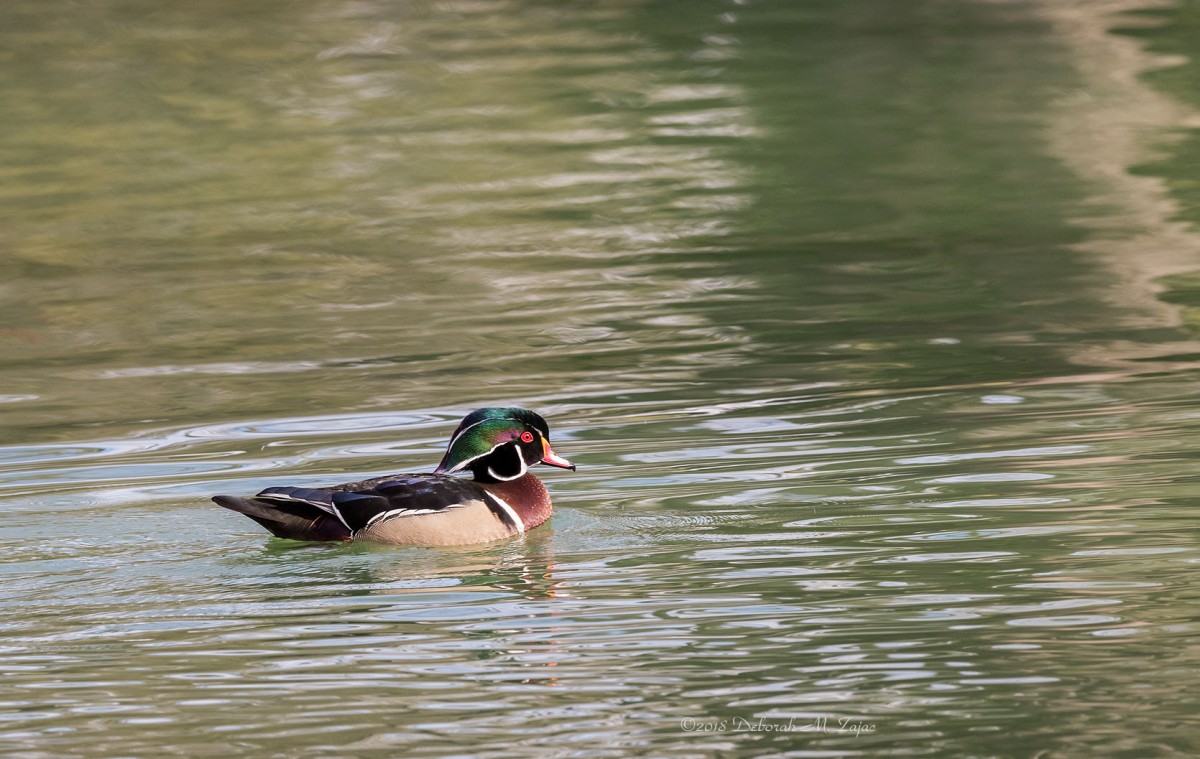
Wood Duck Male

Wood Duck Female- She’s looking up at a nesting box that the Wood Ducks kept taking turns flying up to.  They’re paired up now so brooding is on their minds no doubt. 🙂
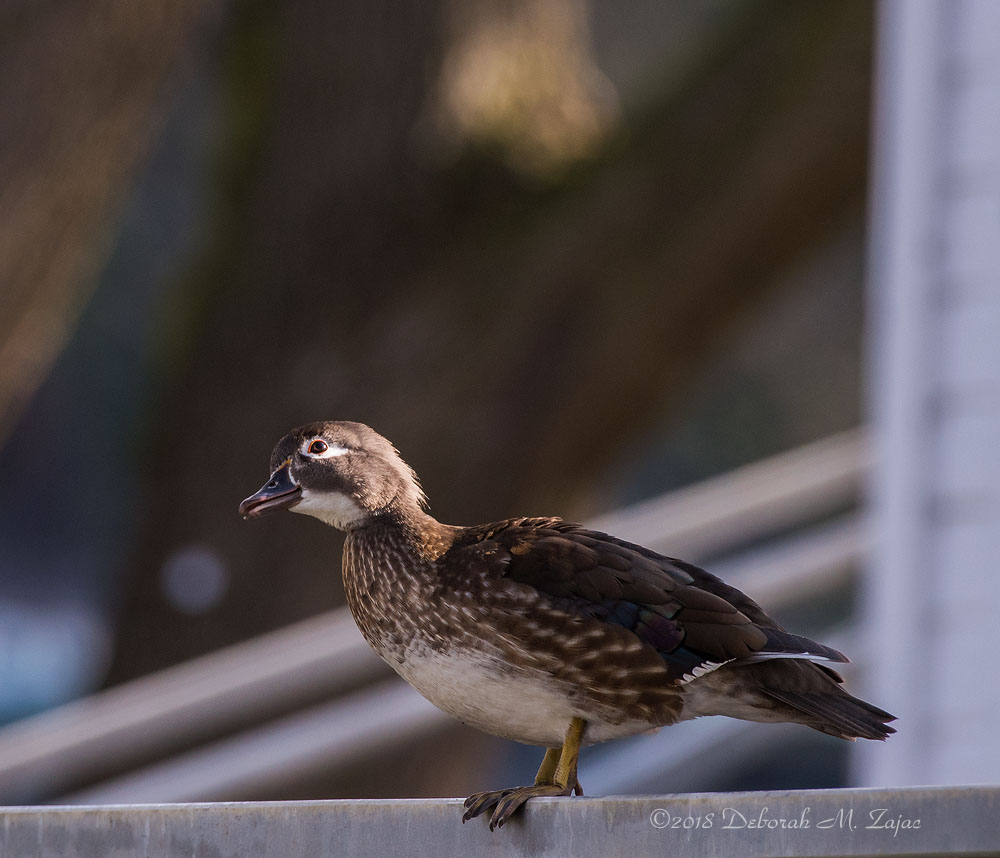
Wood Duck Female

Wood Duck pair-  I was focused on the male, and shooting at f/8, but the female isn’t as sharp as I would have liked her to be.  What do you think he’s talking about? Traffic on the pond? Or how beautiful she is? Or how wonderful he is at nesting, and fathering chicks? 🙂
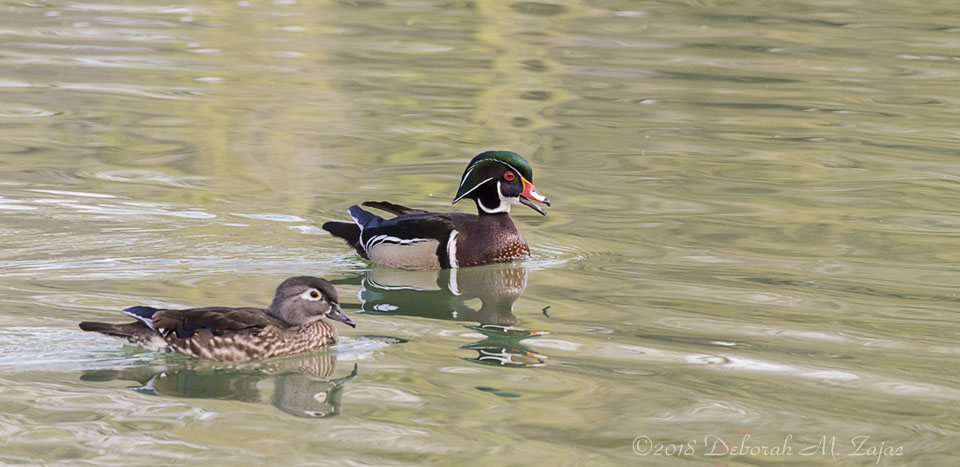
Wood Duck Pair

The African Goose- Isn’t really from Africa they think it’s really from China and related to the Swan Goose from China.  It’s most distinguishing feature is its knob on its bill/face front.

I’d never seen this Goose before. We don’t have many knobbed fronted birds here, but it’s a beauty.  It’s not listed in either of my Bird books for North America so, I turned to Wikipedia for information about it. See below the images.

This one might be a mix of white and brown because of the orange in its knob, or maybe it’s breeding colors? IDK? 🙂
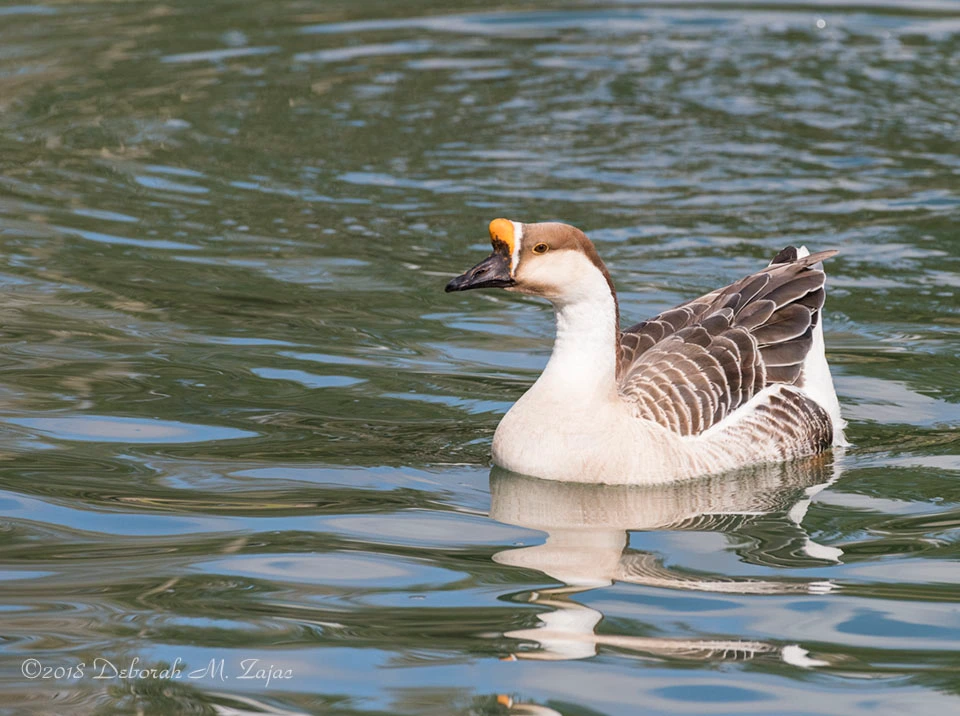
African Goose in the Pond

Several came out of the pond to forage on the lawn. I liked the way this one stopped foraging to give me “the look”.   I didn’t get any closer.  🙂
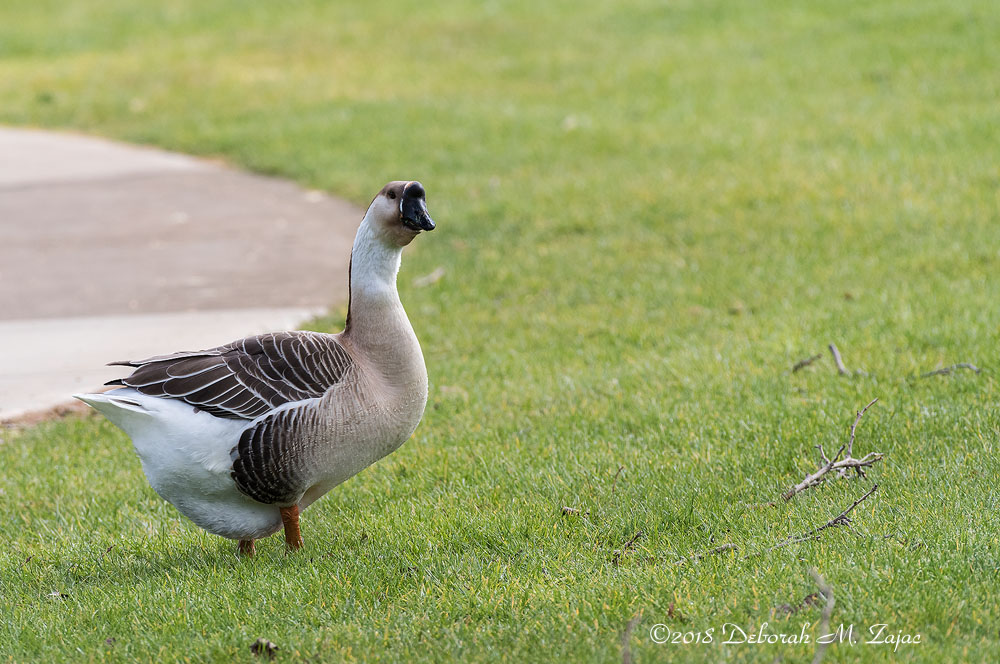
African Goose

Here’s an image of what I think is a male African Goose. It was HUGE, and you can see the Dewlap (the hanging bit under the chin) that is mentioned below as a distinguishing feature.
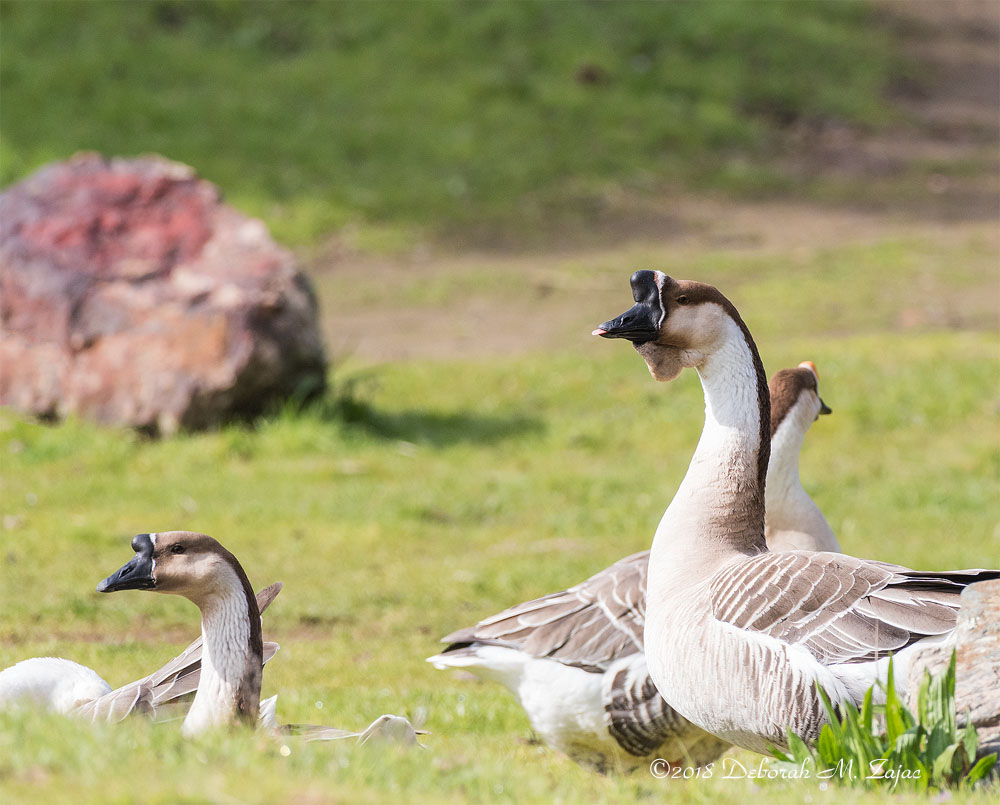
African Goose Male

The African Goose is a breed of goose. The African goose breed most likely originated in China, despite the name. They may possibly be related to the wild swan goose a smaller species of goose, just like their close cousin the Chinese goose. Though they share some similar characteristics (such as colour variations), the two can be distinguished by the African’s larger dewlap and different knob shape. African geese are also quite a bit heavier than Chinese, and are better known for their docile temperaments. Also, they are known to lay far fewer eggs than Chinese geese, 25-40 eggs per year for the African goose vs. 40-65, or, in extreme cases, up to 200 eggs per year for Chinese geese.

Two origin theories persist for the fowl: the first purporting that Africans are the result of crosses of swan geese and Chinese, while the other asserts that they are pure derivations of the swan goose, and their unique traits are simply the result of selective breeding. Whichever the case, it has existed as a distinct breed since at least the middle of the nineteenth century, and was admitted to the American Poultry Association‘s Standard of Perfectionin 1874.

Ganders often have a higher pitched call than the geese, and are taller, while the females are shorter and stockier, with larger keels or lobes.

African geese appear in three color varieties: Brown, Buff and White. Browns have black bills and knobs, and plumage with irregular shades, from a very light to dark brown. Whites have all-white plumage and orange bills and knobs.” ~https://en.wikipedia.org/wiki/African_goose


It was an outstanding morning at the pond seeing these and several other species.

I hope your week is going well, and it’s easy going til Friday!

Nikon D810| Nikkor 200-500mm| San Disk Digital Film| PS CC 2018

more to come…
 

Wild Wednesday 8/52 Hawk

Copyright ©2018 Deborah M. Zajac. ALL RIGHTS RESERVED

While out birding in Central Valley last month I saw lots of Red-tailed Hawks. This one was happy to pose for me. 🙂 At least I think this one is a Red-tailed Hawk.

Hawk

Red-tailed Hawks are quite common here. Their habitat is wide open fields. They like to perch in trees along fields, fence posts, and telephone poles.

Their Behavior- from All About Birds:

“You’ll most likely see Red-tailed Hawks soaring in wide circles high over a field. When flapping, their wing beats are heavy. In high winds they may face into the wind and hover without flapping, eyes fixed on the ground. They attack in a slow, controlled dive with legs outstretched – much different from a falcon’s stoop.”~allaboutbirds.org

They’re so common here I almost take them for granted. I’m always hoping to spy other types of Hawks instead of them, but when there are none about I’m so happy they’re here.

Sunday, I planned to go out to do some photography at the coast, but the wind was blowing 20-25 mph, and it was cold and gray, so I stayed in and watched Season 1 of Monk. Guess who found Streampix? 🙂 I hadn’t ever watched that show before, but I really like it. I’ll be watching every season til I am caught up. Yep, I’m hooked. 🙂

Recently I’ve also binged watched Vikings, and Camelot.  Those are two more T.V. shows I’m now Jonesing for the next season to begin already!

I’m currently reading A Dead Guy at the Summerhouse by Marian Allen who I discovered here on WordPress via Thursday Doors. You can find her here.  She writes Sci-fi stuff too. Yeah, she’s right up my street. 🙂 Check her out if you enjoy reading these genres too.

So, what are birds are seeing in your neighborhood, what are watching and reading right now?

Nikon D810| Nikkor 200-500mm| Hoodman Digital Film

more to come…

Wild Wednesday 4/52 White-tailed Kite

Copyright ©2018 Deborah M. Zajac.  ALL RIGHTS RESERVED

A friend and I went birding Saturday at two Wildlife Refuges. We reversed the order we normally do these two refuges and I’m glad we did. It was pretty birdy at Merced Wildlife National Refuge, but I’m going to share with you the last bird I photographed for the day at San Luis National Wildlife Refuge.

And, what a bird to end the day on! It’s my favorite raptor.

White-tailed Kite

It’s a medium sized raptor and likes open grasslands, and savannas.  It hovers while hunting for prey, and have big amber/red eyes. Here’s some information about their hunting behavior from allaboutbirds.com

While hunting, the White-tailed Kite characteristically hovers up to 80 feet off the ground and then drops straight down onto prey items. This ability to hold a stationary position in midair without flapping is accomplished by facing into the wind, and is so characteristic of these birds that it has come to be called kiting. White-tailed Kites also perform ritualized courtship displays in which a male offers prey to a female prior to egg laying. In an often spectacular aerial exchange, the female flies up to meet the male, turns upside-down, and grasps the prey.“`allaboutbirds.com

I think they’re the prettiest of the raptors.  If I could be a bird this is the one I’d be. 🙂

You’ll find them up and down Western to Central California, Oregon, Mexico, Central and South America.

Nikon D810| Nikkor 200-500mm@500mm| 1/640s| ISO 500| cropped| Hoodman Digital Film| PS CC 2018

more to come…


Wild Weds. 2/52 Wild Ones at Home

Copyright ©2018 Deborah M. Zajac.  ALL RIGHTS RESERVED

It rained this week! I’m not complaining we need it, so when He-Man and I went for a hike on Saturday we went late morning to let it dry out a bit, and get warmer. We kept to the paved streets in the nearby hills b/c I did not want to trod uphill and down in the mud on the trails.  We walked just over 2 miles and gained about 600ft in elevation.  It felt like a workout.

FWIW: If I’m hiking or stretching my legs with a hike I’d rather go uphill for a bigger pay off verses a longer, flat walk.  Since it was late morning there wasn’t any wildlife; the birds, deer, coyotes, and wild turkey were all napping I guess.  Not a bad place to be on a late Saturday morning though. 🙂

Sunday it rained all day. Like me all the wildlife was hunkered down somewhere cozy, warm, and dry.

So, it’s to my archives we go.

Here are a few wild ones that visit my backyard bushes and feeders taken last year.

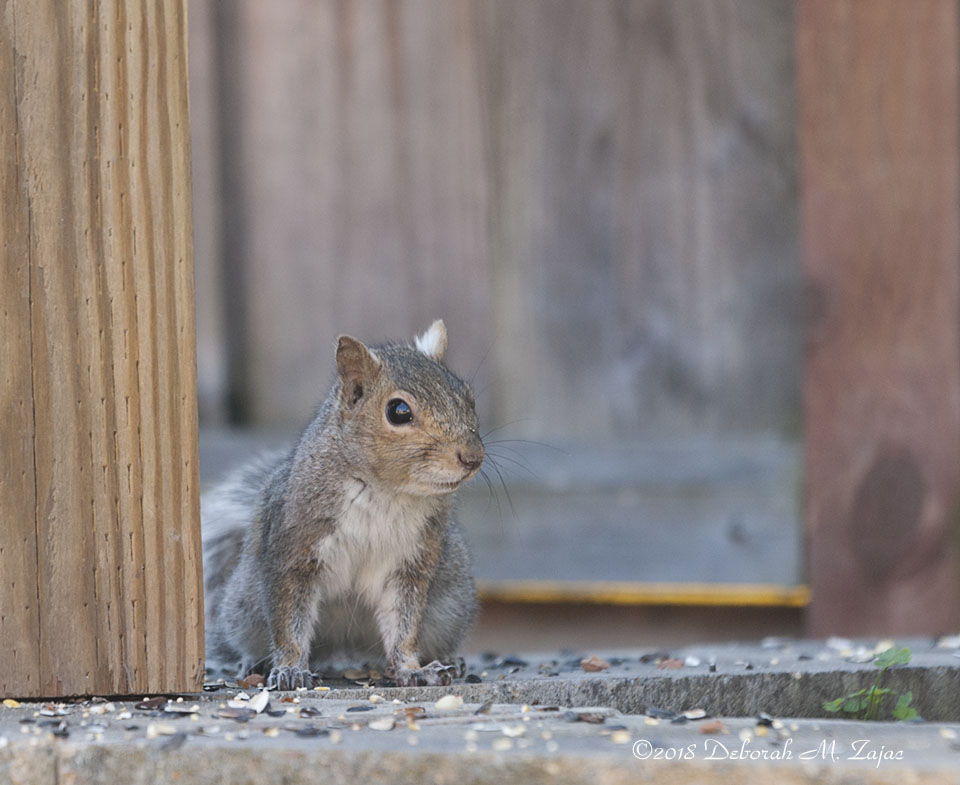
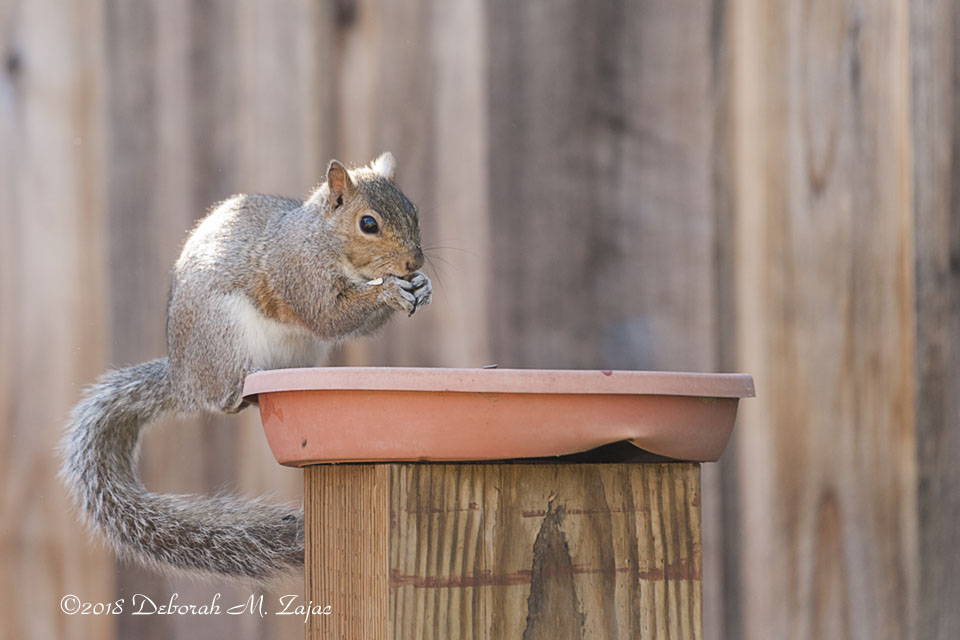
hum… something Squirrely (sp?) is going on here…

Bird Feeder Raider

Yep! This one found the one feeder he/she can get in to!

Squirrel at Bird Feeder

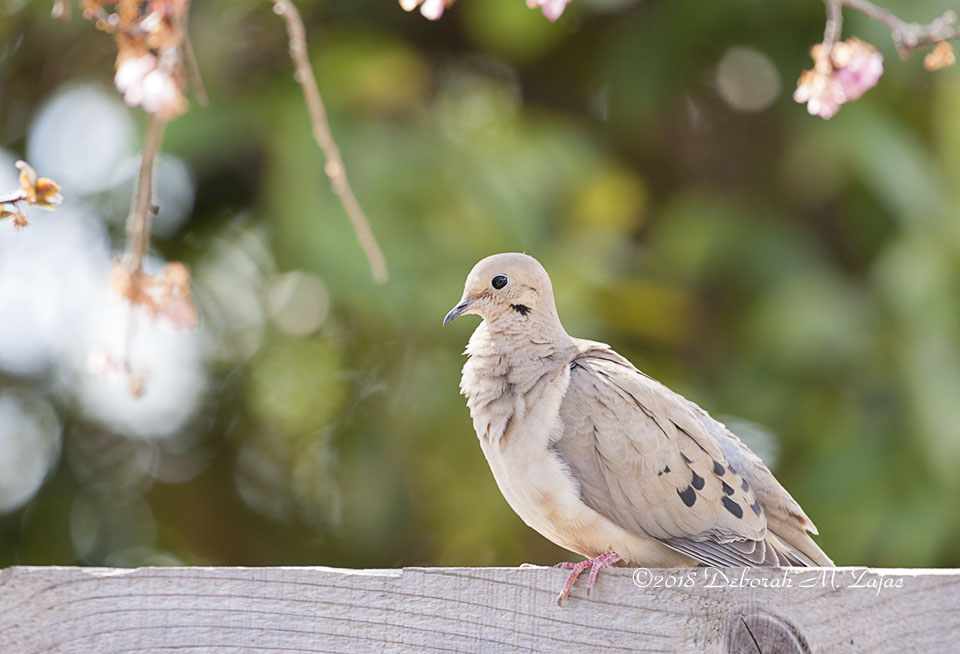
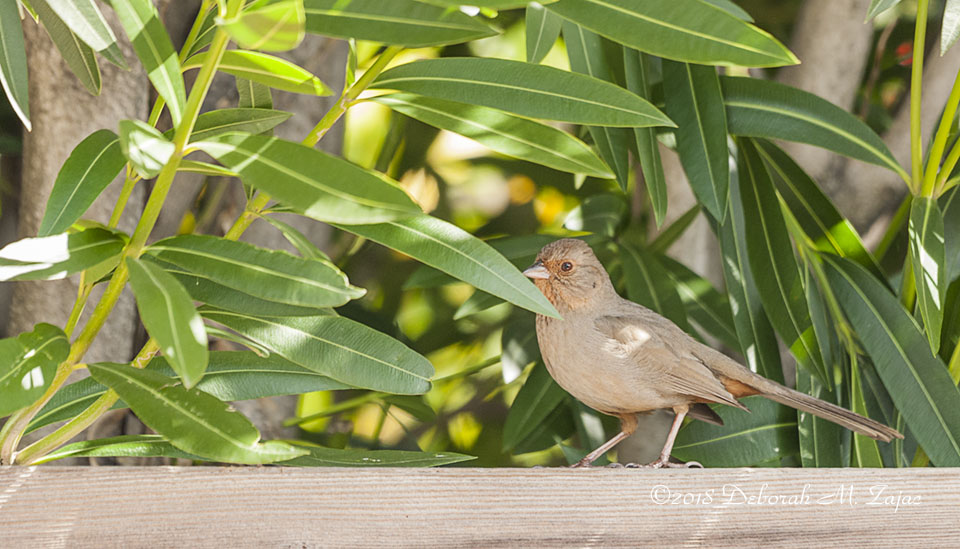
Then there’s the fence sitters.

Morning Dove

California Towhee

The top bird is a Mourning Dove…which I’m thinking was born in the hanging basket on my patio, or their Mother.  The bottom bird is a California Towhee. I can’t tell if it’s the male of female.


I hope you’re all having a wonderful week and staying warm!

Nikon D700| Nikkor 200-500mm| Hoodman Digital Film| PS CC 2018

more to come…


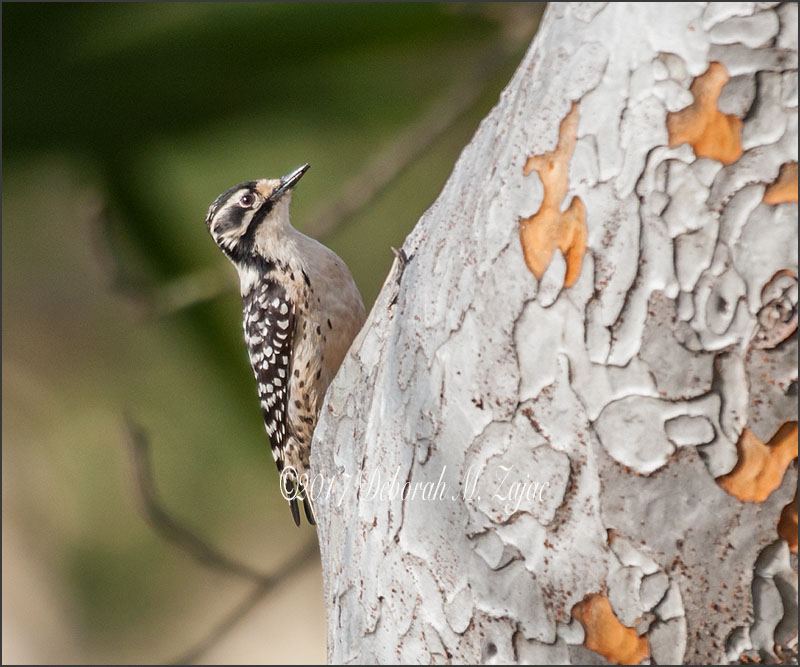
Wordless Wednesday 25/52 Nuttal’s Woodpecker

Copyright ©2017 Deborah M. Zajac. ALL RIGHTS RESERVED

Nuttall's Woodpecker

Nikon D700| Nikkor 200-500mm @460mm| f/5.6| ISO800| 1/1600s| Hoodman Digital Film|PS CC 2017

more to come…

American Bald Eagle & Me

Copyright © 2017 Deborah M. Zajac. ALL RIGHTS RESERVED

I was birding on Saturday June 3rd looking for an Indigo Bunting and upon my arrival to the location soaring over my head was an American Bald Eagle! That’s a big deal in Santa Clara County. Eagles have been making a comeback here for the last few years which is super exciting to birders, but there are still only a handful here.

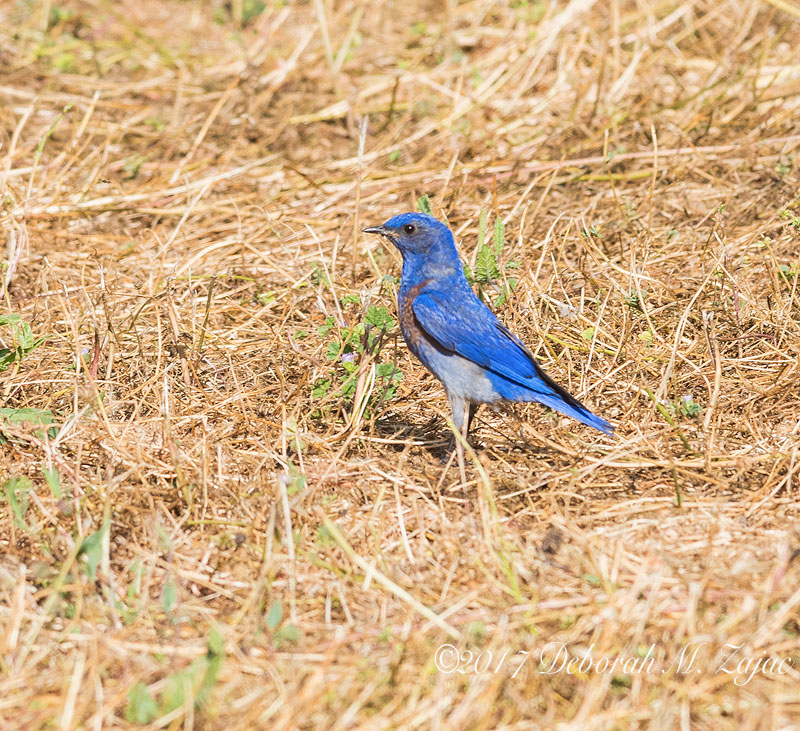
Anyway, it flew across the pond to a grove of tall trees and perched there and looked like he/or she was settled in for a long rest.  I watched it for sometime then moved to the grassy area to photograph Western Bluebirds which I’ll be sharing soon.

Then I followed some Red-winged Blackbirds a bit then turned around to check on the Eagle and OMG! It was flying right for me!

I brought my camera up to my face in lighting speed, and fired off a burst of images following its flight path.  We made eye to camera lens contact, then it veered right and headed for the northern hills, and I lost it.  I was doing my happy dance! Isn’t that wing span somethin’?

Click on the image to see it better. WP compression isn’t working for me again. 😦  I may have to mess around with image sizes again to find something that looks good without having to click on an image.

I received my 200-500mm back from Nikon Service on Thursday, but I haven’t felt good enough to get out with it.  I hope tomorrow this bug is over being in my system so I can go out and play!

Hope you all are having a great start to your week-end!

Nikon D810| Nikkor 300mm f/4| Hoodman Digital Film| PS CC 2017

more to come…