Friday’s Feathered Friends- Greater Roadrunner

Copyright ©2025 Deborah M. Zajac. ALL RIGHTS RESERVED.

PLEASE DO NOT USE MY IMAGES WITHOUT EXPRESSED WRITTEN PERMISSION.

Last month about a week before Thanksgiving I went on a quick road trip to Las Vegas/Henderson with a girl-friend. She was wanting to see her parents who live in Vegas, and I was wanting to go to Henderson which is just 20 minutes south of downtown Vegas to do some birding. So we got a plan together and went. While she was hanging out with her parents I was birding at the Henderson Bird Viewing Preserve. I was hoping to see the Long-tailed Duck that is back this winter, alas, I did not see it, but I had a fantastic meeting with a Greater Roadrunner.

I was walking up a path and turned a corner and there it was standing in the middle of the path. I stopped. It jumped back and looked at me. There we stood eyeing each other up. When it was apparent it wasn’t going to flee and be flighty I started making photographs of it. After a minute it approached me! I backed up to keep it in my focal range. It was too close!!! Such a problem to have right? 😂 This profile is the best image I made showing its colorful skin behind its eye. The colors say Southwest to me.
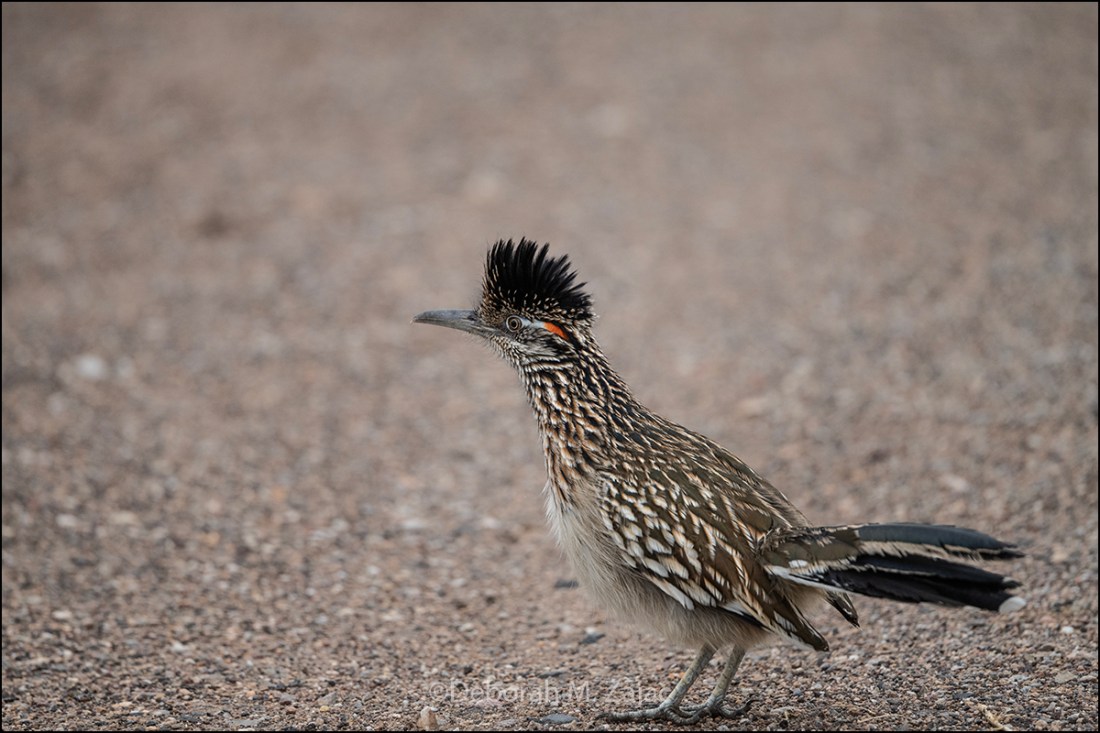
©Deborah M. Zajac | http//:circadianreflections.com
Greater Roadrunner

I didn’t back up enough because as you see I nearly cut off his feet!

Here it is showing me its lovely long tail.

©Deborah M. Zajac | http//:circadianreflections.com
Greater Roadrunner- I backed up more for to make this image.

I can’t tell if it is a male or female. I do know it’s an adult though. It stayed on the path walking back and forth in front of me, and crossing the path from side to side for nearly 5 minutes! I have quite a few images of it. I think it must have had a nest nearby guarding it perhaps? Anyway, I figured I’d better get moving and let the Roadrunner get back to doing whatever it does. I thanked it for such a lovely encounter and as quietly as I could walked up the path then when the Roadrunner thought I was too close it darted into the bushes.

That was only the 3rd Roadrunner I’ve ever seen and by far the best encounter with one ever!

Fun Facts: Gleaned from AllAboutBirds.org

    • For a generation of Americans, the familiar “beep, beep” of Warner Brothers’ cartoon Roadrunner was the background sound of Saturday mornings. Despite the cartoon character’s perennial victories over Wile E. Coyote, real-life coyotes present a real danger. The mammals can reach a top speed of 43 miles an hour—more than twice as fast as roadrunners.
    • Roadrunners have evolved a range of adaptations to deal with the extremes of desert living. Like seabirds, they secrete a solution of highly concentrated salt through a gland just in front of each eye, which uses less water than excreting it via their kidneys and urinary tract. Moisture-rich prey including mammals and reptiles supply them otherwise-scarce water in their diet. Both chicks and adults flutter the unfeathered area beneath the chin (gular fluttering) to dissipate heat.
    • Greater Roadrunners eat poisonous prey, including venomous lizards and scorpions, with no ill effect, although they’re careful to swallow horned lizards head-first with the horns pointed away from vital organs. Roadrunners can also kill and eat rattlesnakes, often in tandem with another roadrunner: as one distracts the snake by jumping and flapping, the other sneaks up and pins its head, then bashes the snake against a rock. If it’s is too long to swallow all at once, a roadrunner will walk around with a length of snake still protruding from its bill, swallowing it a little at a time as the snake digests.
    • Based on banding records, the oldest roadrunner was at least 7 years old.
    • Roadrunners hold a special place in Native American and Mexican legends and belief systems. The birds were revered for their courage, strength, speed, and endurance. The roadrunner’s distinctive X-shaped footprint—with two toes pointing forward and two backward—are used as sacred symbols by Pueblo tribes to ward off evil. The X shape disguises the direction the bird is heading, and is thought to prevent evil spirits from following.

Isn’t that folklore about its X shaped footprint interesting! I didn’t know that until I read the fun facts. 😊

I hope you all have a lovely week-end. Beep, beep!

more to come…

Friday’s Feathered Friends-Virginia Rail

Copyright ©2025 Deborah M. Zajac. ALL RIGHTS RESERVED.

PLEASE DO NOT USE MY IMAGES WITHOUT EXPRESSED WRITTEN PERMISSION.

This is a bird I don’t think I’ve shared often as they’re very elusive and shy.

Last month while birding up in Washoe County we were thrilled to see this one come out of the reeds to forage in the shallow end of the lake. This one is a juvenile which is why it was foraging in the open for sometime. There was another one behind in the reeds tut-tutting…probably an adult.

©Deborah M. Zajac | http//:circadianreflections.com
Virginia Rail

Fun Facts:

A secretive bird of freshwater marshes, the Virginia Rail often remains hidden in dense vegetation, but its loud grunting may give away its presence. As it slowly pokes its way through the marsh, you might get a glimpse of its reddish bill, black-and-white barred sides, and its twitching tail, showing off white tail feathers beneath. It possesses many adaptations for moving through its nearly impenetrable habitat, including a laterally compressed body, long toes, and flexible vertebrae.

  • The forehead feathers of Virginia Rails are adapted to withstand wear and tear that results from pushing through dense and often sharp marsh vegetation.
  • The Virginia Rail is more adept at walking on soft mud than swimming, but it occasionally swims across wetlands and even dives underwater, propelling itself with its wings.
  • As a group, rails have the highest ratio of leg muscles to flight muscles of any bird, which may explain their propensity to walk rather than fly.
  • The Virginia Rail builds numerous “dummy nests” in addition to the one where eggs are actually laid.

Fun Facts gleaned from https://www.allaboutbirds.org/guide/Virginia_Rail/overview

I’m birding this morning so will be late to your blogs and comments. I hope you all have a Happy Halloween, and great week-end.

more to come…

Friday’s Feathered Friends- Rufous Hummingbird

Copyright ©2025 Deborah M. Zajac. ALL RIGHTS RESERVED.

PLEASE DO NOT USE MY IMAGES WITHOUT EXPRESSED WRITTEN PERMISSION.

A few weeks ago a pair of Rufous Hummingbirds returned to my backyard feeder. They’ve been chasing off the Black-chinned and having skirmishes all day everyday since their return.

I’m beginning to think I need to add another Shepard’s hook and feeder so the territorial squabbling gets better.

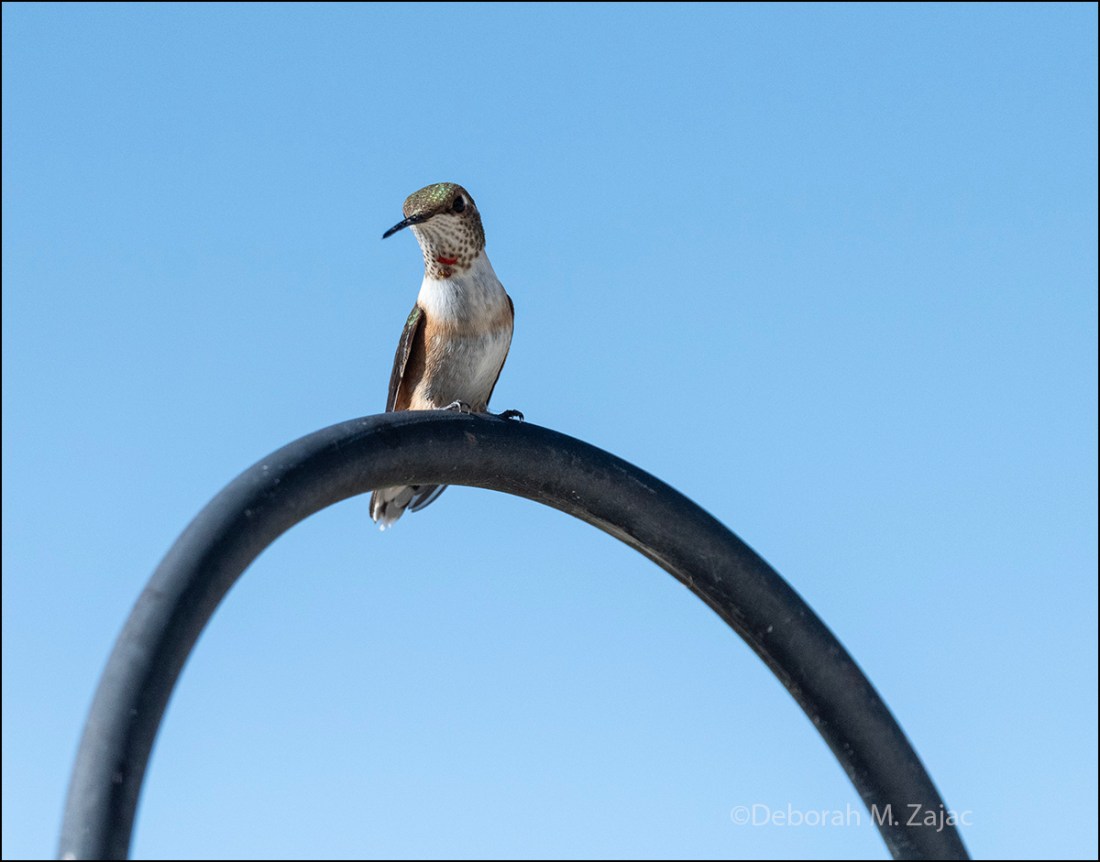
Here’s what I think is a female perched on top of the hook claiming possession. She lands here on and off all day long letting the other Hummingbirds know this is her feeder. You can see a little bit of her Gorget on her throat.

©Deborah M. Zajac | http//:circadianreflections.com Image

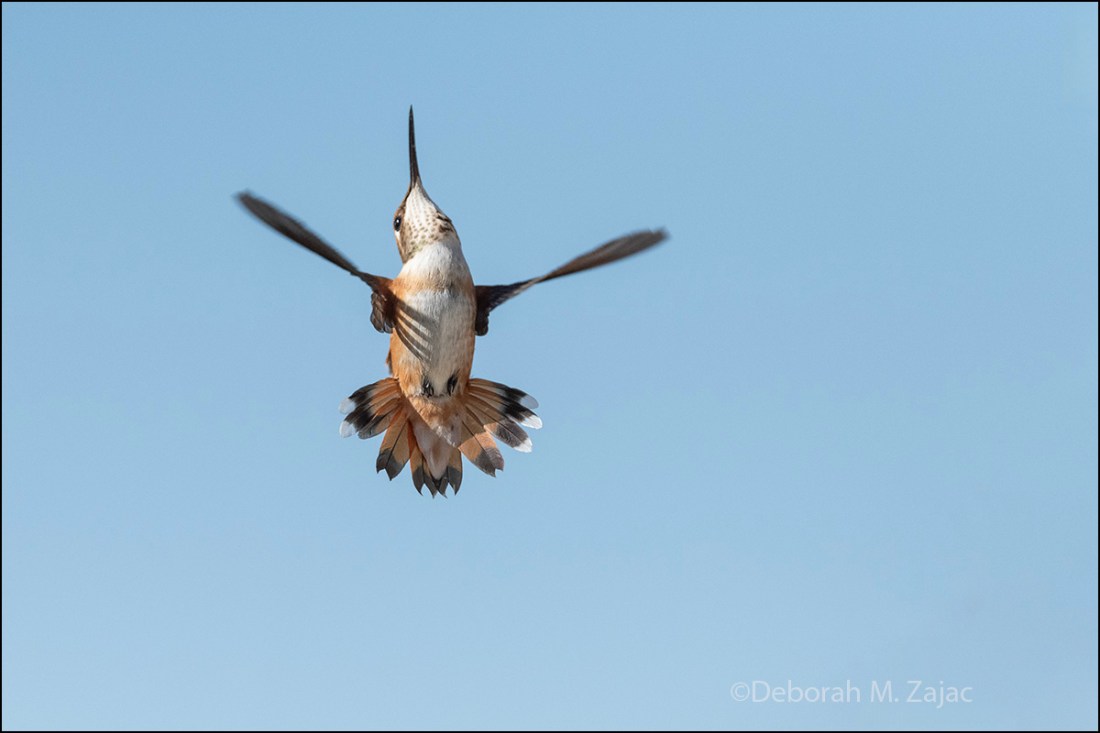
Here she is just after chasing off two other Hummingbirds. I love her tail!

©Deborah M. Zajac | http//:circadianreflections.com Image

I could be wrong about her sex as it could also be an immature female/ male. If you know which it is please let me know.

Fun Facts:

  • The Rufous Hummingbird is a common visitor to hummingbird feeders. It is extremely territorial at all times of year, attacking any visiting hummingbird, including much larger species. They’ve been seen chasing chipmunks away from their nests.
  • The Rufous Hummingbird makes one of the longest migratory journeys of any bird in the world, as measured by body size. At just over 3 inches long, its roughly 3,900-mile movement (one-way) from Alaska to Mexico is equivalent to 78,470,000 body lengths. In comparison, the 13-inch-long Arctic Tern’s one-way flight of about 11,185 mi is only 51,430,000 body lengths. (AAB)
  • During their long migrations, Rufous Hummingbirds make a clockwise circuit of western North America each year. They move up the Pacific Coast in late winter and spring, reaching Washington and British Columbia by May. As early as July they may start south again, traveling down the chain of the Rocky Mountains. People first realized this pattern after examining detailed field notes and specimens, noting the birds’ characteristic dates of arrival on each part of the circuit.
  • The Rufous Hummingbird has an excellent memory for location, no doubt helping it find flowers from day to day, or even year to year. Some birds have been seen returning from migration and investigating where a feeder had been the previous year, even though it had since been moved.
  • The Rufous Hummingbird breeds as far north as southeastern Alaska – the northernmost breeding range of any hummingbird in the world. Of the western hummingbirds that occasionally show up in the east, the Rufous Hummingbird is the most frequent.
  • Rufous Hummingbirds, like most other hummingbirds, beat their wings extremely fast to be able to hover in place. The wingbeat frequency of Rufous Hummingbirds has been recorded at 52–62 wingbeats per second.
  • The Rufous Hummingbird is not a colonially nesting species; however, there have been reports from Washington state that have 20 or more Rufous Hummingbird nests only a few yards apart in the same tree. (From the BNA)
  • Hummingbirds are hard to catch, but there are records of Rufous Hummingbirds being caught by a large flycatcher (Brown-crested Flycatcher) and by a frog.
  • The oldest recorded Rufous Hummingbird was a female, and at least 8 years, 11 months old when she was recaught and rereleased during banding operations in British Columbia in 2004.

I’ve been slower to your blogs this week as I’m visiting with family, and I will be for the next several days, but I’ll catch up!

Have a lovely week-end!!

Nikon D850| Nikkor 500mm| Fun Facts-https://www.allaboutbirds.org/guide/Rufous_Hummingbird/overview

more to come…

Friday’s Feathered Friends-Birds, Birds, Birds

Copyright ©2025 Deborah M. Zajac. ALL RIGHTS RESERVED.

PLEASE DO NOT USE MY IMAGES WITHOUT EXPRESSED WRITTEN PERMISSION.

I thought I’d share some of the birds I’ve seen the last couple of weeks.

Starting with a little Pygmy Nuthatch. It was flying to and from its nest the hole in a tree trunk you can sort of see behind it.

©Deborah M. Zajac | http//:circadianreflections.com Image

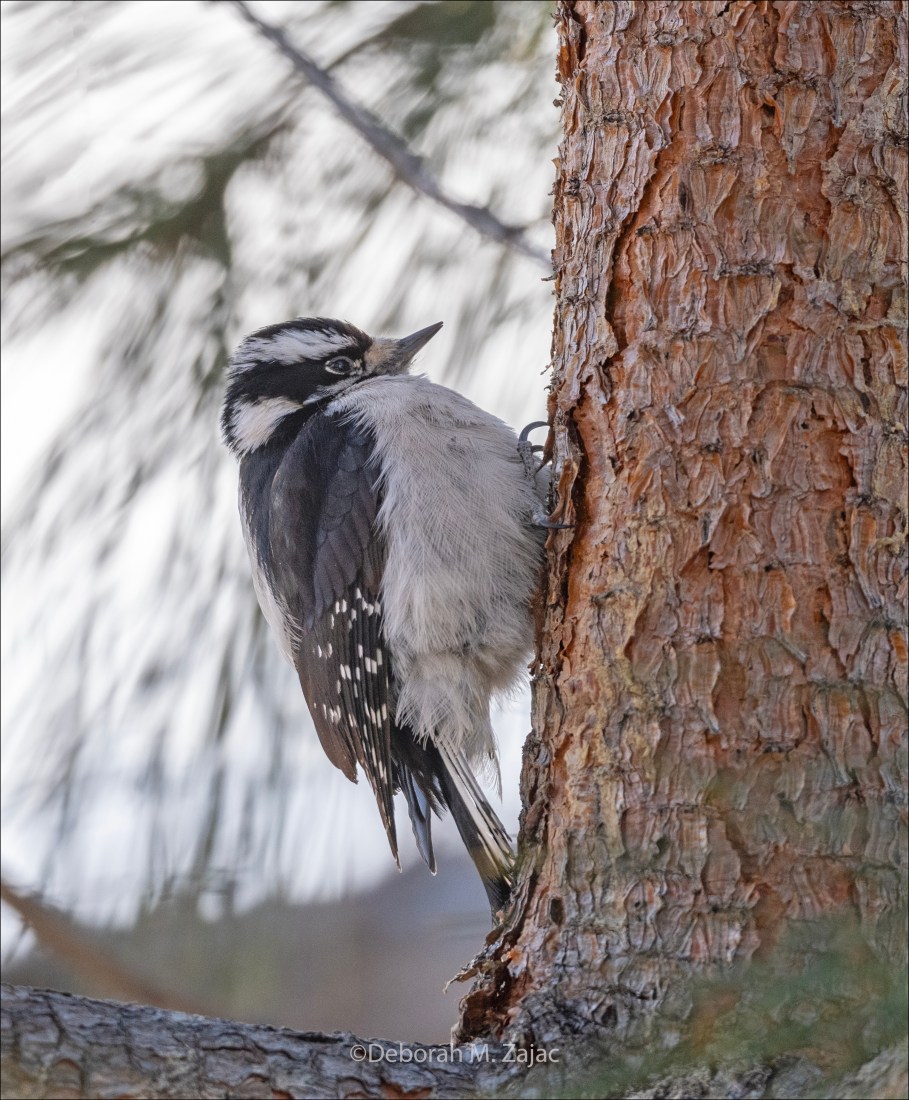
A female Downy Woodpecker who was cold that morning. It was 15 degrees F when we started birding. She didn’t move from that tree for the longest time.

©Deborah M. Zajac | http//:circadianreflections.com Image

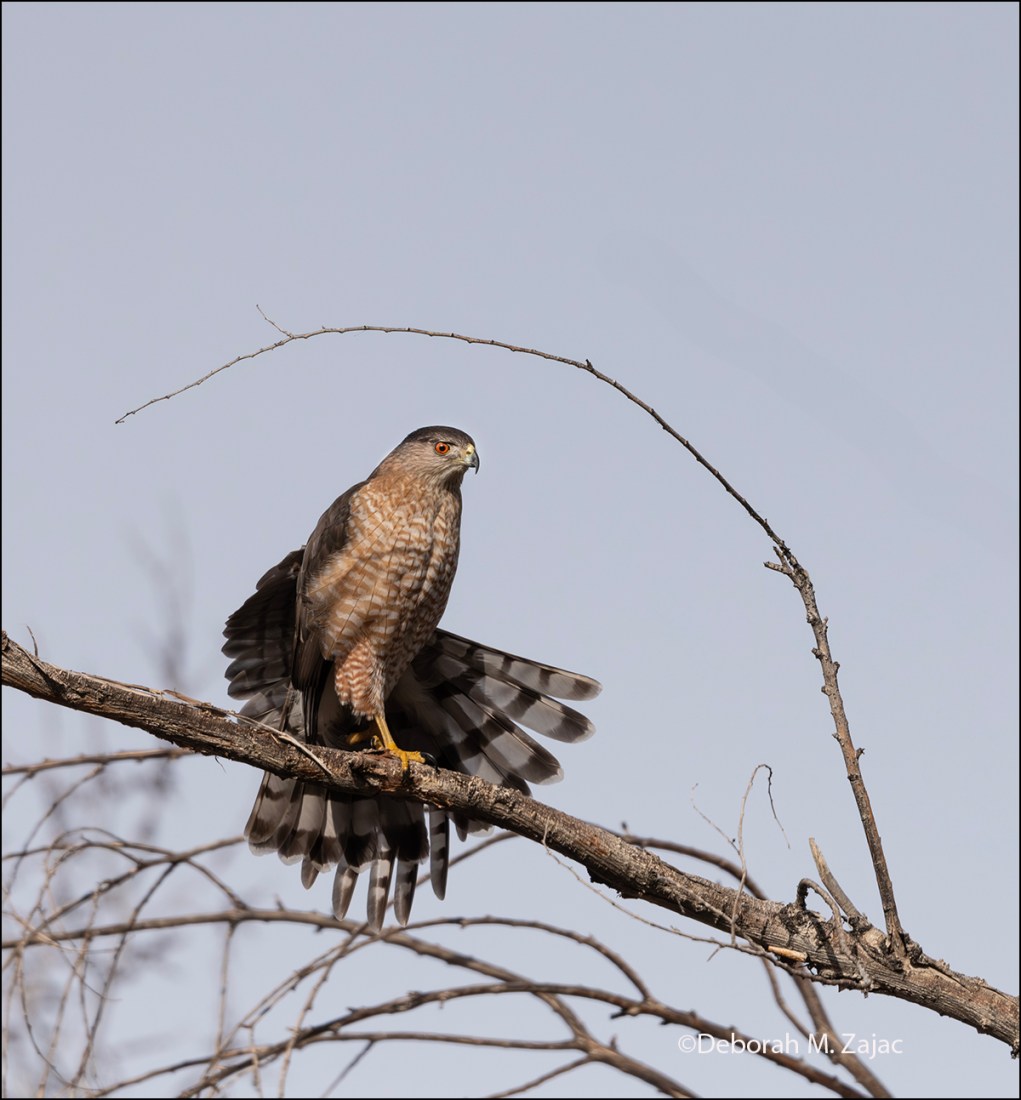
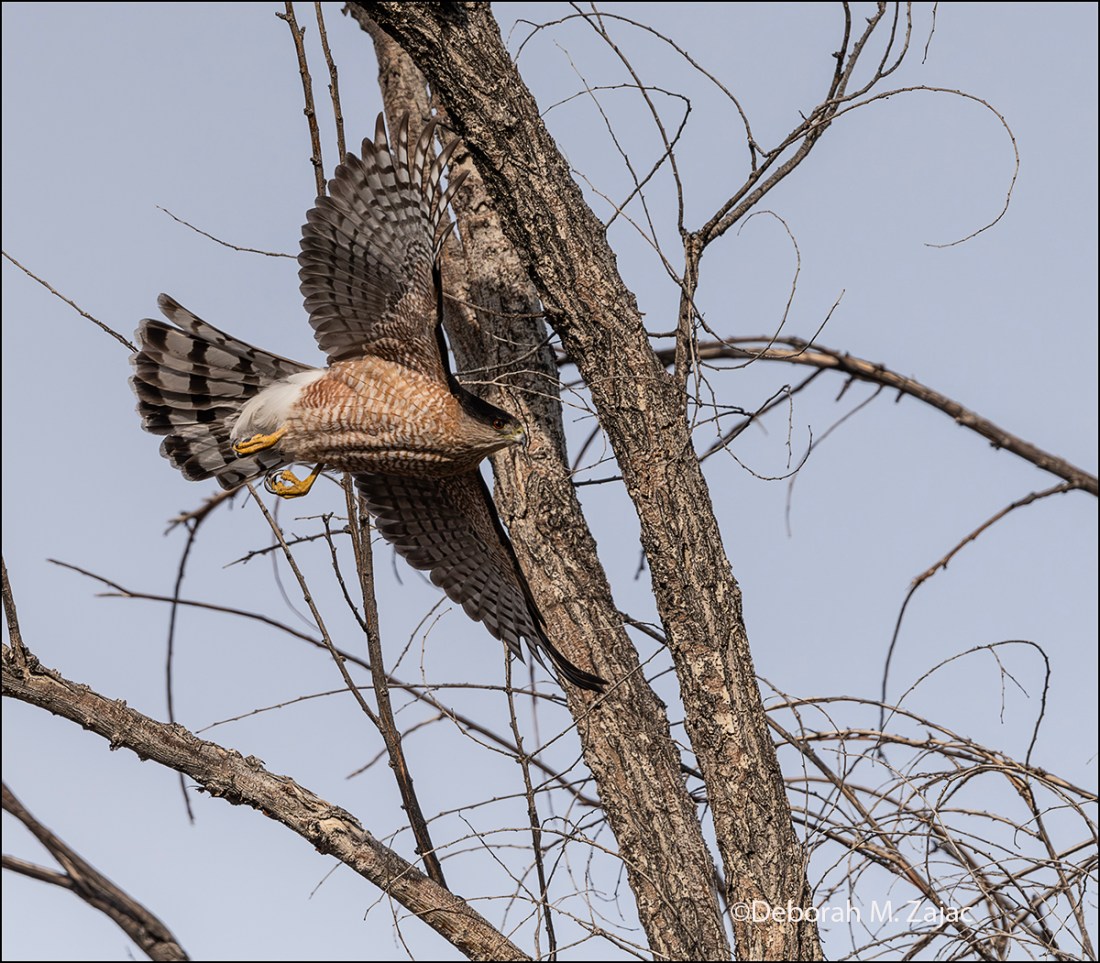
Another morning I had the pleasure of viewing a posing Cooper’s Hawk. Look at that tail!

©Deborah M. Zajac | http//:circadianreflections.com Image

Then it showed off its wing.

©Deborah M. Zajac | http//:circadianreflections.com Image

Then it flew showing off its wing span.

©Deborah M. Zajac | http//:circadianreflections.com Image

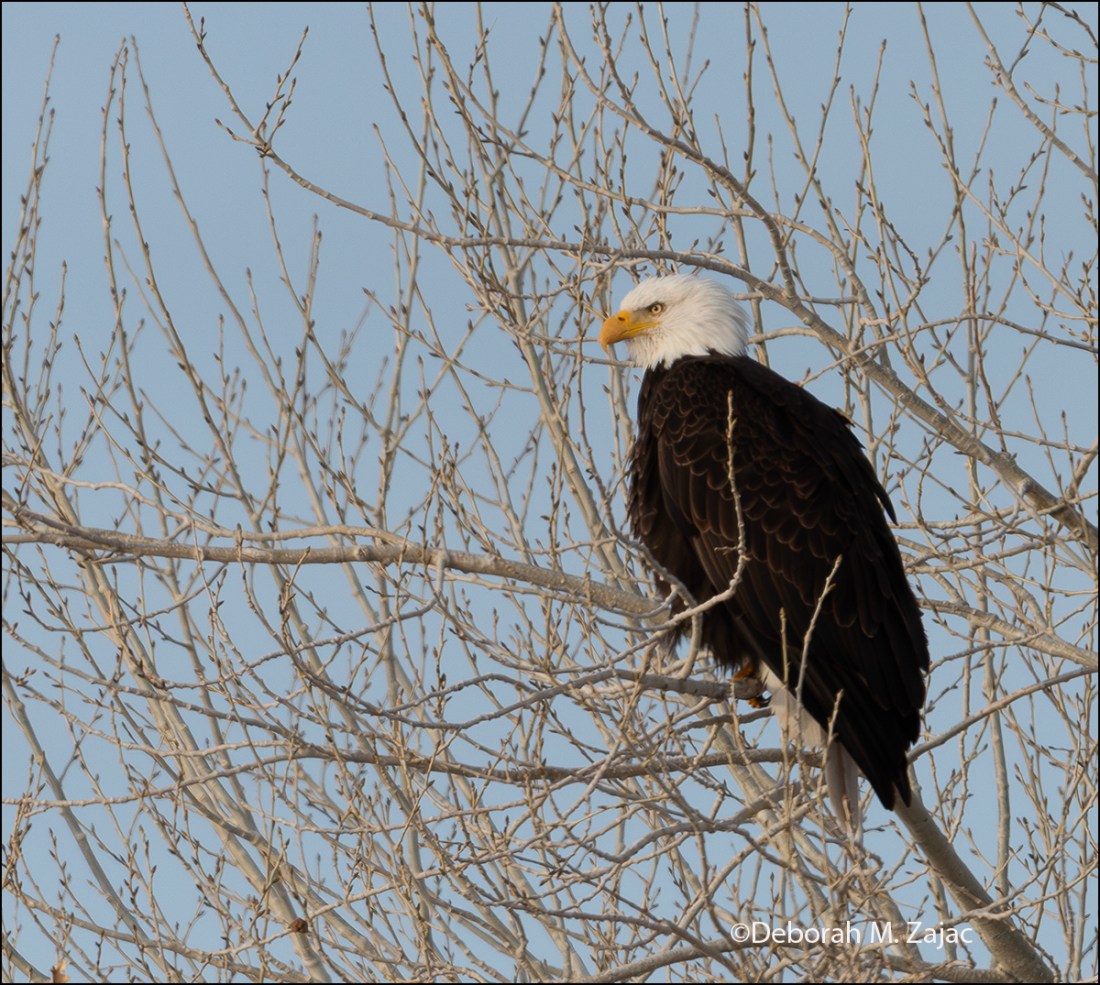
Last but not least, I saw the pair of Bald Eagles in their tree near my house on my way out last week. He was obscured by all the branches, but she was up high and in the open. I had to stop for a photo of her.

©Deborah M. Zajac | http//:circadianreflections.com Image

That’s all I have for you this week. I may be late getting to your posts and blogs this morning as I’m birding with my bird group.

More to come…

Friday’s Feathered Friends-Couples

Copyright ©2025 Deborah M. Zajac. ALL RIGHTS RESERVED.

PLEASE DO NOT USE MY IMAGES WITHOUT EXPRESSED WRITTEN PERMISSION.

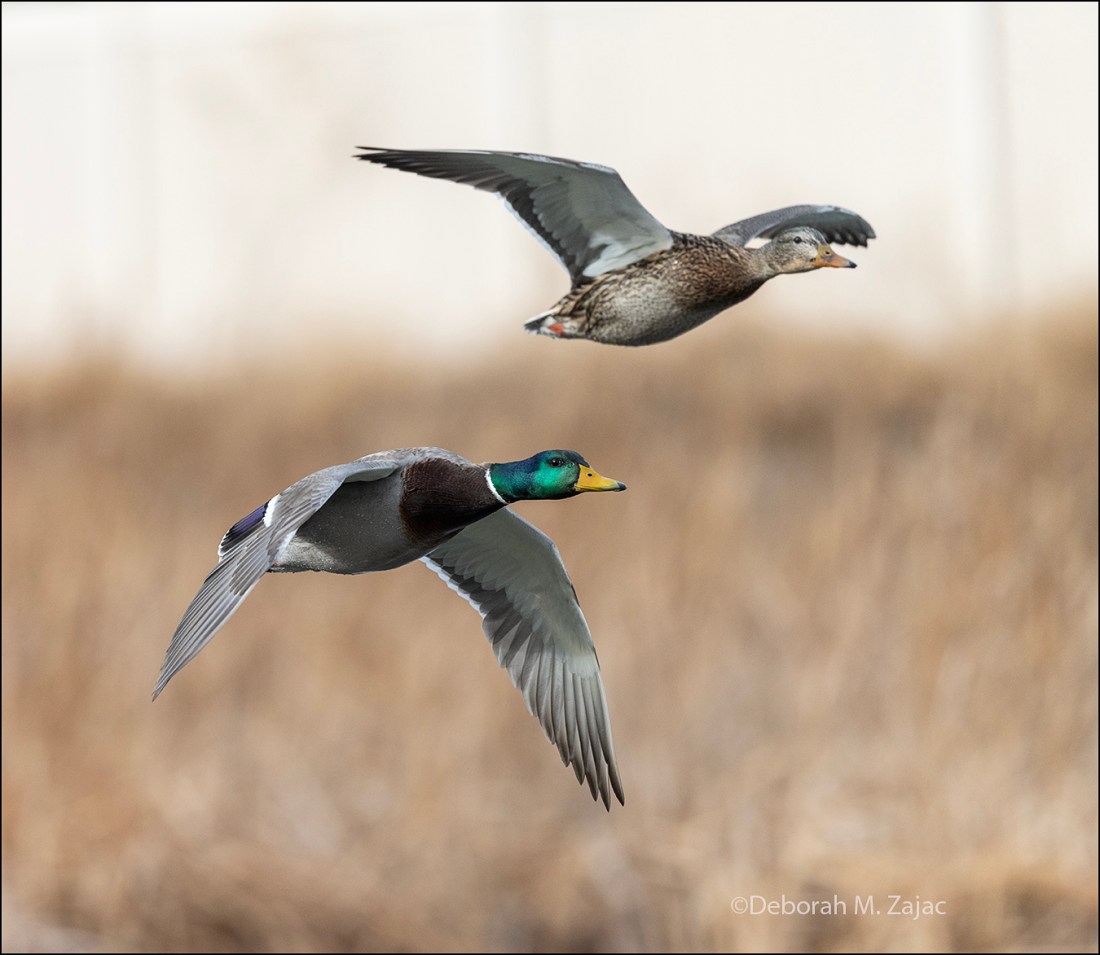
Being Valentine’s Day today I thought I’d share a couple of bird pairs/couples.

Mallard pair

©Deborah M. Zajac | http//:circadianreflections.com Image

Hooded Merganser pair

©Deborah M. Zajac | http//:circadianreflections.com Image

I hope you all have a lovely Valentine’s Day and great weekend.

Nikon D850| Nikkor 500mm| PS CC

more to come…

Friday’s Feathered Friends- Tundra Swan

Copyright ©2025 Deborah M. Zajac. ALL RIGHTS RESERVED.

PLEASE DO NOT USE MY IMAGES WITHOUT EXPRESSED WRITTEN PERMISSION.

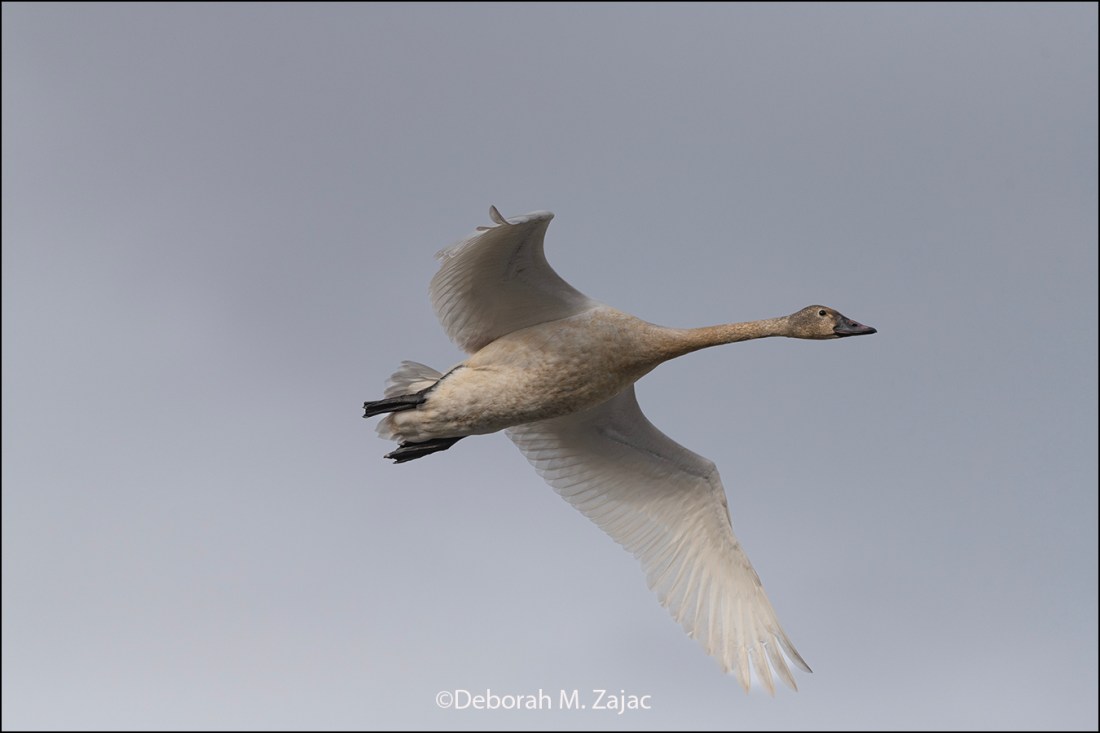
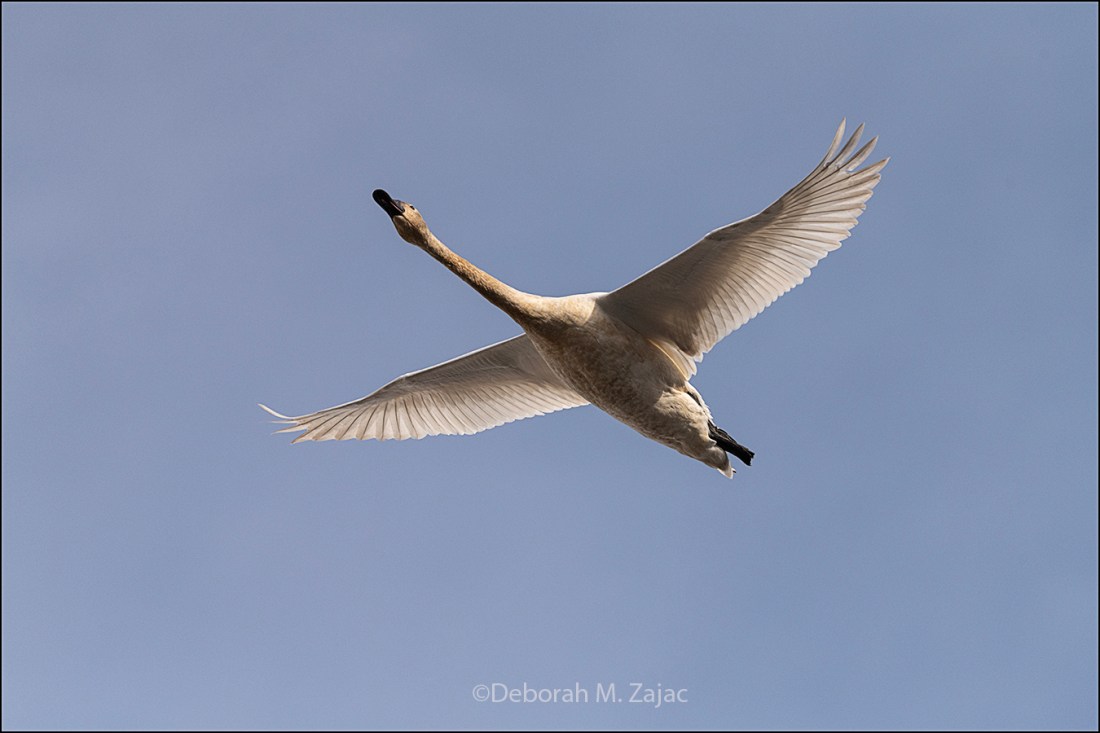
While out birding with the group last Friday morning we had the pleasure of a Tundra Swan fly-by. The single Swan flew by three times actually. Probably checking out the slough and ponds to see if that was the place to land or if his partner was there. We didn’t see a another swan and after three passes we didn’t see it again.

©Deborah M. Zajac | http//:circadianreflections.com Image

Here it was flying over my head.

©Deborah M. Zajac | http//:circadianreflections.com Image

Both images are cropped a bit. It was higher in the sky than these make it look.

Fun Facts:

  • Lewis and Clark provided the first written description of the Tundra Swan during their expedition to the West, where the birds’ whistle-like calls prompted Meriwether Lewis to dub them “whistling swans.”
  • The whistling swan, the American race of the Tundra Swan, currently is considered the same species as the Eurasian race, the Bewick’s swan. They were considered separate species in the past, distinguished by the large yellow patches on the face of the Bewick’s swan.
  • The Tundra Swan stays in flocks except when on a breeding territory. Although most swans spread out to breed, a large proportion of the population on the breeding grounds still can be found in flocks. These swans are not breeding, and may be young birds that have not yet bred, adult pairs whose breeding attempts failed, or adults that bred in the past but for some reason do not in that year.
  • During the breeding season the Tundra Swan sleeps almost entirely on land, but in the winter it sleeps more often on water.
  • Tundra Swans breed in the remote arctic of North America. Parents defend their nests and young against a host of predators including foxes, weasels, wolves, and bears, as well as birds such as Glaucous Gulls, Common Ravens, Parasitic Jaegers, Pomarine Jaegers, and Golden Eagles. If the parents are present, they are able to defend the nest and nestlings from these threats. Wolves, people, and bears, however, are too big to fight, and most incubating swans leave their nests while these large predators are far away. By leaving quickly when large predators approach, the parents may make the nest harder to find.
  • Tundra Swans wintering in Chesapeake Bay feed almost exclusively on clams that they dislodge from the mud. But it can be challenging to enjoy a peaceful meal: often the swan has to fend off a Ring-billed, Herring, or Greater Black-backed gull that swoops in to grab a clam from the swan’s bill – a successful tactic in about half of these “kleptoparasitic” encounters.
  • Swans have long been associated with ideals of romance. Added to their elegant outlines and all-white plumage is their tendency to form permanent pair bonds by the time they’re 2-3 years old. Once a pair forms, Tundra Swans feed and roost together year-round.
  • Based on banding records, the oldest known Tundra Swan was a female and at least 23 years, 7 months old when she was identified by her band in the wild, in Ohio. She was originally banded in the same state.

Fun Facts gleaned from allaboutbirds.org

If the rain holds off this morning I’ll be birding so I may be late getting to your blogs, and comments.

more to come…

Friday’s Feathered Friends- The Anhinga

Copyright ©2024 Deborah M. Zajac. ALL RIGHTS RESERVED.

PLEASE DO NOT USE MY IMAGES WITHOUT EXPRESSED WRITTEN PERMISSION.

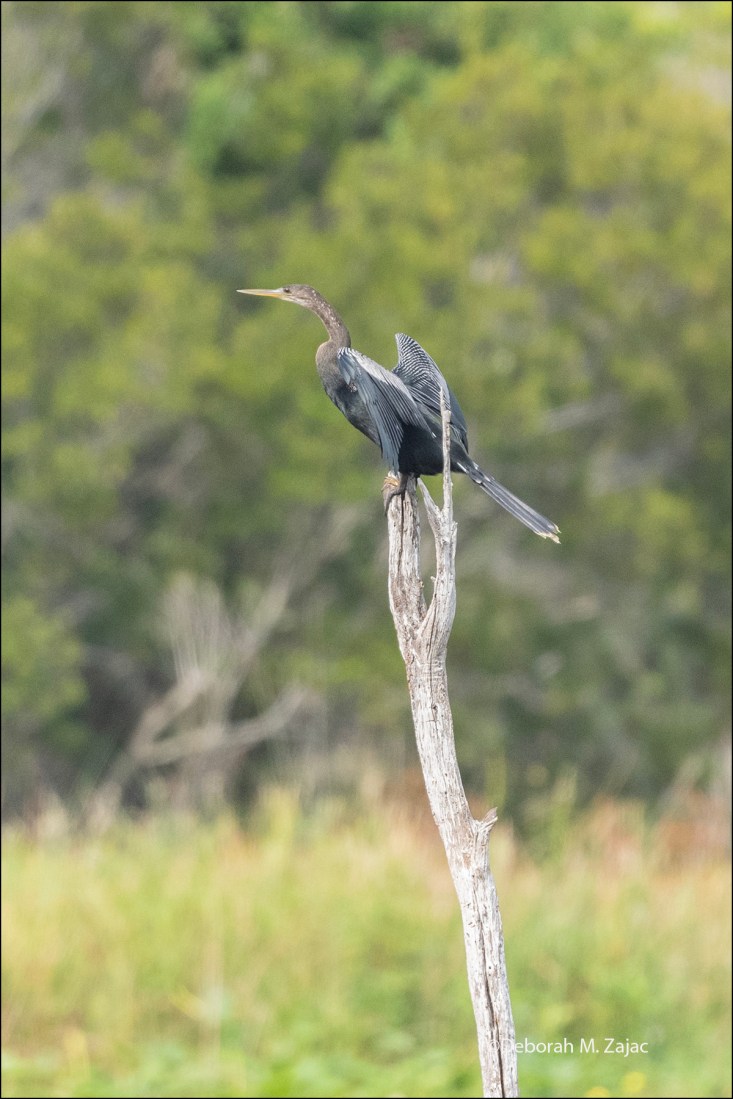
The Anhinga was one of 4 birds I really wanted to see while I was in Florida in September and I saw 3 of them! One male and two Females…I think.

It’s another pre-historic cool looking bird.

I think this is a male because his neck is black. He’s drying his wings.

©Deborah M. Zajac | http//:circadianreflections.com Image

Here’s the female also drying out her wings. Like Cormorants they don’t have waterproof feathers so they get on a perch or land and spread them open to dry them out.

©Deborah M. Zajac | http//:circadianreflections.com
As I crept closer to her to get a better shot I spooked her and off she flew.

Fun Facts:

  • The Anhinga’s distinctive shape earned it the nickname “water turkey” for its turkeylike tail, and “snake bird” for its long snakelike neck as it slithers through the water.
  • Unlike most waterbirds, the Anhinga doesn’t have waterproof feathers. While that may seem like a disadvantage for their watery lifestyle, their wet feathers and dense bones help them slowly submerge their bodies under the water so they can slyly stalk fish.
  • The name Anhinga comes from the Tupi Indians in Brazil, meaning “devil bird” or “evil spirit of the woods.”
  • The oldest recorded Anhinga was at least 12 years old when it was shot in Louisiana in 1948.

Fun facts gleaned from https://www.allaboutbirds.org/guide/Anhinga/overview

We may have a break from the wind and beat the rain this morning so I’m going birding with friends which means I’ll be a bit late checking out your blogs, and reading comments.

more to come…