Copyright ©2017 Deborah M. Zajac. ALL RIGHTS RESERVED


Nikon D700| Nikkor 200-500mm| Lexar Digital Film| PSCC 2017
More to come…
“A good snapshot keeps a moment from running away.” ― Eudora Welty
Copyright ©2017 Deborah M. Zajac. ALL RIGHTS RESERVED
Nikon D700| Nikkor 200-500mm| Lexar Digital Film| PSCC 2017
More to come…
Copyright ©2017 Deborah M. Zajac. ALL RIGHTS RESERVED
Saturday I paid another visit to the wildlife refuge with the Anna’s Hummingbird chicks to see their progress. Seeing them was nothing short of amazing! Each visit brings new delights, and wonder to my eyes and soul.
They were bigger and their feathers, and colors were more like Hummingbirds now. I must have just missed Mom when I got there.
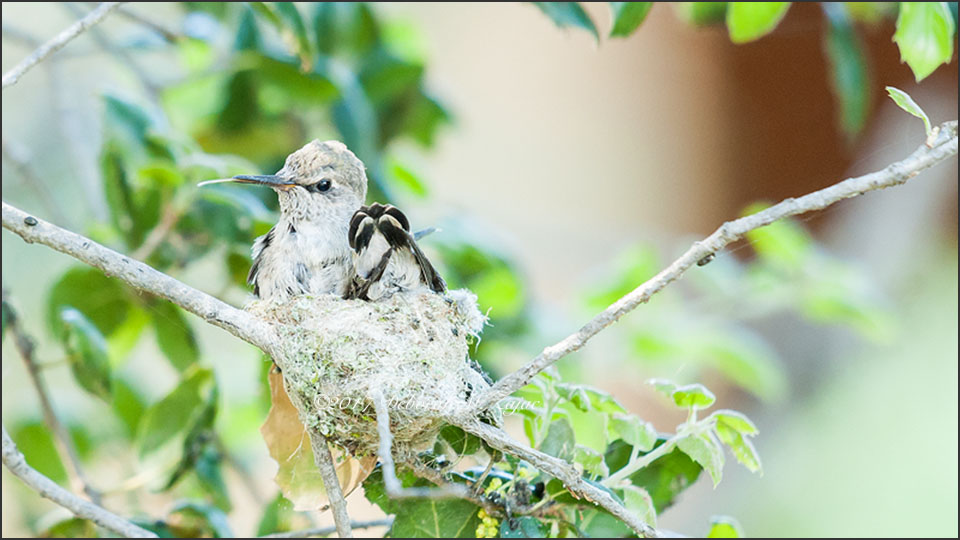
It wasn’t long before she returned to feed them. Here’s probably the last image I’ll have of them together as a family.
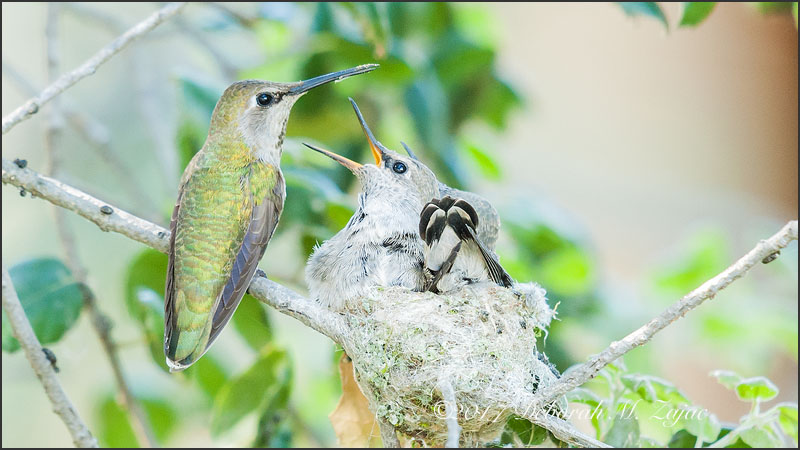
After feeding the chicks rested a minute. Then the one on the right got very active flapping its wings preparing for flight.
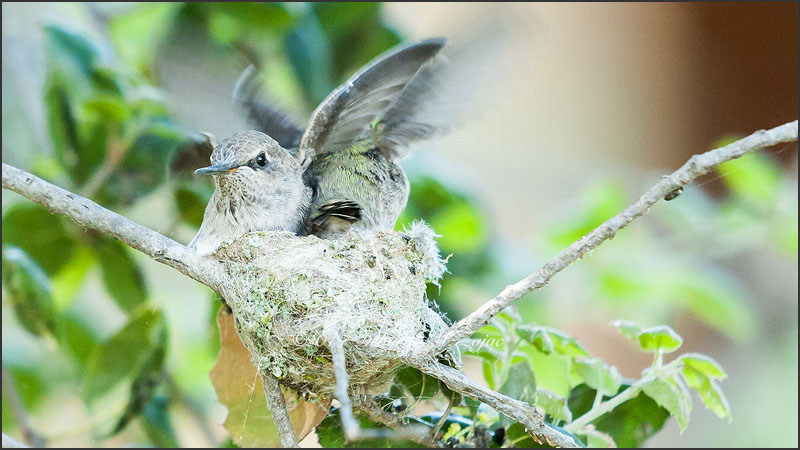
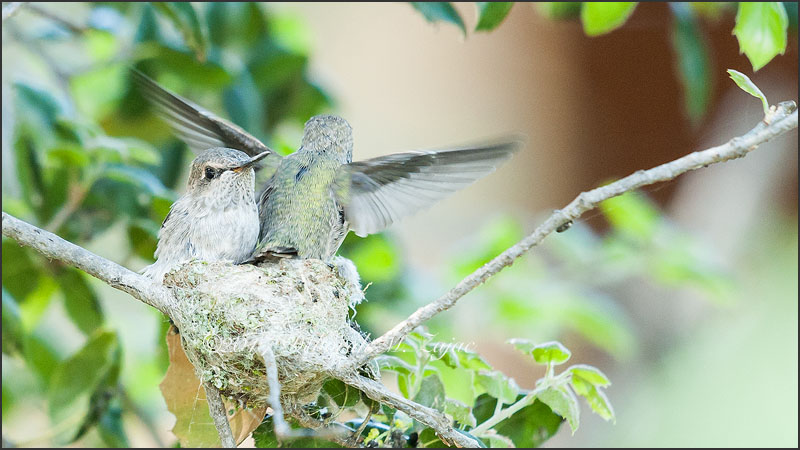
…and before I knew it it did an in flight turn just milliliters above the nest and BOOM! it was on the branch! ” Ta Da! Look! I’m as big and beautiful as Mom!”
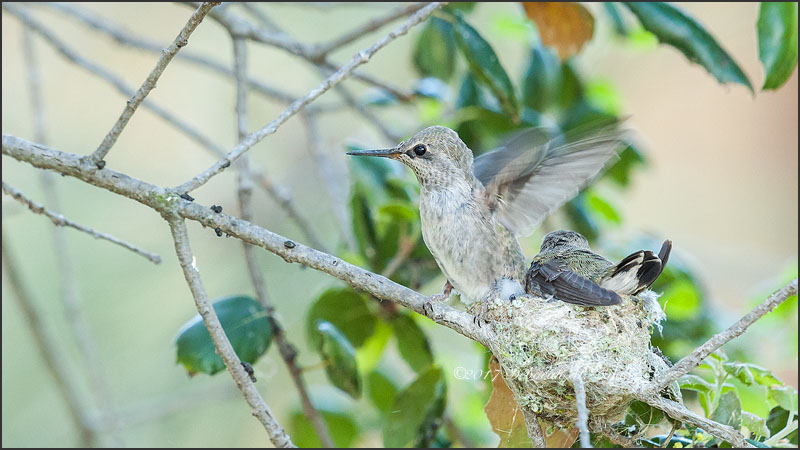
Siblings on the verge of Adulthood, and Flight.
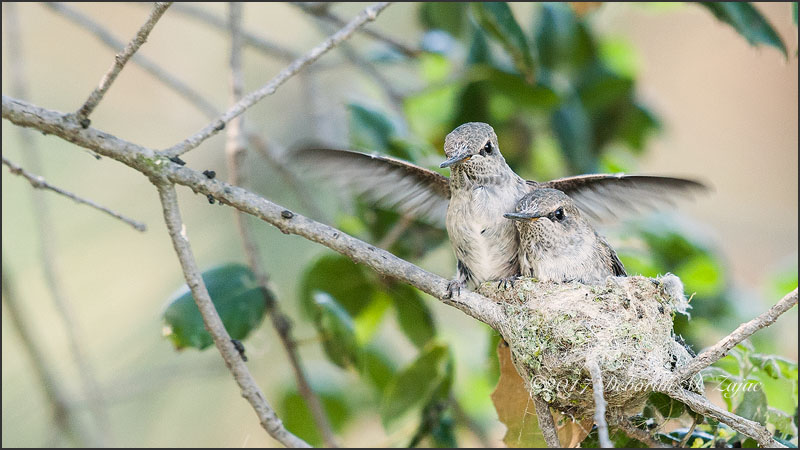
I heard yesterday that they are flying around well above the branches now. They’ll be leaving the nest today I think.
I feel so blessed and lucky to have seen these two delightful gifts of nature.
Nikon D700| Nikkor 200-500mm| Lexar Professional Digital Film| PS CC 2017
More to come…
Copyright ©2017 Deborah M. Zajac. ALL RIGHTS RESERVED
Here’s the post I promised on Monday here that I would be sharing this week about a birding surprise.
After sunrise, and a little birding last Saturday Gordon, myself, and another friend went to breakfast then we headed over to another part of Don Edward’s Wildlife Refuge to check out the Anna’s Hummingbird on her nest.
I had heard from a good friend that she had had her brood of two. There were indeed two chicks in the nest, and their eyes were open!
They waited for Mama to return to the nest with food! They were so quiet. I thought they would be peeping constantly, but they didn’t. They look too big for the nest already don’t they. Mom must sleep on top of the nest with them smooched down into the nest to keep them warm at night.
This nest isn’t deep in the canopy either! It’s pretty exposed.
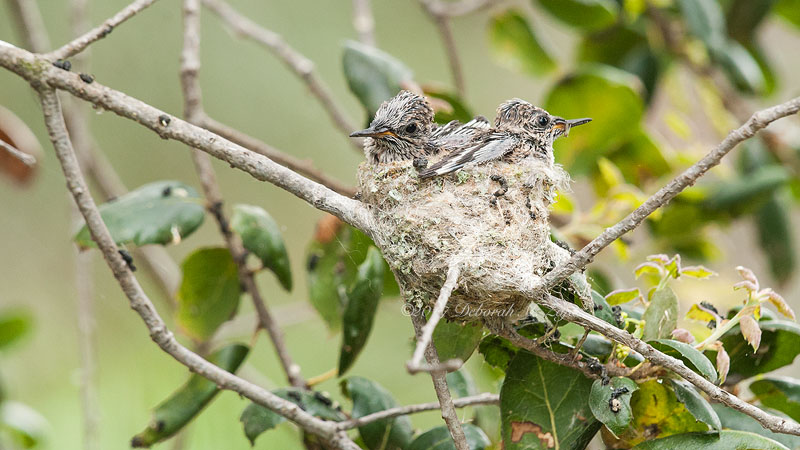
When the chicks are new their Mom will leave the nest for very short periods of time. Just a minute up to 15 minutes to find food. The chicks can’t keep warm without her so she doesn’t dare leave them alone long. Once they can regulate their own temperatures and keep warm she leaves the nest to forage for food for up to 20 minutes. This Mom would leave for 15-20 minutes, but return to do buzz or hover check several times too.
Here is the Female/Mom just returning from a food sortie.
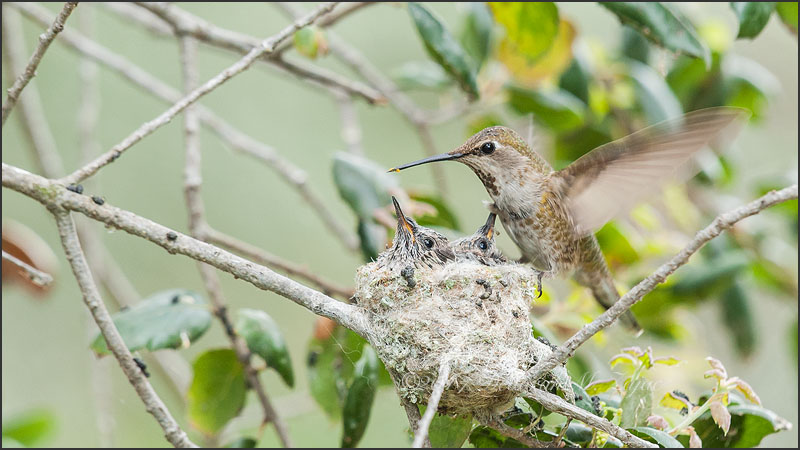
Two little beaks hungry and not patient anymore.
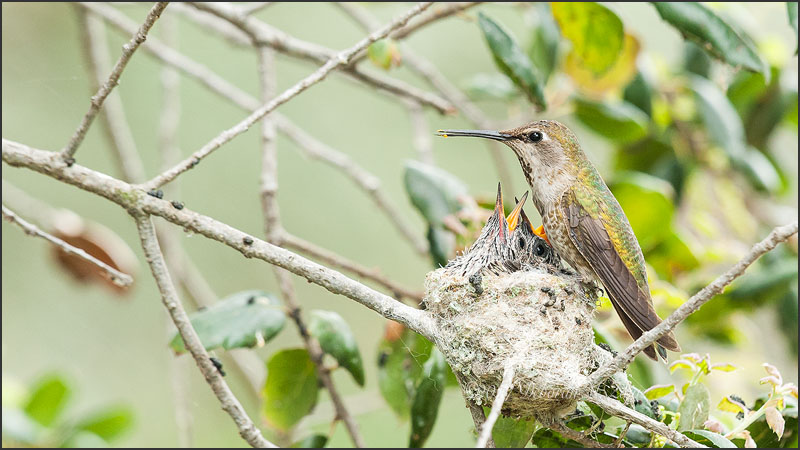
Food at last!
She eats insects and drinks nectar which she regurgitates as a liquid mixture into the open mouths of the chicks. She’s on the go constantly hunting for food and feeding the chicks every 20 minutes! The male doesn’t help at all feeding or raising the chicks. If the male does come around the Female will chase him away b/c she finds him a threat to the chicks.
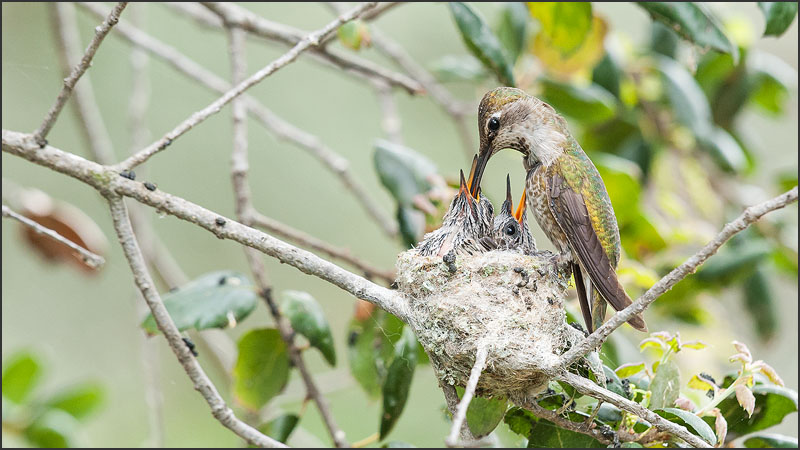
These chicks are already a couple of weeks old. At 3 weeks old they will look more like Hummingbirds, and will be testing out their wings more to get ready for flight. Once they’re flying the Female will show them how to catch bugs, and drink nectar, and within a few days of that the chicks will fly away as adults never to return to the nest.
I can’t tell you how amazing this was to watch and photograph! It was gift! It’s so moving, and beautiful watching her feed the chicks and knowing how dedicated she is, and how tired she must be. These images were made on March 18, 2017
I dropped by Thursday afternoon (3/23) to see them. They were still in the nest with Mama feeding them every 20 minutes. There was quite a crowd there, and I had #1 Grandson with me. He got a kick out seeing the chicks too. I didn’t break out my camera today. I was holding #1 in my arms so he could see them, but I’m hoping I can get back over once more before they fly from the nest which may be as early as a week and a half away.
For more information about Hummingbird chicks you can visit http://www.worldofhummingbirds.com/baby.php
Nikon D700| Nikkor 200-500mm| Lexar Digital Film| PS CC 2017
Have a wonderful week-end everyone!
More to come…
Copyright © 2017 Deborah M. Zajac. ALL RIGHTS RESERVED
The American Kestrel is the littlest Falcon in North America and the most colorful. They’re quite fierce for the size. They often perch on wires, or poles to watch and wait for unsuspecting prey. ” Hunting for insects and other small prey in open territory, kestrels perch on wires or poles, or hover facing into the wind, flapping and adjusting their long tails to stay in place.”~AllAboutBirds.com
Gordon and I stopped at San Luis National Wildlife Refuge on Saturday morning before joining a Meet-Up group we’re in at another National Wildlife Refuge and while on the auto route where the Tulle Elk are we spotted this Kestrel on a post. It was just after a heavy rain storm so there was Tulle Fog all over the valley hence the white sky. I love the rain drops or dew drops on his breast feathers.
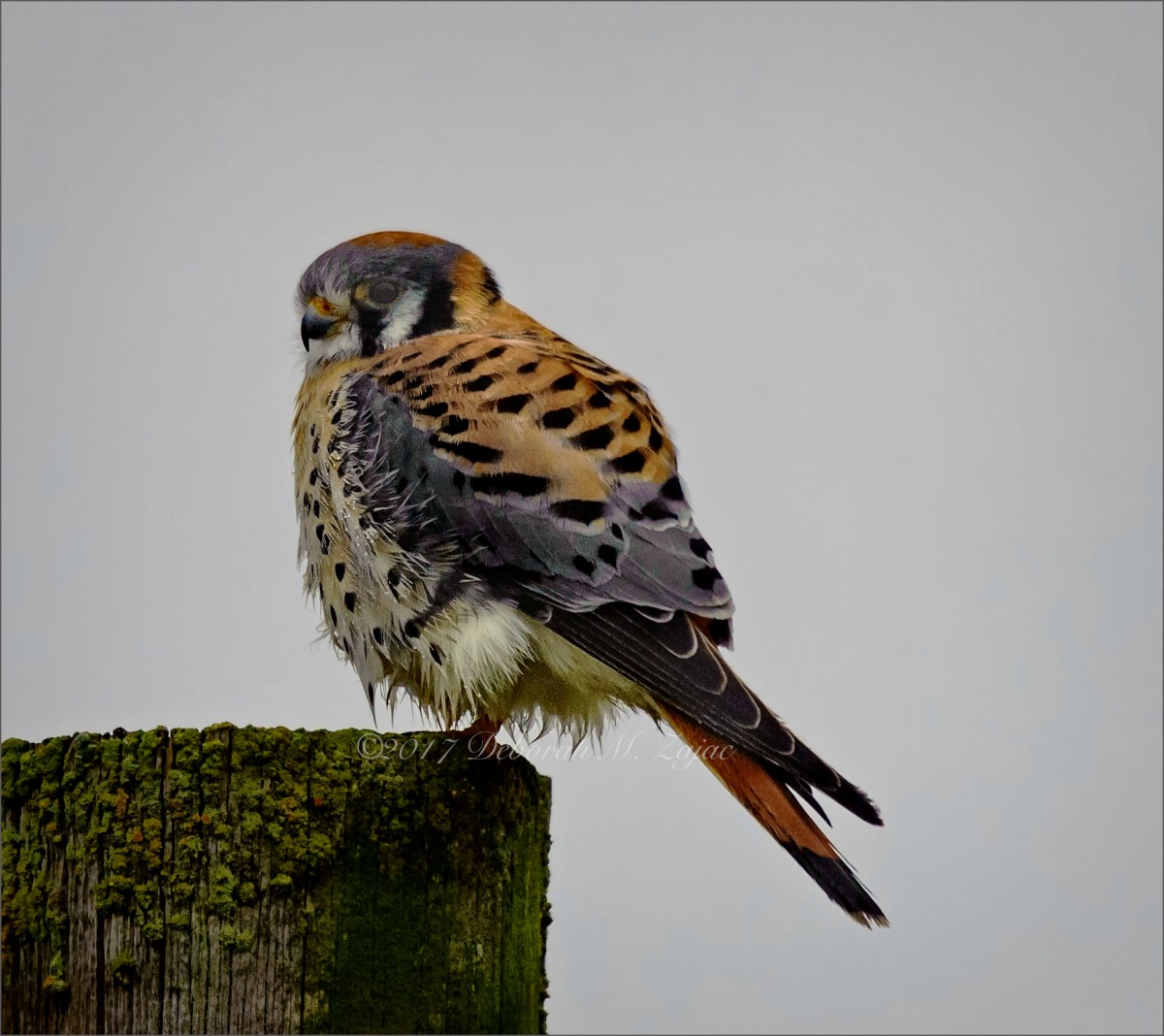
We didn’t see any Tulle Elk in the paddock. Not one! They must have been deep in the trees until it warmed up. Thankfully for us this Kestrel was out and about looking for breakfast!
Nikon D700|Nikkor 200-500mm @ 460mm| Lexar Digital Film| PS CC 2017
More to come…
Copyright ©2017 Deborah M. Zajac ALL RIGHTS RESERVED
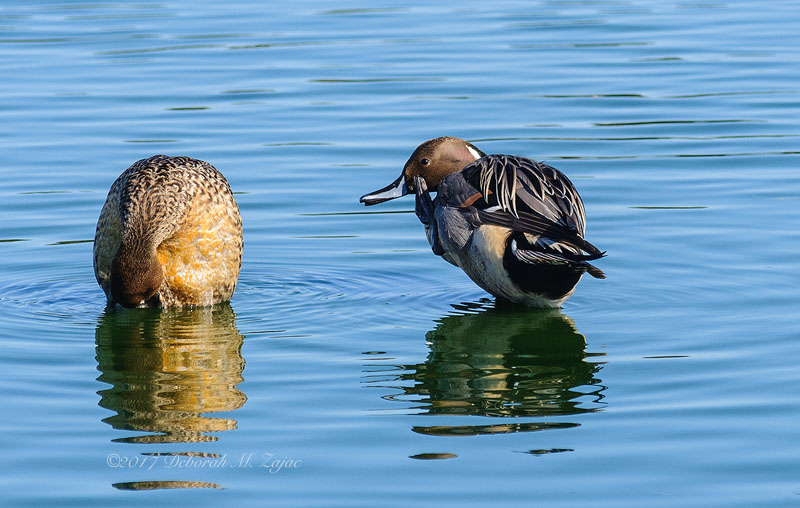
Northern Pintail-pair
Nikon D300s| 80-200mm @200mm + Tamron 1.4x TC| SanDisk Digital Film| Image made in 2011| PS CC 2017
More to come…
Copyright ©2016 Deborah M. Zajac ALL RIGHTS RESERVED
As we approach the end of 2016 I’m looking back on the year’s images; seeing which were the most liked by others, which images I love, which techniques failed, or succeeded, and falling in love all over again with the places I’ve visited, and the people I met during the last year.
I made thousands of images in 2016 whittling them down to just 10 isn’t easy when I love so many, and divorcing myself from the emotional aspects of making the images and being purely objective is hard!
While going through my images I also took a look at my 2016 Top Ten most viewed images over at my Flickr site. Since those are easier to get to I thought I’d share those images with you again this year. Most of these you’ve seen before if you’ve been following my blog this year. Voici!
1) 
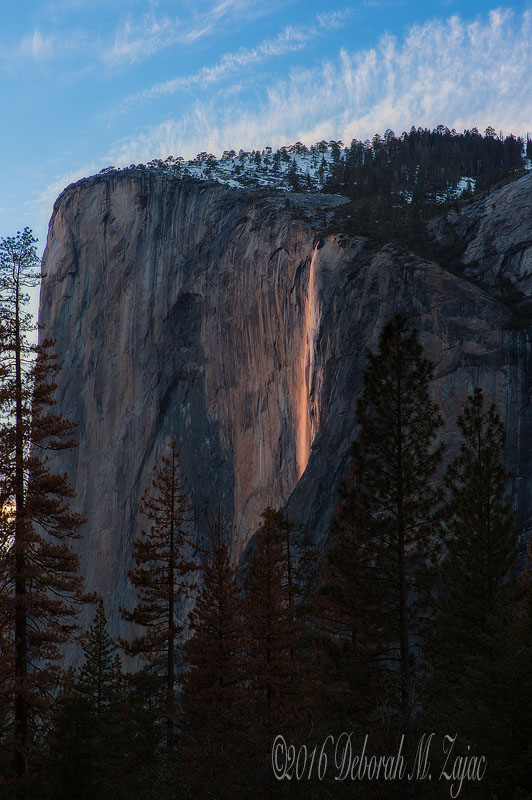
2)
3)
4)
5)
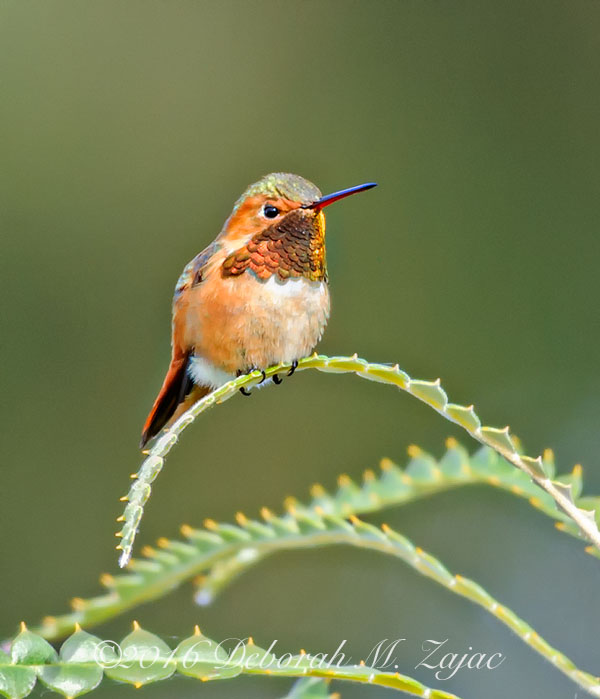
6)
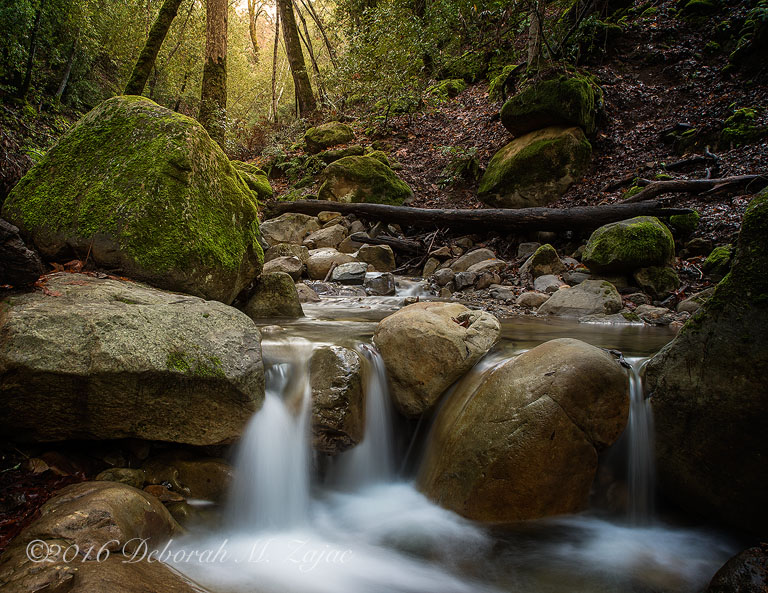
7)
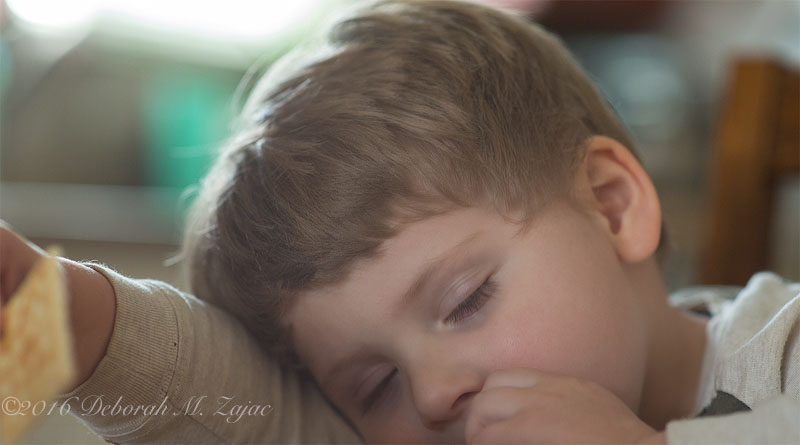
8)
9)
10)
Voila! The Top 10 2016 Most Viewed Images on my Flickr site.
I’ve whittled down my favorites of the year down to 35. Getting that number down to 10-15 is my next task and I’ll share those images soon!
I hope those that celebrate Christmas had a lovely Holiday, and those celebrating Hanukkah are having a great one so far, and I hope we all have a fantastic week!
More to come…
Copyright ©2016 Deborah M. Zajac. ALL RIGHTS RESERVED
After several years of trying to get a decent image of a Belted Kingfisher I finally got one yesterday while out birding with Gordon and other friends in the Pacific Flyway. I was birding in the refuge rich area north of Sacramento, CA. They asked me to show them around the place and I was eager and happy to do it.
I’m sure Gordon will share many of his images too.

It was an amazing day of birding. We saw so many great birds. Most notable were the Belted Kingfisher, a Bald Eagle, American Bittern, Ring-necked Pheasants, Hawks, Falcon, Ibis, thousands of Snow Geese, some White Fronted Geese, northern pintails, shovelers, Egrets, Blue Herons, Night Herons, Sparrows, Wrens, Goldfinches, Hummingbirds, Warblers, maybe a Thrush of some sort. Need to work on getting an ID on it.
There were quite a few more types of birds seen. We even saw some other wildlife; skunk, deer, and hares, but for me getting this image means no more agonizing over all the butt shots, missed shots, blurry in flight shots, and how very skittish they are! 🙂 I finally got the shot!! 🙂
This one was quite content to sit on this branch looking at the pond below her while keeping an eye on us too. It was a gift!
Can you see me doing my “happy dance”? Yeah, I’m still dancing. 🙂 We had a GREAT day of birding.
Nikon D700| Nikkor 200-500mm| Lexar Professional Digital Film| PS CC 2017
More to come.


You must be logged in to post a comment.