P52 26/52 Milky Way Rising and Falling Star

Copyright © 2014 Deborah M. Zajac. ALL RIGHTS RESERVED
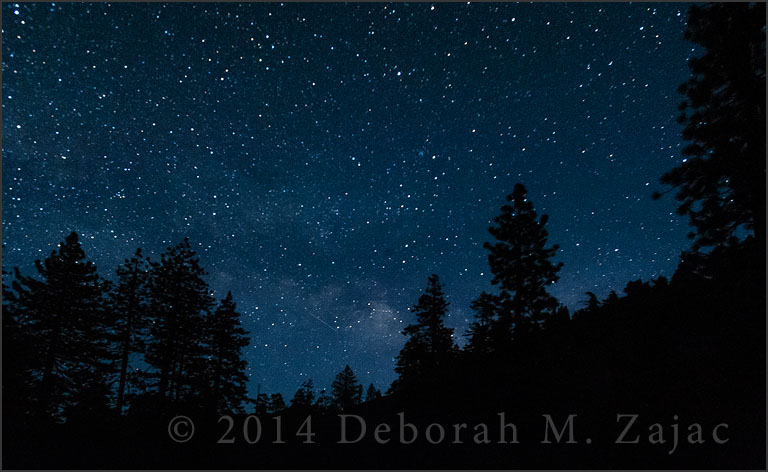
P52 26 of 52 Milky Way  Rising and Falling Star Stanislaus NatioSome friends and I went camping in North Eastern CA over the week-end to take advantage of the Moonless nights, and get away from light pollution which is ideal for night sky imaging. I got lucky and saw quite a few falling stars throughout the week-end.
The sky was so dark that ISO 3200 wasn’t enough to bring out more of the Milky Way’s light. I made adjustments the following evening. In this image the Milky Way is just rising above the mountains and was still too light out to get the rich detail of the gas, dust, and dark vein of the Great Rift, but I want to share the falling star that was streaking along the MW that I captured. Though faint I thought it was neat.

Nikon D700| AF-S Nikkor 17-35mm @17mm | 20 seconds| ISO 3200| Manual Priority| Tripod

Travelerette enjoying the view of the Stanislaus River. This was right behind our campsite.
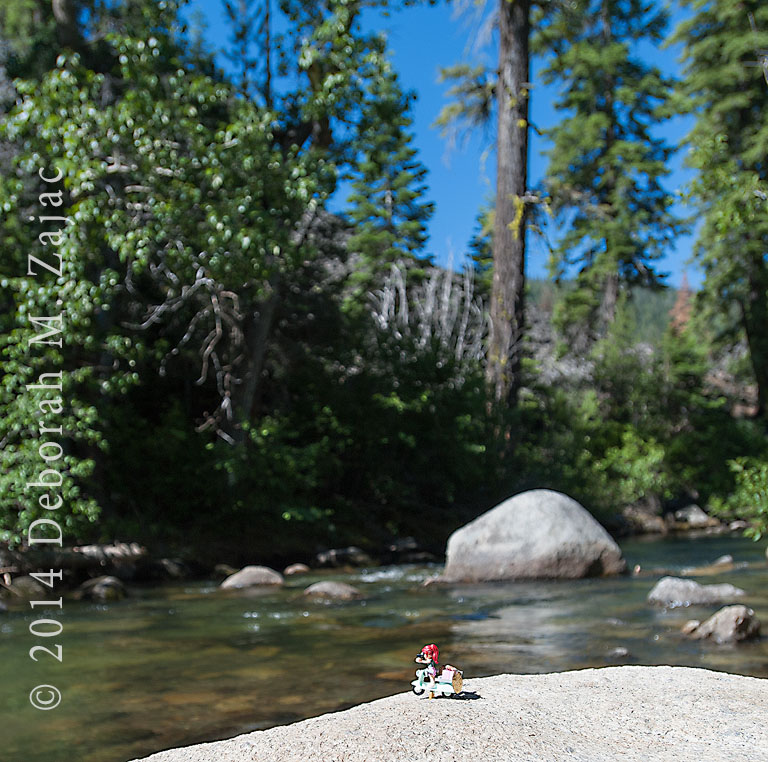
Travelerette on the  Stanislaus RiverOur campsite was in a Walk-in campground.  There were 10 campsites, with one Vault toilet, no potable water, and tent camping only. Fortunately, we were able to get a spot with shade and on the river. No reservations; this campground is “first come-first serve.
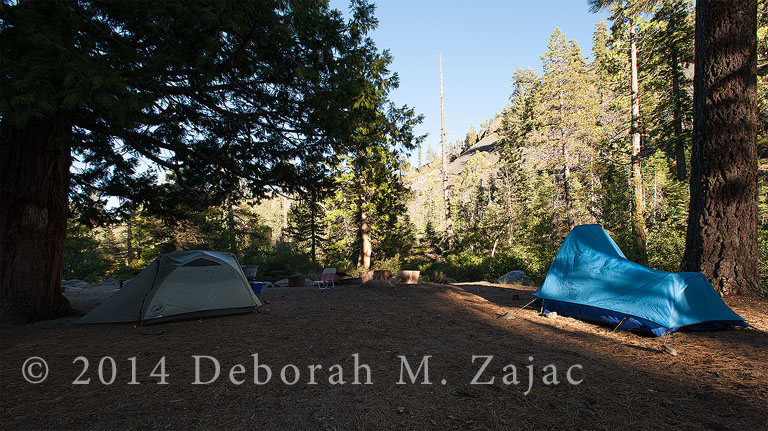
Campsite No 4My tent is on the left under a big pine tree. It’s a Big Agnes 2. I have plenty of room for me and my stuff.  The tent set up is color coded so, it’s a breeze to set up.

I took my old Red Rider wagon which made hauling our gear to and from the campsite a piece of cake. The hike in was about an 1/8 of mile…maybe a wee bit less. The days were hot, but not unbearable, sitting in the shade I got chilly, the nights, and mornings were chilly, but by 8AM both mornings I was shedding layers. We met some lovely people all were also from the Bay Area.

more to come…
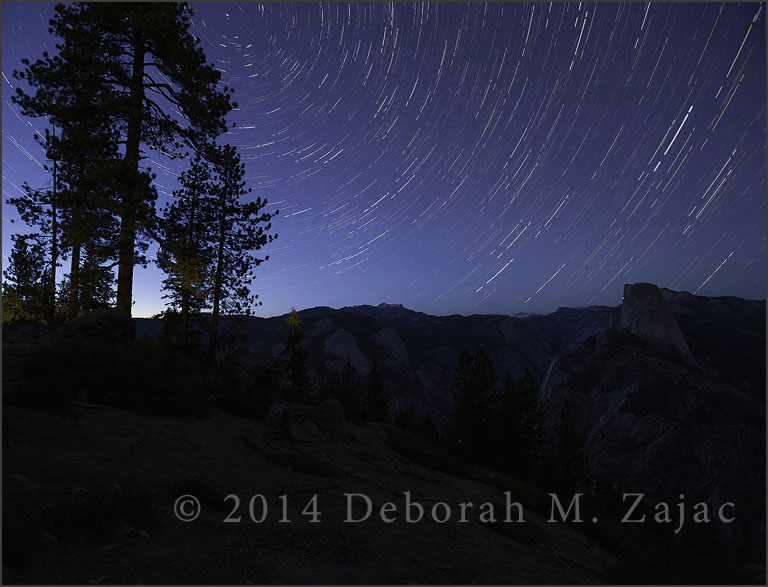
 

P52 21/52 One Thousand Five Hundred Seventy Five Seconds under the Stars

Copyright © 2014 Deborah M. Zajac. All Rights Reserved.

P52 21 of 52 One Thousand Five Hundred Seventy Five Seconds undeTaken from Washburn Point in Yosemite National Park.

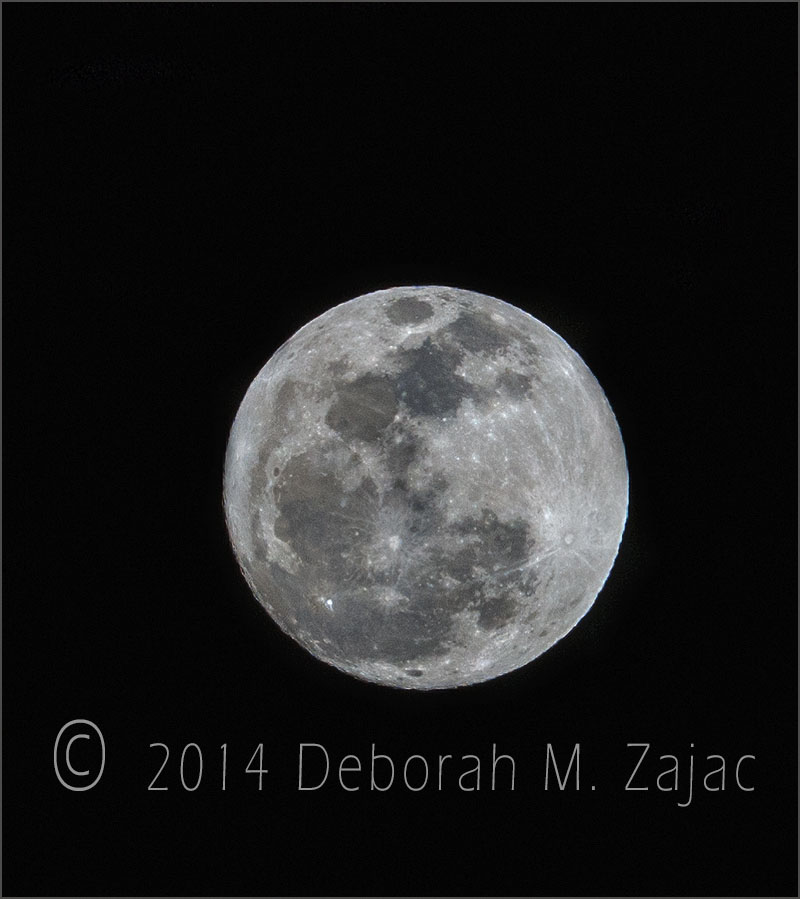
Last week while in Yosemite I shot the stars for an hour, but the Moon was out early and so bright, being nearly Full that it washed out the majority of the stars. I decided to make a return visit since the Moon wasn’t going to rise until midnight.

I thought I’d be alone up there after sunset, but there were two more star/night sky enthusiast there. It was really nice to have the company.
It was lovely meeting you both David, and Brian!

15 frames| 105 seconds each| stacked in StarStaX

P52 17/52 Spring Morning Sun

Copyright © 2014 Deborah M. Zajac. All Rights Reserved.

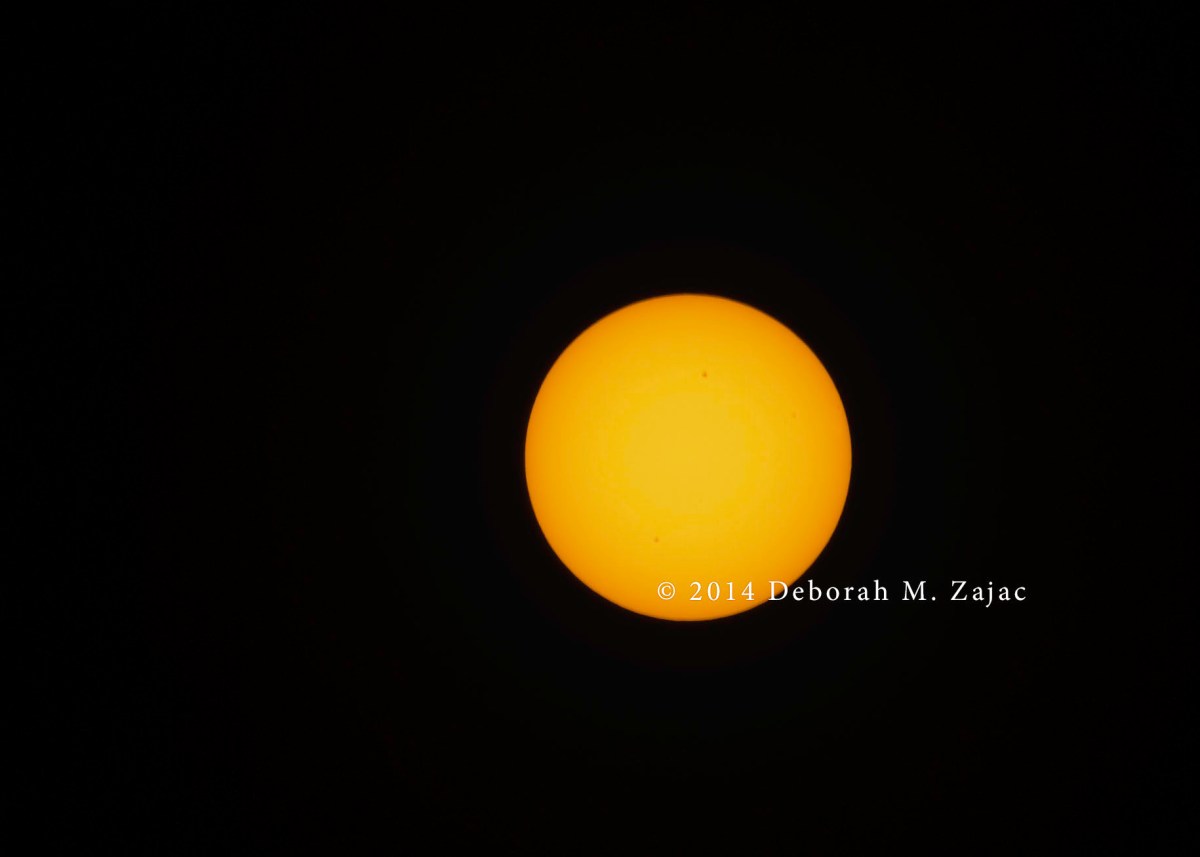
Project 52 17 of 52 Spring Morning SunIt’s been sometime since I last made an image of the Sun so, I thought I’d dig out my Solar Filter and capture the Sun while it was still fairly low in the morning sky for this week’s Project 52 image.

There are two nice Sun Spots showing up in this image; one in each hemisphere. I’ll have to look at NOAA’s image and see how many they see with their bigger lens and better filter.

I had a nice surprise when I opened the Solar Filter’s box. I discovered the B+W ND Filter I’ve been looking for. I couldn’t remember where I put it, but knew I put it somewhere safe when I was boxing up the house to have new carpeting and flooring put in last October. I have been looking for this ND filter for months. I’m happy to have found it. I will use it next month when I return to Yosemite for my birthday hike.
Nikon D300s| AF-S Nikkor 300mm f4@ f20| 1/30s| ISO 200| Manual Priority| Matrix Metering| Tripod| Orion Solar Filter

Iridium Flare

Copyright 2013 Deborah M Zajac. All Rights Reserved

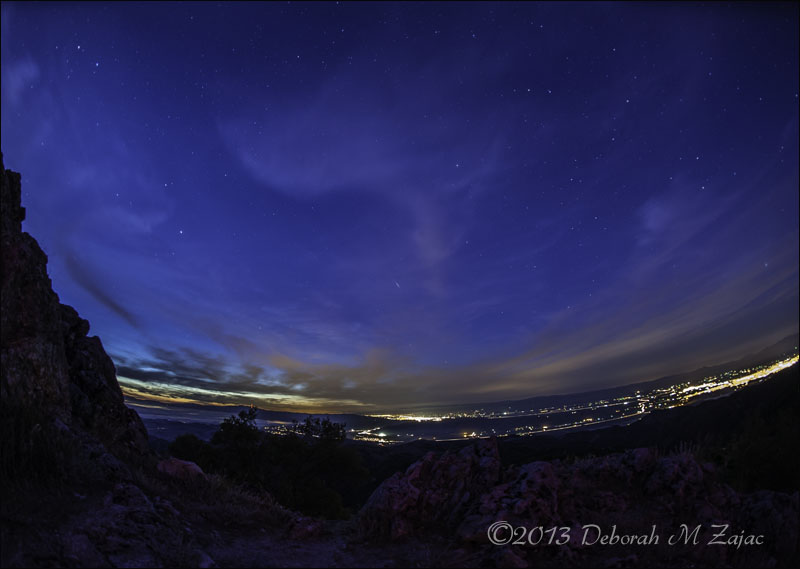
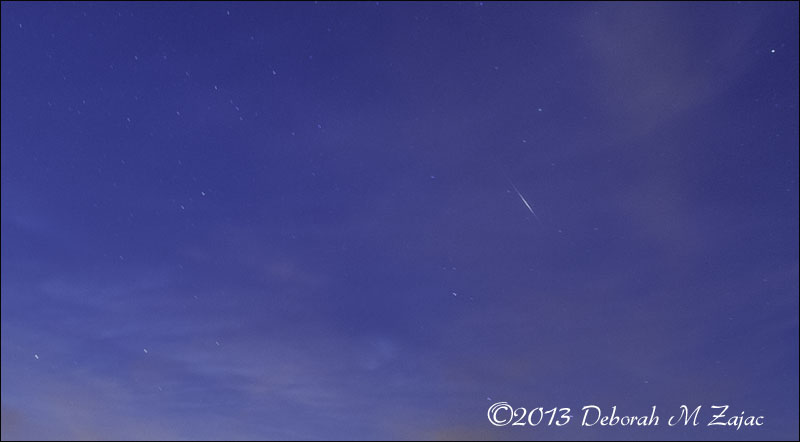
Iridium Flare?I took this photo last month when I was shooting in Fremont Peak State Park with several Night Sky Photographers. This is one of the set-up/ test shots I took before starting my star trail sequence. After uploading the frames I was going through them and discovered I may have caught an Iridium Flare. Iridium Flare is the sun reflecting off communication satellites orbiting in space. ” The Iridium communication satellites have a peculiar shape with three polished door-sized antennas, 120° apart and at 40° angles with the main bus. The forward antenna faces the direction the satellite is traveling. Occasionally, an antenna reflects sunlight directly down at Earth, creating a predictable and quickly moving illuminated spot on the surface below of about 10 km diameter. To an observer this looks like a bright flash, or flare in the sky, with a duration of a few seconds.

Ranging up to -8 magnitude (rarely to a brilliant -9.5), some of the flares are so bright that they can be seen in the daytime; but they are most impressive at night. This flashing has caused some annoyance to astronomers, as the flares occasionally disturb observations and can damage sensitive equipment.

When not flaring, the satellites are often visible crossing the night sky at a typical magnitude of 6, similar to a dim star.” ~Wikipedia

I realize the flare is hard to see in this photo so I’ve zoomed in on it and cropped it out to enable one to see it better. It has the classic shape of Iridium Flare. I took this photo on May 11, 2013 at 9:06pm PDT.

Close of FlareI need to check out the site that has predictions to see if this could be Iridium Flare.  I think the site is called Heaven’s Above.

Nikon D700| Nikkor 16mm Fisheye lens

Update: After checking the Heaven’s Above site to see if there was an Iridium Flare predicted on the date and time I took this photo I found there was a predicted flare on May 10, 2013 at 19:31 h.  in the same place in the sky as this flare. I’m confused. Nothing was listed for May 11th. The site says all times are local. Do I need to factor in Daylight Savings time? I wondered if it could another satellite?  Searching the sites FAQ’s I found this.

Q. While I was out waiting for a flare or other satellite to appear, I saw another flare which wasn’t in the predictions. What could it have been?
A. This was probably a flare from a failed Iridium satellite. Several satellites have failed in orbit, and are not in the nominal orbit and/or attitude. However, they can still produce flares just like the operational ones. The difference is, that we can’t predict when they will happen.

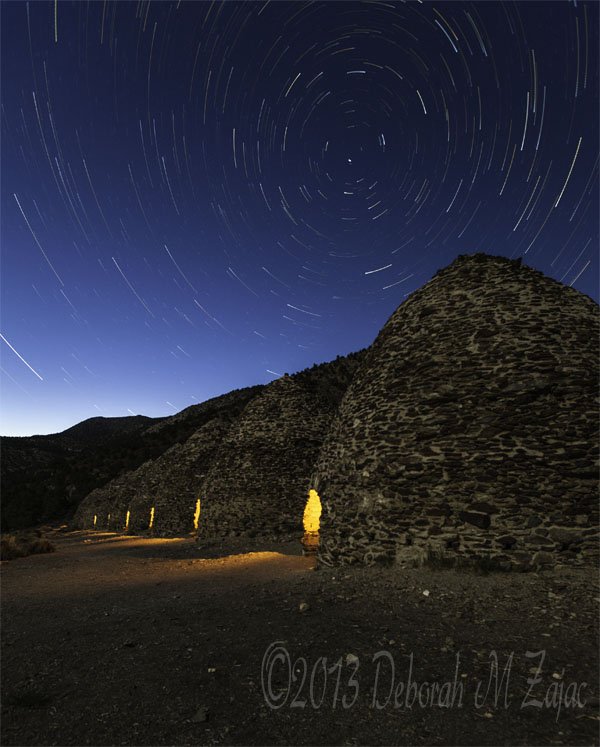
Polaris over the Charcoal Kilns Death Valley National Monument

Copyright © 2013 Deborah M Zajac. All Rights Reserved.

A year or two ago I saw my friend Rick Whitacre’s photograph of the Charcoal Kilns with Star-trails and loved it so much I hoped to photograph it myself on my next trip to Death Valley.  The first two nights of my recent visit to Death Valley National Monument I had clouds or partial cloudy skies, but the last night the sky was clear so He-Man and I headed to the Wildrose Charcoal Kilns so I could make a photograph of the kilns with star-trails.

Star Trails over the Charcoal Kilns Death Valley CaliforniaHe-Man and I drove out the Charcoal Kilns arriving just before sunset.  I got my gear out and started planning and plotting my composition. Once I found my composition I started thinking about lighting the kiln doors.  I went inside several of the kilns to check out the size of the opening, and where the best place to stand might be. I’m glad we arrived here while it was light enough to see inside each kiln. If I had arrived in the dark I would have been a little apprehensive about critters sleeping inside the kilns, but they were empty.  On a side note: They’re huge inside!

He-Man was going to light the doors for me so we did a timed test-run to see if he would be able to get all the doors lit in one 2 minute exposure. I had purchased a Brinkman light (thanks Marsha for the model info!) I also brought my Rogue Gels along to use to change the light from white to an orange-yellow  to look like there was fire in the kilns, but  when it got dark enough to start shooting we did another trail run using the light, and it wasn’t quite as bright as I had hoped for. Thinking that might happen I also packed my Nikon SB600 Speedlight. I taught He-Man how to set the flash off then we did another trial run. Loving what I saw using the Speedlight I made my final test shots for my star trails then set up my Intervelometer to begin my series.

It was quite a bit cooler up here than it was down in the valley so I needed my jacket before I wrapped up for the night. There was a Hoot Owl in the trees behind me softly hooting, and there were crickets chirping, but no other sounds. He-Man had gone to the car to read and wait for me.  It was peaceful. I found my “happy place” here.
Thank you He-Man for lighting each door so well and for going with me! I’m really happy with this photo.

Nikon D700| Nikkor 17-35@17mm| f4| 30 frames stacked in CS6| 121 seconds| ISO 200| Manual Priority| Tripod

A couple of my friends have also traveled to Death Valley and made their own photo here please take a look!

Phil McGrew- Startrails over Wildrose Kilns

Alex Baranda- Stars and Kilns

For the History Buffs-

Wildrose Charcoal Kilns

“In 1877 construction on the kilns was completed. The produced charcoal that was used as fuel for two silver-lead smelters  that George Hearst had in the Argus Range 25 miles away.  The kilns operated until 1878 when the Argus mines shut down.

There are 10 kilns which stand 25ft tall, and have an approximate circumference of 30ft. Each kiln held 42 cords of pinyon pine logs, and would burn for a week producing 2,000 bushels of charcoal.” ~Digital Desert.com  http://digital-desert.com/death-valley-history/wildrose-kilns.html

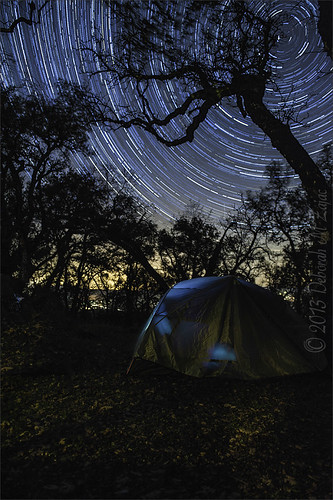
Campsite 24

Campsite 24, originally uploaded by dmzajac2004-.Copyright © 2013 Deborah M Zajac. All Rights Reserved.

I’ve wanted to shoot my tent under the stars for about a year now. Last night the opportunity arrived. It’s not the shot I’ve imaged, but it was good practice and a great learning experience. As always there are a couple of things I’d do differently, but overall I like this shot.

I had a lot of fun hanging out with like-minded photographers last night, and I hope to do more shoots like this as the weather gets a bit warmer.

Nikon D700| Nikkor 24-70 @ 24mm|  f/3.5| 48 frames each 121 seconds| ISO 160| Manual Priority| Tripod| Developed in LR4.4| Stacked in CS6