Copyright ©2025 Deborah M. Zajac. ALL RIGHTS RESERVED.
PLEASE DO NOT USE MY IMAGES WITHOUT EXPRESSED WRITTEN PERMISSION.
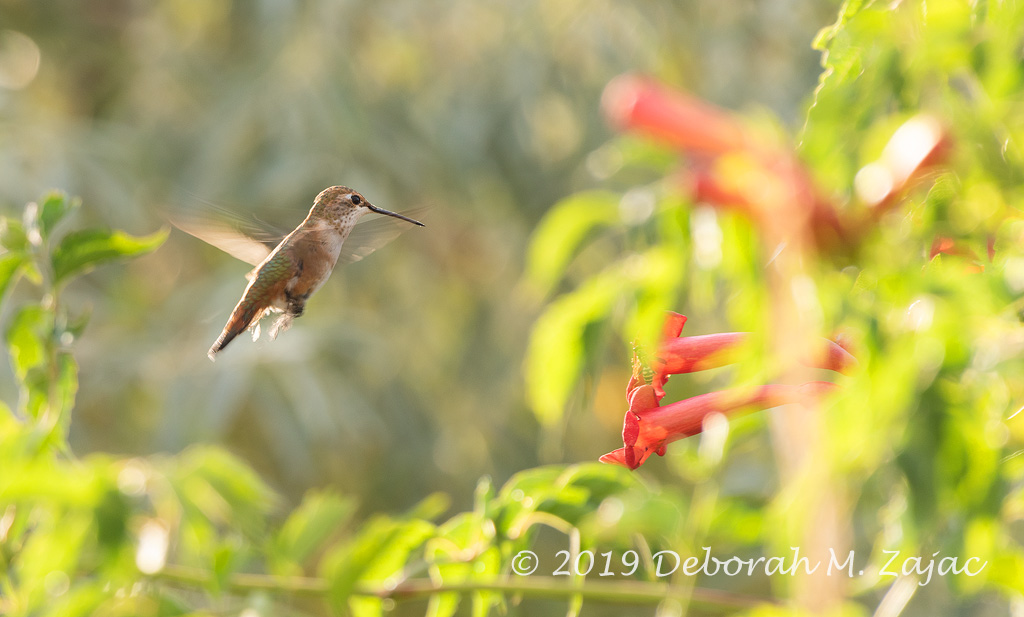
A few weeks ago a pair of Rufous Hummingbirds returned to my backyard feeder. They’ve been chasing off the Black-chinned and having skirmishes all day everyday since their return.
I’m beginning to think I need to add another Shepard’s hook and feeder so the territorial squabbling gets better.
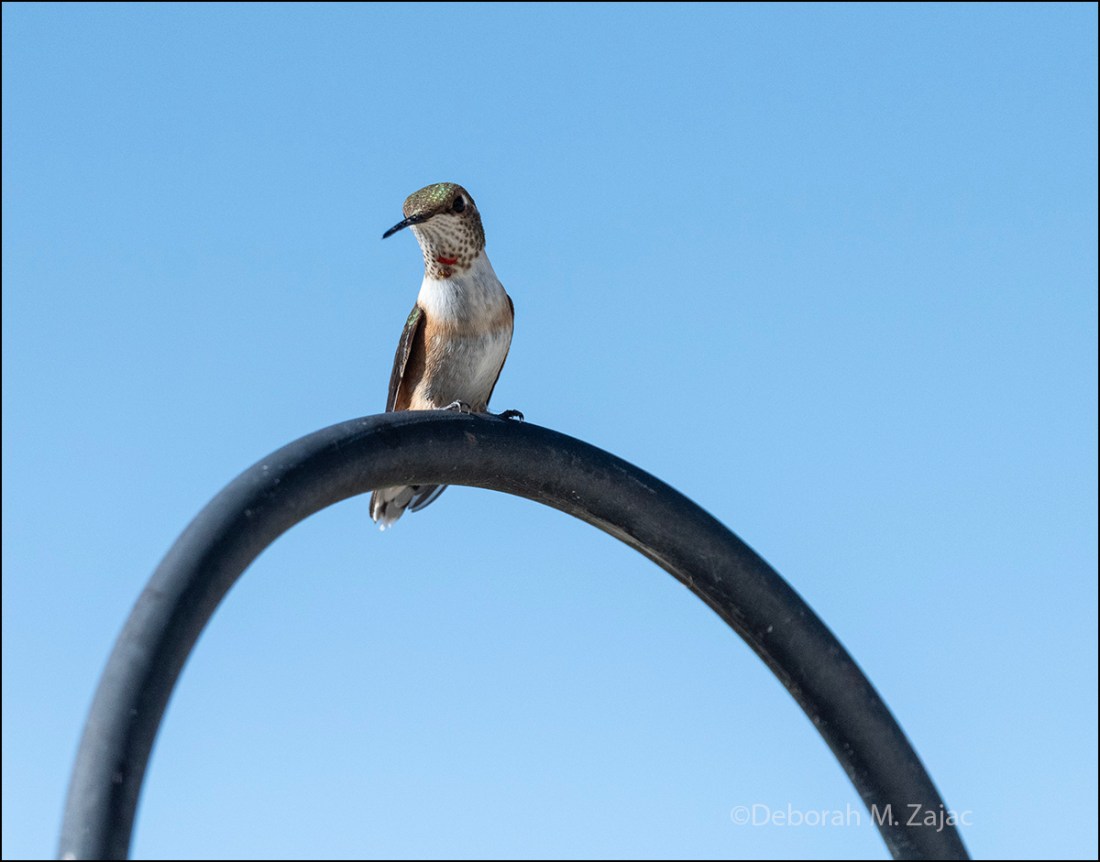
Here’s what I think is a female perched on top of the hook claiming possession. She lands here on and off all day long letting the other Hummingbirds know this is her feeder. You can see a little bit of her Gorget on her throat.
Here she is just after chasing off two other Hummingbirds. I love her tail!
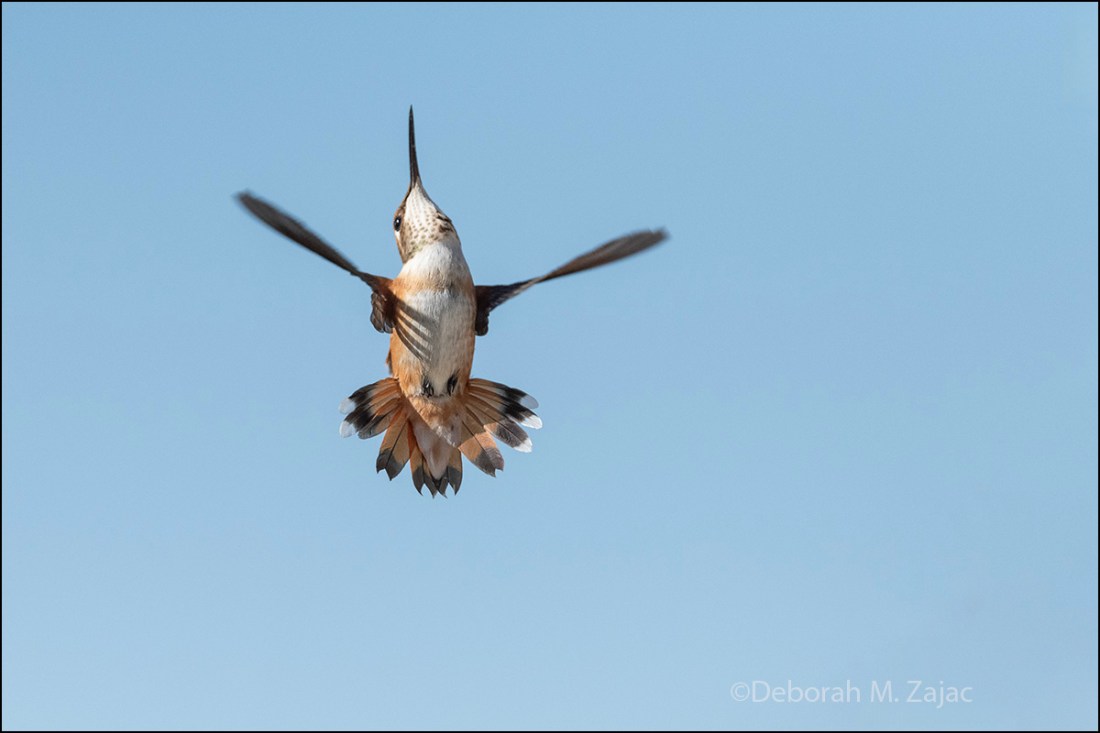
I could be wrong about her sex as it could also be an immature female/ male. If you know which it is please let me know.
Fun Facts:
- The Rufous Hummingbird is a common visitor to hummingbird feeders. It is extremely territorial at all times of year, attacking any visiting hummingbird, including much larger species. They’ve been seen chasing chipmunks away from their nests.
- The Rufous Hummingbird makes one of the longest migratory journeys of any bird in the world, as measured by body size. At just over 3 inches long, its roughly 3,900-mile movement (one-way) from Alaska to Mexico is equivalent to 78,470,000 body lengths. In comparison, the 13-inch-long Arctic Tern’s one-way flight of about 11,185 mi is only 51,430,000 body lengths. (AAB)
- During their long migrations, Rufous Hummingbirds make a clockwise circuit of western North America each year. They move up the Pacific Coast in late winter and spring, reaching Washington and British Columbia by May. As early as July they may start south again, traveling down the chain of the Rocky Mountains. People first realized this pattern after examining detailed field notes and specimens, noting the birds’ characteristic dates of arrival on each part of the circuit.
- The Rufous Hummingbird has an excellent memory for location, no doubt helping it find flowers from day to day, or even year to year. Some birds have been seen returning from migration and investigating where a feeder had been the previous year, even though it had since been moved.
- The Rufous Hummingbird breeds as far north as southeastern Alaska – the northernmost breeding range of any hummingbird in the world. Of the western hummingbirds that occasionally show up in the east, the Rufous Hummingbird is the most frequent.
- Rufous Hummingbirds, like most other hummingbirds, beat their wings extremely fast to be able to hover in place. The wingbeat frequency of Rufous Hummingbirds has been recorded at 52–62 wingbeats per second.
- The Rufous Hummingbird is not a colonially nesting species; however, there have been reports from Washington state that have 20 or more Rufous Hummingbird nests only a few yards apart in the same tree. (From the BNA)
- Hummingbirds are hard to catch, but there are records of Rufous Hummingbirds being caught by a large flycatcher (Brown-crested Flycatcher) and by a frog.
- The oldest recorded Rufous Hummingbird was a female, and at least 8 years, 11 months old when she was recaught and rereleased during banding operations in British Columbia in 2004.
I’ve been slower to your blogs this week as I’m visiting with family, and I will be for the next several days, but I’ll catch up!
Have a lovely week-end!!
Nikon D850| Nikkor 500mm| Fun Facts-https://www.allaboutbirds.org/guide/Rufous_Hummingbird/overview
more to come…
 Circadianreflections Blog
You must be logged in to post a comment.