Something for Sat. Ruby Crowned-Kinglet

Copyright ©2024 Deborah M. Zajac. ALL RIGHTS RESERVED. 

PLEASE DO NOT USE MY IMAGES WITHOUT EXPRESSED WRITTEN PERMISSION.

I don’t want the week to go by without a post so here we have me posting on a rare Saturday.

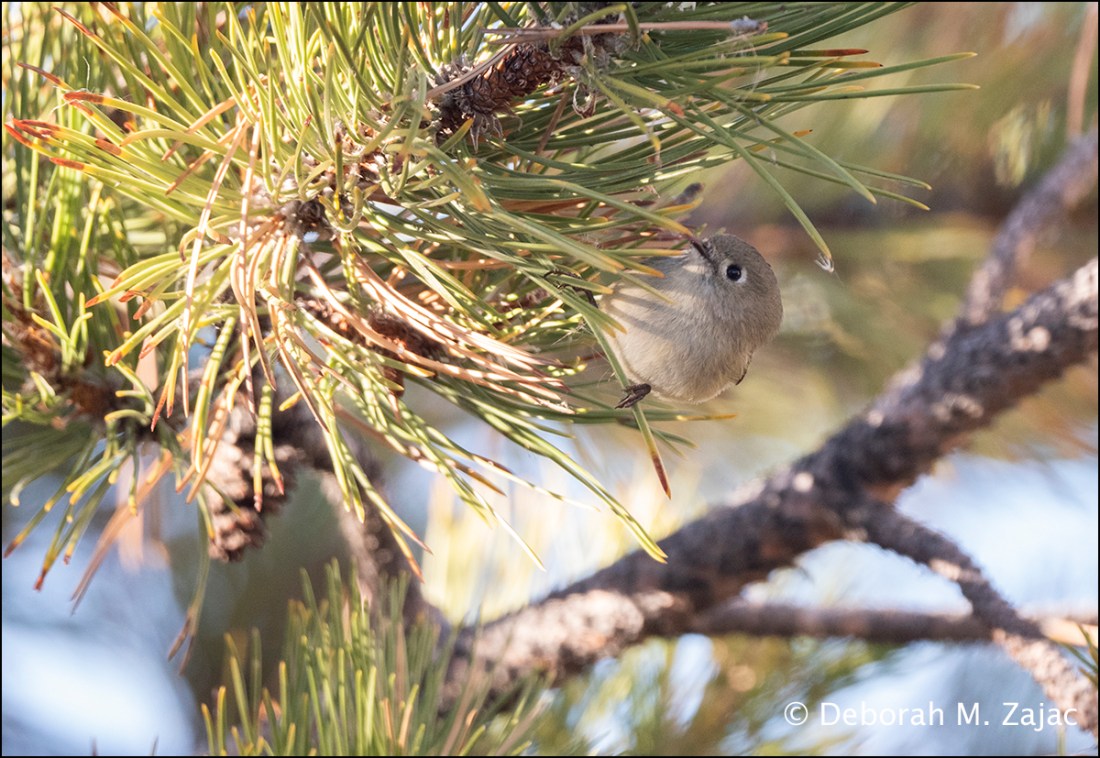
This little Kinglet is so cute, but very flitty normally but, on this day earlier this month I was able to get quite a few good looks at this one.

They’re a small bird being only 3.5-4.3 inches in length, and weigh 0.2-0.3 ounces.

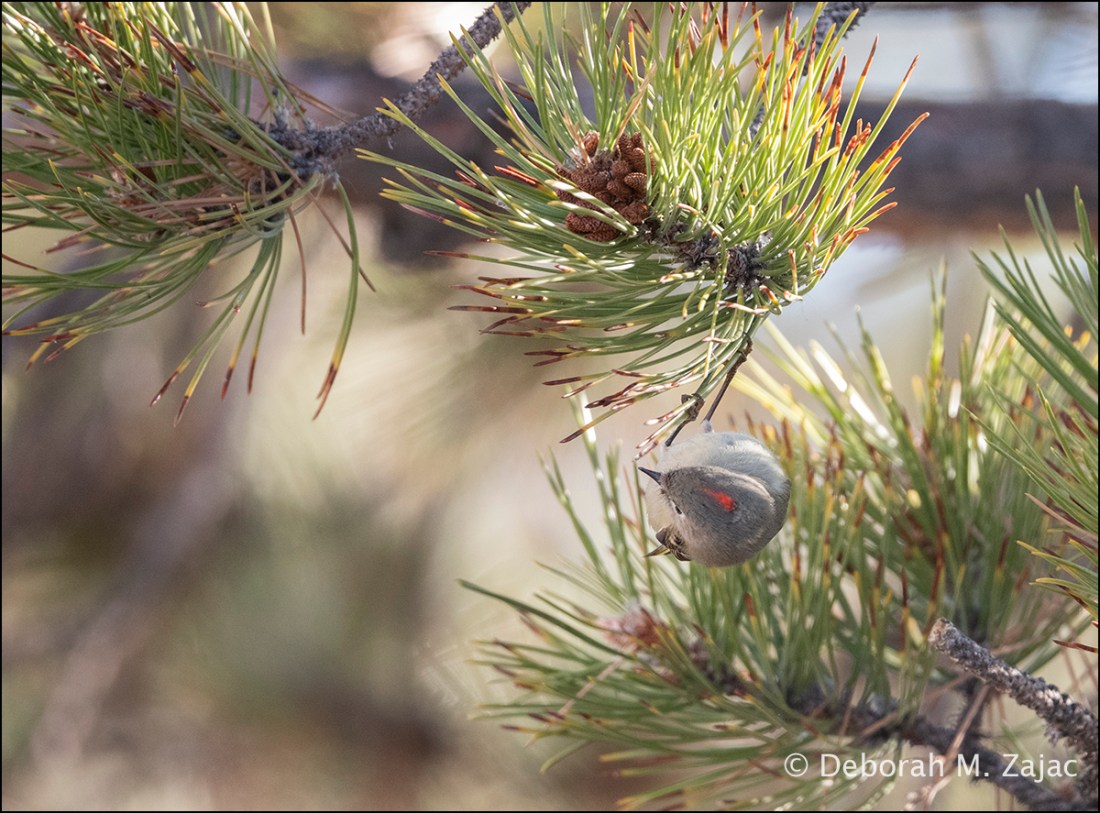
They get their name from a Ruby spot on their crown.

I have yet to see it flared, but here’s a look at the top of its head showing the Ruby spot.

This one is busy being an acrobat which afforded me a good look at its Ruby Spot which was a treat. Just look at how light they are it’s holding onto those pine needles and they aren’t bending!

Fun Facts:

  • The Ruby-crowned Kinglet is a tiny bird that lays a very large clutch of eggs—there can be up to 12 in a single nest. Although the eggs themselves weigh only about a fiftieth of an ounce, an entire clutch can weigh as much as the female herself.
  • Ruby-crowned Kinglets seem nervous as they flit through the foliage, flicking their wings nearly constantly. Keeping an eye out for this habit can be a useful aid to identifying kinglets.
  • Metabolic studies on Ruby-crowned Kinglets suggest that these tiny birds use only about 10 calories (technically, kilocalories) per day.
  • The oldest known Ruby-crowned Kinglet was a female, and at least 8 years, 8 months old, when she was recaptured and rereleased during banding operations in Texas in 2017. She was banded in the same state in 2008.

Fun facts gleaned from allaboutbirds.orghttps://www.allaboutbirds.org/guide/Ruby-crowned_Kinglet/overview

I hope you all have a great week-end!

Nikon D810| Nikkor 500mm PF-e| PS CC 25.3.1

more to come…

Whatever Weds. Occultation of Antares

Copyright ©2024 Deborah M. Zajac. ALL RIGHTS RESERVED. 

PLEASE DO NOT USE MY IMAGES WITHOUT EXPRESSED WRITTEN PERMISSION.

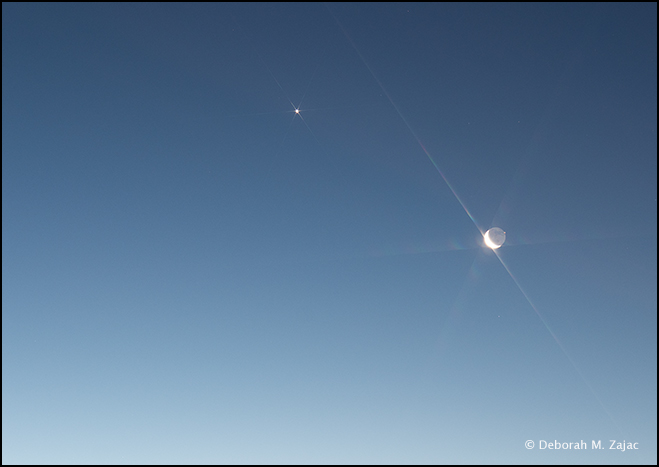
January 8th just at dawn I photographed my first celestial event of the year. The Occultation of the crescent moon and Antares the brightest star in the constellation of Scorpius.

The tiny dot of light on the Earthshine side of the crescent moon is Antares right before it slipped behind the Moon. Venus the morning star shines brightly above and to the left of the Moon.

I give you three views, one with my star filter on my lens, one with my ultra wide angle lens, and one deeply cropped to show Antares slipping behind the Moon.

20mm view of the Crescent Moon, Venus, and Antares.

Crescent Moon, Antares, Venus dawn January 8, 2024

Venus above and left of the Crescent Moon, Antares a tiny dot of light on the Earthshine side of the Crescent Moon just before it disappeared behind the Moon.

I was in a bit of a rush putting on my star filter so it went on askew so some of the star lines aren’t clean, and worse it’s now stuck. It’s on too tight for me to unscrew it, and I broke my filter wrench some time ago removing a ND (neutral density) filter, and failed to replace it. DOH! I have ordered a new one…and not a plastic one this time. It should arrive today.

We had our first big snow drop that stuck on Sat/Sun. It required shoveling. My neighbor bought a new cordless snow-blower and did our driveway twice! I just shoveled the clean up and the road below our driveway. She’s a jewel! She said it took just 12 minutes to do the driveway. We’ve made a deal. She’ll do the snow-blower and I do the clean up shoveling on 3 driveways and sidewalks. I told her I’d spring for the Hot Cocoa with marshmallows!

We have another big storm coming this weekend which is going to mess up my plans to meet friends, and do some birding at one of our favorite California refuges. It’s going to snow here, and in the mountains I’d need to cross, and it’s got rain on the forecast for there. It’s always a risk in the winter though isn’t it. Looks like I’ll be cancelling my plans.

Hopefully, we can meetup in February.

That’s me all caught up. How’s it going for you? Were any of you up and notice the tiny reddish star right beside the moon Monday morning?

Nikon D810| Nikkor 24-120mm & Nikkor 20mmG| PS CC 25.3.1

more to come…

Whatever Weds. American Kestrel

Copyright ©2023 Deborah M. Zajac. ALL RIGHTS RESERVED. 

PLEASE DO NOT USE MY IMAGES WITHOUT EXPRESSED WRITTEN PERMISSION.

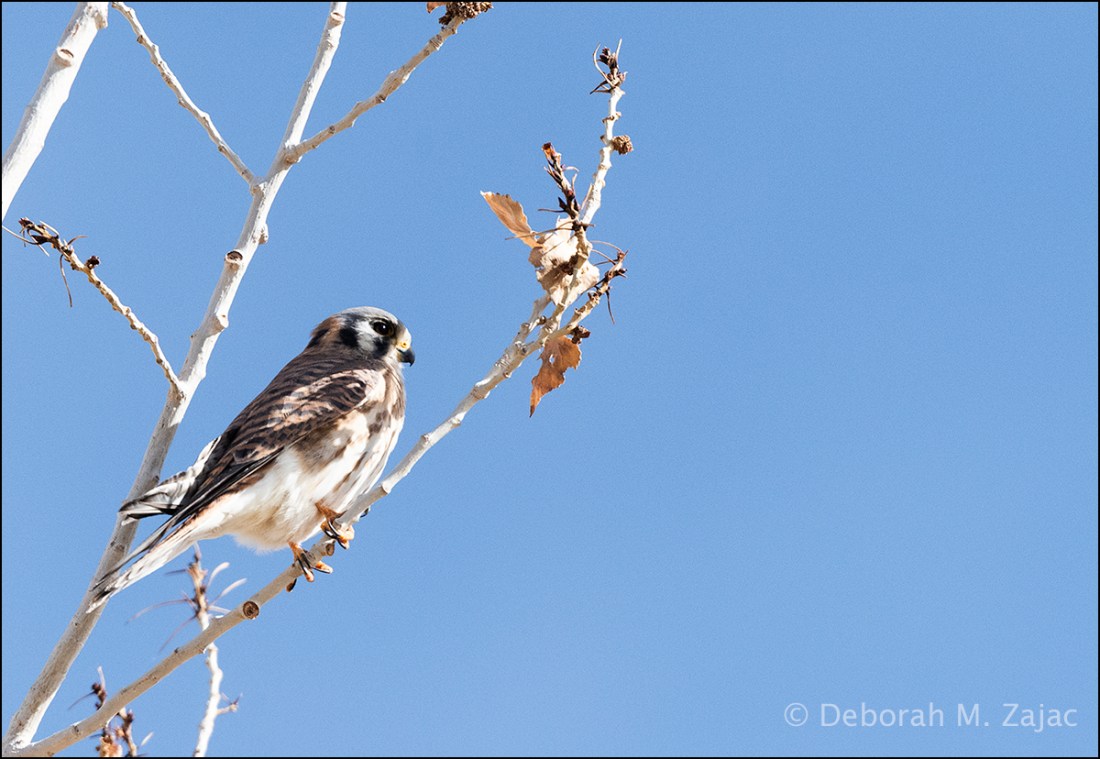
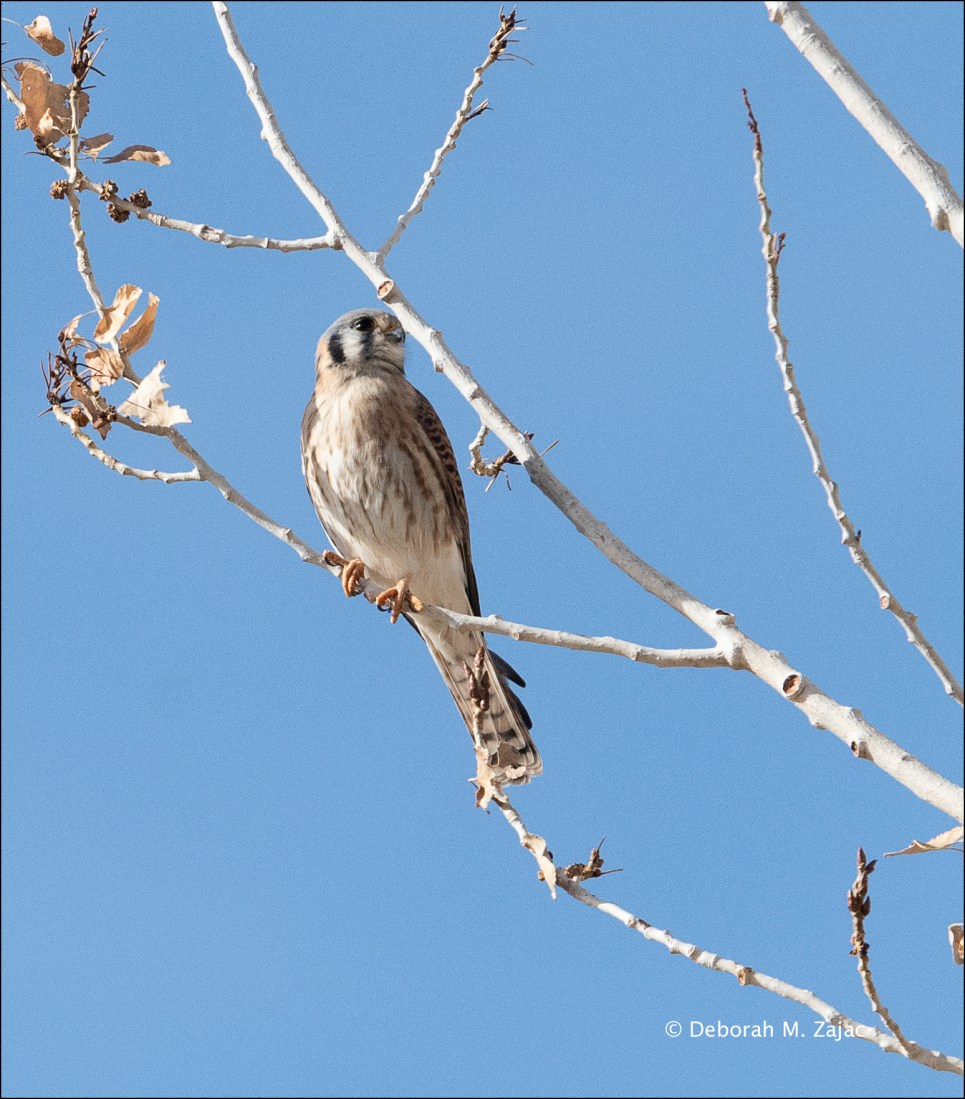
This is a Kestrel I saw in December. I’ll show her from the two sides I got to observe her from. It’s a treat to actually get two side views of a bird.

When I first spotted her high in a Cottonwood tree-

Female American Kestrel

They’re one of the smallest birds of prey, but so cute.

Here she is from the other side, with her chest showing.

American Kestrel Female

Fun Facts:

    • Sports fans in some cities get an extra show during night games: kestrels perching on light standards or foul poles, tracking moths and other insects in the powerful stadium light beams and catching these snacks on the wing. Some of their hunting flights have even made it onto TV sports coverage.
    • When nature calls, nestling kestrels back up, raise their tails, and squirt feces onto the walls of the nest cavity. The feces dry on the cavity walls and stay off the nestlings. The nest gets to be a smelly place, with feces on the walls and uneaten parts of small animals on the floor.
    • It can be tough being one of the smallest birds of prey. Despite their fierce lifestyle, American Kestrels end up as prey for larger birds such as Northern Goshawks, Red-tailed Hawks, Barn Owls, American Crows, and Sharp-shinned and Cooper’s Hawks, as well as rat snakes, corn snakes, and even fire ants.
    • In winter in many southern parts of the range, female and male American Kestrels use different habitats. Females use the typical open habitat, and males use areas with more trees. This situation appears to be the result of the females migrating south first and establishing winter territories, leaving males to the more wooded areas.
    • Unlike humans, birds can see ultraviolet light. This enables kestrels to make out the trails of urine that voles, a common prey mammal, leave as they run along the ground. Like neon diner signs, these bright paths may highlight the way to a meal—as has been observed in the Eurasian Kestrel, a close relative.
    • Kestrels hide surplus kills in grass clumps, tree roots, bushes, fence posts, tree limbs, and cavities, to save the food for lean times or to hide it from thieves.
    • The oldest American Kestrel was a male and at least 14 years, 8 months old when he was found in Utah in 2001. He was banded in the same state in 1987.

“Like neon diner signs”! 😂 I loved that description.

Fun facts gleaned from allaboutbirds.org

Happy New Year to all my blogging friends, and visitors!

Nikon D810| Nikkor 500mm| PS CC 25.3.1

more to come…

Merry Christmas!

Copyright ©2023 Deborah M. Zajac. ALL RIGHTS RESERVED. 

PLEASE DO NOT USE MY IMAGES WITHOUT EXPRESSED WRITTEN PERMISSION.

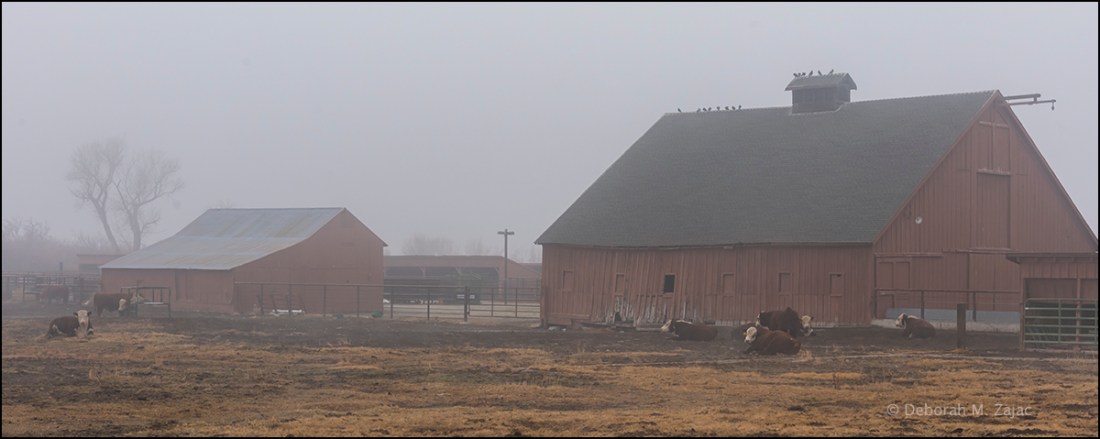
Carson River on a Foggy Morning 12.21.2023

Wishing you and yours a very Merry Christmas!

Nikon D810| Nikkor 24-120mm| PS CC 25.2.0

more to come…

Whatever Weds. Yellowlegs

Copyright ©2023 Deborah M. Zajac. ALL RIGHTS RESERVED. 

PLEASE DO NOT USE MY IMAGES WITHOUT EXPRESSED WRITTEN PERMISSION.

I saw this one foraging in a shallow pond earlier in the month. I think it’s a Lesser Yellowlegs, but if I’m wrong let me know! It’s so hard to tell it apart from the Greater Yellowlegs. I’m going on the bill not being too much longer than its head.

I don’t see this type of bird too often so it’s pretty neat when I do. It’s either passing through or hanging out for winter migration.

Yellowlegs

Fun Facts:

    • Despite their very similar appearance, Greater and Lesser Yellowlegs are not each other’s closest relatives. Lesser Yellowlegs is more closely related to the much larger Willet.
    • Lesser Yellowlegs are known for their steadfast defense of their eggs and chicks. Biologist William Rowan once noted, “they will be perched there as though the safety of the entire universe depended on the amount of noise they made.”
    • Both the male and female Lesser Yellowlegs provide parental care to the young, but the female tends to leave the breeding area before the chicks can fly, thus leaving the male to defend the young until fledging.
    • The Lesser Yellowlegs saw significant declines due to market hunting for the fashion trade. The species’ tendency to return and hover above wounded flock mates made them easy targets. Populations rebounded when market hunting was banned in the U.S and Canada in the early 20th century.
    • The oldest recorded Lesser Yellowlegs was at least 4 years, 11 months old when it was found in South Dakota in 1965. It had been banded in the Lesser Antilles in 1960.

more to come…

Sunday Stillness-Sliders & a Softshell

Copyright ©2023 Deborah M. Zajac. ALL RIGHTS RESERVED. 

PLEASE DO NOT USE MY IMAGES WITHOUT EXPRESSED WRITTEN PERMISSION.

Red-eared Sliders & Spiny Softshell
Slide Mountain View from Prison Hill East

Nikon D810| Nikkor 24-120mm & iPhone 14 Pro

more to come…