Friday’s Feathered Friends- Rufous Hummingbird

Copyright ©2025 Deborah M. Zajac. ALL RIGHTS RESERVED.

PLEASE DO NOT USE MY IMAGES WITHOUT EXPRESSED WRITTEN PERMISSION.

A few weeks ago a pair of Rufous Hummingbirds returned to my backyard feeder. They’ve been chasing off the Black-chinned and having skirmishes all day everyday since their return.

I’m beginning to think I need to add another Shepard’s hook and feeder so the territorial squabbling gets better.

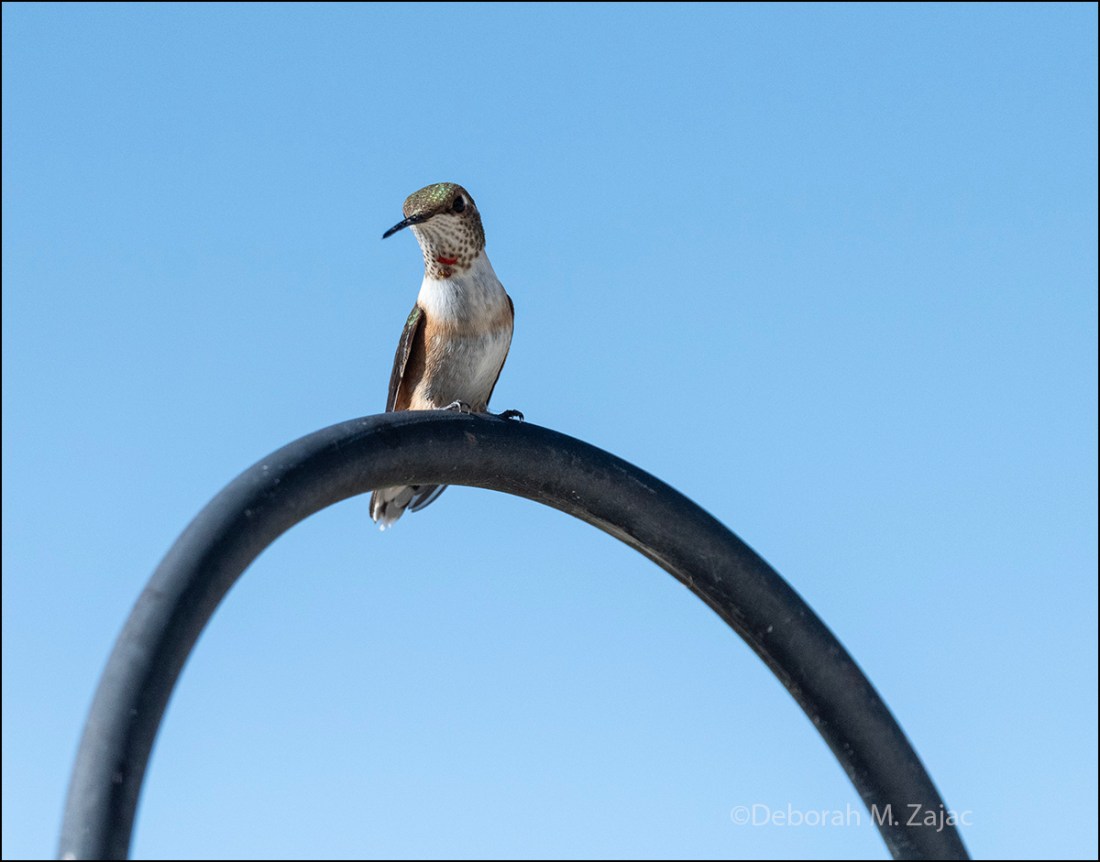
Here’s what I think is a female perched on top of the hook claiming possession. She lands here on and off all day long letting the other Hummingbirds know this is her feeder. You can see a little bit of her Gorget on her throat.

©Deborah M. Zajac | http//:circadianreflections.com Image

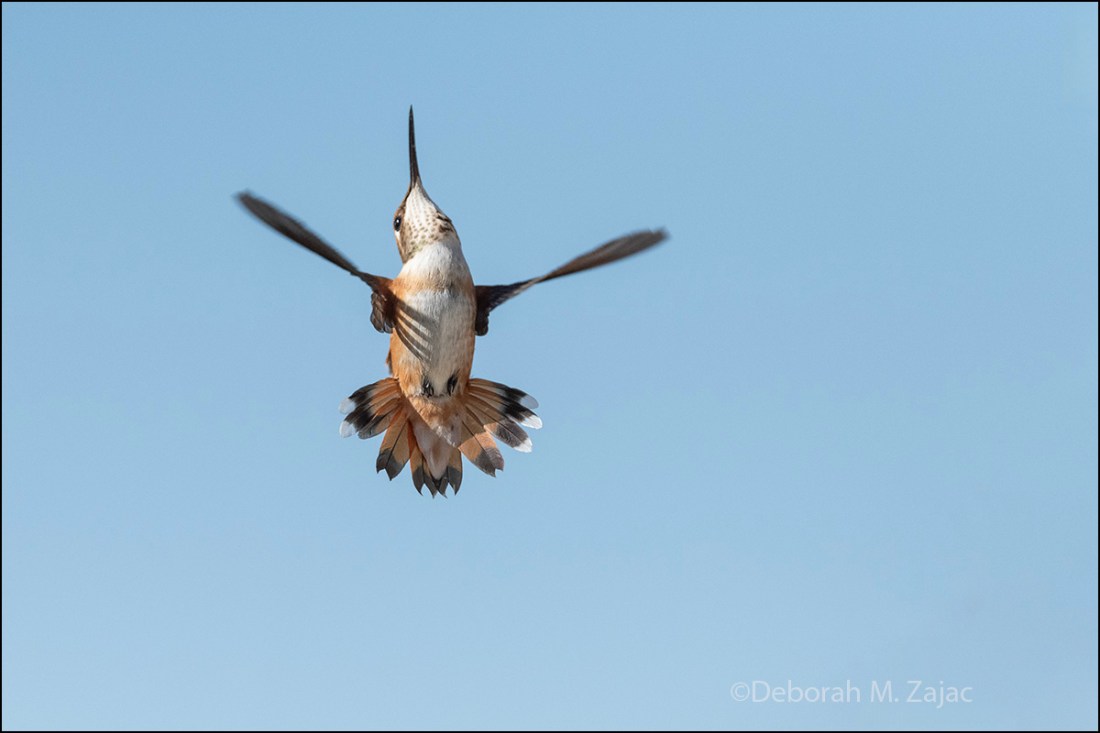
Here she is just after chasing off two other Hummingbirds. I love her tail!

©Deborah M. Zajac | http//:circadianreflections.com Image

I could be wrong about her sex as it could also be an immature female/ male. If you know which it is please let me know.

Fun Facts:

  • The Rufous Hummingbird is a common visitor to hummingbird feeders. It is extremely territorial at all times of year, attacking any visiting hummingbird, including much larger species. They’ve been seen chasing chipmunks away from their nests.
  • The Rufous Hummingbird makes one of the longest migratory journeys of any bird in the world, as measured by body size. At just over 3 inches long, its roughly 3,900-mile movement (one-way) from Alaska to Mexico is equivalent to 78,470,000 body lengths. In comparison, the 13-inch-long Arctic Tern’s one-way flight of about 11,185 mi is only 51,430,000 body lengths. (AAB)
  • During their long migrations, Rufous Hummingbirds make a clockwise circuit of western North America each year. They move up the Pacific Coast in late winter and spring, reaching Washington and British Columbia by May. As early as July they may start south again, traveling down the chain of the Rocky Mountains. People first realized this pattern after examining detailed field notes and specimens, noting the birds’ characteristic dates of arrival on each part of the circuit.
  • The Rufous Hummingbird has an excellent memory for location, no doubt helping it find flowers from day to day, or even year to year. Some birds have been seen returning from migration and investigating where a feeder had been the previous year, even though it had since been moved.
  • The Rufous Hummingbird breeds as far north as southeastern Alaska – the northernmost breeding range of any hummingbird in the world. Of the western hummingbirds that occasionally show up in the east, the Rufous Hummingbird is the most frequent.
  • Rufous Hummingbirds, like most other hummingbirds, beat their wings extremely fast to be able to hover in place. The wingbeat frequency of Rufous Hummingbirds has been recorded at 52–62 wingbeats per second.
  • The Rufous Hummingbird is not a colonially nesting species; however, there have been reports from Washington state that have 20 or more Rufous Hummingbird nests only a few yards apart in the same tree. (From the BNA)
  • Hummingbirds are hard to catch, but there are records of Rufous Hummingbirds being caught by a large flycatcher (Brown-crested Flycatcher) and by a frog.
  • The oldest recorded Rufous Hummingbird was a female, and at least 8 years, 11 months old when she was recaught and rereleased during banding operations in British Columbia in 2004.

I’ve been slower to your blogs this week as I’m visiting with family, and I will be for the next several days, but I’ll catch up!

Have a lovely week-end!!

Nikon D850| Nikkor 500mm| Fun Facts-https://www.allaboutbirds.org/guide/Rufous_Hummingbird/overview

more to come…

Friday’s Feathered Friends-Eastern Phoebe

Copyright ©2025 Deborah M. Zajac. ALL RIGHTS RESERVED.

PLEASE DO NOT USE MY IMAGES WITHOUT EXPRESSED WRITTEN PERMISSION.

With this sighting of the Eastern Phoebe on May 13th while birding in Ohio I have now seen all 3 Phoebe’s that reside in the Unites States.

©Deborah M. Zajac | http//:circadianreflections.com Image

The Eastern Phoebe can be found throughout the eastern half of the continent from the Northwest Territories all the way down to Mexico.

The other two Phoebes are found in the Western regions of North America. They are the Say’s Phoebe, and the Black Phoebe.

Fun Facts:

  • In 1804, the Eastern Phoebe became the first banded bird in North America. John James Audubon attached silvered thread to an Eastern Phoebe’s leg to track its return in successive years.
  • The use of buildings and bridges for nest sites has allowed the Eastern Phoebe to tolerate the landscape changes made by humans and even expand its range. However, it still uses natural nest sites when they are available.
  • Unlike most birds, Eastern Phoebes often reuse nests in subsequent years—and sometimes Barn Swallows use them in between. In turn, Eastern Phoebes may renovate and use old American Robin or Barn Swallow nests themselves.
  • The Eastern Phoebe is a loner, rarely coming in contact with other phoebes. Even members of a mated pair do not spend much time together. They may roost together early in pair formation, but even during egg laying the female frequently chases the male away from her.
  • The oldest known Eastern Phoebe was at least 10 years, 4 months old. It had been banded in Iowa in 1979 and was found in 1989 in Alberta.
  • Fun facts gleaned as always from allaboutbirds.org

I hope you all have a lovely week-end!

more to come…

Friday’s Feathered Friends- Yellow Warbler

Copyright ©2025 Deborah M. Zajac. ALL RIGHTS RESERVED.

PLEASE DO NOT USE MY IMAGES WITHOUT EXPRESSED WRITTEN PERMISSION.

Myself and He-Man went to Ohio for several days of birding Wood Warblers. I hoped to see some I didn’t see last year and see those I did see last year again. It was a great trip. Not only did I see a number of the Warblers I saw last year, I also saw some new species of Warblers plus a couple of other birds. 14 new to me birds or in birder speak ” Lifers”. On Monday the 12th (my birthday) I saw 7 Lifers! What a gift!!

I have thousands of images to cull but, I’m hoping I have a few good images to share in upcoming posts.

In the meantime here’s a cheerful Yellow Warbler I saw while there. These guys were everywhere on May 11th. They were singing and filling up on insects in all the trees in bloom getting ready for their over night migration to get to their breeding grounds in the USA, and some flew over the 26 miles of Lake Erie to get to Canada where their breeding grounds are.

On May 12th their numbers at the marsh were remarkably lower than the day before. I only saw a few.

©Deborah M. Zajac | http//:circadianreflections.com Image

I’m catching up with mail, email, bills, of course the laundry, and your blogs.

I hope you have a lovely week-end.

Fun facts:

  • In addition to the migratory form of the Yellow Warbler that breeds in North America, several other resident forms can be found in Mexico, Central America, and the Caribbean. Males in these populations can have chestnut caps or even chestnut covering the entire head.
  • The nests of the Yellow Warbler are frequently parasitized by the Brown-headed Cowbird. The warbler often builds a new nest directly on top of the parasitized one, sometimes resulting in nests with up to six tiers.
  • Life can be dangerous for a small bird. Yellow Warblers have occasionally been found caught in the strands of an orb weaver spider’s web.
  • The oldest-known Yellow Warbler was a female and was at least 11 years old when she was recaught and rereleased during banding operations in New York. ~https://www.allaboutbirds.org/guide/Yellow_Warbler

more to come…

Friday’s Feathered Friends-Couples

Copyright ©2025 Deborah M. Zajac. ALL RIGHTS RESERVED.

PLEASE DO NOT USE MY IMAGES WITHOUT EXPRESSED WRITTEN PERMISSION.

Being Valentine’s Day today I thought I’d share a couple of bird pairs/couples.

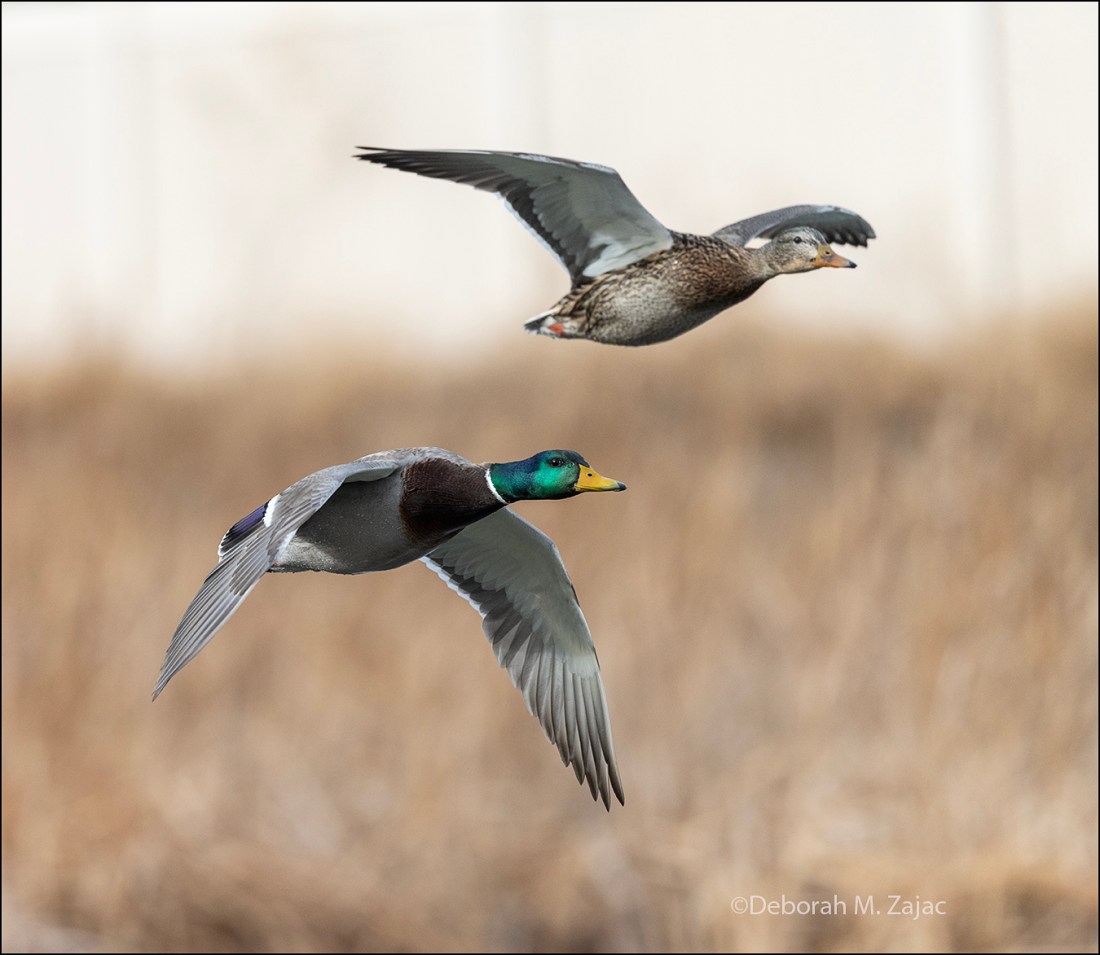
Mallard pair

©Deborah M. Zajac | http//:circadianreflections.com Image

Hooded Merganser pair

©Deborah M. Zajac | http//:circadianreflections.com Image

I hope you all have a lovely Valentine’s Day and great weekend.

Nikon D850| Nikkor 500mm| PS CC

more to come…

Friday’s Feathered Friends- Tundra Swan

Copyright ©2025 Deborah M. Zajac. ALL RIGHTS RESERVED.

PLEASE DO NOT USE MY IMAGES WITHOUT EXPRESSED WRITTEN PERMISSION.

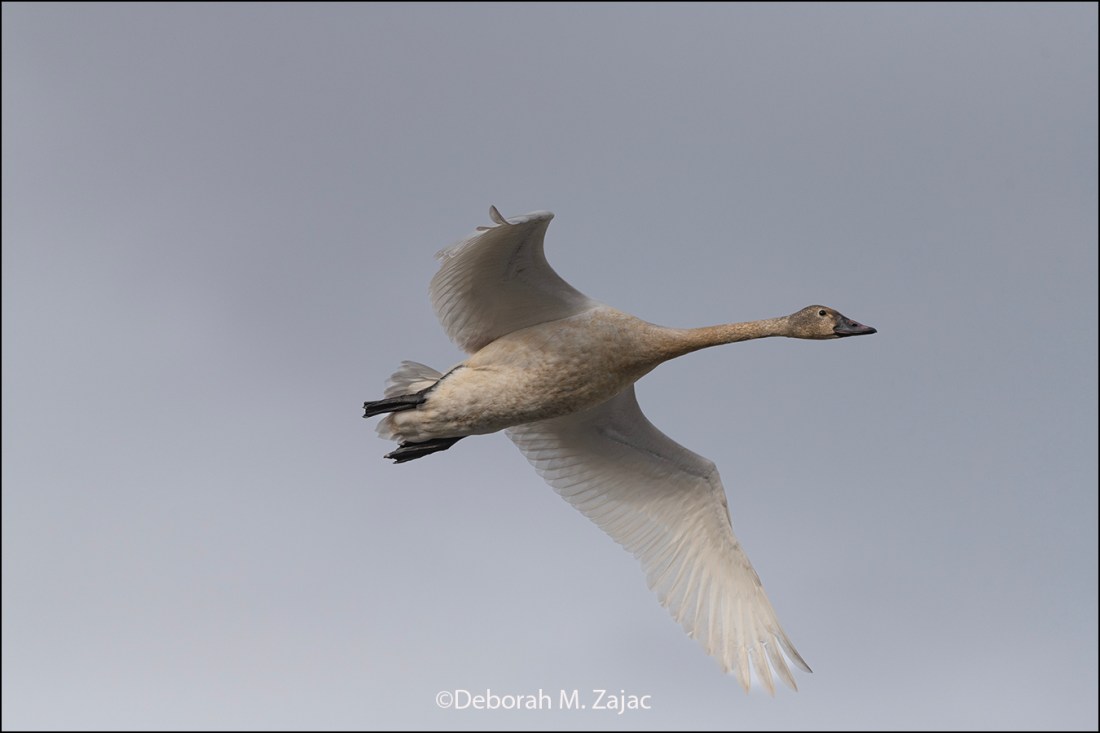
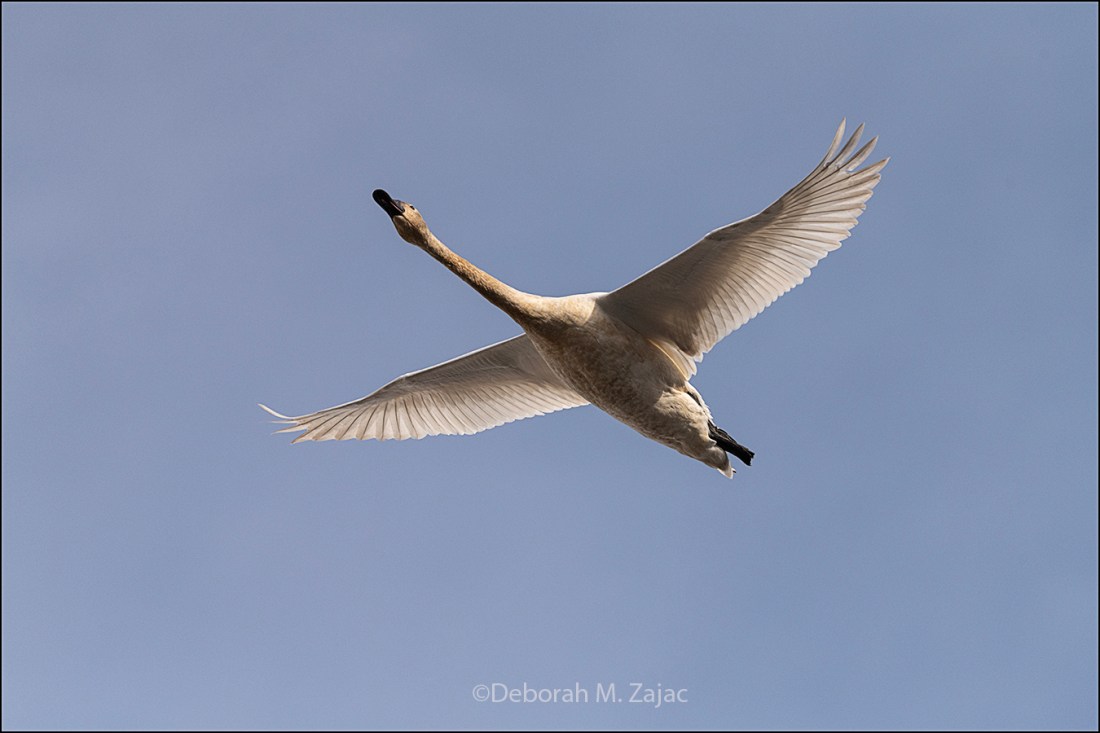
While out birding with the group last Friday morning we had the pleasure of a Tundra Swan fly-by. The single Swan flew by three times actually. Probably checking out the slough and ponds to see if that was the place to land or if his partner was there. We didn’t see a another swan and after three passes we didn’t see it again.

©Deborah M. Zajac | http//:circadianreflections.com Image

Here it was flying over my head.

©Deborah M. Zajac | http//:circadianreflections.com Image

Both images are cropped a bit. It was higher in the sky than these make it look.

Fun Facts:

  • Lewis and Clark provided the first written description of the Tundra Swan during their expedition to the West, where the birds’ whistle-like calls prompted Meriwether Lewis to dub them “whistling swans.”
  • The whistling swan, the American race of the Tundra Swan, currently is considered the same species as the Eurasian race, the Bewick’s swan. They were considered separate species in the past, distinguished by the large yellow patches on the face of the Bewick’s swan.
  • The Tundra Swan stays in flocks except when on a breeding territory. Although most swans spread out to breed, a large proportion of the population on the breeding grounds still can be found in flocks. These swans are not breeding, and may be young birds that have not yet bred, adult pairs whose breeding attempts failed, or adults that bred in the past but for some reason do not in that year.
  • During the breeding season the Tundra Swan sleeps almost entirely on land, but in the winter it sleeps more often on water.
  • Tundra Swans breed in the remote arctic of North America. Parents defend their nests and young against a host of predators including foxes, weasels, wolves, and bears, as well as birds such as Glaucous Gulls, Common Ravens, Parasitic Jaegers, Pomarine Jaegers, and Golden Eagles. If the parents are present, they are able to defend the nest and nestlings from these threats. Wolves, people, and bears, however, are too big to fight, and most incubating swans leave their nests while these large predators are far away. By leaving quickly when large predators approach, the parents may make the nest harder to find.
  • Tundra Swans wintering in Chesapeake Bay feed almost exclusively on clams that they dislodge from the mud. But it can be challenging to enjoy a peaceful meal: often the swan has to fend off a Ring-billed, Herring, or Greater Black-backed gull that swoops in to grab a clam from the swan’s bill – a successful tactic in about half of these “kleptoparasitic” encounters.
  • Swans have long been associated with ideals of romance. Added to their elegant outlines and all-white plumage is their tendency to form permanent pair bonds by the time they’re 2-3 years old. Once a pair forms, Tundra Swans feed and roost together year-round.
  • Based on banding records, the oldest known Tundra Swan was a female and at least 23 years, 7 months old when she was identified by her band in the wild, in Ohio. She was originally banded in the same state.

Fun Facts gleaned from allaboutbirds.org

If the rain holds off this morning I’ll be birding so I may be late getting to your blogs, and comments.

more to come…

Friday’s Feathered Friends- American Redstart

Copyright ©2024 Deborah M. Zajac. ALL RIGHTS RESERVED.

PLEASE DO NOT USE MY IMAGES WITHOUT EXPRESSED WRITTEN PERMISSION.

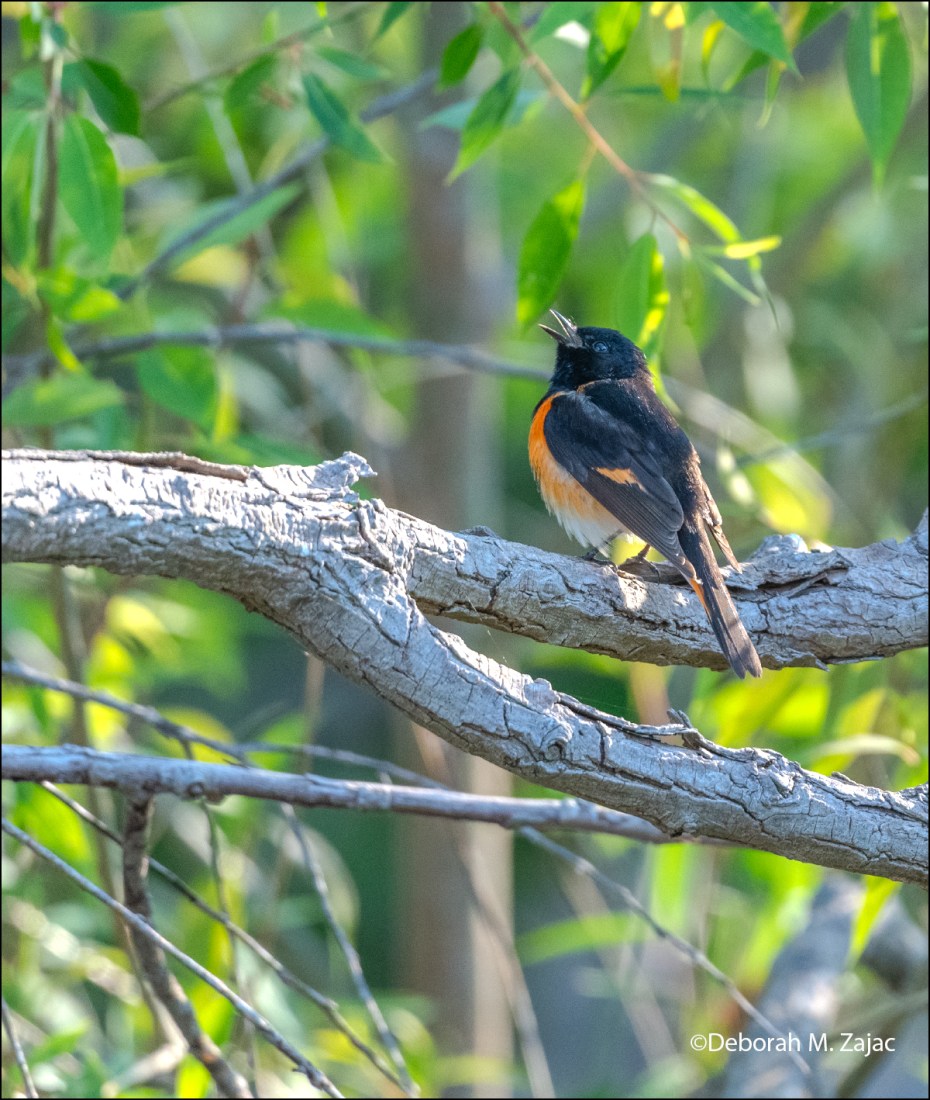
Going back to my Spring trip to Ohio for these images. The American Redstart male.

He’s a Warbler. I’m on the edge of it’s range. If only one or two would stray a bit further west I wouldn’t have needed to go to Ohio to this one. 😂

©Deborah M. Zajac | http//circadianreflections.com

Here’s an audio clip of its song.

https://www.bird-sounds.net/american-redstart/

Fun Fact:

  • Like the Painted Redstart and other “redstarts” of the Neotropics, the American Redstart flashes the bright patches in its tail and wings. This seems to startle insect prey and give the birds an opportunity to catch them. Though these birds share a common name, they are not closely related to each other. In fact, there are other unrelated birds around the world—such as the fantails of Australia and southeastern Asia, and other redstarts of Europe—that share the same foraging tricks.
  • Young male American Redstarts have gray-and-yellow plumage, like females, until their second fall. Yearling males sing vigorously in the attempt to hold territories and attract mates. Some succeed, but most do not breed successfully until the following year when they develop black-and-orange breeding plumage.
  • The male American Redstart sometimes has two mates at the same time. While many other polygamous bird species involve two females nesting in the same territory, the redstart holds two separate territories that can be separated by a quarter-mile. The male begins attracting a second female after the first has completed her clutch and is incubating the eggs.
  • The oldest American Redstart was at least 10 years and one month old, when he was recaptured and rereleased during a banding operation in Ontario.

Fun facts gleaned from allaboutbirds.org

I may be late replying this morning as I’m starting my week-end birding a new to me area in South Lake Tahoe. I hope you all have a great day and week-end.

more to come…

Friday’s Feathered Friends- Warblers

Copyright ©2024 Deborah M. Zajac. ALL RIGHTS RESERVED.

PLEASE DO NOT USE MY IMAGES WITHOUT EXPRESSED WRITTEN PERMISSION.

For Mother’s Day and my birthday He-Man and I went to Ohio for several days of birding the Spring migration of Eastern birds. It was fantastic. I added 27 new birds to my life list most of which were Warblers.

Here are three that I have processed.

Magnolia Warbler, female
Black-throated Blue, male
Chestnut-sided Warbler, male.

My favorite Warbler seen was the Chestnut-sided. Isn’t he gorgeous.

I have thousands of images to cull and sort through so I’ll be dribbling out the images over the next several weeks.

It was a great trip. I hope I get an opportunity to return as there are Warblers, and other birds I still hope to see.

Have a great week-end everyone.

Nikon D850| Nikkor 500mm PF-e

more to come…