Crater Lake in early May


Crater Lake in early May, originally uploaded by dmzajac2004-.

Via Flickr:
Copyright © 2012 Deborah M. Zajac. All Rights Reserved.

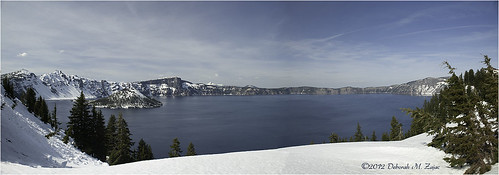
While in OR this past May we were only an 1.5 hours drive from Crater Lake so we spent our last afternoon and evening here. The weather and scenery didn’t disappoint.

Nikon D700| Nikkor 24mm @f16| 1/125second| ISO 200| Manual Priority| Tripod| 4 frame Pano stitched in CS6

For the historians:
The lake was formed after the collapse of an ancient volcano, posthumously named Mount Mazama. This volcano violently erupted approximately 7,700 years ago. That eruption was 42 times as powerful as the 1980 eruption of Mt. St. Helens. The basin or caldera was formed after the top 5,000 feet of the volcano collapsed. Subsequent lava flows sealed the bottom, allowing the caldera to fill with approximately 4.6 trillion gallons of water from rainfall and snow melt, to create the seventh deepest lake in the world at 1,932 feet.

Rolling mountains, volcanic peaks, and evergreen forests surround this enormous, high Cascade Range lake, recognized worldwide as a scenic wonder. On summer days, neither words or photographs can capture Crater Lake’s remarkable blueness. For much of the year, usually October to July at higher elevations, a thick blanket of snow encircles the lake. Snowfall provides most of the park’s annual 66 inches of precipitation.

Crater Lake rarely freezes over completely; it last did in 1949. Heat from the summer sun stored in the immense body of water retards ice formation throughout the winter. On the earth clock, natural forces only recently constructed this landscape. Lava flows first formed a high plateau base on which explosive eruptions then built the Cascade volcanoes. Humans probably witnessed the cataclysmic eruption of Mount Mazama about 7,700 years ago.
~Crater Lake National Park Service
 

“Mystery creates wonder and wonder is the basis of man’s desire to understand.” Neil Armstrong


Copyright © 2012 Deborah M. Zajac. All Rights Reserved.

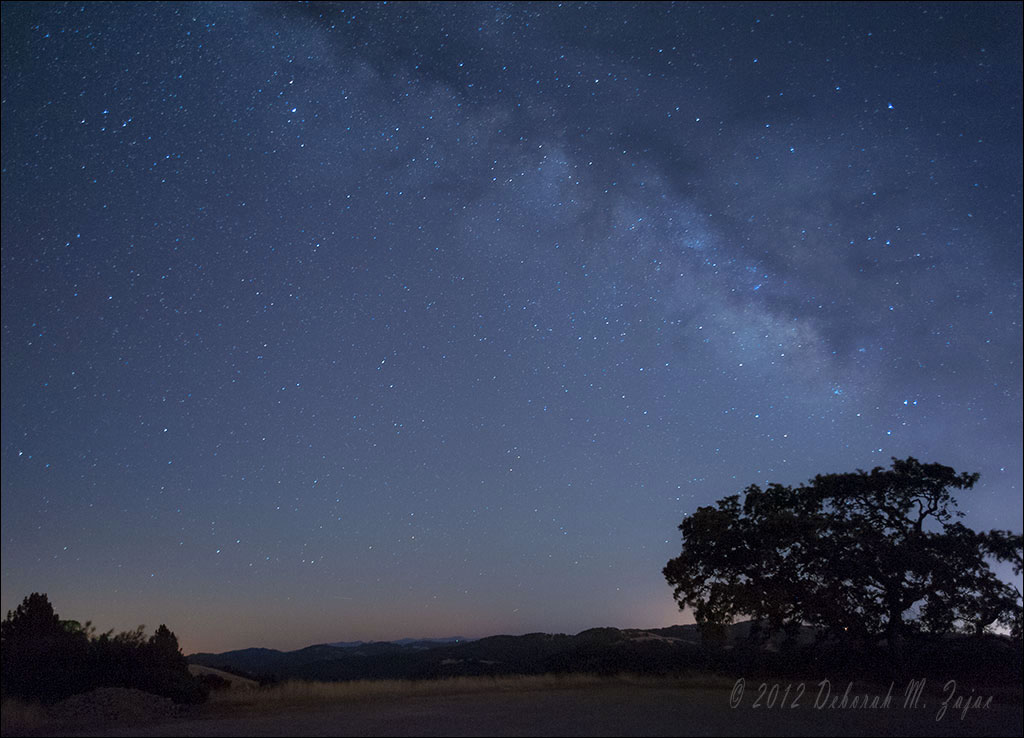
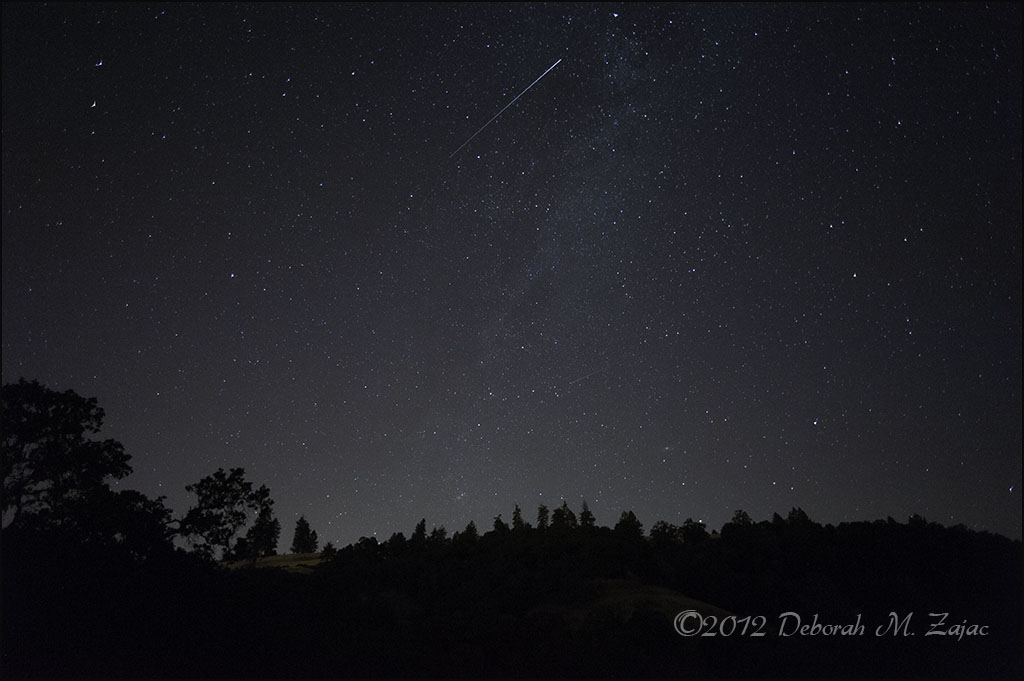
My friend Dali and I went out last night to watch and photograph the sky hoping we’d see and capture a meteor or two streaking through the night sky. We saw one huge fire-ball streaking over our heads and I’m going to blend those exposures in the future and share them, but there were a few like this that I was fortunate to capture on film. Do you see the faint one  below this big one and sort of center? My camera caught several like that, but I wondered all night if my eyes were playing tricks on me.
The weather was perfect too. It was a lovely night for star-gazing.
The Perseids peak tonight. If you get a chance to go out and watch the sky I recommend it.

Nikon D700| Nikkor 18mm| f3.5| 23 sec| ISO 400| Manual Priority| Tripod


Prevailing Winds


Prevailing Winds, originally uploaded by dmzajac2004-.

Via Flickr:
Copyright © 2012 Deborah M. Zajac. All Rights Reserved.

Please click on photo to view larger.

I’ve been wanting to do some Night Industrial photography this year and have stopped by here numerous times looking for steam. Last night there was finally steam, but a good wind too which unfortunately for this area is normal. I will be going back to photograph this again. I think at night this plant transforms into a sparkling beauty.
I also think it looks futuristic. I am reminded of Aurthor C. Clark’s book Earthlight. I can imagine the Republics he created on Mars, Venus, and the Moon looking like this.

Earthlight was one of the first Sci-fi novels I read back in late 70’s. I still have that book. The price tag says it was $1.50.
Nikon D700| Nikkor 24mm AF-D @ f10| 25 seconds| ISO 200| Tripod|


Civil War Days- Sharpshooters

Copyright © Deborah M. Zajac. All Rights Reserved.

“Ravenous, the gods of war demanded men- lots of men. Northern armies were at first manned solely by volunteers, with each state assigned a quota based on population. But in 1863, after volunteering had slackened off, Congress passed a federal conscription law for the first time on a nationwide scale in the United States.” ~The American Pageant, 9th edition, Thomas A. Bailey and David M. Kennedy

APPLY IN PERSON AT COMPANY TENT.

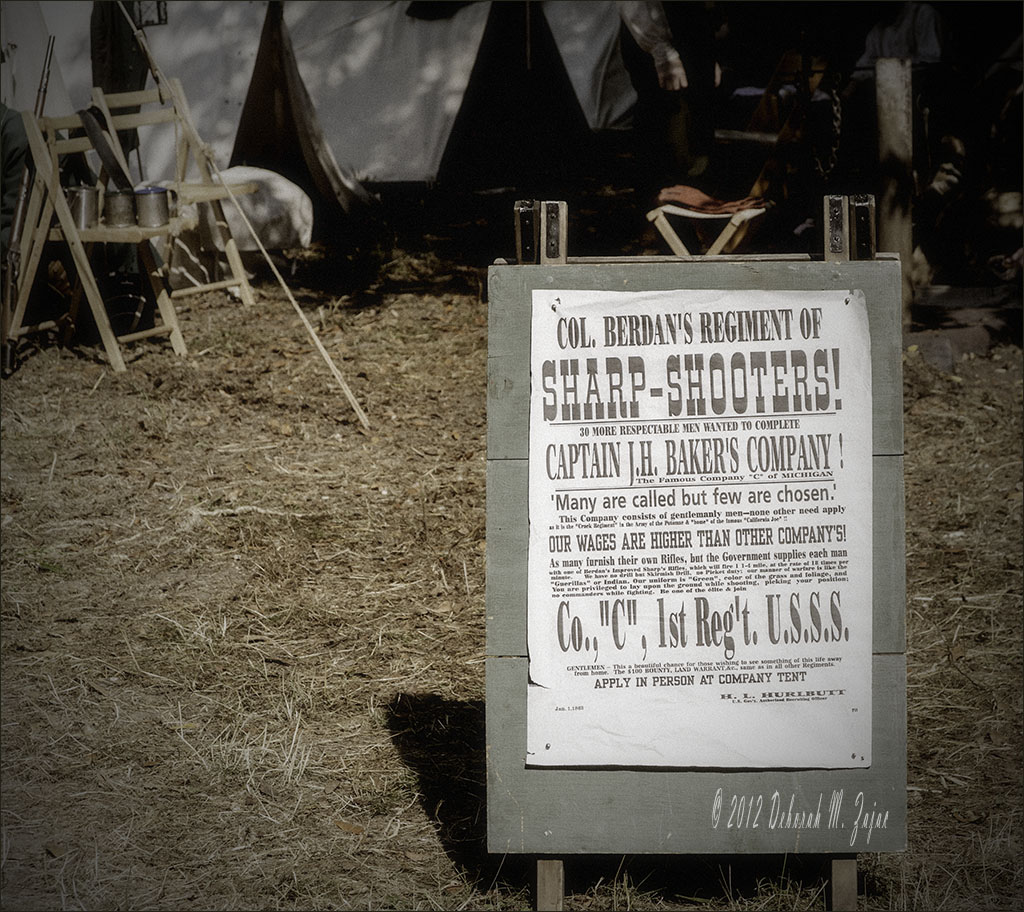
The sign says:

Col. Berdan’s Regiment.

Sharp – Shooters!

30 more Respectable Men Wanted to Complete

Captain J.H. Baker’s Company!-The famous company “C” of Michigan

Many are called but few are chosen!

This company consists of gentlemanly men-none other need apply- as it is the “Crack Regiment” in the Army of the Potomac & “home” of the famous “California Joe”!!

OUR WAGES ARE HIGHER THAN OTHER COMPANY’S!

As many furnish their own Rifles, but the Government supplies each man with of Berdan’s Improved Sharp’s Rifles, while will fire 1 ¼ miles, at the rate of 18 times per minute. We have no drill but Skirmish Drill, no Picket duty; our manner of warfare is like the “Guerillas” or Indian. Our uniform is “Green”, color of the grass and foliage, and You are privileged to lay upon the ground while shooting, picking your position; no commanders while fighting. Be one of the elite & join

Co,. “C”, 1st Reg’t. US.S.S.

GENTLEMEN – This  is a beautiful chance for those wishing to see something of this life away from home. The $100 BOUNTY, LAND WARRANT,&c,. same as in all other Regiments.

APPLY IN PERSON AT COMPANY TENT

Jan. 1, 1863                       H.L. HURLBUTT-U.S. Gov’t Authorized Recruiting Officer

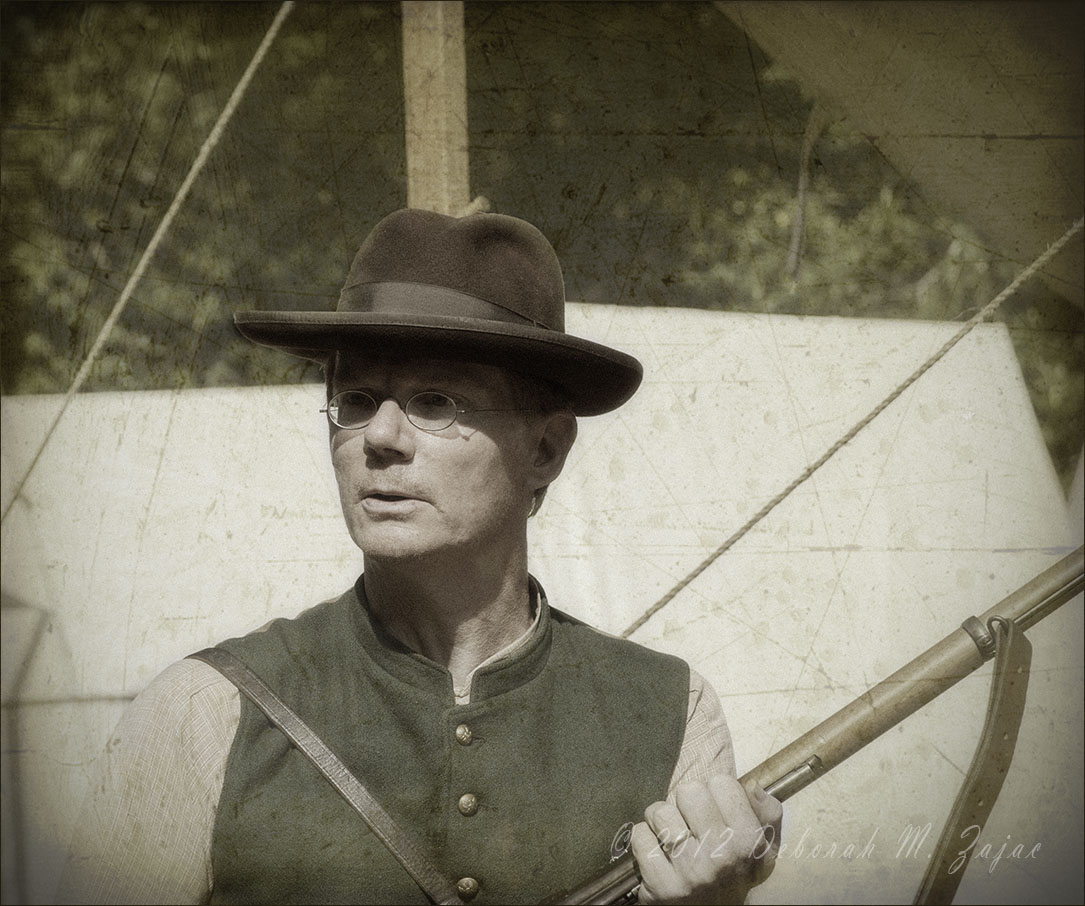
Union Colonel Hiram Berdan proposed forming units of outstanding riflemen, largely equipped with Sharps rifles, in 1861, and as a result the 1st and 2nd regiments of US Sharpshooters were organized.

The Sharps weapons were the most advanced breechloaders in America when the war began. The Union bought 9100 Sharps rifles and more than 80,000 Sharps carbines during the war. Confederate forces

bought small numbers of these weapons. The rifles were  used by the US Sharpshooters, while the carbine was mainly a cavalry weapon. Both were single-shot, were accurate up to 600 yards, and could fire at a rate of about 10 rounds per minute.~Chronicles of the Civil War John Bowman, General Editor

The 1st Sharpshooters fought on the Peninsula and at Chancellorsville, and Gettysburg. The 2nd Sharpshooters’ first significant action was at Antietam.

Both regiments fought at the Wilderness and Spotsylvania. For the entire war, both units had casualty rates approaching 40 percent. ~ Chronicles of the Civil War-John Bowman General Editor


As able-bodied men got scarcer bounties for enlistment were offered by federal, state, and local authorities. A man with a gift for making money might pocket more than $1000.00!

Nikon D700, Nikkor 80-200mm + 1.4x Tamron TC and 28-105mm AF-D.  Duncans Mills, CA.

Related articles

Civil War Days-Artillery

Copyright © 2012 Deborah M. Zajac. All Rights Reserved.

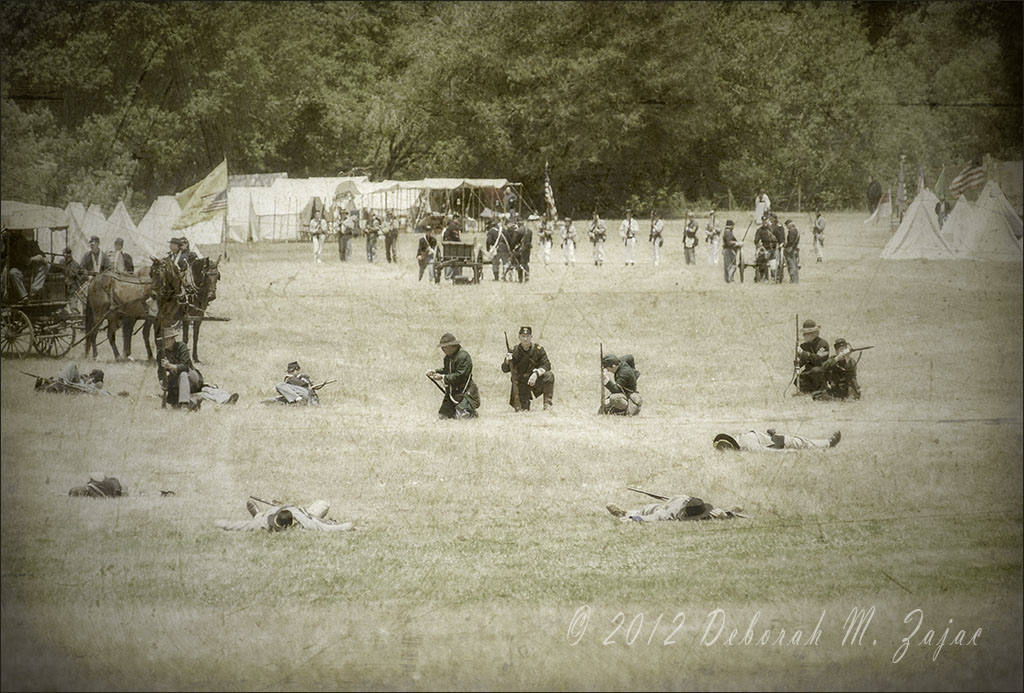
I had the pleasure of spending Saturday afternoon at a Civil War Reenactment in Duncans Mills, CA. Follow me to the year 1863 where these wonderful reenactors bring  this period of  USA history to life.

“Soon after his defeat of the Federal Army of the Potomac at Chancellorsville in May 1863 General Robert E. Lee decided for the second time to invade the North with his Confederate Army of Northern Virginia. There were a number of reasons for his decision. Even though Lee had just won a brilliant victory, things were bad in the Confederacy and getting worse; Ulysses S. Grant was about to secure Vicksburg for the Union, inflation was running wild in the South, and badly needed European recognition had not come, the Confederate government was torn by partisan squabbles, the Union blockade along the Southern coast was growing steadily more effective, and antiwar sentiment was fading in the North. A major Confederate victory on enemy soil might ameliorate all those problems. Moreover, after their string of victories Lee and his men had begun to believe fatally, as it turned out- that they were virtually invincible.

General James Longstreet, Lee’s second in command since the death of Stonewall Jackson, objected to the invasion from the beginning. Longstreet entreated his commander to purse a defensive strategy in Virginia and send troops to reinforce Braxton Briggs in Tennessee.

Longstreet’s idea was sound, but Lee insisted on his invasion plan; his instincts invariably told him to take the offensive. Thus in early June 1863, The Army of Northern Virginia pulled away from Fredericksburg and headed for Pennsylvania with about 80,000 men.” – Chronicles of the Civil War by John Bowman, General Editor

Artillery

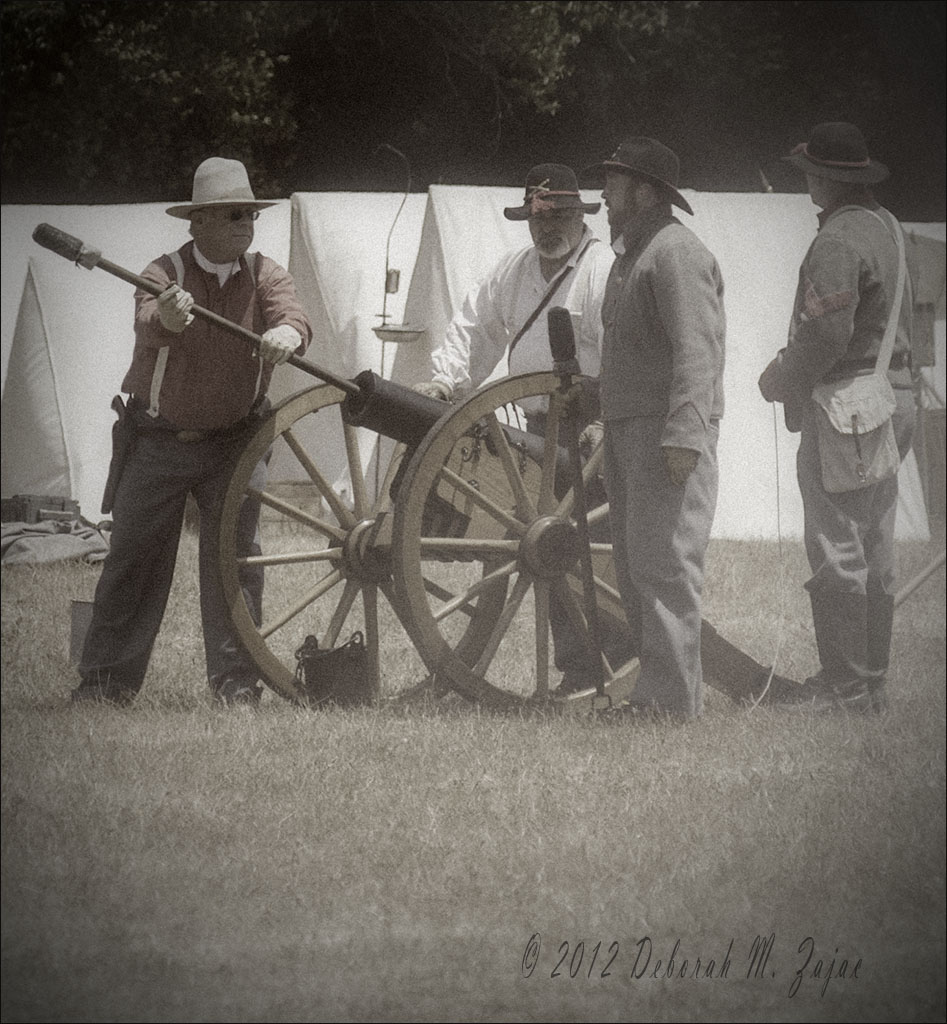
“Designed to fire at high angles, dropping low-velocity explosive shells behind the enemy’s cover, Howitzers exemplified the traditional artillery that predominated during the Civil War.” –Chronicles of the Civil War by John Bowman, General Editor

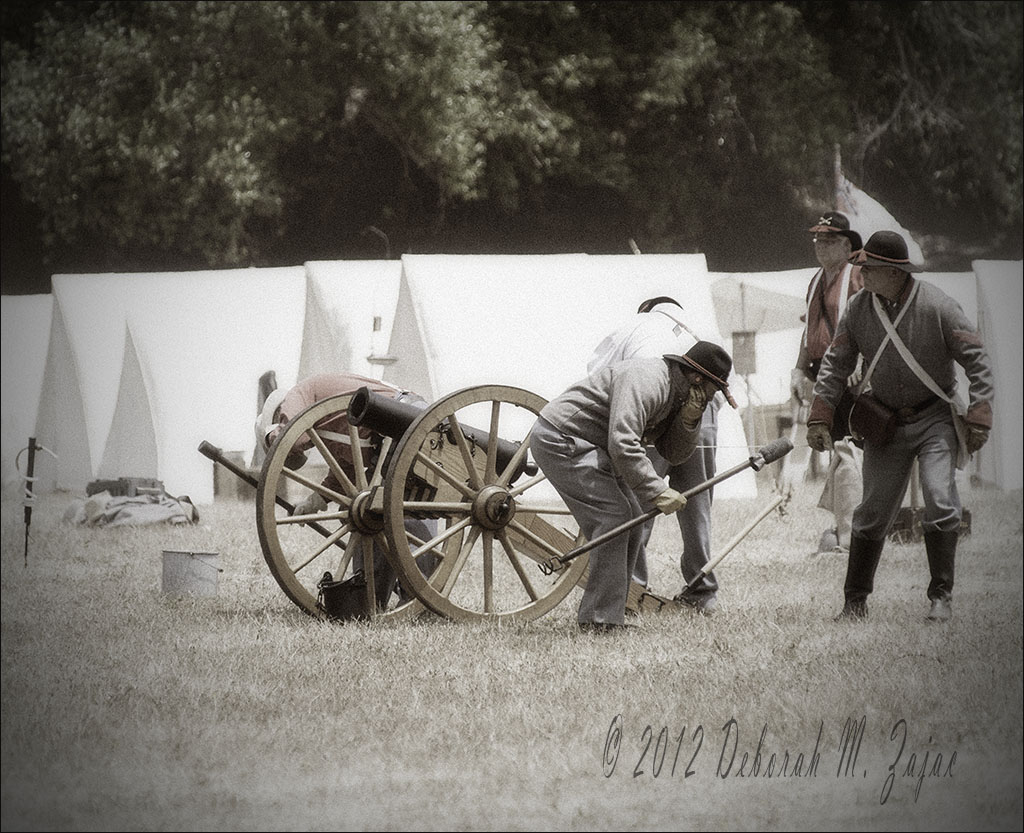
Confederate Sponge rammer loading the cannon-

“Artillery in the 1800’s fought side by side with infantry units because the range of the big guns limited them to visible targets. Like the infantry weapons, Civil War-era cannon were muzzle loaders and required a crew of eight men to aim, load, and fire the weapon.”~Thomas’Legion; The 69th North Carolina Regiments, located at www.thomaslegion.net, written by Matthew D. Parker, was first published to the internet on August 27, 2005 and accessed on July 16, 2012.

Stepping away-

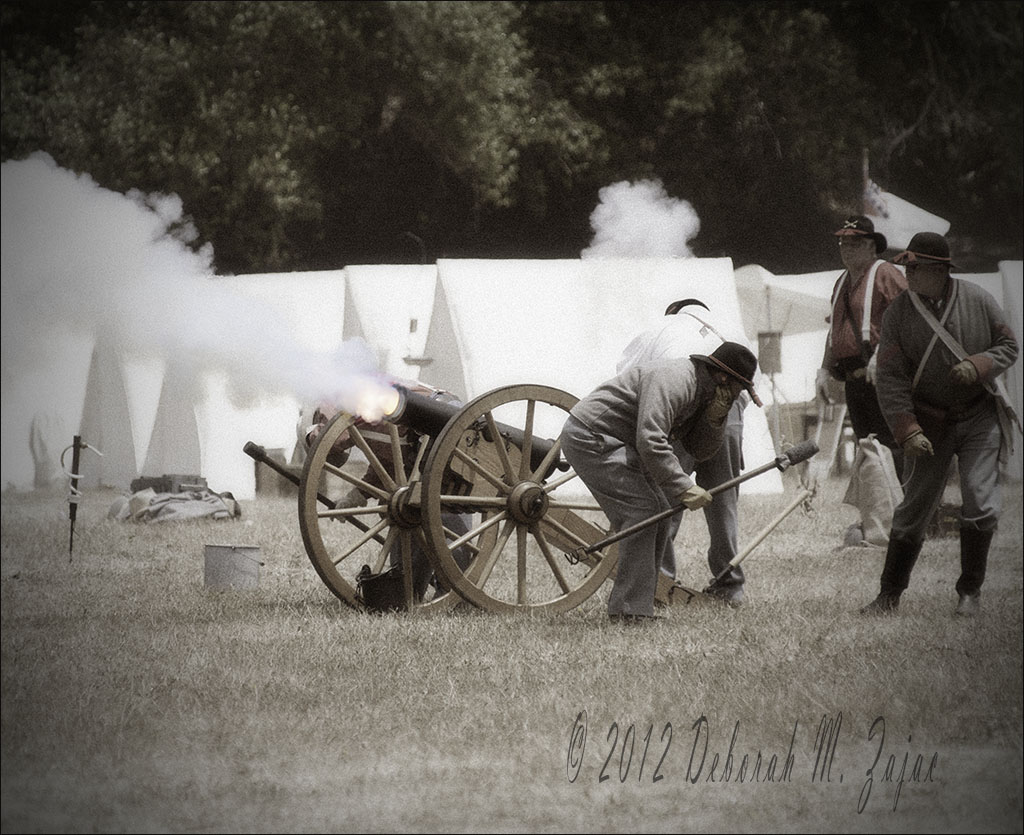
FIRE!

The infantrymen marched right into the face of a firing cannon. Many didn’t live to tell about it.

It was a fun afternoon and I have quite a few photos to go through. I hope to share more soon.

Nikon D700| Nikkor 80-200mm w/Tamron 1.4x extender


“Somewhere, something incredible is waiting to be known.” Carl Sagan

Copyright © 2012 Deborah M. Zajac. All Rights Reserved.

Even with all the light pollution I think this came out pretty well.

I was happy to see I still was able to get to my Internet server when I arrived home after midnight this morning. I hope this bodes well for my week. “)

Nikon D700| Nikkor 18mm AI-S| f3.5| 33 seconds| ISO 3200| Tripod

“I’m waiting for you Morning Star…herald of the dawn.” ~ Deborah M. Zajac

Copyright © 2012 Deborah M. Zajac. All Rights Reserved.

“Rise quickly for I am numb with Winter’s morning chill.
My fingers ache for your warm embrace.”~

That’s my plea every sunrise shoot, and to be honest most nights too! My fingers are the first to go numb, and I’ve not found a hand-warmer or pair of gloves to keep me warm enough to thwart the chill.

This is a shot from Convict Lake taken the third morning of 2012.  Seeing sunrises like the one my friends and I saw on this morning make the early rise, drive time, and standing in the cold worth it!

Nikon D700| Nikkor 17-35@17mm| f13| 10 seconds| ISO200| Manual Priority| Tripod