Ruby-crowned Kinglet

Copyright ©2016 Deborah M. Zajac. ALL RIGHTS RESERVE

It was a busy week-end with little to no time spent on the computer. Of course Photography figured high on my list of things to do this past week-end.

The Super Moon was number 1 on my list and I made plans months ago to shoot it with friends in Central Valley Calif.  We were a large group and while waiting for the group to assemble before heading to our chosen shooting location I was photographing little birds in a nearby bush.

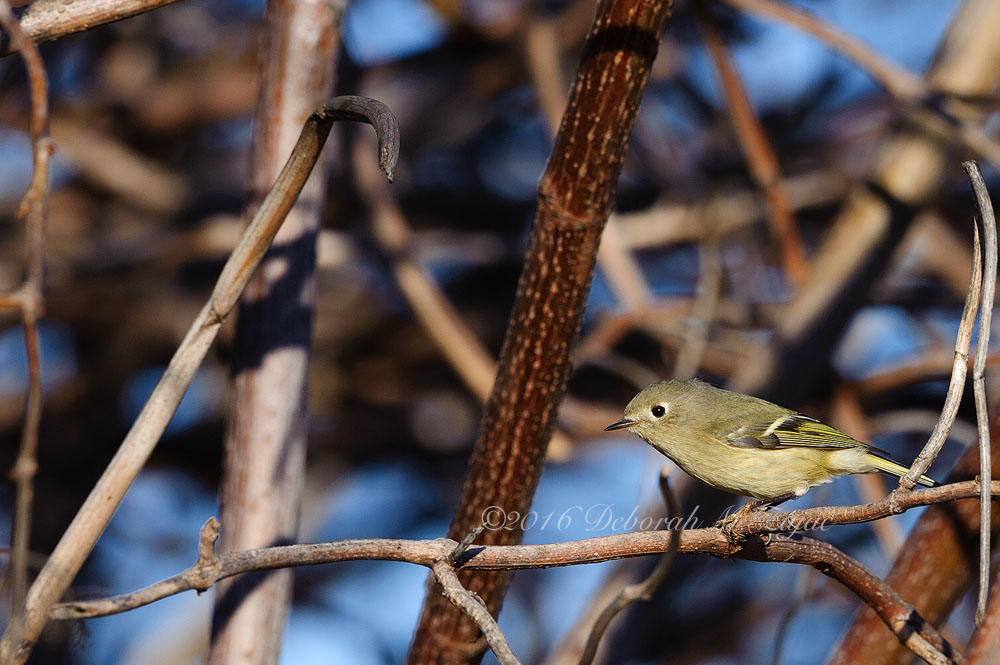
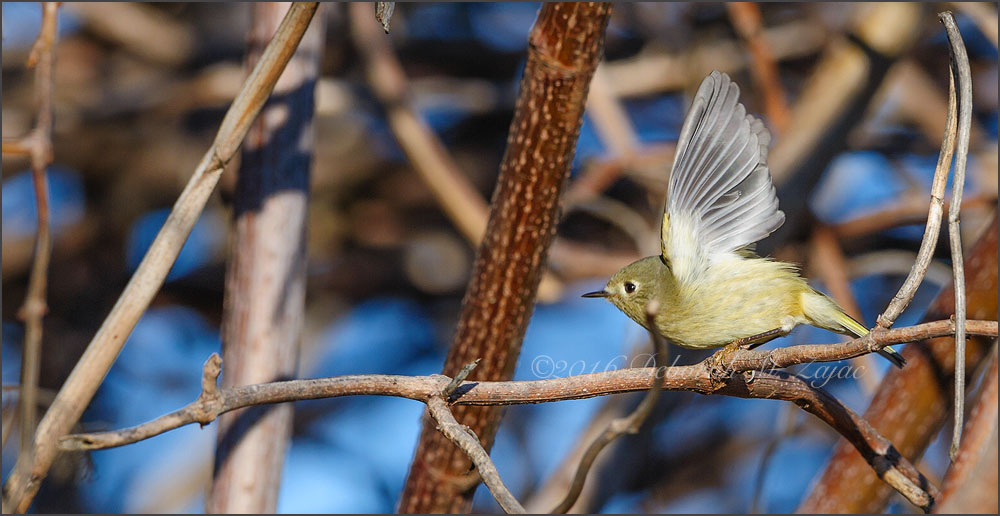
A friend and I spied a little flighty bird hopping from one branch to the next all the while staying deep in the foliage.  I thought it might be a Warbler of some sort, but couldn’t be sure until I got a better look.  I watched and waited hoping it would come out just for one good look and image. A little patience paid off.  It showed itself in the open less than a minute! I managed to get only 3 frames of it hoping with fingers crossed that just one of those frames would be good.

Imagine my delight at finding I liked all three well enough to keep and share!

Then late last night I was trying to catch up with blogs and emails and read Donna’s post about her latest birding adventure and there in her images was a bird that looked just like the little bird I photographed that very afternoon!

I pulled out my Stokes Field Guide to the Birds of North America to compare my bird, and Donna’s bird with the Field Guide to see if I had a match and positive identification.  I believe so!  If true then this bird is a new ” Lifer” for me! An exciting spotting indeed! Thank you Donna!

Without further ado I present a Ruby-crowned Kinglet with the 3 images I made:
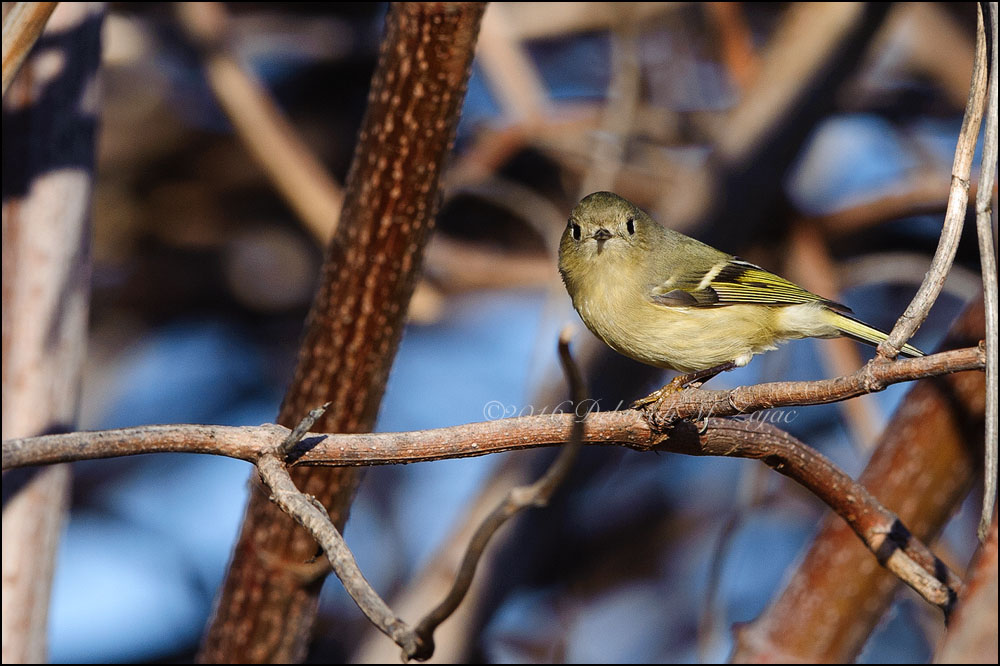
Ruby-crowned Kinglet

Ruby-crowned Kinglet

Ruby-Crowned Kinglet

If you think this is different bird please let me know!

Nikon D700| Nikkor 200-500mm| Lexar Professional Digital Film|

More to come…

Clark’s Grebes

Copyright ©2016 Deborah M. Zajac. ALL RIGHTS RESERVED

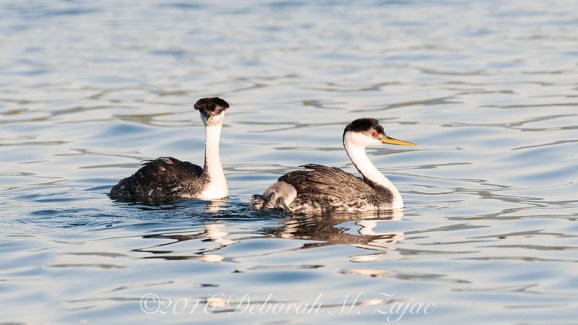
Today I thought I share some images from my Spring Grebe excursion.   We met at 5:45am to get out on the water to see the sun rise over the mountains and get that great light.

We were so fortunate to have a lovely morning with a rosy glow, and the Grebes were up and feeding already as well.

The male Grebes impressed me by how hard they work to feed the family.  I’ll try to convey that with some images.

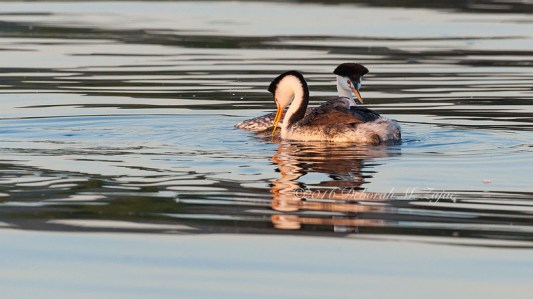
The male making a fish transfer to his mate and a hungry chick poking its head out in anticipation;

Clark's Grebe Pair making fish transfer

…but that little fish was a slippery one and she dropped it, fortunately, she was able to retrieve it quickly!

Clark Grebe Pair

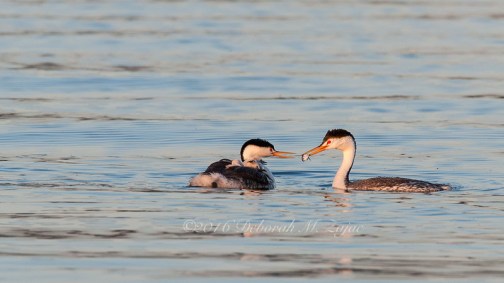
Here a Clark’s Grebe male is just about to make the transfer;

Clark's Grebe Male making Fish Transfer to Female

Here’s a Clark’s Grebe male feeding a fish directly to a chick. That fish looks too big for that tiny bill!

Clark's Grebe Male Transferring Fish to Grebe Chick

With several mouths to feed the male does a whole lot of fishing!

He helps with swimming lessons, and even gives the female a break by allowing the chicks to swim from Mom’s back to his. Western Grebes:  Yes, it’s a butt shot. 🙂

Western Grebes

Seeing this was so exciting and so darn adorable!!

Nikon D700| Nikkor 200-500mm| Lexar Professional Digital Film| PS CC 2015.5

Have a wonderful week-end Everyone!

More to come…


California Thrasher II

Copyright ©2016 Deborah M. Zajac. ALL RIGHTS RESERVED

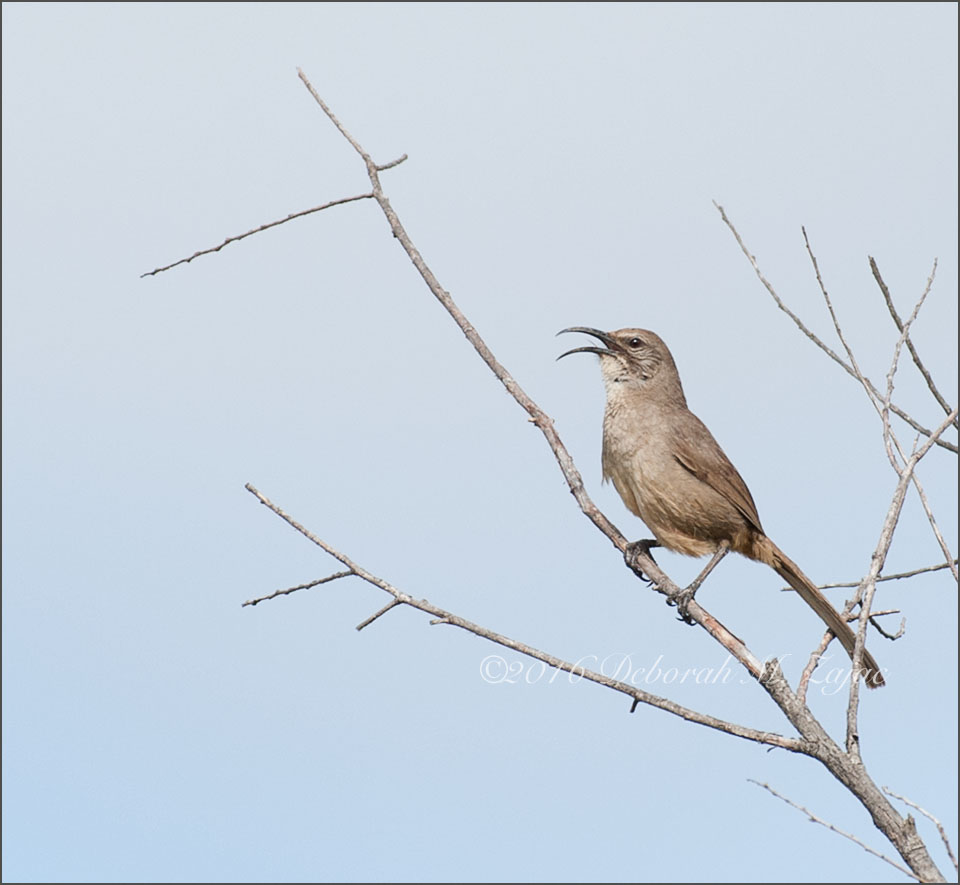
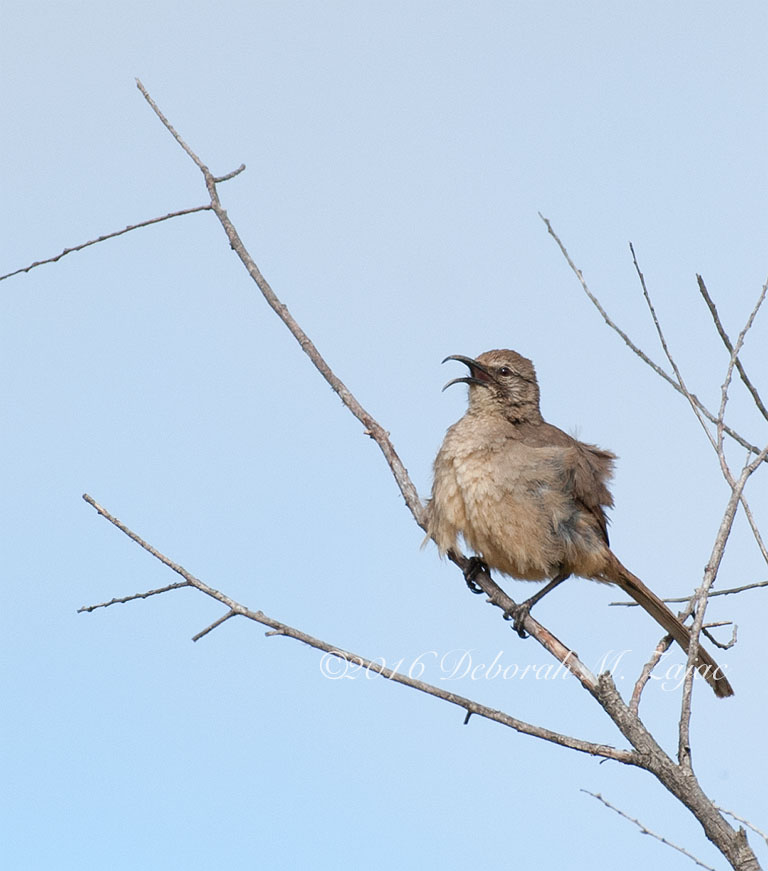
Back in March while birding and photographing flowers in Santa Cruz, CA I was thrilled to hear and see a California Thrasher for a minute…long enough to get a few images, before I spooked it trying to get a little bit closer to it.  You can see that post here.

I’ve been wishing to see one again, and be closer to it. Well, on Sunday I got my wish while birding down in the southern end of Santa Clara Valley.

California Thrasher

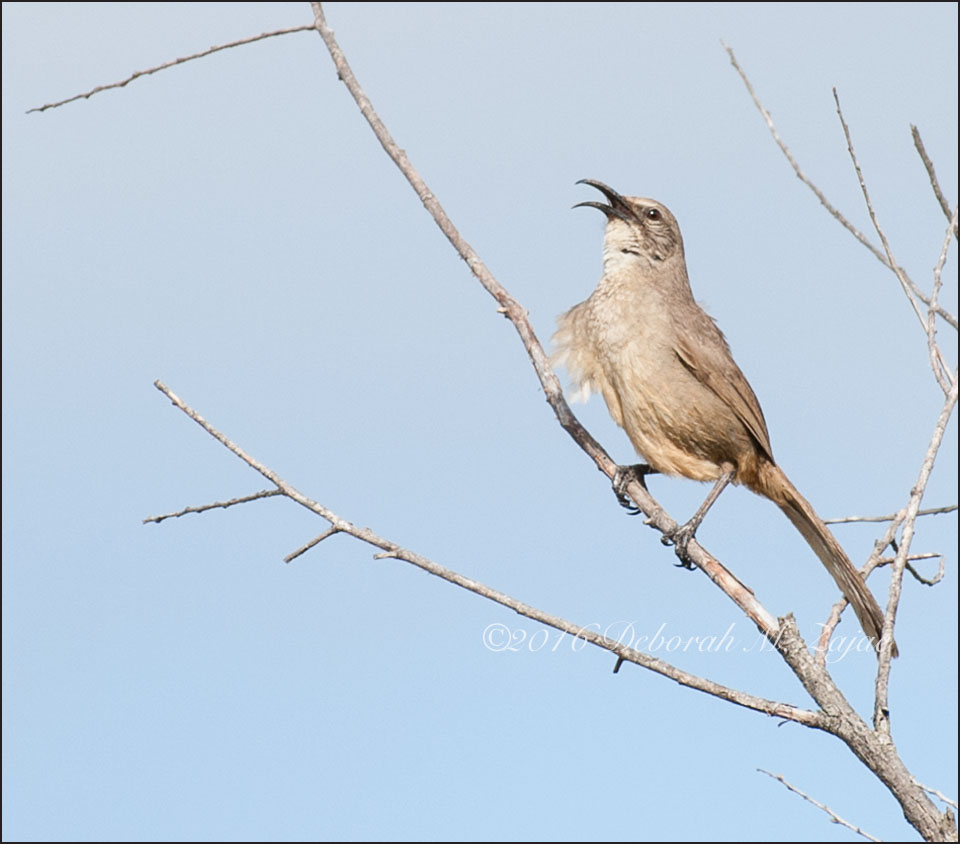
He was singing his little heart out!

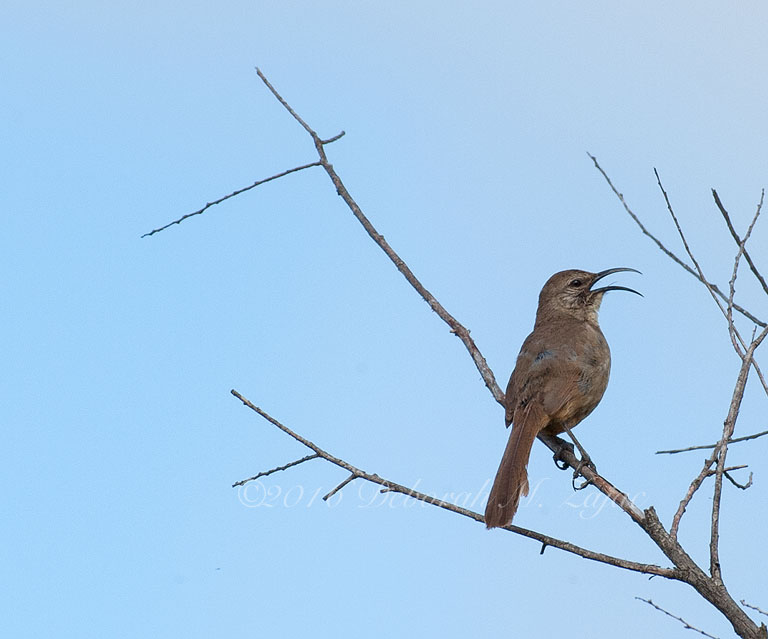
California Thrasher

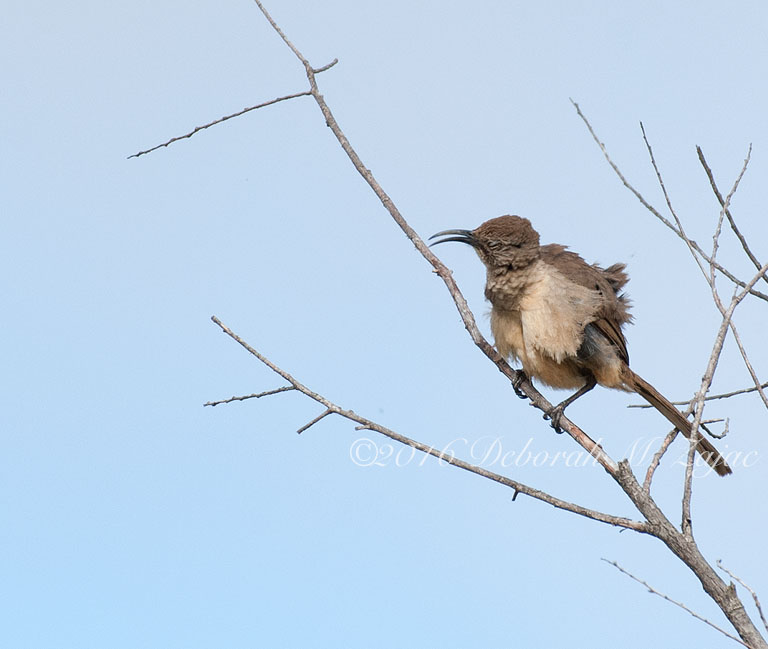
He sang for 10 minutes.  Then he stopped, gave himself a real good shake…

California Thrasher

…took a breath, and began singing again!

California Thrasher

Two little Bushtits flew into the bush beside him and began talking to him,

Bushtits

so he turned around to sing to them.

California Thrasher

There were a few more notes sung by the Bushtits to the Thrasher then they flew off. It happened so fast I was only able to get 3 shots of the Bushtits.  The image isn’t great. My lens kept wanting to focus on the branches in front of the bird rather than the little bird.

Then the Thrasher flew north. What a treat that was to hear him singing for so long.  It was the highlight of my morning.

The California Thrasher is found in California and Baja California.

I found some  California Thrasher Song sound files over on allaboutbirds.com that you can listen to here.

Nikon D700| Nikkor 200-500mm| Lexar Professional Digital Film| PS CC 2015

More to come…


Tribute Day May 14, 2016

Copyright ©2016 Deborah M. Zajac. ALL RIGHTS RESERVED

Today is National Train Day in the States, and it’s also Global Big Day 2016 in the Birding World.  I thought I’d honor both here with a short post.

Back in 2012 myself and two friends Dali, and Phil were looking for a particular waterfall called Phantom Fall in Butte county. We hiked through a woodland forest, along railroad tracks, crossed creeks, and climbed grassy hills looking for it. While on a grassy hill taking a break I heard the rumble of a train, and the low train’s whistle and turned to find the train.

I waited for it to get around the curve hoping it was a long enough train to go around the whole curve. It was a wee bit short. 🙂 Still neat to see, and hear though.

We hiked, and drove a lot of miles that day looking for that elusive waterfall, but didn’t find it. Dali and I found it a year or so later, but I’m saving that story. Not enough time has passed yet. I need to be older and the tale a bit more aged before it comes out in public.

Amtrak train

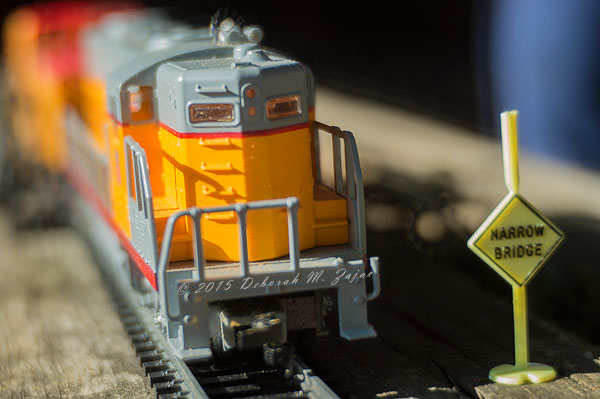
Here’s a fun macro image I made of a toy Bachman’s Engine some of you may remember from a post I made last year.  This is from a train set we used to set up around the Christmas tree when my kids were little.

Toy train

To honor Global Big Day and my love of birds here’s an image of a Western Wood Peewee.

I took this image while looking for the Gray Flycatcher posted here  The Western Wood Peewee is a “lifer” for me! That was an exciting day of Birding with 2 “life” birds added to my list.

Western Wood Peewee

I hope you all have a wonderful week-end!

Nikon D700, & Nikon Df| Nikkor 70-300mm VR, 200-500mm VR, and LensBaby

More to come…

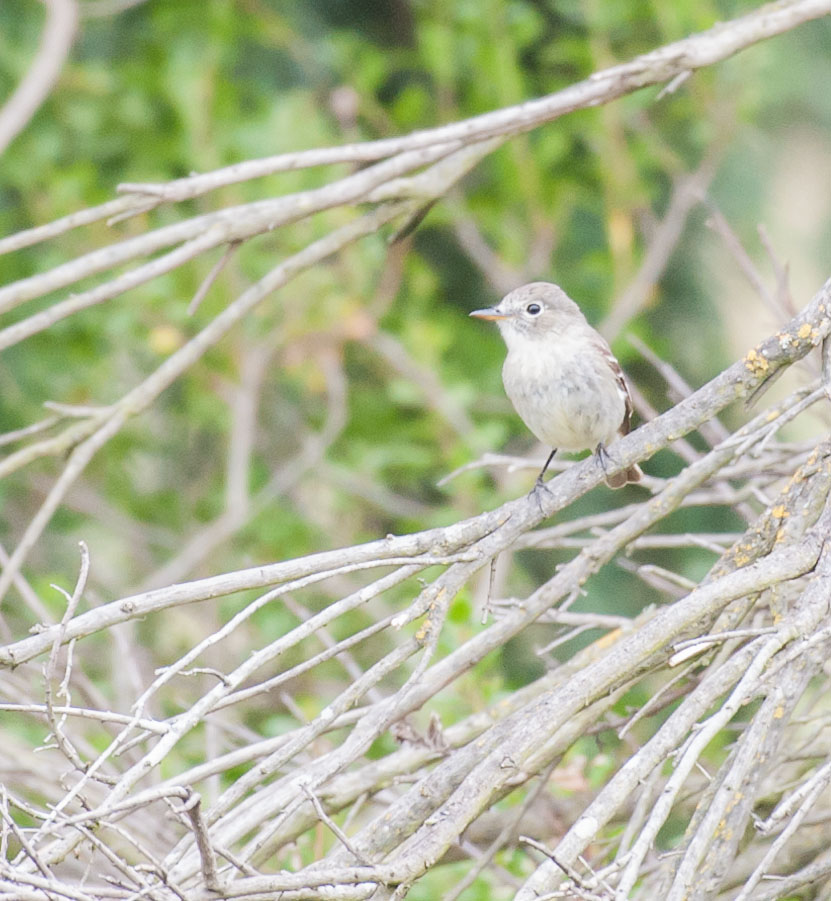
Gray Flycatcher

Copyright ©2016 Deborah M. Zajac. ALL RIGHTS RESERVED

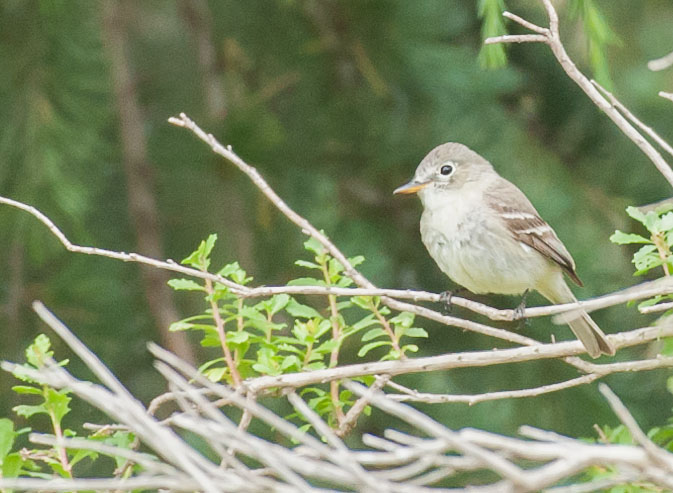
I went birding on both Saturday and Sunday this past week-end hoping to find two birds I’d never seen or photographed before. I got lucky with really good looks on the first bird on my list: The Gray Flycatcher.  A “lifer” for me!

Gray Flycatcher

There were other birders there looking for the same bird which made the experience more fun and exciting. It also helped to have several pairs of eyes, and ears on the lookout.

Gray flycatcher

It’s migrating south, and this one is further west than it’s regular migration route.

Gray Flycatcher

He was pretty far away from me, and in the shadows of the trees so I boosted my ISO to keep up my shutter speed to prevent blurring, and these images are cropped.

Sunday I went back to look for the second bird on my list, but I was not successful.  I’ll have another go this week-end if I hear it’s still in the area.

Nikon D700| Nikkor 200-500mm| Lexar Professional Digital Film| Tripod|

Note to self- take the bug spray! I got eaten alive by mosquitoes!

More to come…


Killdeer

Copyright ©2016 Deborah M. Zajac. ALL RIGHTS RESERVED

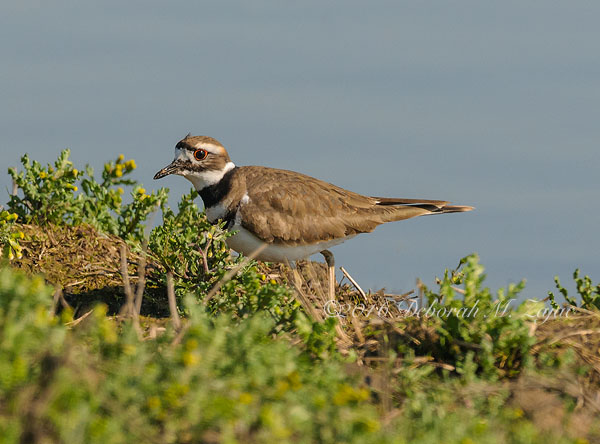
Killdeer-

The Killdeer is a year round resident in California, and gets its name from the shrill, wailing kill-deer call it makes.  I love their big eyes.

Killdeer_ Photography

Happy Earth Day!

Nikon D300s| Nikkor 200-500mm| Lexar Professional Digital Film| PS CC 2015|

More to come…

Twitterpated

Copyright ©2016 Deborah M. Zajac. ALL RIGHTS RESERVED

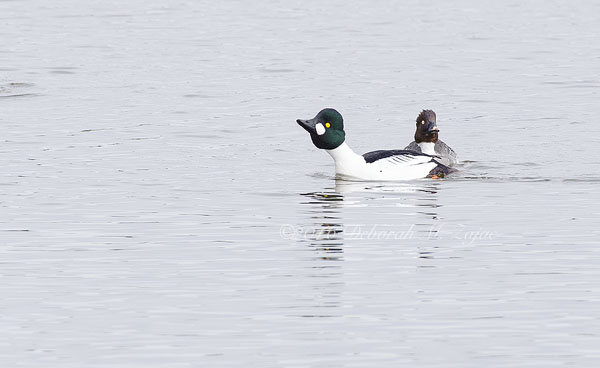
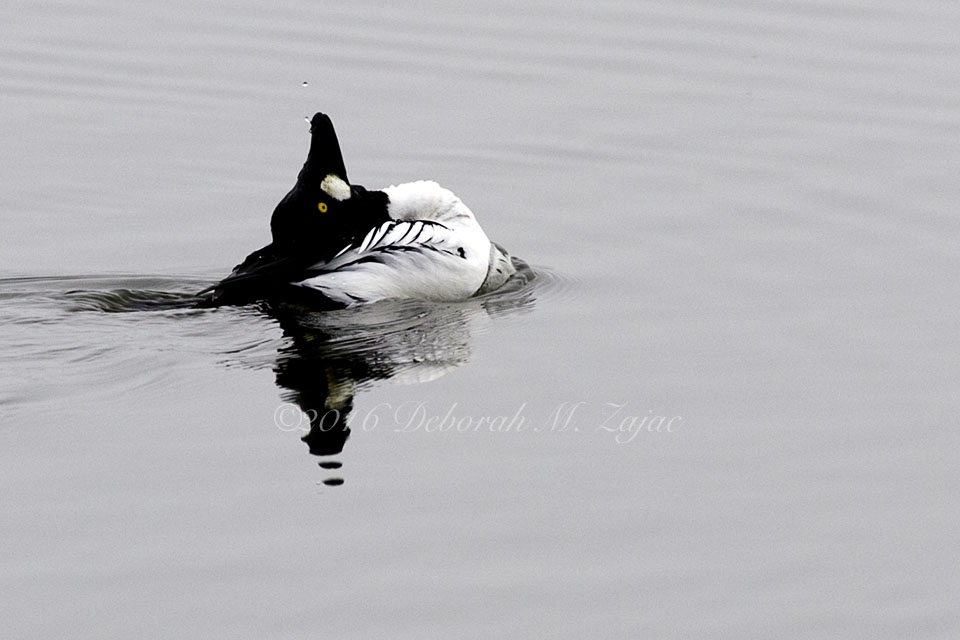
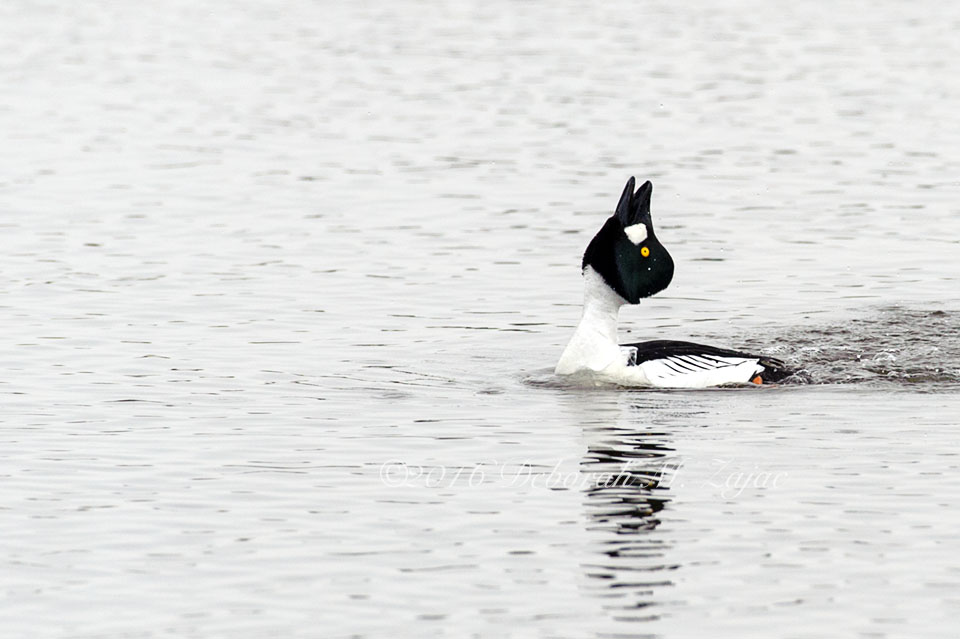
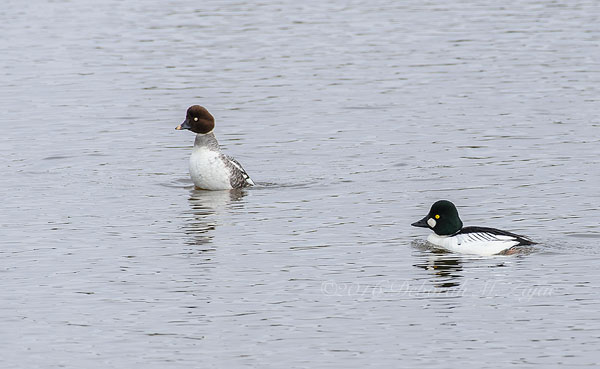
I had a most delightful morning a couple of months back watching  some Common Golden-eye males doing the their mating dance/display.

Common Goldeneye Male-Mating Ritual Dance-Photography

Common Goldeneye male- Mating Ritual Dance Photography

Common Goldeneye Male-Mating Ritual Dance-Photography

Common Goldeneye Male-Mating Ritual Dance-Photography

She likes me!

Common Goldeneye Male-Mating Ritual Dance-Photography

I think I nailed that.

Common Goldeneye Male-Mating Ritual Dance-Photography

The word Twitterpated was first used in the movie Bambi. It means to be overcome with romantic feelings; smitten.

UPDATE: I looked up the scene in the original Disney movie and found the dialog about Spring Twitterpation.  I think it’s delightful! Hope you do too.

Bambi 1942

Flower: [about two birds fluttering around] Well! What’s the matter with them?
Thumper: Why are they acting that way?
Friend Owl: Why, don’t you know? They’re twitterpated.
Flower, Thumper, Bambi: Twitterpated?
Friend Owl: Yes. Nearly everybody gets twitterpated in the springtime. For example: you’re walking along, minding your own business. You’re looking neither to the left, nor to the right, when all of a sudden, you run smack into a pretty face. Woo-woo! You begin to get weak in the knees. Your head’s in a whirl. And then you feel light as a feather; and before you know it, you’re walking on air. And then you know what? You’re knocked for a loop, and you completely lose your head!
Thumper: Gosh. That’s awful.
Flower: Gee whiz.
Bambi: Terrible!
Friend Owl: And that ain’t all. It can happen to anybody. So you’d better be careful.
[points at Bambi]
Friend Owl: It could happen to you…
[points at Thumper]
Friend Owl: …and you, and…
[Flower looks at Owl shyly]
Friend Owl: Yes, it could even happen to you!
Thumper: Well, it’s not gonna happen to me.
Bambi: Me neither.
Flower: Me neither.

Nikon D700| Nikkor 200-500mm| Lexar Professional Digital Film| PS CC 2015

More to come…