Whatever Weds. A Coyote Tale

Copyright ©2026 Deborah M. Zajac. ALL RIGHTS RESERVED.

PLEASE DO NOT USE MY IMAGES WITHOUT EXPRESSED WRITTEN PERMISSION.

Saturday morning after I’d finished Wordle and Strands I shared my results with my sister. We trade results and talk about where we struggled or where we felt it was easy. We talked for a bit and then I got up to make a second cup of tea this was about 7A.M. I just caught out the corner of my eye out back a Coyote streaking by. I moved to the backdoor to see where it was going and here came another one streaking by following the first one! That was neat. I thought they were probably heading back to the den since the sun was up already.

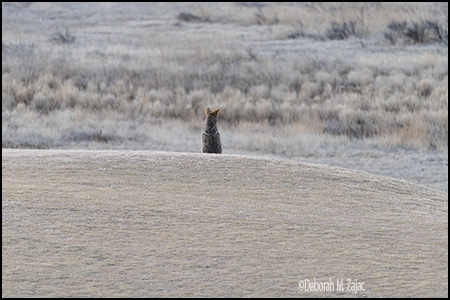
Fast forward 50 minutes and when I looked up from reading there out at the edge of the golf course was a Coyote with its back to me gazing out across the flood plain. Oh! I raced to get my camera that was in my retreat. I wished as I was racing that it would still be there when I got back. It was!
©Deborah M. Zajac | http//:circadianreflections.com
Coyote Gazing across the field.

As I opened the sliding glass door and screen it heard me and turned to see what the noise was. It soon realized I was no threat so turned its gaze back to the field. Above is exactly what I saw that had me run for my camera.
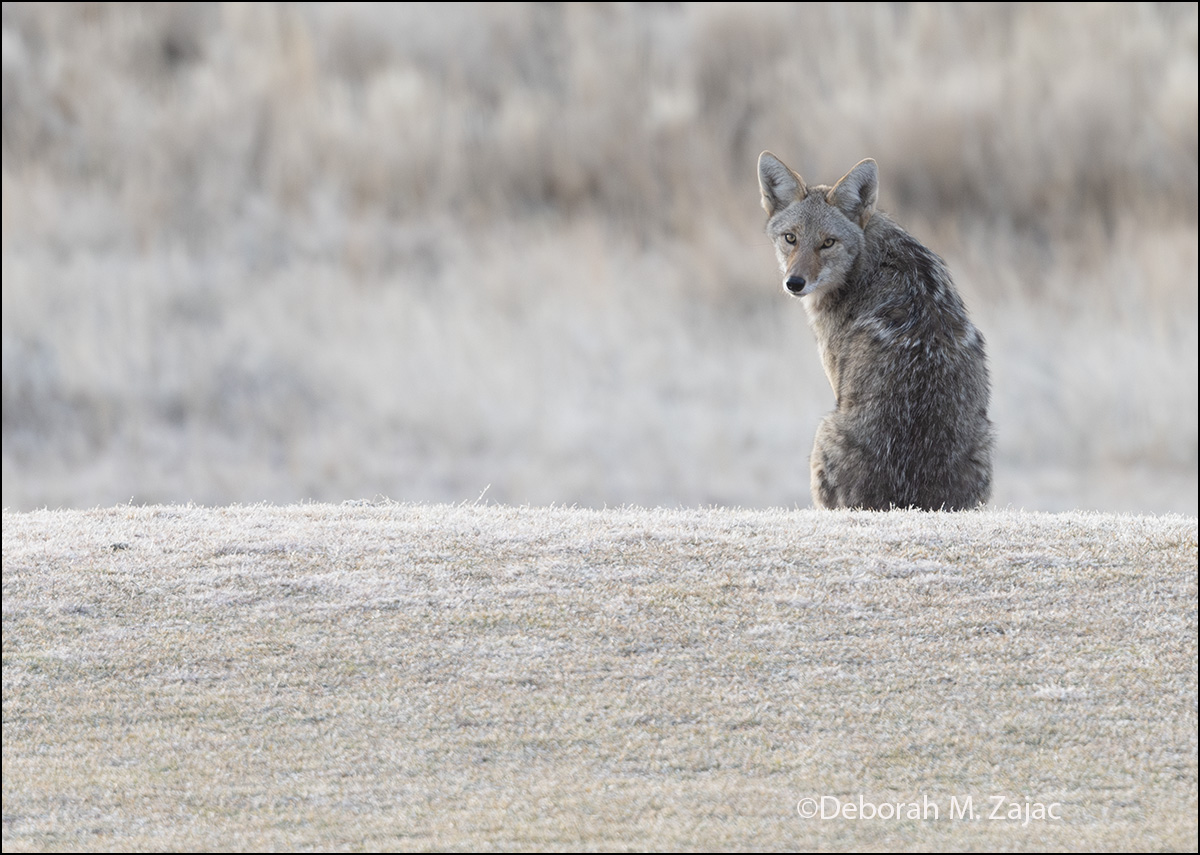
©Deborah M. Zajac | http//:circadianreflections.com

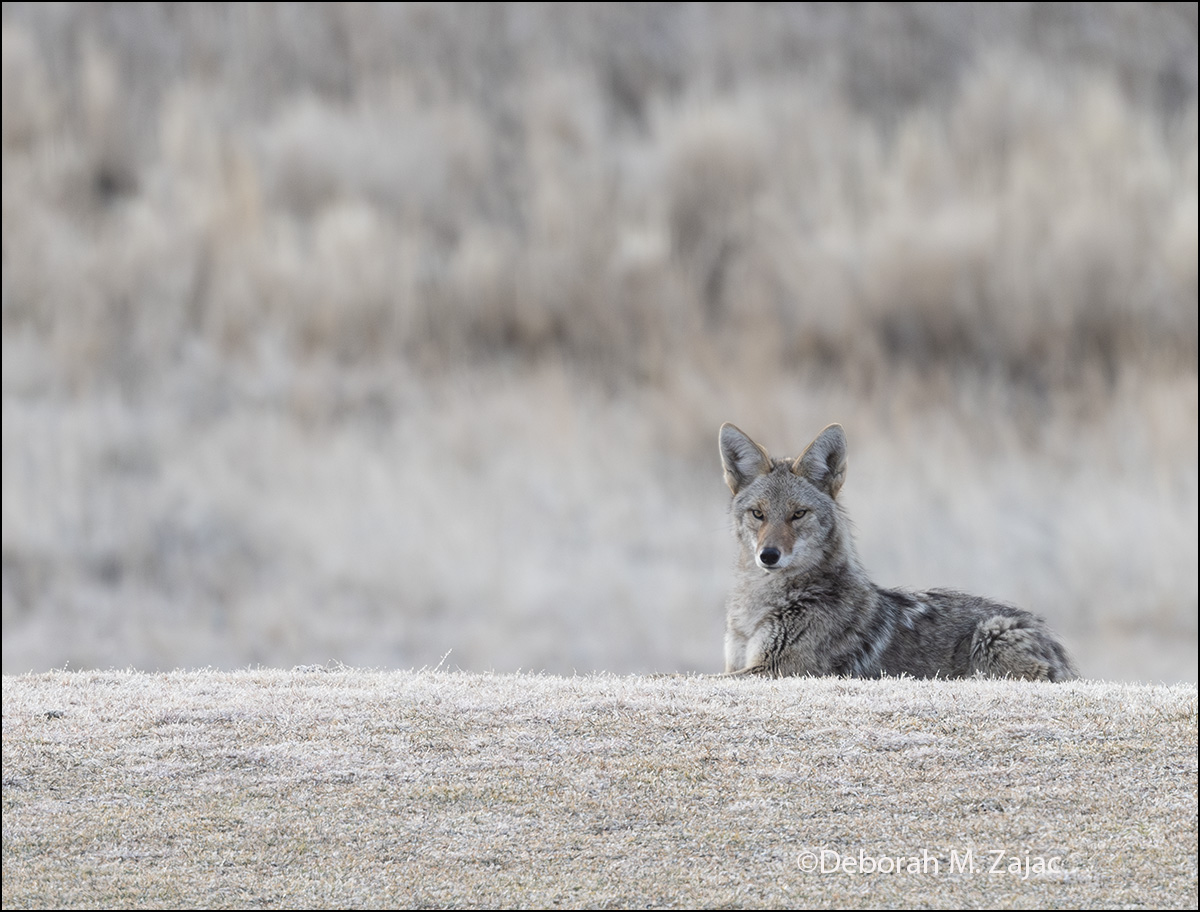
Then I guess it decided there was nothing to worry about or going on so it laid down in the cold grass.
©Deborah M. Zajac | http//:circadianreflections.com
I think my neighbor came out to look and as it seems to be looking that way rather than at me.

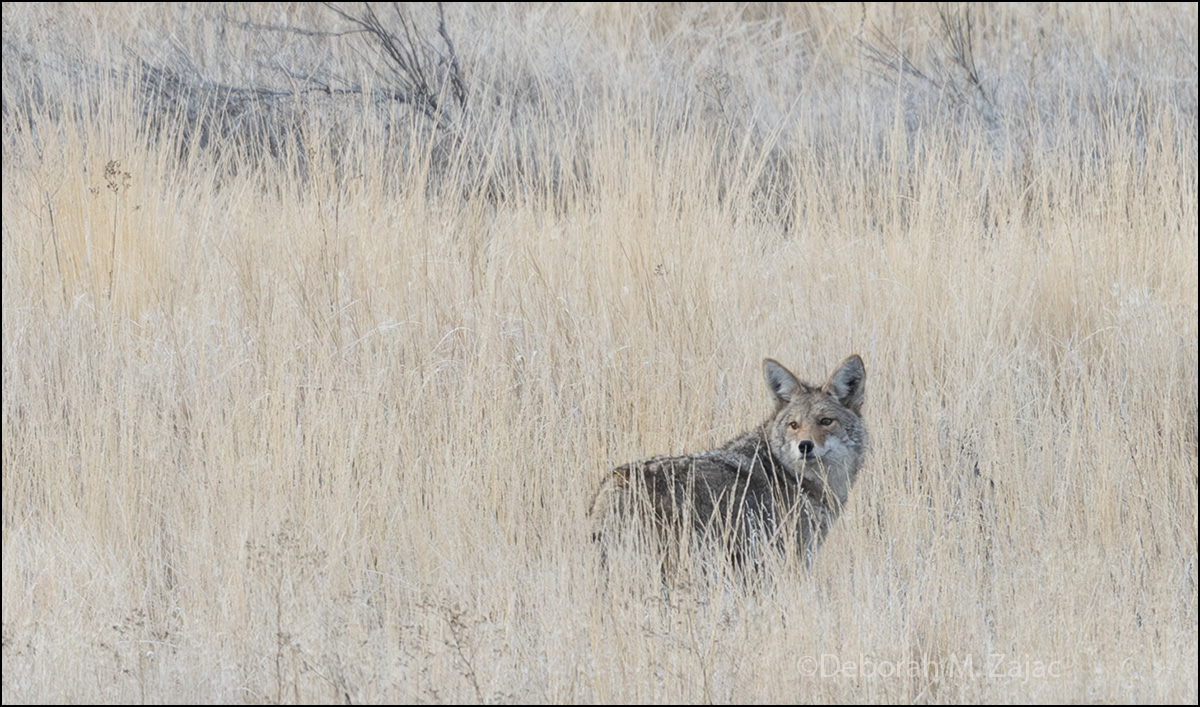
After a few minutes something caught its attention out in the field and it got up to look. I looked too. Oh! There out in the field further west was another Coyote! Perhaps these two were the two I had seen running by an hour before?

Here’s Number Two out in the field looking back at Number One. This is cropped in a bit.
©Deborah M. Zajac | http//:circadianreflections.com

Next, Number One started making its way across the golf course closer to me! Curious perhaps or had it heard the birds?
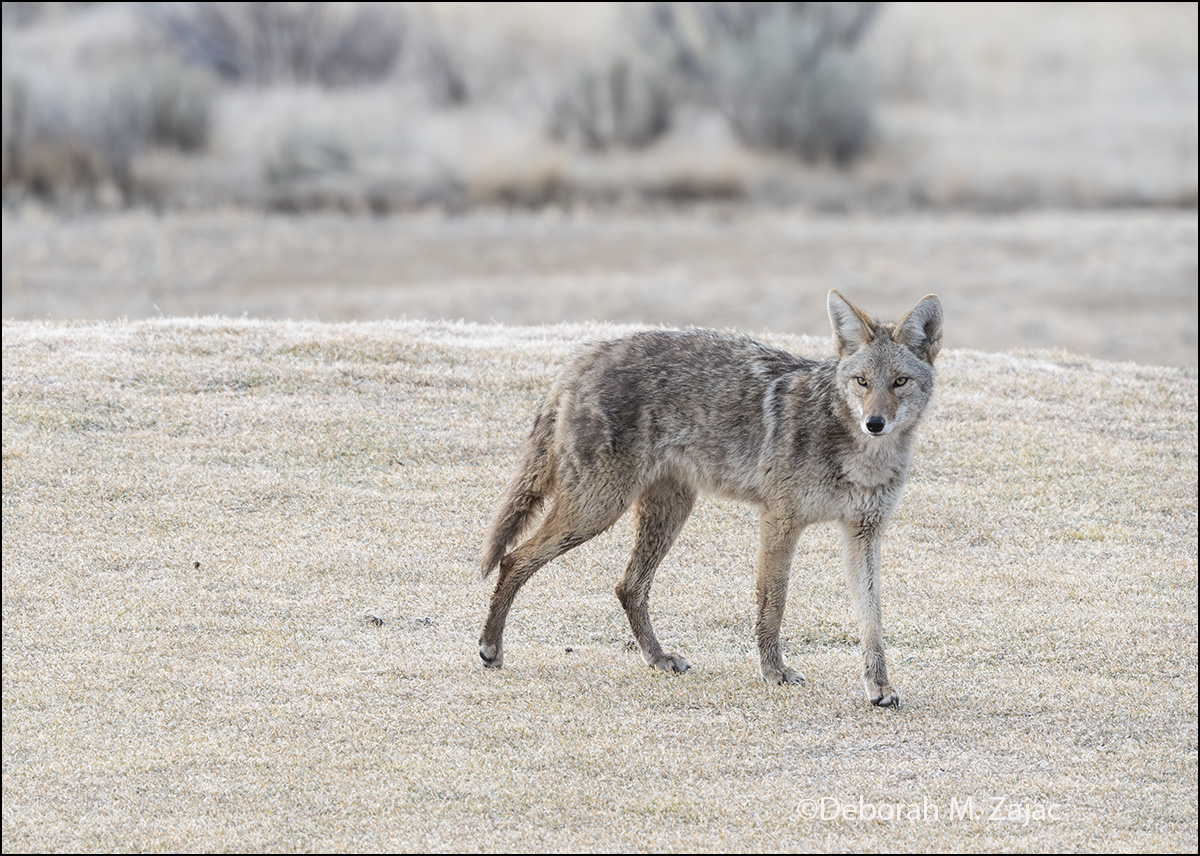
©Deborah M. Zajac | http//:circadianreflections.com
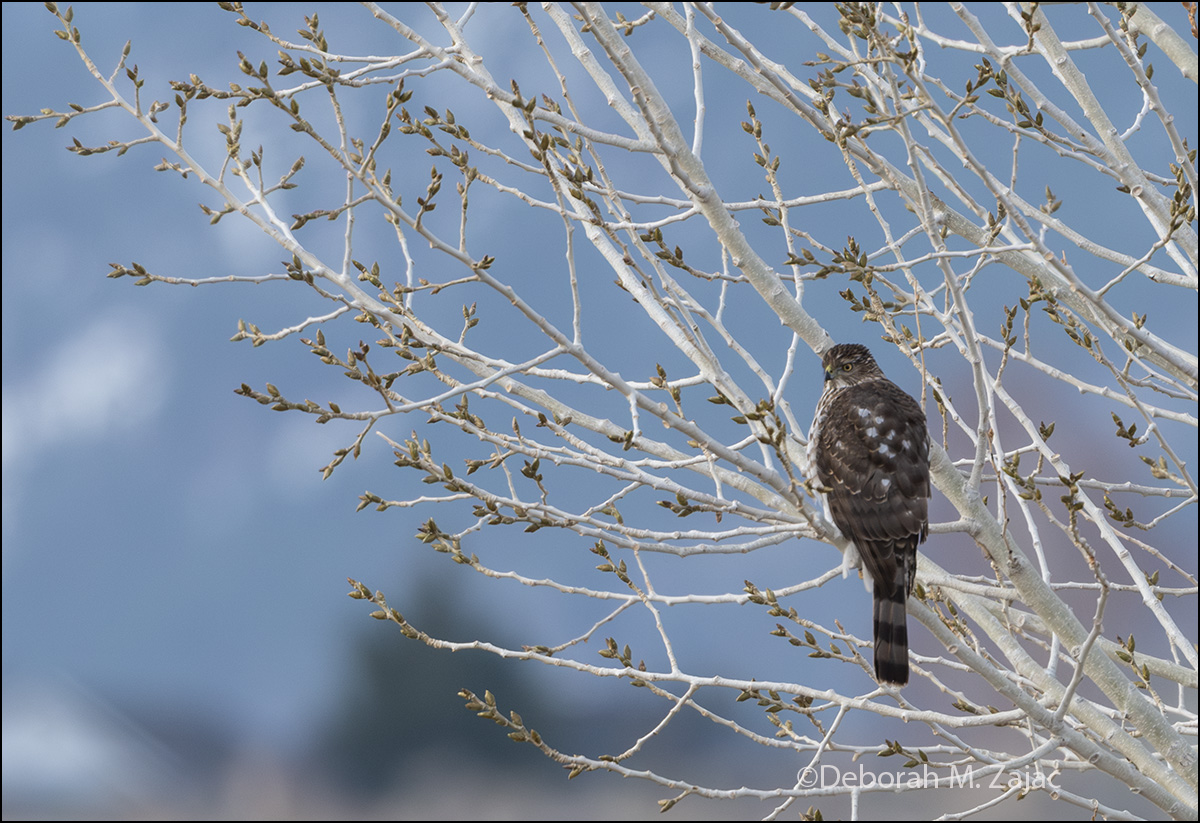
It kept coming closer then below me a Cooper’s Hawk swooped in low over the Sagebrush just behind my fence! The Sparrows and Quail all dove into the Sagebrush and got really quiet. The Hawk landed up on a branch in my neighbor’s tree. The Hawk was watching the approaching Coyote not the birds. I was watching them all.
©Deborah M. Zajac | http//:circadianreflections.com
Cooper’s Hawk

Coyote Number One got to the bottom of the hill below me but, I couldn’t see him anymore. Then he started up the golf cart path headed east and soon was out of sight.

Number Two couldn’t see Number One I think, so came up to the edge of the course. It spotted me. Our eyes met. Then it turned to look east after its buddy, and off it went after it head down on the scent.
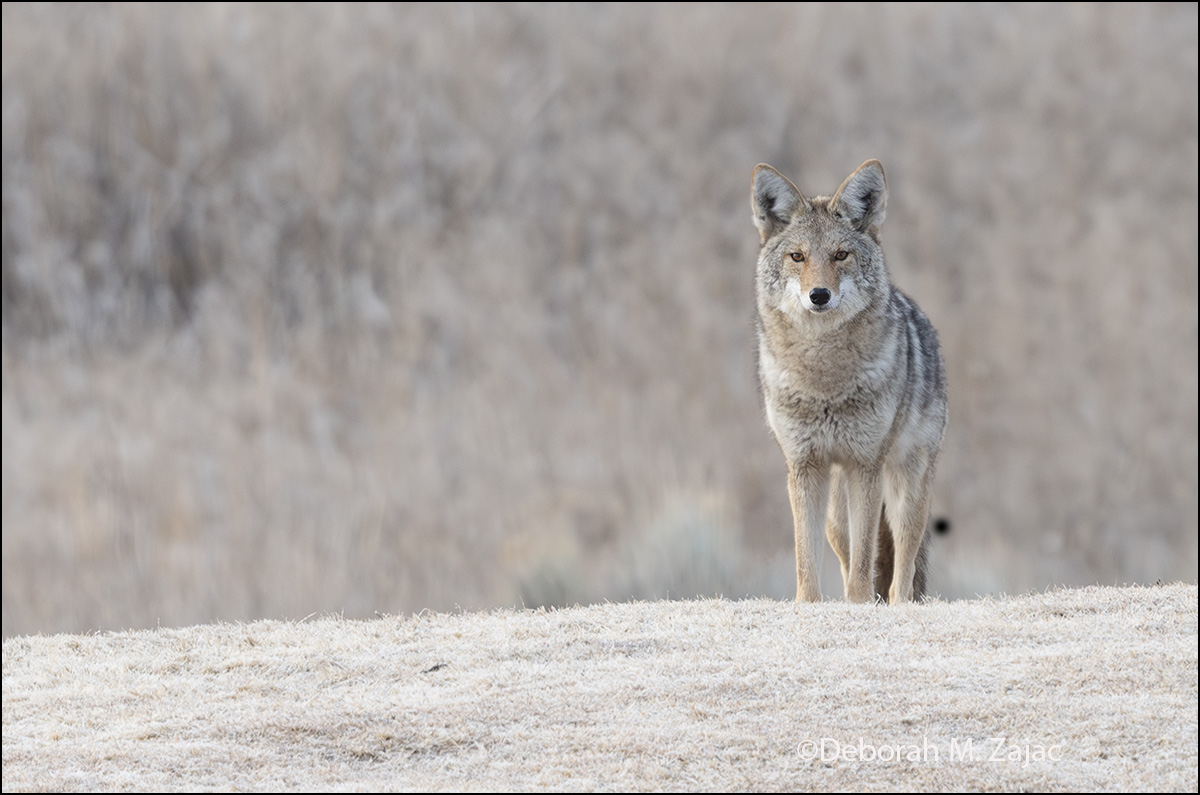
©Deborah M. Zajac | http//:circadianreflections.com Image

I watched it until it was out of sight then looked up and there out in the distance were 3 Hot Air Balloons rising. I hoped they’d float my way, but they never do. Prevailing winds tend to head east. This morning was no different they all floated east behind the mountains out into the great Nevada desert.
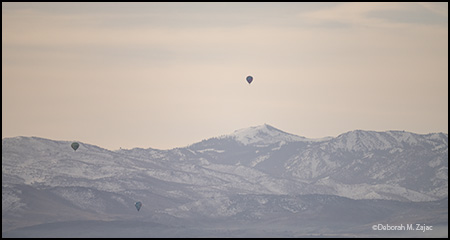
©Deborah M. Zajac | http//:circadianreflections.com Image

I watched until the last balloon slid behind the mountains and out of view. It was my turn to turn away from the view. I went to get my forgotten cup of tea now cold then headed to the kitchen to make a fresh cup. Happy with the way my day started and counting my blessings. I was thinking how wonderful it is to have all this nature and wildlife here and I was very thankful to be home Saturday morning to see it all.

more to come…
Friday’s Feathered Friends-Cooper’s Hawk

Copyright ©2026 Deborah M. Zajac. ALL RIGHTS RESERVED.

PLEASE DO NOT USE MY IMAGES WITHOUT EXPRESSED WRITTEN PERMISSION.

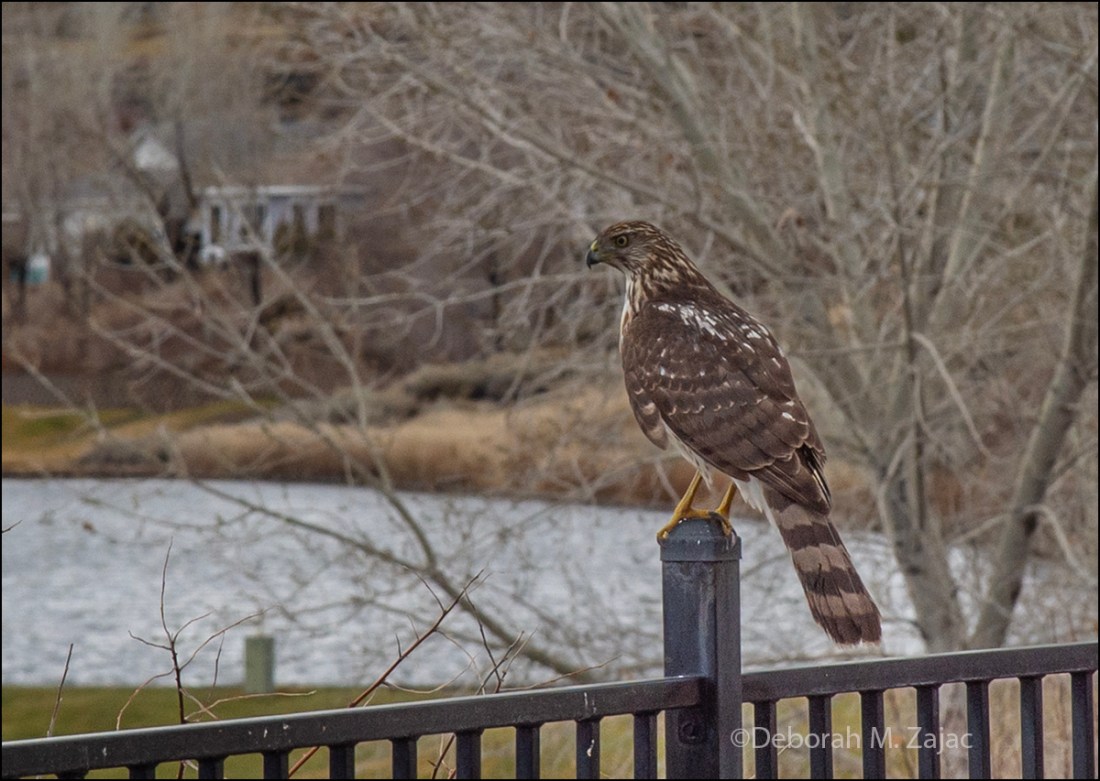
January 2nd a Cooper’s Hawk came to look for breakfast at my neighbor’s house. I quietly opened the back door and grabbed what are the first Hawk images of 2026. Here’s one.

I’m taking that as a sign that it’s going to be a good year of birding.

©Deborah M. Zajac | http//:circadianreflections.com
Cooper’s Hawk

This winter has started off a bit bumpy on the home-front. Our heater went out just after Christmas on a Sunday. Fortunately, we were able to have our preferred heating and air company come out that afternoon and fix it.

Then I discovered we have a leak in the garage. We had a roofer out and they found several broken tiles. Errant golf balls no doubt. Our house gets hit a lot. I wish they…the golfers would learn to hit toward their other right!

The roofers sealed up the cracks and we’re scheduled to have the tiles replaced at the end of the month. I welcome the rain and snow, but not the leaky roof.

We’ve had several storms so I haven’t been out birding, but today the weather looks cold, but sunny so I’ll be birding with the group this morning. I’ll be late getting to your blogs and comments.

Fun Facts:

  • Dashing through vegetation to catch birds is a dangerous lifestyle. In a study of more than 300 Cooper’s Hawk skeletons, 23 percent showed old, healed-over fractures in the bones of the chest, especially of the furcula, or wishbone.
  • A Cooper’s Hawk captures a bird with its feet and kills it by repeated squeezing. Falcons tend to kill their prey by biting it, but Cooper’s Hawks hold their catch away from the body until it dies. They’ve even been known to drown their prey, holding a bird underwater until it stopped moving.
  • Once thought averse to towns and cities, Cooper’s Hawks are now fairly common urban and suburban birds. Some studies show their numbers are actually higher in towns than in their natural habitat, forests. Cities provide plenty of Rock Pigeon and Mourning Dove prey. Though one study in Arizona found a downside to the high-dove diet: Cooper’s Hawk nestlings suffered from a parasitic disease they acquired from eating dove meat.
  • Life is tricky for male Cooper’s Hawks. As in most hawks, males are significantly smaller than their mates. The danger is that female Cooper’s Hawks specialize in eating medium-sized birds. Males tend to be submissive to females and to listen out for reassuring call notes the females make when they’re willing to be approached. Males build the nest, then provide nearly all the food to females and young over the next 90 days before the young fledge.
  • The oldest recorded Cooper’s Hawk was a male and at least 20 years, 4 months old. He was banded in California in 1986, and found in Washington in 2006.

I wish you all a great week-end!

more to come…

Friday’s Feathered Friends- Cooper’s Hawk

Copyright ©2023 Deborah M. Zajac. ALL RIGHTS RESERVED. DO NOT USE MY IMAGES WITHOUT EXPRESSED WRITTEN PERMISSION!

HAPPY NEW YEAR!!

For several weeks we’ve had a Cooper’s Hawk perching on a neighbor’s tree out back. With all the White-crown Sparrows, and Quail about I’m sure it’s hoping for a meal.

I’ve been enjoying seeing it perched there.

Cooper’s Hawk

Fun Facts-

    • Dashing through vegetation to catch birds is a dangerous lifestyle. In a study of more than 300 Cooper’s Hawk skeletons, 23 percent showed old, healed-over fractures in the bones of the chest, especially of the furcula, or wishbone.
    • A Cooper’s Hawk captures a bird with its feet and kills it by repeated squeezing. Falcons tend to kill their prey by biting it, but Cooper’s Hawks hold their catch away from the body until it dies. They’ve even been known to drown their prey, holding a bird underwater until it stopped moving.
    • Once thought averse to towns and cities, Cooper’s Hawks are now fairly common urban and suburban birds. Some studies show their numbers are actually higher in towns than in their natural habitat, forests. Cities provide plenty of Rock Pigeon and Mourning Dove prey. Though one study in Arizona found a downside to the high-dove diet: Cooper’s Hawk nestlings suffered from a parasitic disease they acquired from eating dove meat.
    • Life is tricky for male Cooper’s Hawks. As in most hawks, males are significantly smaller than their mates. The danger is that female Cooper’s Hawks specialize in eating medium-sized birds. Males tend to be submissive to females and to listen out for reassuring call notes the females make when they’re willing to be approached. Males build the nest, then provide nearly all the food to females and young over the next 90 days before the young fledge.
    • The oldest recorded Cooper’s Hawk was a male and at least 20 years, 4 months old. He was banded in California in 1986, and found in Washington in 2006.

Fun Facts gleaned from allaboutbirds.org

Fuji X-T3| Fujinon 100-400mm| PS CC 24.1.0

more to come…

Wordless Wednesday 7/52

Copyright ©2017 Deborah M. Zajac. ALL RIGHTS RESERVED

Red-tailed Hawk

Red-tailed Hawk

Nikon D700| Nikkor 200-500mm| Lexar Professional Digital Film| PS CC 2017

More to come…

Red-tailed Hawk 2

Copyright ©2016 Deborah M. Zajac. ALL RIGHTS RESERVED

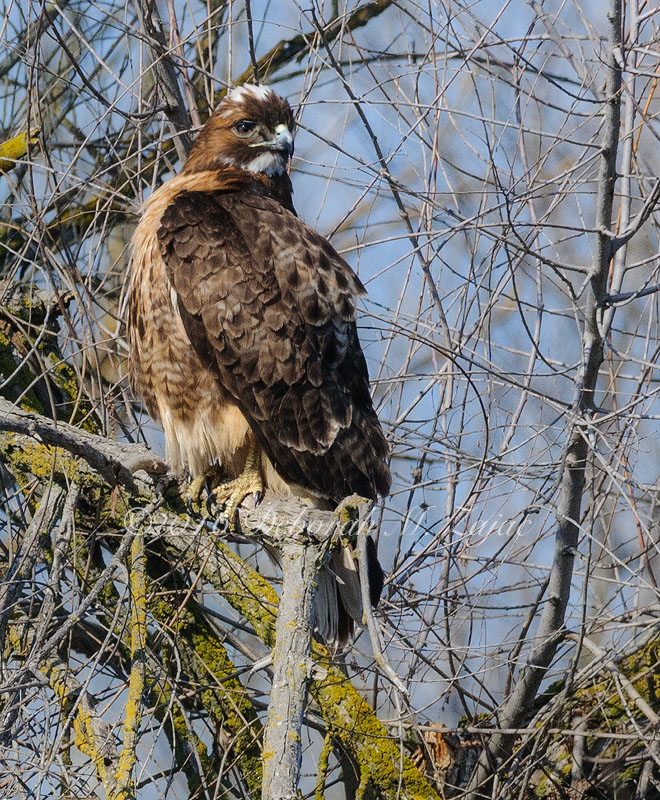
This Red-tail is from a couple of weeks back.  My friend and I were birding in San Luis National Wildlife Refuge and nearing the end of one of the auto-routes when we spotted it high in the tree.  I was driving and didn’t think I’d get a decent photograph of it because it was on the passenger side of the car/road, and climbing over the console and gear box wasn’t something I wanted to do.

Red-tail Hawk

We had the route nearly to ourselves so I thought I’d pull the car caddy-whompus across the road and shoot leaning into the passenger seat.  I was able to get several images of it before another car came up and I had to move.

It is striking isn’t it with its white cap and that gaze?

Nikon D300s| Nikkor 200-500mm VR| Lexar Digital Film| PS CC 2015

Red-tail Hawk with Prey

Copyright ©2016 Deborah M. Zajac. ALL RIGHTS RESERVED

Warning!: Some may find these images too graphic!

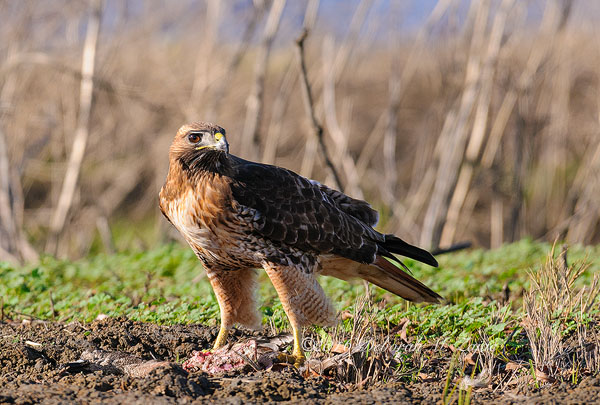
While birding a couple of weeks ago in the Sacramento Valley we spotted this Red-tail Hawk having lunch on a levy about 25-30ft away from us.  It spotted us too.  It didn’t like the way we kept staring while it was trying to eat so…
Red tail Hawk with meal

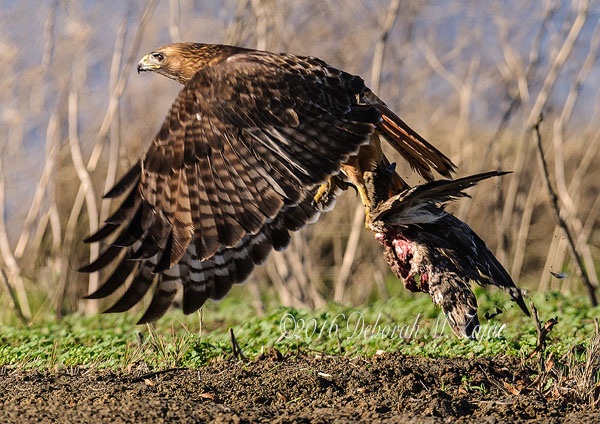
…it picked up its meal…

Red-tailed Hawk with Prey in Flight

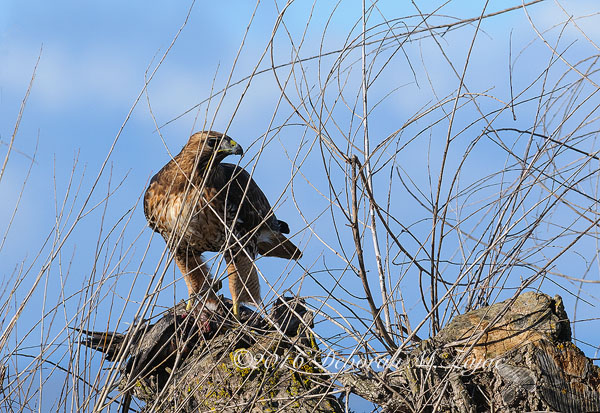
…and flew to a tree stump that offered a bit more privacy.

Red tail with prey on tree stump

We watched it eat for a couple of minutes then slowly drove away leaving it to enjoy its meal.

The second image with the Red-tail in flight has a bit of motion blur. I was hand-holding the lens and not used to its weight and think it was me being a wobbly rather than a slight pan.  The eye is pretty sharp, and the blur gives it a sense of movement I like enough to save, and share it.

I was also racked out to 500mm and I didn’t frame up the shot giving the bird enough room to fly out of the frame, so I extended the canvas a bit then added in some of the background to give the bird some room to fly out of the frame, and fix the composition.  There’s a learning curve to  all new lenses; getting used to the weight, and bulkiness -it’s a chubby lens, and framing with it will be what I strive to master in the coming years.

I liked the lens so much I bought one right after I returned the rental lens.

Nikon D300s| Nikkor 200-500mm VR (rental lens)| Lexar Professional Digital Film| PS CC 2015

More to come…