Copyright ©2023 Deborah M. Zajac. ALL RIGHTS RESERVED.
PLEASE DO NOT USE MY IMAGES WITHOUT EXPRESSED WRITTEN PERMISSION.
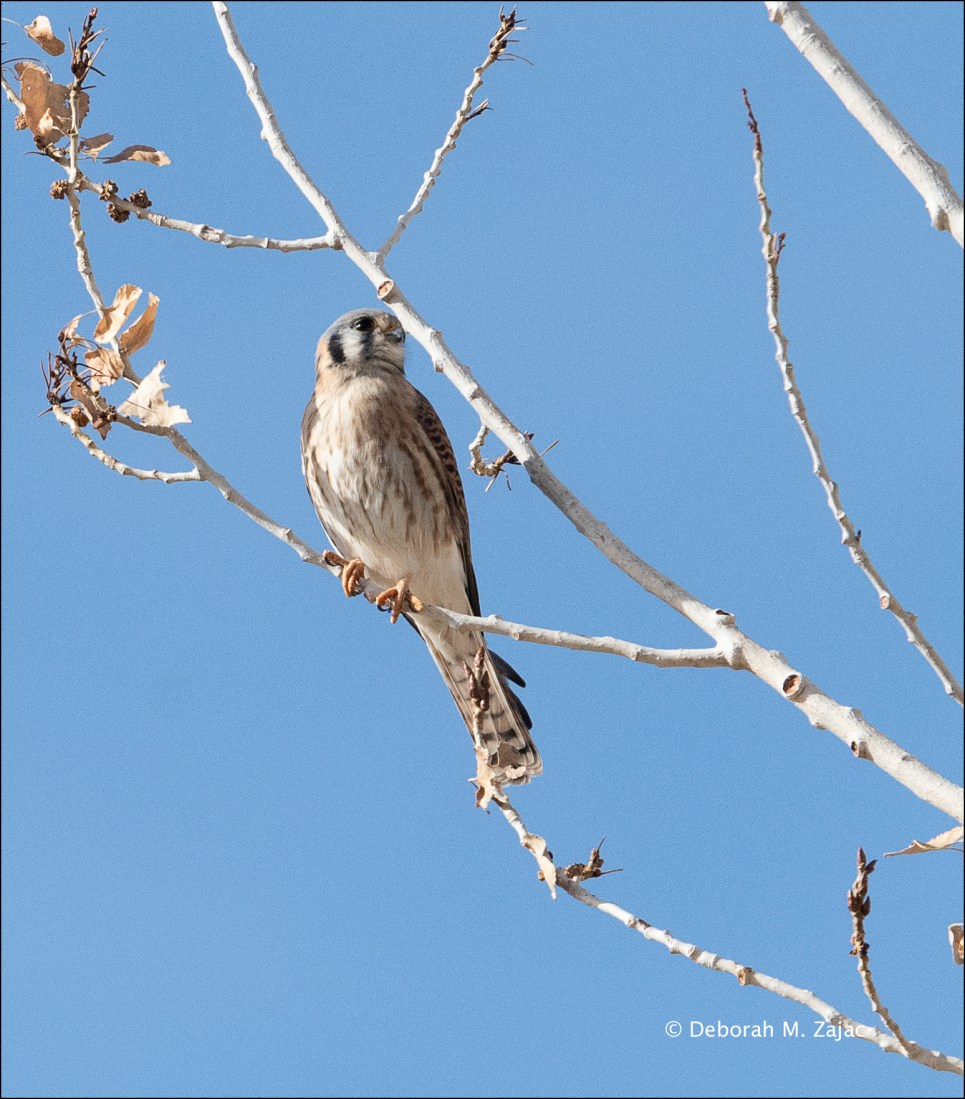
This is a Kestrel I saw in December. I’ll show her from the two sides I got to observe her from. It’s a treat to actually get two side views of a bird.
When I first spotted her high in a Cottonwood tree-
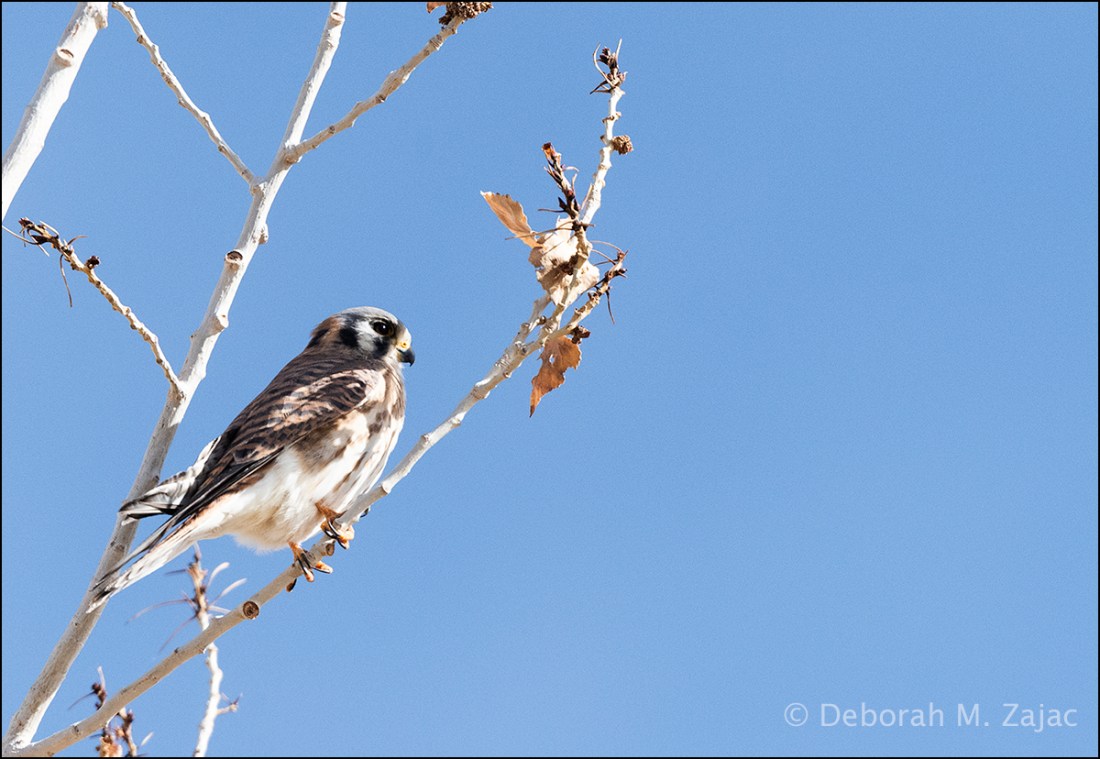
They’re one of the smallest birds of prey, but so cute.
Here she is from the other side, with her chest showing.
Fun Facts:
-
- Sports fans in some cities get an extra show during night games: kestrels perching on light standards or foul poles, tracking moths and other insects in the powerful stadium light beams and catching these snacks on the wing. Some of their hunting flights have even made it onto TV sports coverage.
- When nature calls, nestling kestrels back up, raise their tails, and squirt feces onto the walls of the nest cavity. The feces dry on the cavity walls and stay off the nestlings. The nest gets to be a smelly place, with feces on the walls and uneaten parts of small animals on the floor.
- It can be tough being one of the smallest birds of prey. Despite their fierce lifestyle, American Kestrels end up as prey for larger birds such as Northern Goshawks, Red-tailed Hawks, Barn Owls, American Crows, and Sharp-shinned and Cooper’s Hawks, as well as rat snakes, corn snakes, and even fire ants.
- In winter in many southern parts of the range, female and male American Kestrels use different habitats. Females use the typical open habitat, and males use areas with more trees. This situation appears to be the result of the females migrating south first and establishing winter territories, leaving males to the more wooded areas.
- Unlike humans, birds can see ultraviolet light. This enables kestrels to make out the trails of urine that voles, a common prey mammal, leave as they run along the ground. Like neon diner signs, these bright paths may highlight the way to a meal—as has been observed in the Eurasian Kestrel, a close relative.
- Kestrels hide surplus kills in grass clumps, tree roots, bushes, fence posts, tree limbs, and cavities, to save the food for lean times or to hide it from thieves.
- The oldest American Kestrel was a male and at least 14 years, 8 months old when he was found in Utah in 2001. He was banded in the same state in 1987.
“Like neon diner signs”! 😂 I loved that description.
Fun facts gleaned from allaboutbirds.org
Happy New Year to all my blogging friends, and visitors!
Nikon D810| Nikkor 500mm| PS CC 25.3.1
more to come…
 Circadianreflections Blog
WOW! Their markings are so beautiful and nice catch-lights in the eyes!
LikeLike
Thank you so much, Denise! I love those catchlights in eyes as well.
LikeLiked by 1 person
What a beauty! And such interesting facts especially about the ultraviolet light… I had no idea!
LikeLike
Thank you so much, Jill! I didn’t know that either. You learn something new everyday. 😍
LikeLiked by 1 person
Nice capture and fun facts, about the American Kestrel. I can’t remember being anywhere that I didn’t see these a Kestrel from time to time.
LikeLike
Thank you so much, John!
LikeLike
Beautiful photos. I know nothing about these birds so thanks for information.
LikeLike
I’m really glad you enjoyed the images of this Kestrel as well as the information, Ally! 😀
LikeLiked by 1 person
Beautiful shots of this gorgeous gal! She might be small, but she is mighty and powerful! 🙂
LikeLiked by 1 person
She is indeed. Thank you so much, Donna!
LikeLiked by 1 person
You’re welcome, Deborah!
LikeLiked by 1 person
What a handsome little guy. You really captured his personality, Deborah. The information is interesting too. Hugs on the wing.
LikeLiked by 1 person
Thank you so much, Teagan!!🤗
LikeLike
Great shots of the Kestrel!
LikeLike
Thank you so much, David!
LikeLike
Great shots! I didn’t know what a Kestrel was before I got married. I have heard a lot about them over the years.
LikeLiked by 1 person
Thank you! Landscape photography was my path into wildlife and birding photography. Wanting to know about the animals and birds I was photographing increased my knowledge and got me hooked! 😀
LikeLike
I’ve never seen this bird. Lovely!
LikeLiked by 1 person
I’m happy to have introduced you to her, Jennie! Thank you so much! 😀
LikeLiked by 1 person
You are welcome!
LikeLiked by 1 person
😀
LikeLiked by 1 person
Lovely at both angles!
LikeLike
Isn’t she! Thank you so much, Belinda. 😀
LikeLiked by 1 person
Thanks for the facts, Deborah. I like knowing more about the birds. Wonderful photos. I think the white branches make for an even image. The bird is beautiful.
LikeLiked by 1 person
Thank you so much, Dan! I like knowing more about the birds I see as well. I’m glad you do too and hope most my readers do too. It’s so cute and my second favorite raptor.
LikeLiked by 1 person
A beautiful bird, Deborah. I so enjoy learning about the birds you photograph. Thanks.
LikeLiked by 1 person
Thank you so much, John!
LikeLiked by 1 person
😊
LikeLike
Beautiful captures Deborah, they look a little more attractive than our Aussie ones.
LikeLiked by 1 person
Thank you so much, Ashley!
LikeLiked by 1 person
That feathered friend recognized an accomplished photographer and decided to pose for his portrait. Nice!
LikeLiked by 2 people
Thank you so much, Judy! It was so nice having stick around for awhile so I could take its photo on both sides.
LikeLiked by 1 person
Interesting, so we should our birding events at late sporting events at stadiums? 😉👍
LikeLiked by 1 person
LOL! I think we’d have better odds of seeing them keeping our current birding spot rotation rather than stadiums, but when I find myself in one going forward I’ll be looking! 😀
LikeLiked by 1 person
Thanks for sharing an amazing image. Anita
LikeLiked by 1 person
Thanks!
LikeLiked by 1 person
With regard to surplus food, the kestrel is no wastrel.
LikeLiked by 1 person
LOL! That’s a good one! 😀
LikeLike
I’ve seen Kestrels only a few time, and have photos of only two. I found one dining on what I believe was a baby bird; he was perched in a bare tree rather far away, but at least I have a record of the event. They are cute — and fast! I watched one take off, and it seemed to be the proverbial zero to sixty in about ten feet!
LikeLiked by 1 person
That’s a good record to have and I think a great sighting. Looking at the map they’re in your area in the winter or non-breeding season so there’s a chance you’ll see another one someday.
LikeLiked by 1 person
Those are wonderful shot, Deborah! Not only the bird itself but also the framing and the blue against the white-brown of the kestrel. When I looked up kestrel for a translation in Dutch I also found the name ‘falcon’. Is that the same bird, or is it a more European used name? I loved the information about the bird. Like you I smiled at ‘Like neon diner signs’. Handy to have though! 🙂
LikeLiked by 1 person
Thank you so much, Peter! There is an European Kestrel, but I’m not sure where in Europe it’s found. The Kestrel is part of the falcon family. Probably why they call it that there.
LikeLiked by 1 person
Nice shots. I don’t know that I’ve ever seen one before.
LikeLiked by 1 person
Thank you so much, David. I hope you do one day, as I think they’re year round in your State if I have your state right. MO?
LikeLiked by 1 person
Yes, they are all over the US. I’m surprised I’ve never seen one, but it could be I have and didn’t know it.
LikeLiked by 1 person
Impressive shots, Deborah! Birds are so fascinating. Hope you have a nice 2024!
LikeLiked by 1 person
Thank you so much, Paul! I agree! Thank you, I hope you have a nice 2024 as well.
LikeLiked by 1 person