Copyright ©2026 Deborah M. Zajac. ALL RIGHTS RESERVED.
PLEASE DO NOT USE MY IMAGES WITHOUT EXPRESSED WRITTEN PERMISSION.
January 2nd a Cooper’s Hawk came to look for breakfast at my neighbor’s house. I quietly opened the back door and grabbed what are the first Hawk images of 2026. Here’s one.
I’m taking that as a sign that it’s going to be a good year of birding.
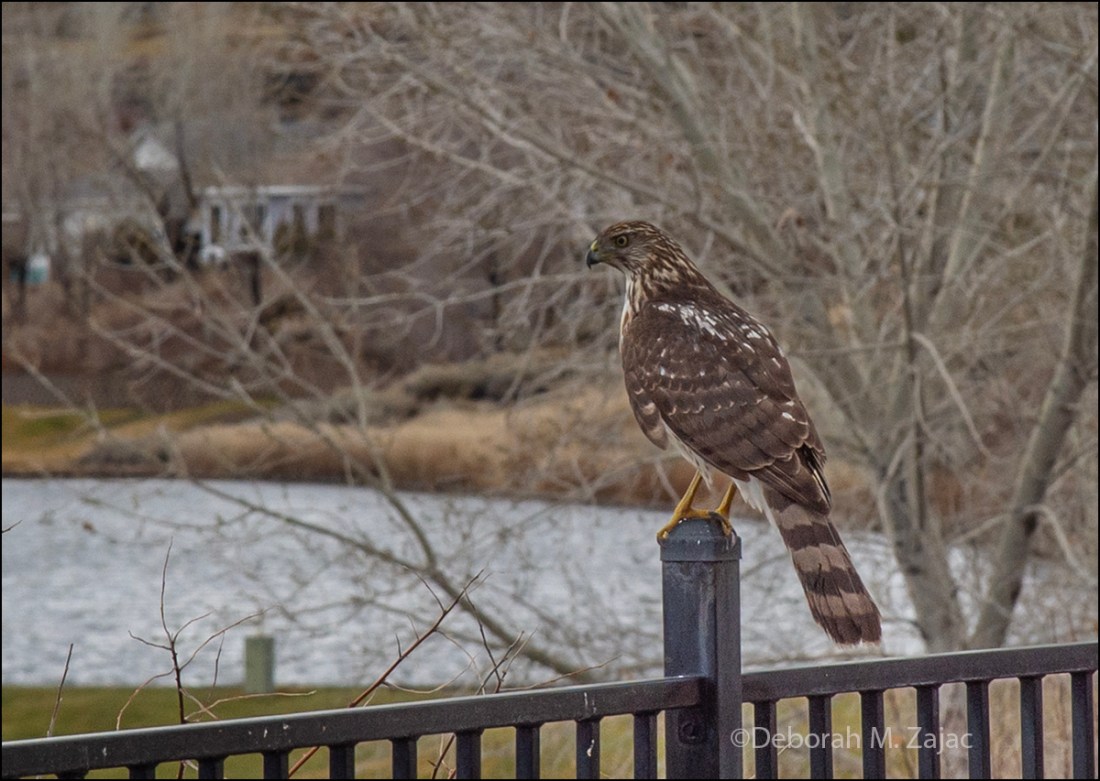
Cooper’s Hawk
This winter has started off a bit bumpy on the home-front. Our heater went out just after Christmas on a Sunday. Fortunately, we were able to have our preferred heating and air company come out that afternoon and fix it.
Then I discovered we have a leak in the garage. We had a roofer out and they found several broken tiles. Errant golf balls no doubt. Our house gets hit a lot. I wish they…the golfers would learn to hit toward their other right!
The roofers sealed up the cracks and we’re scheduled to have the tiles replaced at the end of the month. I welcome the rain and snow, but not the leaky roof.
We’ve had several storms so I haven’t been out birding, but today the weather looks cold, but sunny so I’ll be birding with the group this morning. I’ll be late getting to your blogs and comments.
Fun Facts:
- Dashing through vegetation to catch birds is a dangerous lifestyle. In a study of more than 300 Cooper’s Hawk skeletons, 23 percent showed old, healed-over fractures in the bones of the chest, especially of the furcula, or wishbone.
- A Cooper’s Hawk captures a bird with its feet and kills it by repeated squeezing. Falcons tend to kill their prey by biting it, but Cooper’s Hawks hold their catch away from the body until it dies. They’ve even been known to drown their prey, holding a bird underwater until it stopped moving.
- Once thought averse to towns and cities, Cooper’s Hawks are now fairly common urban and suburban birds. Some studies show their numbers are actually higher in towns than in their natural habitat, forests. Cities provide plenty of Rock Pigeon and Mourning Dove prey. Though one study in Arizona found a downside to the high-dove diet: Cooper’s Hawk nestlings suffered from a parasitic disease they acquired from eating dove meat.
- Life is tricky for male Cooper’s Hawks. As in most hawks, males are significantly smaller than their mates. The danger is that female Cooper’s Hawks specialize in eating medium-sized birds. Males tend to be submissive to females and to listen out for reassuring call notes the females make when they’re willing to be approached. Males build the nest, then provide nearly all the food to females and young over the next 90 days before the young fledge.
- The oldest recorded Cooper’s Hawk was a male and at least 20 years, 4 months old. He was banded in California in 1986, and found in Washington in 2006.
I wish you all a great week-end!
more to come…
 Circadianreflections Blog
You must be logged in to post a comment.