Whatever Weds. A Starlit Night

Copyright ©2024 Deborah M. Zajac. ALL RIGHTS RESERVED.

PLEASE DO NOT USE MY IMAGES WITHOUT EXPRESSED WRITTEN PERMISSION.

It’s that time of year when I yearn to be out imaging and gazing at the night sky. A friend and I went back down to Mono Lake to do just that. Thankfully, we didn’t have any clouds to worry about.
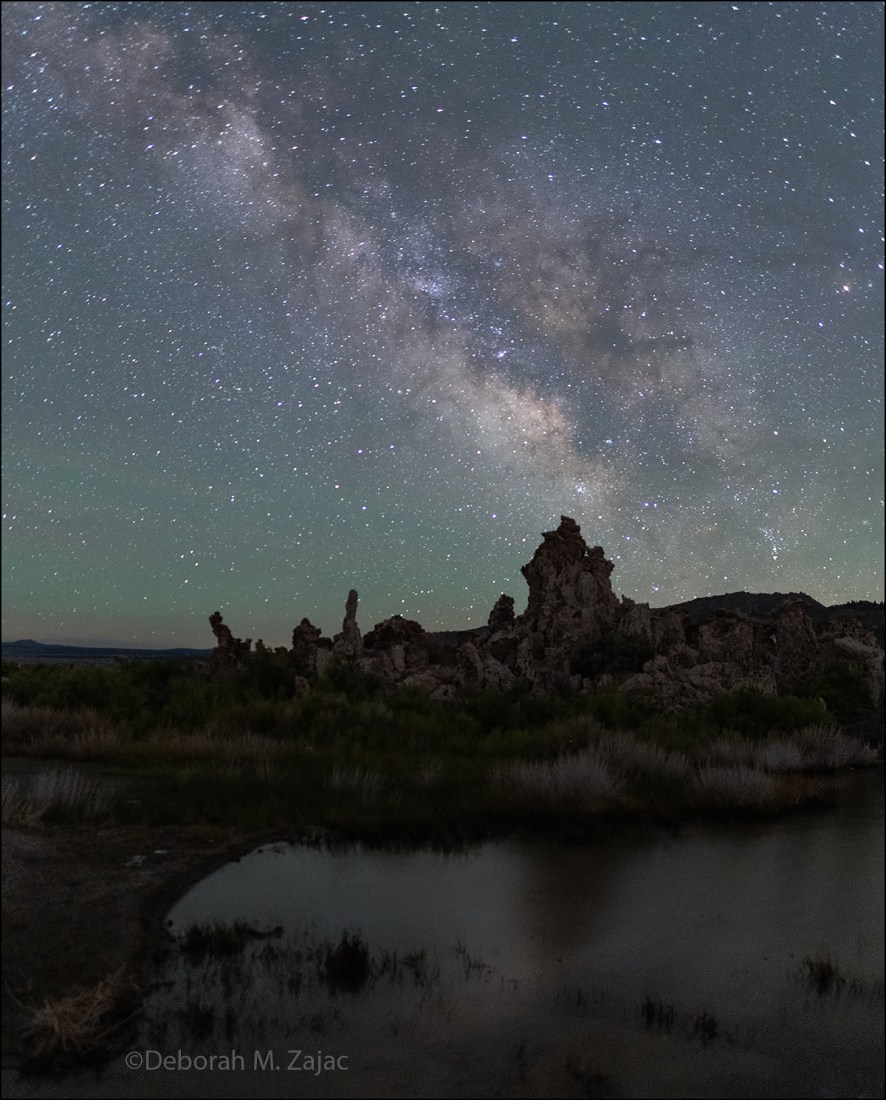
Milky Way the Great River in the Sky

The lake is really high eliminating a lot of the beach area we learned from our camping trip last month so, we knew to take our tall boots because standing in the lake might be our best bet for imaging. We scouted in the afternoon and found this spot. When we were leaving for dinner we ran into a Ranger who told us she would be giving a talk on the summer sky and constellations that evening on the beach and invited us back to attend it. We said we’d be there. The talk was a fast 2 hours. It was great hearing the stories the Native Americans tell about the stars and how they named the constellations and how to find them . The talk ended just after 10PM which was perfect as the Milky Way was already visible and we had some time to get to our spot in time for the Galactic Center to rise. The Galactic Center is the central region of our galaxy. The best months to photograph the Milky Way in the Northern Hemisphere are from May to August when the Galactic Center is highest in the sky and the weather is usually better in the warmer months.

We were standing in water to photograph this scene, but it wasn’t very deep, and the waves were gentle so we didn’t have to worry about a big one coming along and getting into our boots. 😊

I got home about lunch time yesterday, unpacked, got the car washed, and then started getting ready for a visit with my son and daughter-in-law. I’ll be on and offline for a bit. I hope your week and summer are going well.

Nikon D850|Nikkor 20mm F1.8G|

more to come…

Hubble Movies Provide Unprecedented View of Supersonic Jets from Young Stars

Via Flickr:
The glowing, clumpy streams of material shown in these NASA Hubble Space Telescope images are the signposts of star birth.

Ejected episodically by young stars like salvos from a cannon, the blobby material zips along at more than 440,000 miles (770,000 kilometers) an hour. Called Herbig-Haro or HH objects, these speedy outflows have a bumpy ride through space.

When fast-moving blobs “rear-end” slower gas, bow shocks (the blue features) arise as the material heats up. Bow shocks are glowing waves of matter similar to waves produced by the bow of a ship plowing through water. In HH 2, at lower right, several bow shocks (the compact blue and white features) can be seen where fast-moving clumps bunch up like cars in a traffic jam. In HH 34, at lower left, a grouping of merged bow shocks reveals regions that brighten and fade over time as the heated material cools, shown in red, where the shocks intersect.

In HH 47, at top, a long jet of material has burst out of a dark cloud of gas and dust that hides the newly forming star. The blue, fan-shaped region at left is the edge of a cavity illuminated by the fledgling star. A massive clump of jet material collides with upstream gas, creating the white bow-shaped shock wave at right.

These images are part of a series of time-lapse movies astronomers have made showing the outflows’ motion over time. The movies were stitched together from images taken over a 14-year period by Hubble’s Wide Field Planetary Camera 2. Hubble followed the jets over three epochs. Observations of HH 2 were made from 1994, 1997, and 2007; HH 34 from 1994, 1998, and 2007; and HH 47 from 1994, 1999, and 2008.

The outflows are roughly 1,350 light-years from Earth. HH 34 and HH 2 reside near the Orion Nebula, in the northern sky. HH 47 is located in the southern constellation Vela.
Object Names: HH 47, HH 34, HH 2
Image Type: Astronomical/Annotated

To read more go to: www.nasa.gov/mission_pages/hubble/science/supersonic-jets…

Credit: NASA, ESA, and P. Hartigan (Rice University)..NASA Goddard Space Flight Center enables NASA’s mission through four scientific endeavors: Earth Science, Heliophysics, Solar System Exploration, and Astrophysics. Goddard plays a leading role in NASA’s accomplishments by contributing compelling scientific knowledge to advance the Agency’s mission.