Copyright ©2026 Deborah M. Zajac. ALL RIGHTS RESERVED.
PLEASE DO NOT USE MY IMAGES WITHOUT EXPRESSED WRITTEN PERMISSION.
I’ve been away visiting my Step-dad in FL and while there I had two full days of birding. It was a fantastic visit.
We had a beach day, we ate fresh seafood a couple of times, and Greek food at Hellas in Tarpon Springs. It’s a family favorite.
Birding was awesome. I picked up 12 “lifers” this trip and this adult Crested Caracara is one of them.
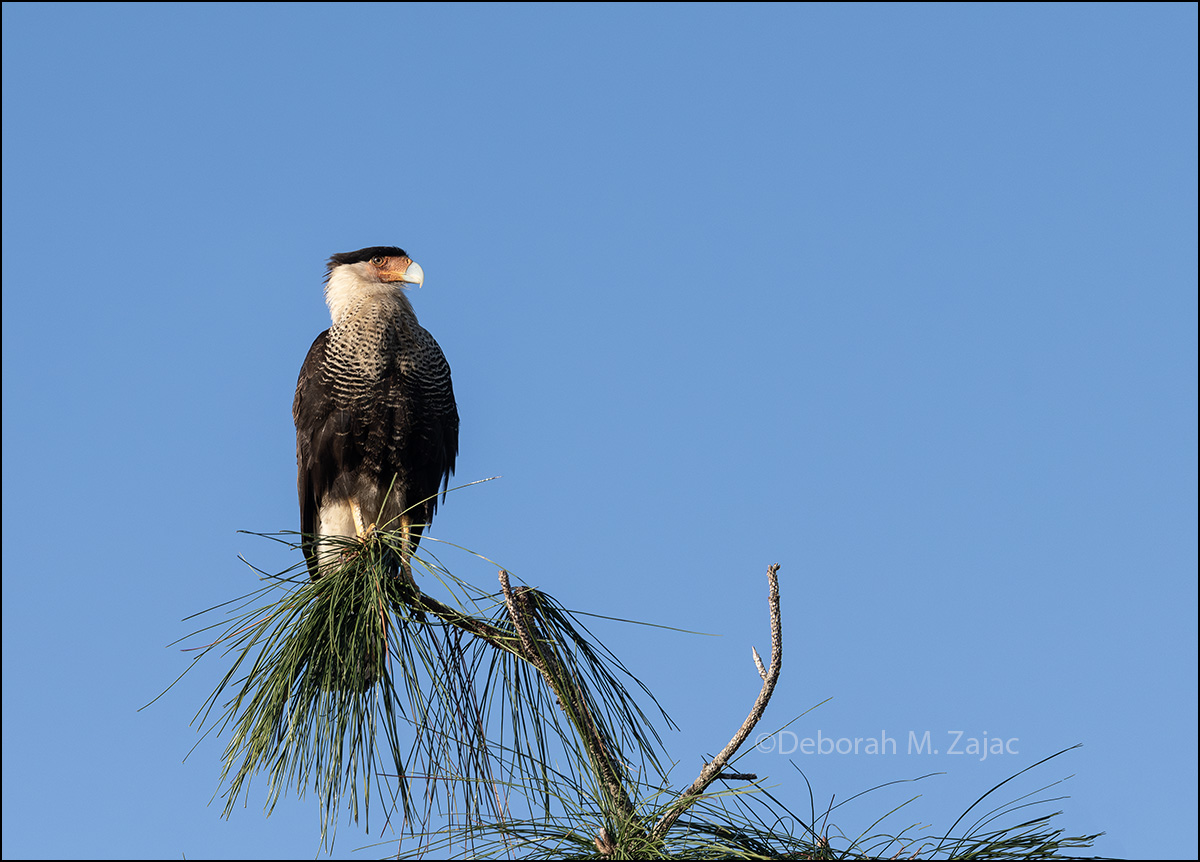
Crested Caracara
Fun Facts:
The Crested Caracara looks like a hawk with its sharp beak and talons, behaves like a vulture, and is technically a large tropical black-and-white falcon. It is instantly recognizable standing tall on long yellow-orange legs with a sharp black cap set against a white neck and yellow-orange face. The Crested Caracara is a bird of open country and reaches only a few states in the southern U.S. It flies low on flat wings, and routinely walks on the ground.
- A common subject of folklore and legends throughout Central and South America, the Crested Caracara is sometimes called the “Mexican eagle.”
- Although it looks like a long-legged hawk the Crested Caracara is actually a falcon.
- The Crested Caracara is the only falcon that collects material to build a nest. Other falcons lay their eggs in an old nest built by another species or in a scrape on the ground.
- The oldest recorded Crested Caracara was at least 21 years, 9 months old when it was identified by its band in 2015 in Florida. It was originally banded in the same state in 1994.
- Fun facts gleaned from https://www.allaboutbirds.org/guide/Crested_Caracara/overview
I’m really behind with your blogs, but I’ll catch up.
Have a wonderful week-end, everyone!
more to come…

 Circadianreflections Blog
You must be logged in to post a comment.