Civil War Days-Artillery

Copyright © 2012 Deborah M. Zajac. All Rights Reserved.

I had the pleasure of spending Saturday afternoon at a Civil War Reenactment in Duncans Mills, CA. Follow me to the year 1863 where these wonderful reenactors bring  this period of  USA history to life.

“Soon after his defeat of the Federal Army of the Potomac at Chancellorsville in May 1863 General Robert E. Lee decided for the second time to invade the North with his Confederate Army of Northern Virginia. There were a number of reasons for his decision. Even though Lee had just won a brilliant victory, things were bad in the Confederacy and getting worse; Ulysses S. Grant was about to secure Vicksburg for the Union, inflation was running wild in the South, and badly needed European recognition had not come, the Confederate government was torn by partisan squabbles, the Union blockade along the Southern coast was growing steadily more effective, and antiwar sentiment was fading in the North. A major Confederate victory on enemy soil might ameliorate all those problems. Moreover, after their string of victories Lee and his men had begun to believe fatally, as it turned out- that they were virtually invincible.

General James Longstreet, Lee’s second in command since the death of Stonewall Jackson, objected to the invasion from the beginning. Longstreet entreated his commander to purse a defensive strategy in Virginia and send troops to reinforce Braxton Briggs in Tennessee.

Longstreet’s idea was sound, but Lee insisted on his invasion plan; his instincts invariably told him to take the offensive. Thus in early June 1863, The Army of Northern Virginia pulled away from Fredericksburg and headed for Pennsylvania with about 80,000 men.” – Chronicles of the Civil War by John Bowman, General Editor

Artillery

“Designed to fire at high angles, dropping low-velocity explosive shells behind the enemy’s cover, Howitzers exemplified the traditional artillery that predominated during the Civil War.” –Chronicles of the Civil War by John Bowman, General Editor

Confederate Sponge rammer loading the cannon-
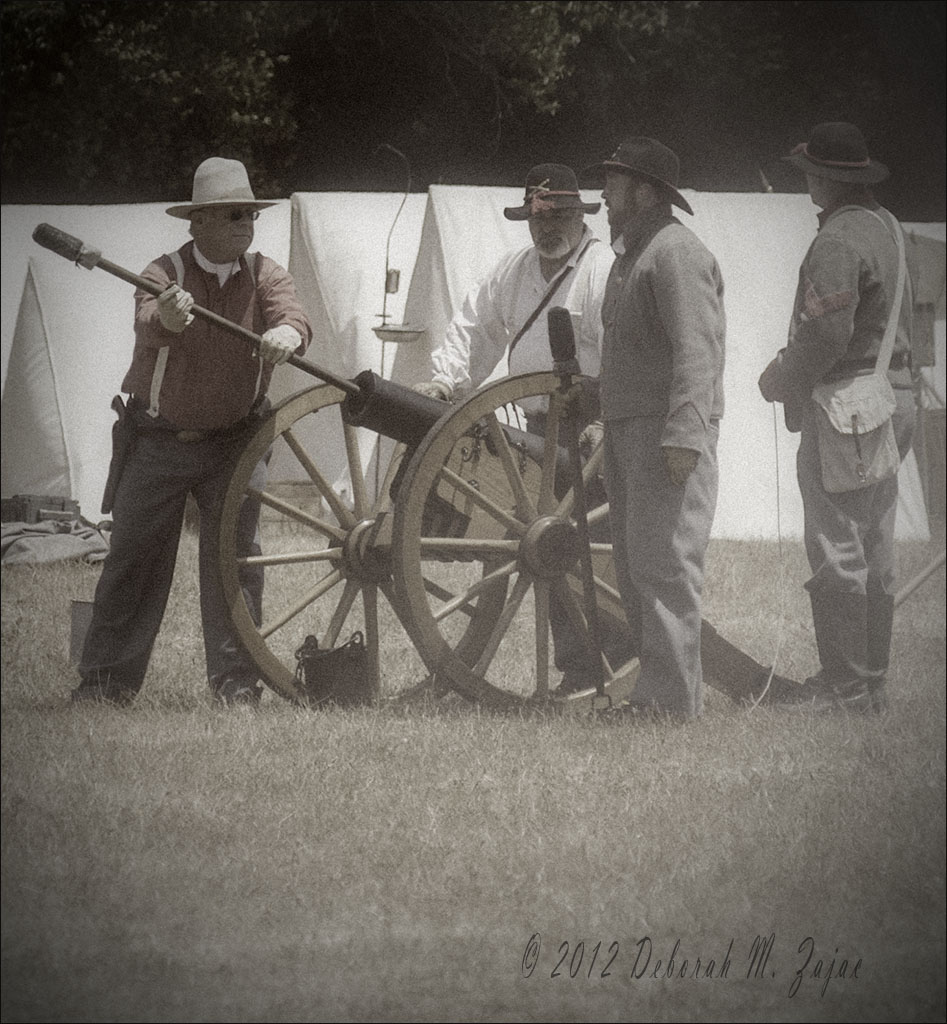
“Artillery in the 1800’s fought side by side with infantry units because the range of the big guns limited them to visible targets. Like the infantry weapons, Civil War-era cannon were muzzle loaders and required a crew of eight men to aim, load, and fire the weapon.”~Thomas’Legion; The 69th North Carolina Regiments, located at www.thomaslegion.net, written by Matthew D. Parker, was first published to the internet on August 27, 2005 and accessed on July 16, 2012.

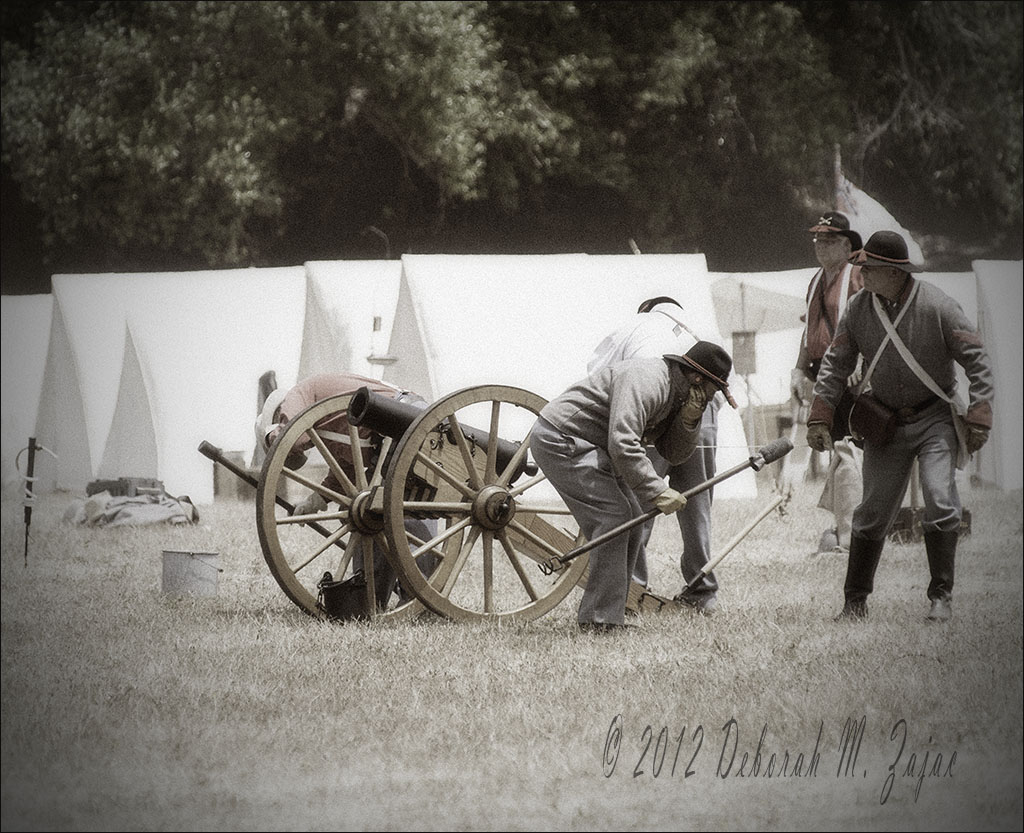
Stepping away-
FIRE!
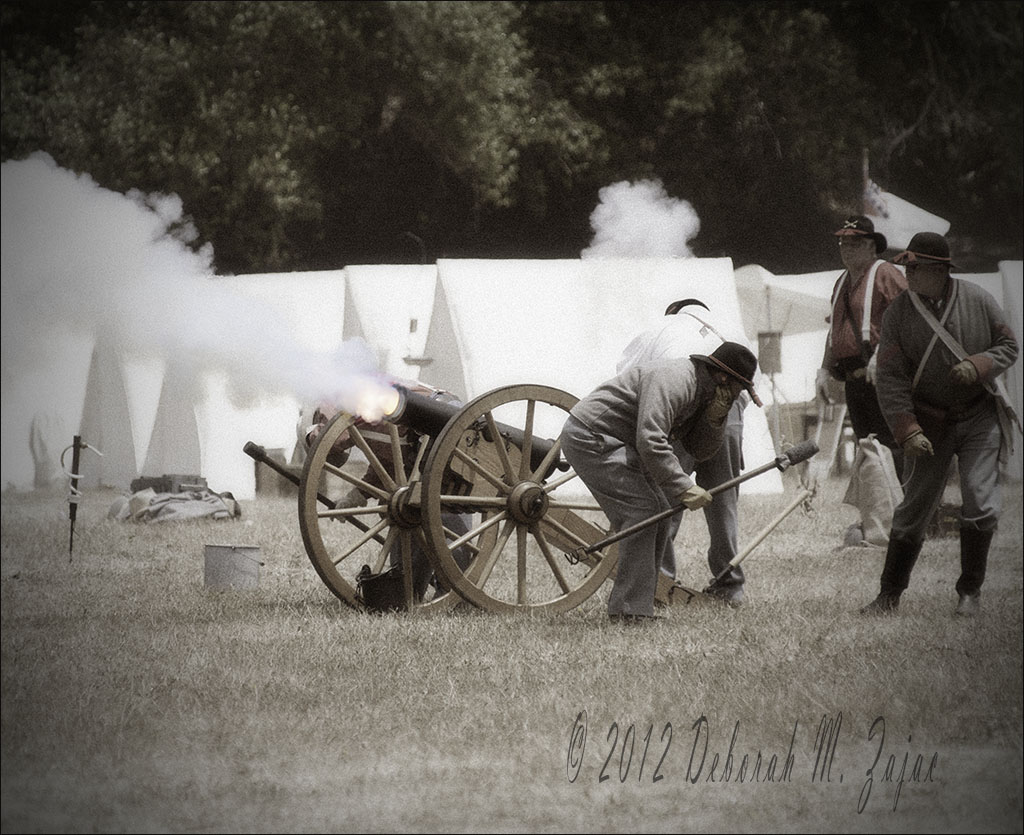
The infantrymen marched right into the face of a firing cannon. Many didn’t live to tell about it.

It was a fun afternoon and I have quite a few photos to go through. I hope to share more soon.

Nikon D700| Nikkor 80-200mm w/Tamron 1.4x extender


An Otterly great morning on the Slough

Copyright © 2012 Deborah M. Zajac. All Rights Reserved.

I went kayaking for the first time Sunday morning in Elkhorn Slough which is in the Monterey Peninsula in a sleepy little coastal hamlet called Moss Landing here in California.
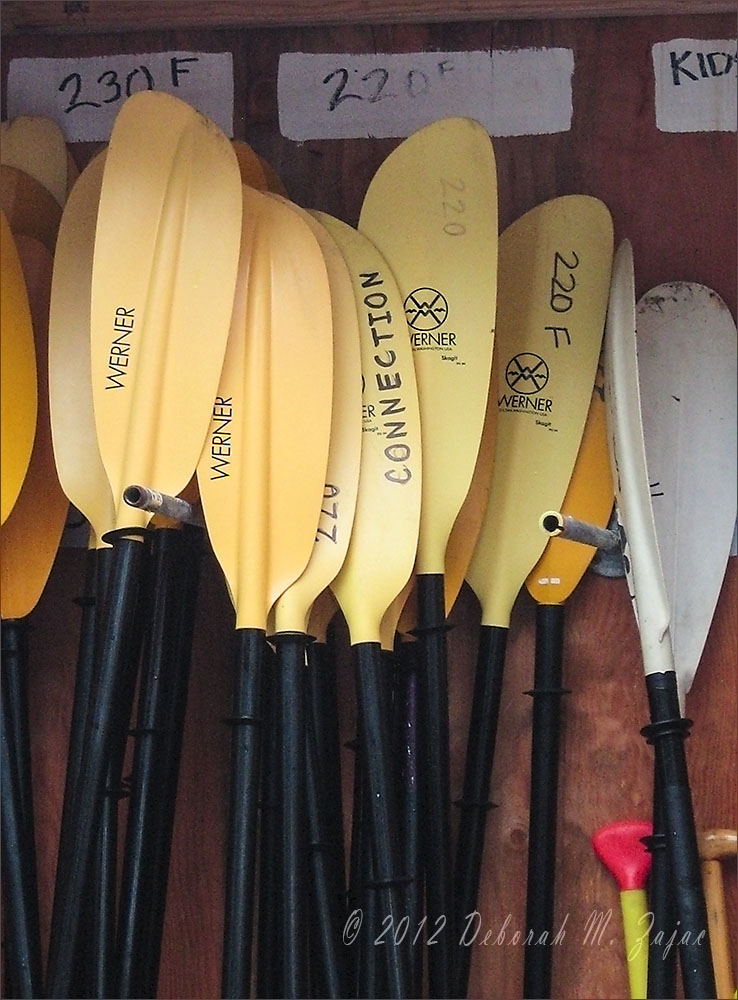
This is something I’ve wanted to do since I was out here on a Pontoon boat with a Photography group last year.  My friend Dali and I both signed up for the Basics Course at Kayak Connection which is located right on the Slough .The red kayak behind the blue  one was mine for morning. She’s sleek, quick, and her number is KC58. I had the good fortune of having a great instructor who got me through the basics in just 3 hours.

While we were practicing how to go straight, and proper paddle position  I got close to Dali  so I stopped , and thought to pull out my camera for a quick photo of him gliding through the water in his yellow kayak.

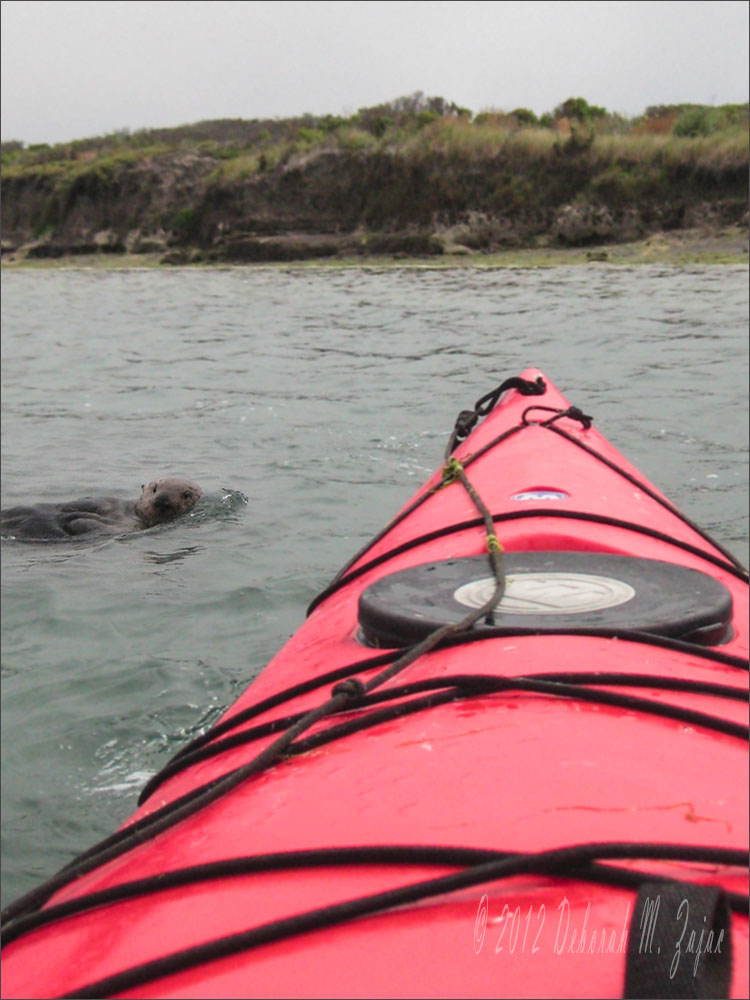
After learning how to paddle straight, turn, stop, and go backwards, and learning to quickly steer clear of obstacles with a maneuver called the “J move” it was time to venture further into the slough.  We rowed out toward the mouth of the harbor when two male otters came to play. They were so close to me. One swam under my kayak and started knocking his clam on the underside of my kayak to crack it open. It was so exciting! Just look how close this one was to me.


Our guide Courtland  told us this Otter’s red tail tag meant he’d been released from the Monterey Bay Aquarium for being too familiar with humans. Evidently he’s still quite fond of humans. He showed no fear of us at all. He was swimming right up to our kayaks and looking in, and all around them for food I think. This is what I wanted to experience while kayaking.


It was an exciting day! Dali and I are both stoked and looking forward to getting out on the water again!

Canon Powershot SD750, SanDisk Digital Film

Spring, Nature,and the Great Egret

Copyright © 2012 Deborah M. Zajac. All Rights Reserved.

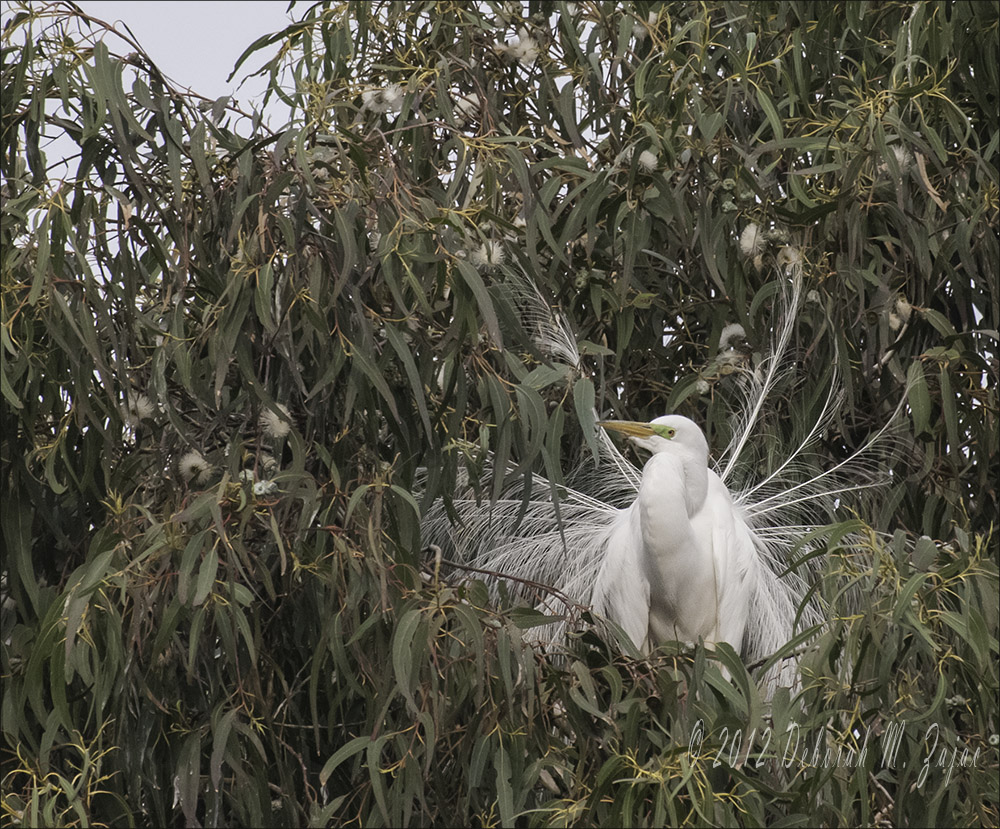
I spent a morning last week in Santa Rosa watching Egrets, and Herons, building nests, tending nests, and trying to attract a mate at a Rookery right in the middle of a suburban neighborhood. Mothers walked their children to school right under them, and traffic flowed on both sides of the street, and the Egrets and Herons were largely oblivious to all but themselves. Great Egrets nest in colonies so there are many, many birds in the trees.

The city is trying to give them some space so they blocked off one lane on each side of the street for a block or so sparing passing cars from being pelted with falling debris, and guano. The street under the Eucalyptus trees they’re nesting in is messy.

In the past when I’ve watch a Great Egret they’ve been very still, quite, and focused on hunting their prey, or I’ve startled them and they’ve flown away. That wasn’t the case on this morning though. The activity scarcely stopped.

Neither did the noise. In breeding season there is quite a lot of squawking, and screeching, and talking. In fact I found them very funny, and amusing.  I laughed out loud many times listening to them.

There were many sorties by the male to gather just the right branch to  build and strengthen the nest.  He will seriously work on attracting a mate once this task is complete. The female lays 4-5 pale blue eggs which take 3-4 weeks to incubate. Both the male and female parents incubate the eggs, and feed the chicks.

During the breeding season the  male Great Egret grows long tail feathers which he  raises and spreads out . I’ve read their plumes were once prized for making ladies hats and they were nearly hunted to extinction.

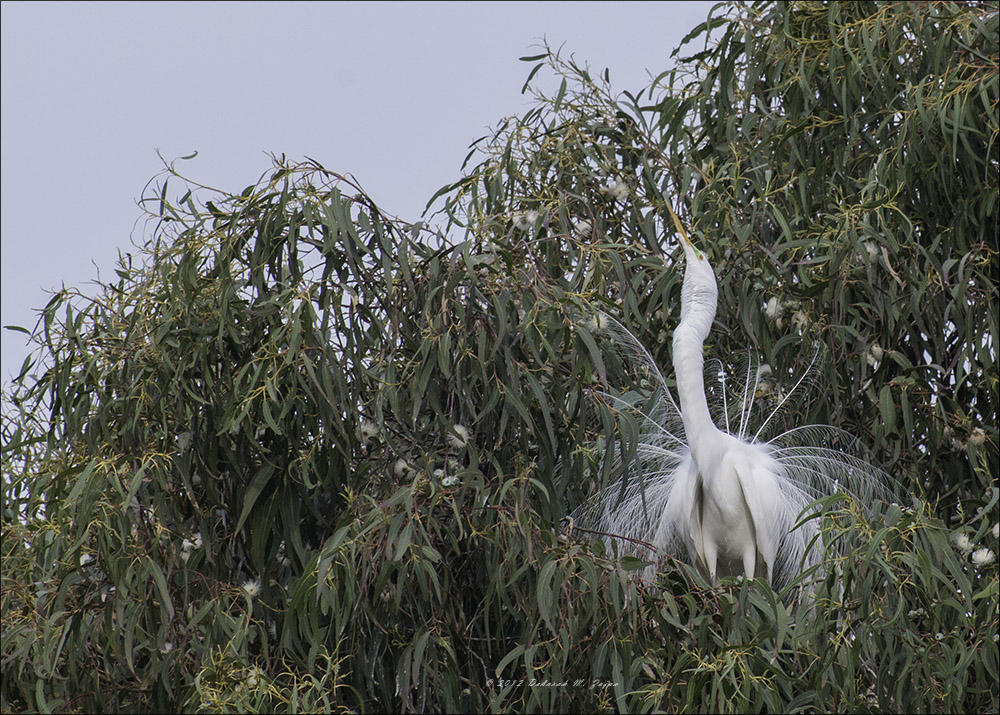
…and he undulates his long neck, and lifts his head toward the sky to try to attract a mate.

It was a wonderful experience observing this behavior up close, and I have more photos to share in the coming days of  Great Egrets, Cattle Egrets, and Night Herons.

Nikon D300s| Nikkor 70-300mm VR

Gliding in a Cloudless Sky

Copyright © 2012 Deborah M. Zajac.  All Rights Reserved.

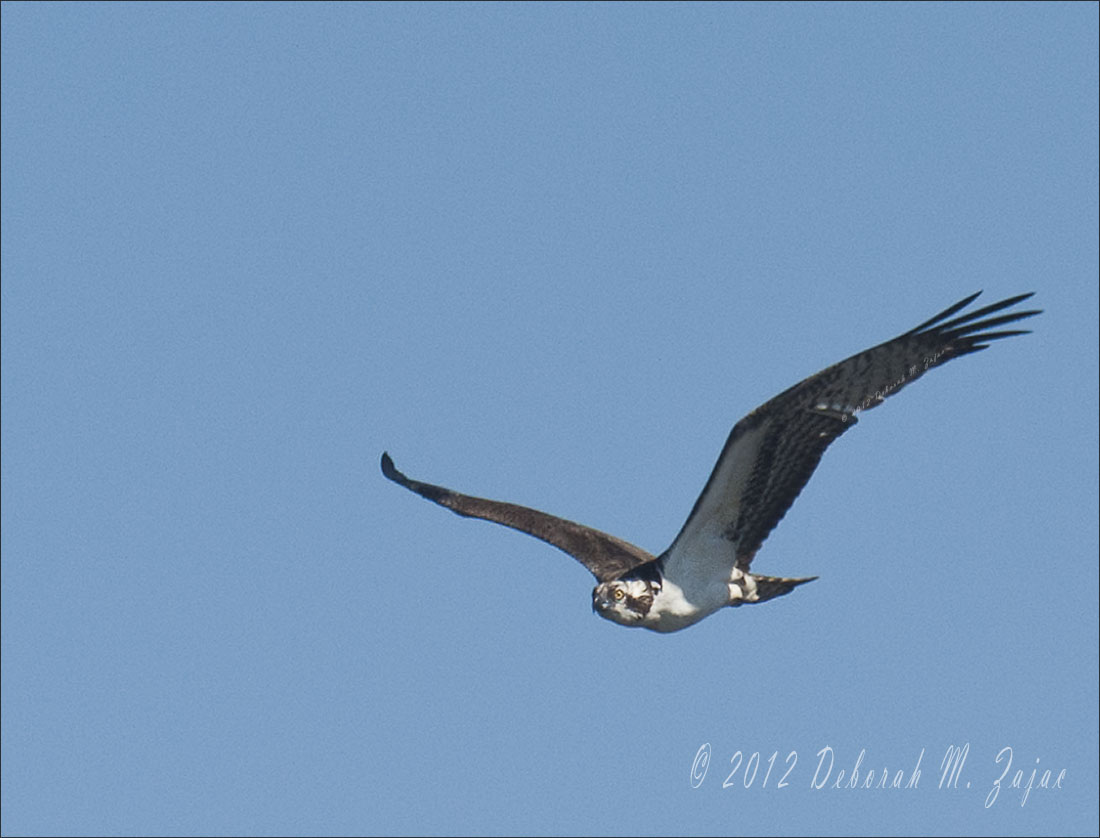
Nikon D700| Nikkor 80-200mm @ 200mm + 1.4x TC | f8| 1/2000 sec| ISO 800| Manual Mode| Tripod  I spent part of the time shooting him in manual focus. With the TC on my Auto-Focus would hunt from time to time and I found it faster just to manually focus. I was changing from AF to MF  I don’t know if this was MF or AF. Must find that in my Metadata.

Please click the photo to view it large. It looks blurry at this compressed size.