Ed Hendler Bridge

Ed Hendler Bridge, originally uploaded by dmzajac2004-.

Via Flickr:
Copyright © 2011 Deborah M. Zajac. All Rights Reserved.

On the way the Glacier National Park I spent the night in Pasco, WA. I was told about this bridge last year and wanted to shoot it then while on my way to Glacier, but arrived late and tired. This year I arrived earlier so wasn’t too tired to scout out a location for a night shot of the bridge.

This is looking south toward the Blue Bridge, and Kennewick, WA. This bridge looks gold at night, but it is white. Last year the people at the hotel called it the White Bridge when I mentioned wanting to photograph it. Keeping it simple I thought since it’s so close to the Pioneer Memorial Bridge which is blue and called the “Blue Bridge”.

For the historians:
“The Cable Bridge, officially called the Ed Hendler Bridge and sometimes called the Intercity Bridge, spans the Columbia River between Pasco and Kennewick in southeastern Washington as State Route 397. It was constructed in 1978 and replaced the Pasco-Kennewick Bridge, an earlier span built in 1922 and demolished in 1990.

At the time, the bridge was thought to be the first in the United States to use a ‘cable-stayed’ design and is constructed almost entirely of pre-stressed concrete (knowledge of the Captain William Moore Bridge, an asymmetric cable-stayed bridge near Skagway, Alaska, which was completed three years earlier, was not widespread outside Alaska. The bridge towers were constructed first, with the bridge deck, which was cast in individual segments, raised up and secured to each other.

The bridge was named after Ed Hendler, a Pasco, Washington insurance salesman, as well as the city’s former mayor, who headed up the committee responsible for obtaining the funding for construction of the bridge. Hendler died in August 2001.

A controversial feature of the bridge was added in 1998, when lights were added to illuminate the bridge at night. Many thought this was unnecessary and a waste of both electricity and money. During a power crisis in 2000, the lights were turned off, but they were turned on for one night to honor Hendler’s passing. Now the lights are turned on at night, and turned off at 2am.”~ Wiki-pedia

Nikon D90| Nikkor 17-35@ 17mm| f13| 13 seconds| ISO 200| Manual Mode| Tripod| Cable Release

The Fountain and the Painted Ladies

Via Flickr:
Copyright © 2011 Deborah M. Zajac. All Rights Reserved.
From the archives

I wish there wasn’t parking allowed here, but with so few parking spots in the city…
One takes the shot!
This was a fun day. Downhill Dali and I went up to shoot a few of the cities cathedrals, this, and we wrapped up the day at Baker Beach where I discovered lots of naked, pink men hang out. LOL!
Only in the city!

Here’s a link to Prometheus Reflects – one shot I took while at Baker Beach

http://www.flickr.com/photos/dmzajac2004/5445963720/in/set-72157625755270699

Nikon D90| Nikkor 17-35 @ 26mm| f8| 1/100 sec| ISO 160| Manual Mode| Tripod| Cable Release
Croque Monsieur w/Mixed Spring Greens

Via Flickr:
Copyright © 2010 Deborah M. Zajac. All Rights Reserved.
A photo from the archives.

T, DD, G, and I went to Brunch at Absinthe Brasserie, and Bar in San Francisco before heading to downtown to photograph Union Square, and then meet-up with our Night group for some Night photography.

I had the Croc Monsieur. It was delicious. Toasted levain bread, with thin sliced Black Forest ham, smothered in melted Gruyère, some Dijon mustard, béchamel, mixed greens.
The restaurant opened at 11:00am we there a few minutes after 11 and there was already a 30-40 minute wait for walk-ins. We ate at the bar.

Nikon D300s|Nikkor 17-35mm @ 20mm| f2.8| 1/13second| ISO 400| Manual Mode| Hand-held

“The Suicide Squad”

Copyright © 2011 Deborah M. Zajac.  All Rights Reserved.

Portuguese & Azorean Style California Bloodless Bullfights

Photograph by Deborah M. Zajac

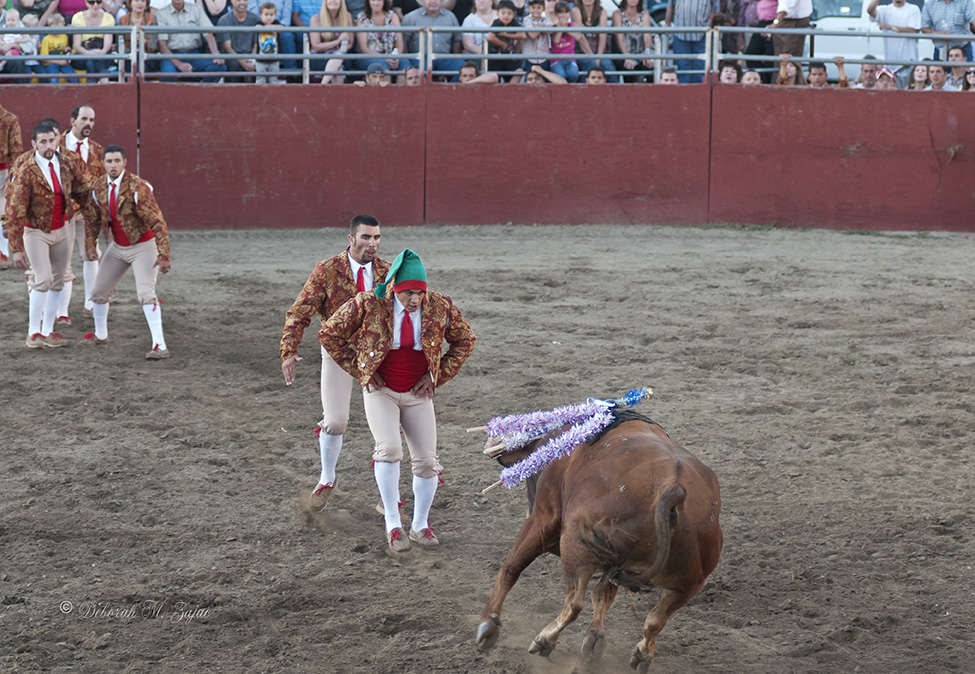
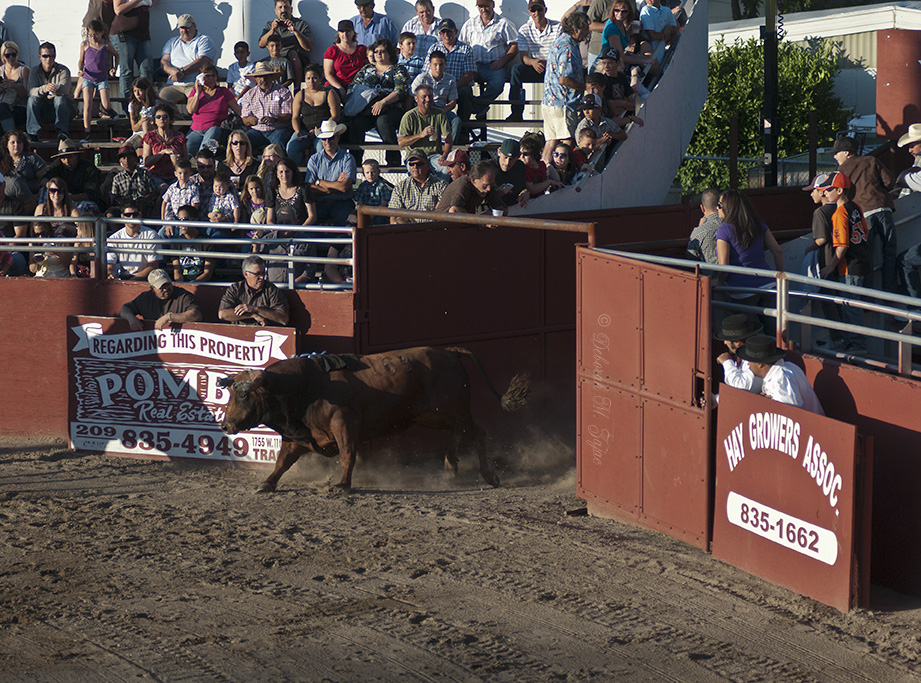
I first read about these Bloodless Bullfights in California 5 or 6 yrs ago. Since that moment I’ve had attending one on my “Bucket List”. When I was a girl I would watch the Bullfights on TV while other kids were watching cartoons. I loved the drama, the costumes, and the crowds shouting Ole!  Recently I went to a Portuguese Bloodless Bullfight. Bloodless because in CA it’s illegal to kill the bull. They use a  “velcro dart” to stab the bull. The bull wears a large piece of fabric on its neck that also has Velcro to keep the “dart” somewhat secure.

I had so much fun. The costumes are as colorful, and fancy as I had hoped, the horses are magnificent, the Matador, and the bulls are passionate, and thrilling! I even shouted Ole!

There is an order to how things are done I’ve learned.

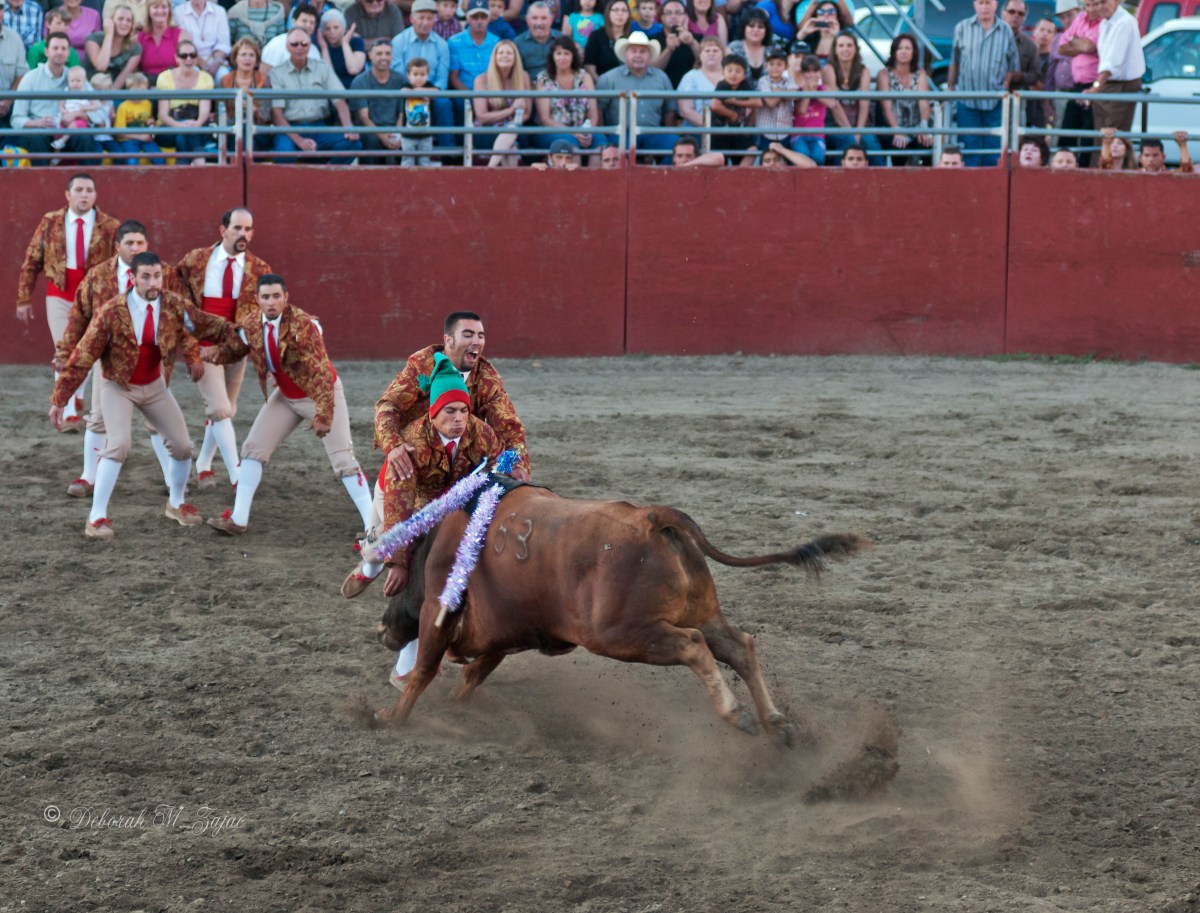
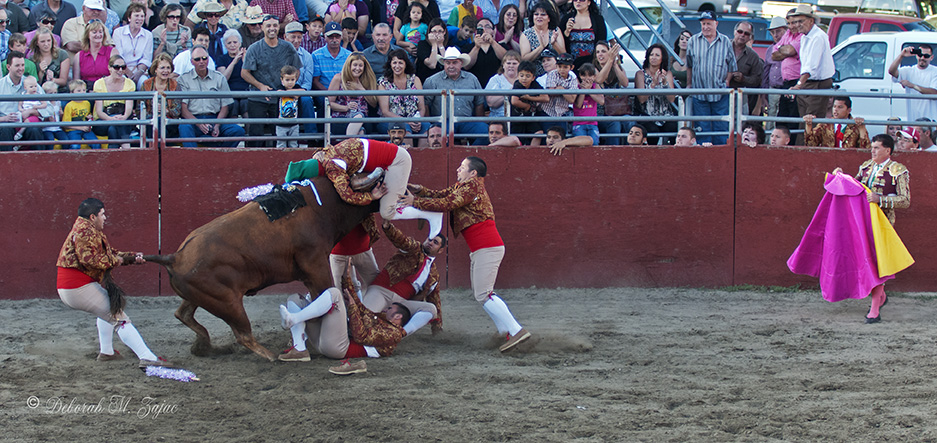
First come the Forcados-(Forcado means Pitchfork) Eight men that line up to face the bull and stop him in his tracks. The lead man faces the bull and draws his attention then he eggs him on to charge him, and perform the “Pega de Cara” (face catch). Literally the lead man takes a full hit of the charging bull who grabs the face and head of the bull then the other men  jump on to stop the bull’s charge.

Photograph by Deborah M. Zajac

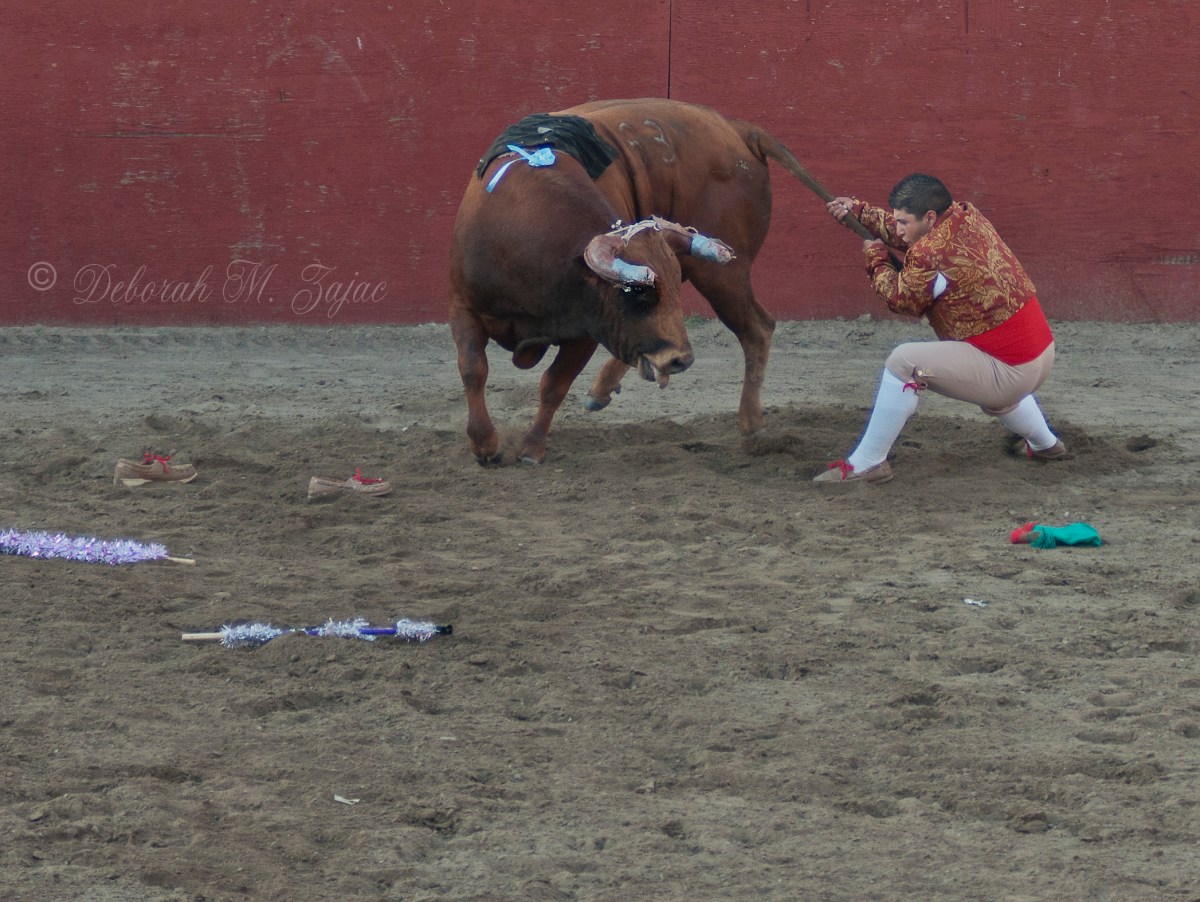
Once the bull has been stopped all but one man let go of the bull. The last man has the bull by the tail. The bull chases the man around and around in a circle trying to catch him, but does not succeed.

Photograph by Deborah M. Zajac

These men are not professional bullfighters and have no training or credentials for becoming a Forcado, but they must follow the traditions of old the moment they step into the arena.

It’s insanely fun, and exciting to watch!

Nikon D300s| Nikkor 80-200mm f2.8 lens| Induro CF213 Tripod

Feeling Blue

Copyright © 2011 Deborah M. Zajac.  All Rights Reserved.

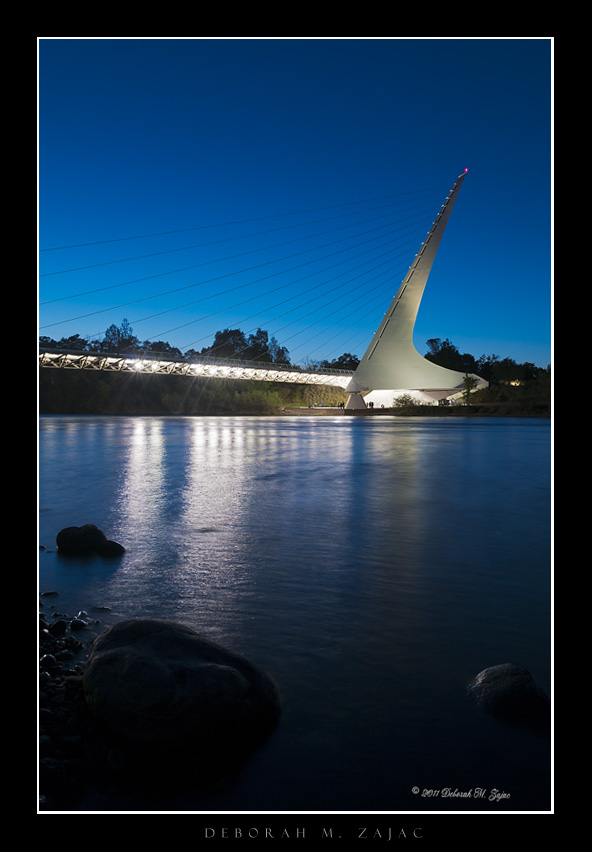
Sundial Bridge, Redding,California

The first time I photographed this bridge at night was in 2009, but I only had my monopod with me at the time so, the image wasn’t as good as I wanted it to be. I’ve wanted to get up here to do another Night image since then. I love this period of Twilight and am so happy to have had another opportunity to photograph this bridge in this special time of day.

Nikon D300s| Nikkor 17-35mm @ 17mm| f8| 4.0 sec.| ISO 200| Manual Mode| Tripod|Remote Release Cable

For the Historians:

The Sundial Bridge at Turtle Bay crosses the Sacramento River in the heart of Redding, California. Opened July 4, 2004, the bridge links the north and south campuses of Turtle Bay Exploration Park and serves as a new downtown entrance for Redding’s extensive Sacramento River Trail system.

The bridge celebrates human creativity and ingenuity, important themes of the 300 acre Turtle Bay Exploration Park. The steel, glass, and granite span evokes a sense of weightlessness and the translucent, non-skid decking provides for spectacular viewing at night. The bridge is also environmentally sensitive to its river setting. The tall pylon and cable stays allow the bridge to avoid the nearby salmon-spawning habitat there are no supports in the water while encouraging public appreciation for the river. Plazas are situated at both ends of the bridge for public use; the north-side plaza stretches to the water allowing patrons to sit at the river’s edge.

In addition to being a functional work of art, the Sundial Bridge is a technical marvel as well. The cable-stayed structure has an inclined, 217 foot pylon constructed of 580 tons of steel. The deck is made up of 200 tons of glass and granite and is supported by more than 4,300 feet of cable. The structure is stabilized by a steel truss, and rests on a foundation of more than 115 tons of steel and 1,900 cubic yards of concrete. The McConnell Foundation, a private, independent foundation established in Redding in 1964, funded the majority of the bridge’s $23 million cost.

World renowned Spanish architect and engineer Santiago Calatrava conceived the Sundial Bridge’s unusual design, his first free-standing bridge in the United States. Calatrava has built bridges, airports, rail terminals, stadiums, and other structures around the world. His notable designs include the new PATH transportation terminal at the World Trade Center site in New York City and several projects at the 2004 Olympic Games in Athens, Greece, including the main stadium where opening and closing ceremonies were held.

~Turtle Bay Exploration Park

More to come…

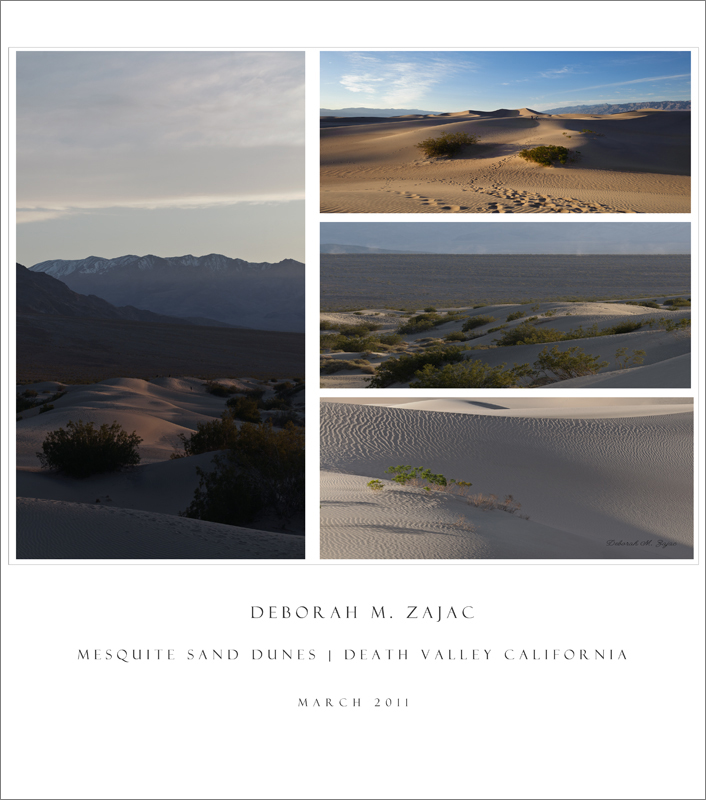
Series- 4 ImageTheme- Mesquite Sand Dunes

Copyright © 2011 Deborah M. Zajac. All Rights Reserved.

Field trip with West Valley College’s Photography Dept. to Death Valley National Park.

4 images taken in the Mesquite Sand Dunes. An assignment for those of us taking all sections of the field studies class was to produce a 4 image theme. I didn’t go into this assignment with any pre-conceived ideas or thoughts. I thought the best approach for me was to go out and shoot whatever I felt compelled to shoot then once home look at all my photographs and see if a “theme” emerged.

What I found when I uploaded all my photographs from the trip was that while out on the Dunes I used the Creosote bushes quite a bit for leading lines, frames, and points of interest; sometimes without being consciously aware that I was doing that. Do I see more in a “compositional” frame of mind than I think I do? One the components of art/photography I feel I struggle with the most is composition, and “seeing” the shot. I think it’s something I’ll always have to work at.

The Creosote bushes were in bloom when I was here. Each time I passed by a bush I could smell its sweet perfume, and I was treated to a symphony of Spring time by the many bees that were busy buzzing from blossom to blossom.

1. “Last light” Sunset Mesquite Dunes
2. Footprints on the Sands of Time
3. Dust up!
4.We need time to dream, time to remember, and time to reach the infinite , time to be.~Gladys Taber

Nikon D700 & Nikon D300s| Nikkor 17-35mm and Nikkor 70-300mm VR| Induro CF Tripod| Hoya UV filters