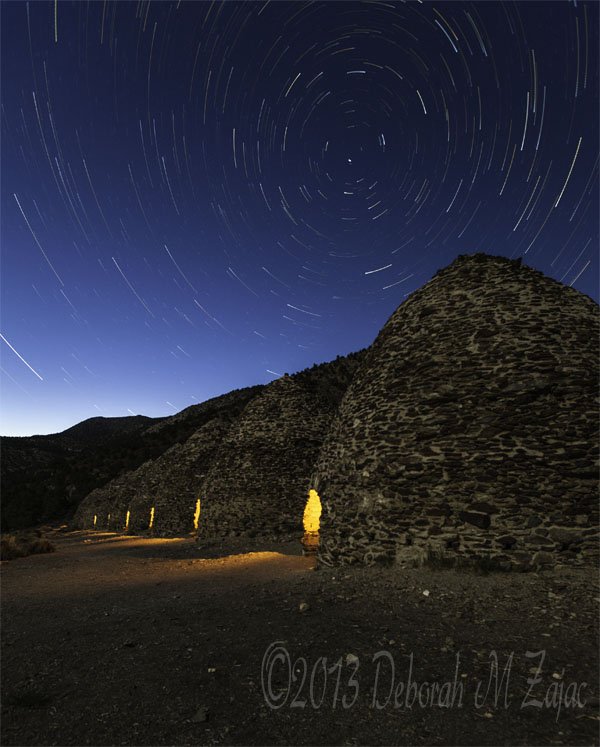
Iridium Flare

Copyright 2013 Deborah M Zajac. All Rights Reserved
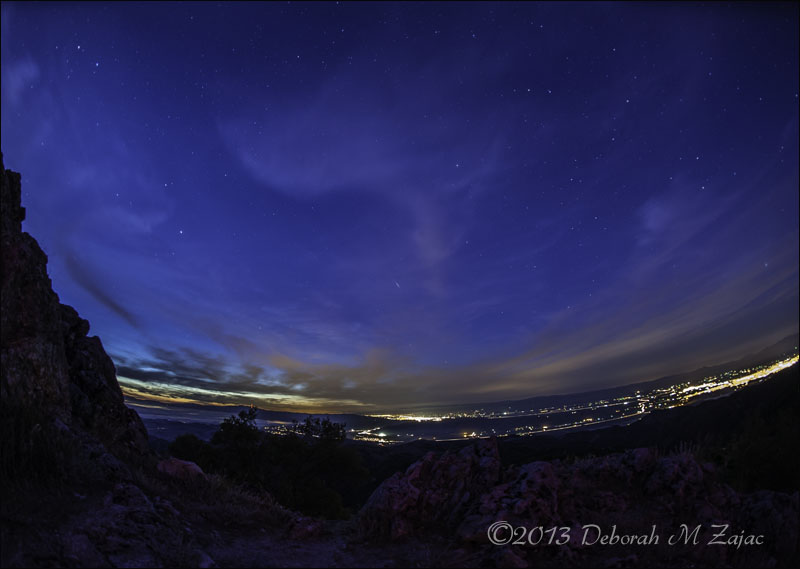
Iridium Flare?I took this photo last month when I was shooting in Fremont Peak State Park with several Night Sky Photographers. This is one of the set-up/ test shots I took before starting my star trail sequence. After uploading the frames I was going through them and discovered I may have caught an Iridium Flare. Iridium Flare is the sun reflecting off communication satellites orbiting in space. ” The Iridium communication satellites have a peculiar shape with three polished door-sized antennas, 120° apart and at 40° angles with the main bus. The forward antenna faces the direction the satellite is traveling. Occasionally, an antenna reflects sunlight directly down at Earth, creating a predictable and quickly moving illuminated spot on the surface below of about 10 km diameter. To an observer this looks like a bright flash, or flare in the sky, with a duration of a few seconds.

Ranging up to -8 magnitude (rarely to a brilliant -9.5), some of the flares are so bright that they can be seen in the daytime; but they are most impressive at night. This flashing has caused some annoyance to astronomers, as the flares occasionally disturb observations and can damage sensitive equipment.

When not flaring, the satellites are often visible crossing the night sky at a typical magnitude of 6, similar to a dim star.” ~Wikipedia

I realize the flare is hard to see in this photo so I’ve zoomed in on it and cropped it out to enable one to see it better. It has the classic shape of Iridium Flare. I took this photo on May 11, 2013 at 9:06pm PDT.
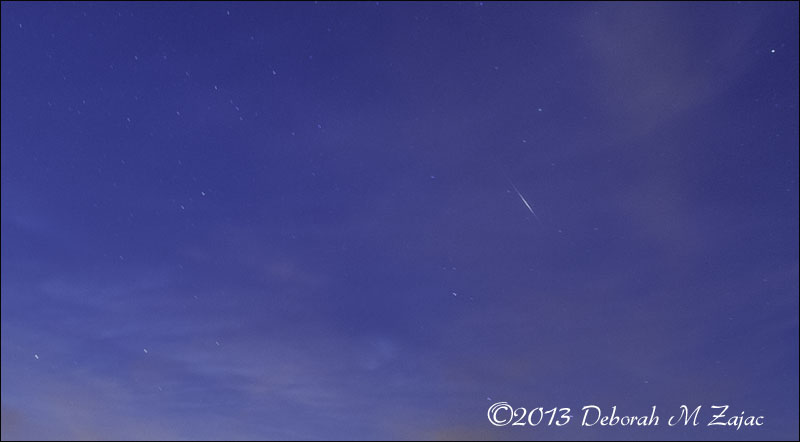
Close of FlareI need to check out the site that has predictions to see if this could be Iridium Flare.  I think the site is called Heaven’s Above.

Nikon D700| Nikkor 16mm Fisheye lens

Update: After checking the Heaven’s Above site to see if there was an Iridium Flare predicted on the date and time I took this photo I found there was a predicted flare on May 10, 2013 at 19:31 h.  in the same place in the sky as this flare. I’m confused. Nothing was listed for May 11th. The site says all times are local. Do I need to factor in Daylight Savings time? I wondered if it could another satellite?  Searching the sites FAQ’s I found this.

Q. While I was out waiting for a flare or other satellite to appear, I saw another flare which wasn’t in the predictions. What could it have been?
A. This was probably a flare from a failed Iridium satellite. Several satellites have failed in orbit, and are not in the nominal orbit and/or attitude. However, they can still produce flares just like the operational ones. The difference is, that we can’t predict when they will happen.

White-breasted Nuthatch

Via Flickr:
Copyright 2013 Deborah M Zajac. All Rights Reserved

This is my first decent capture of a Nuthatch. They’re so quick. I haven’t been able to get one. Today I got lucky. This one wasn’t too skittish. I suppose it is used to people being around.

I found a near mint condition 300mm f4 today and purchase it. I have a week to try it out. Initial thoughts are it is very responsive and quiet. I still have to crop in, but this isn’t a heavy crop. I’ll try it with my TC in the next day or so. Focusing seems spot on. I don’t do scientific tests I just shoot what I like.

I didn’t do much to this photo- in ACR I tweaked white balance …it was fine, then highlights, and whites, pushed the blacks a little, added clarity, vibrance, and the lens correction filter then moved over to Photoshop to sharpen a tiny bit, resize and add my copyright. Pretty much what I do to every photo.

I bought a new backpack too. A Think Tank Streetwalker HardDrive. I plan to take a photo of it very soon loaded with my usual set-up.

Nikon D300s| Nikkor AF-S 300mm @f8| 1/320s| ISO 500| Manual Priority| Matrix Metering| Tripod

San Jose, California- fine weather

Western Tanager-Male

Copyright 2013 Deborah M Zajac. All Rights Reserved

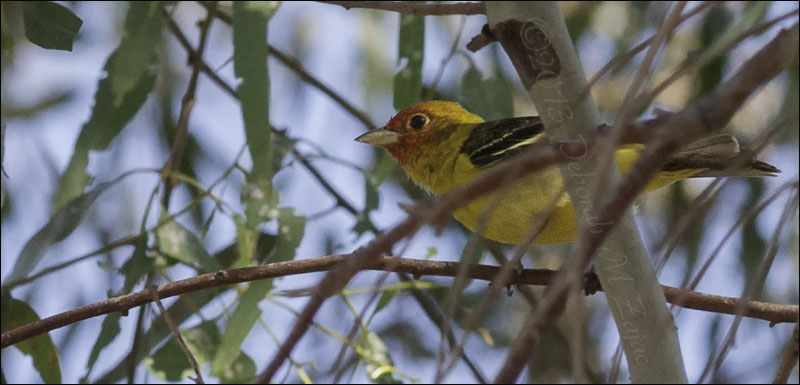
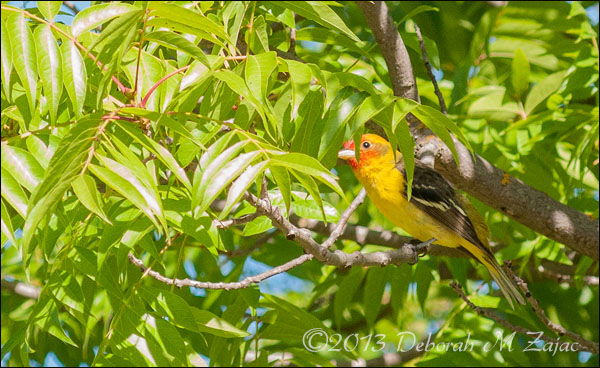
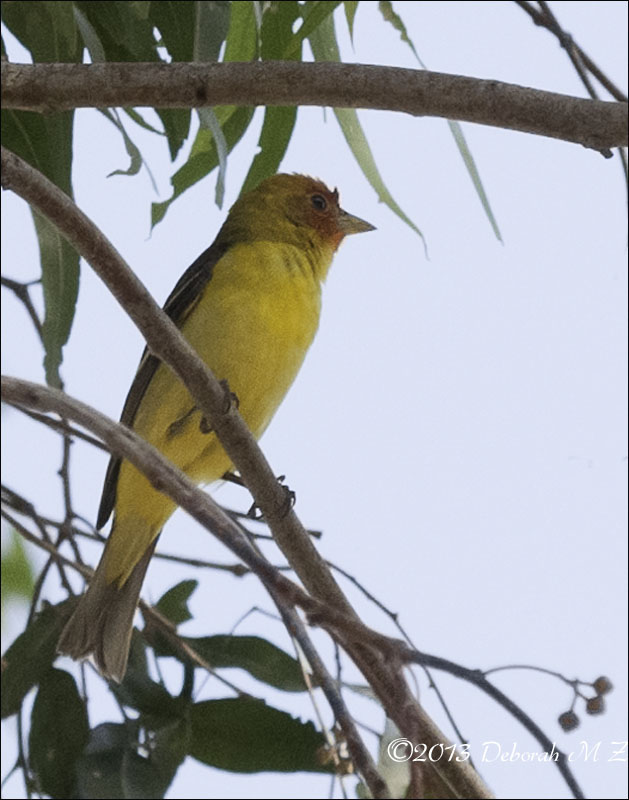
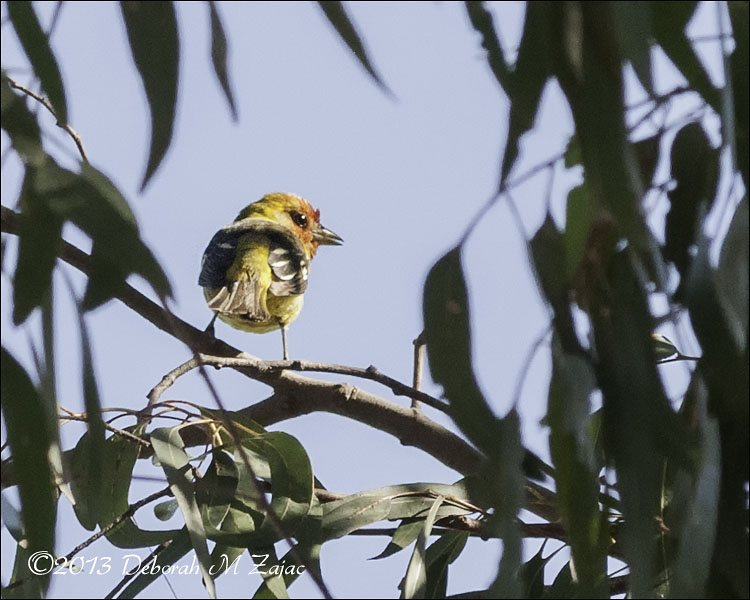
Western Tanager-MaleMy first Western Tanager Photograph! I’ve seen this bird before, but wasn’t able to capture a photograph of it that time. I’m very excited about this capture. This may be one of 5-6 Tanagers in this area that may be nesting here. If so it’s rare. I read yesterday, “The Breeding Bird Atlas of Santa Clara County reports the species as an
“uncommon to rare breeder” in the Santa Cruz Mountains and the Diablo Range, with lowest altitude nests reported at 400-500 feet. Lake Almaden has an altitude of about 200 feet, so if nesting occurs, it would be at the lowest altitude ever noted in the county. ”  Tom Grey

I was in this location yesterday with Dali, Tom Grey, and several others who like me were very excited to see these birds.

Here are a few more poses I managed to capture.

Trying to keep a low profile,

Western Tanager-MaleSurveying the area,
Western Tanager-Male 3

A backward glance,

Western Tanager-Male profile

Nikon D300s| Nikkor 80-200mm| f8| 1/400s| ISO 800| Manual Priority| Matrix Metering| Tripod


Polaris over the Charcoal Kilns Death Valley National Monument

Copyright © 2013 Deborah M Zajac. All Rights Reserved.

A year or two ago I saw my friend Rick Whitacre’s photograph of the Charcoal Kilns with Star-trails and loved it so much I hoped to photograph it myself on my next trip to Death Valley.  The first two nights of my recent visit to Death Valley National Monument I had clouds or partial cloudy skies, but the last night the sky was clear so He-Man and I headed to the Wildrose Charcoal Kilns so I could make a photograph of the kilns with star-trails.

Star Trails over the Charcoal Kilns Death Valley Californiaaawww xx He-Man and I drove out the Charcoal Kilns arriving just before sunset.  I got my gear out and started planning and plotting my composition. Once I found my composition I started thinking about lighting the kiln doors.  I went inside several of the kilns to check out the size of the opening, and where the best place to stand might be. I’m glad we arrived here while it was light enough to see inside each kiln. If I had arrived in the dark I would have been a little apprehensive about critters sleeping inside the kilns, but they were empty.  On a side note: They’re huge inside!

He-Man was going to light the doors for me so we did a timed test-run to see if he would be able to get all the doors lit in one 2 minute exposure. I had purchased a Brinkman light (thanks Marsha for the model info!) I also brought my Rogue Gels along to use to change the light from white to an orange-yellow  to look like there was fire in the kilns, but  when it got dark enough to start shooting we did another trail run using the light, and it wasn’t quite as bright as I had hoped for. Thinking that might happen I also packed my Nikon SB600 Speedlight. I taught He-Man how to set the flash off then we did another trial run. Loving what I saw using the Speedlight I made my final test shots for my star trails then set up my Intervelometer to begin my series.

It was quite a bit cooler up here than it was down in the valley so I needed my jacket before I wrapped up for the night. There was a Hoot Owl in the trees behind me softly hooting, and there were crickets chirping, but no other sounds. He-Man had gone to the car to read and wait for me.  It was peaceful. I found my “happy place” here.
Thank you He-Man for lighting each door so well and for going with me! I’m really happy with this photo.

Nikon D700| Nikkor 17-35@17mm| f4| 30 frames stacked in CS6| 121 seconds| ISO 200| Manual Priority| Tripod

A couple of my friends have also traveled to Death Valley and made their own photo here please take a look!

Phil McGrew- Startrails over Wildrose Kilns

Alex Baranda- Stars and Kilns

For the History Buffs-

Wildrose Charcoal Kilns

“In 1877 construction on the kilns was completed. The produced charcoal that was used as fuel for two silver-lead smelters  that George Hearst had in the Argus Range 25 miles away.  The kilns operated until 1878 when the Argus mines shut down.

There are 10 kilns which stand 25ft tall, and have an approximate circumference of 30ft. Each kiln held 42 cords of pinyon pine logs, and would burn for a week producing 2,000 bushels of charcoal.” ~Digital Desert.com  http://digital-desert.com/death-valley-history/wildrose-kilns.html

American Coot and Chicks

Via Flickr:
Copyright 2013 Deborah M Zajac. All Rights Reserved.

I heard these were in nearby local park, so I went to find them. They’re so ugly they’re cute!

I saw only 3 chicks on this outing, but I went back this morning and there are 5 chicks!

More to come!

Nikon D300s| Nikkor 70-300mm VR

“Catch a falling star an put it in your pocket never let it fade away. Catch a falling star an put it in your pocket save it for a rainy day.”~ Paul Vance and Lee Pockriss

Via Flickr:
Copyright 2013 Deborah M Zajac. All Rights Reserved.

What a night this was. I wanted to shoot the Milky Way while down in Death Valley and high winds and clouds foiled my plans the first night I was there. The second night the sky was clear to the south and the wind wasn’t too bad, so at 10PM He-man and I headed further south, but the wind shifted from north to south. I kept watching the clouds get closer and closer to my position. I wanted to go way out on the plain to shoot a Panorama, but He-Man said with Lightening I couldn’t. Huh? I thought you shouldn’t hide under a tree, but were okay with rubber soles and in the open. Living in CA where lightening is rare I don’t know squat about it. He-Man told me I’d be a sitting duck out there so, I didn’t dare go out into wide open to be the only thing standing. I stayed close to the car hoping the Milky Way would rise before the clouds got there, but that didn’t happen the clouds covered the sky before the Milky Way rose over the mountains. I took a few photos of the location, packed up then He-Man and I drove back to Stovepipe Wells.

I went to bed wanting the shot. I guess my mind kept time while I slept because I woke up wide awake about 2:45AM and my first thought was to go out and see if the sky had cleared and located the Milky Way. I dressed quietly then whispered to He-Man that I would be outside somewhere around the hotel looking for the Milky Way. He mumbled,…."be careful", and off I went.

I got out to the parking lot and looked up and there it was right over my head! I scanned the sky for lightening-there was none so I went hunting for a good location. I wanted to shoot a panorama of the sky. After shooting the pano I went to a nearby field and shot the densest part of the Milky Way. The whole 2 hours I was out shooting there were falling stars racing across the sky. I hoped I captured a few of them. Imagine how thrilled I was to see I had caught 2 possibly 3 in one frame!

I’m not sure my Pano is going to come out, but it was a great learning experience for the next time.

Nikon D300s| Nikkor 16mm @ f3.2| 30 seconds| ISO 3200| Manual Priority| Matrix Metering| Tripod

Death Valley National Monument, California

Zabriskie Point Sunset

Via Flickr:
Copyright © 2013 Deborah M Zajac. All Rights Reserved.

The temperature was 96º when He-man and I arrived in Death Valley, and the wind was strong and steady averaging 14mph wth gusts up to 29mph. I didn’t fancy shooting the sunset out in the Sand Dunes which was my planned photo spot for my first night in Death Valley. Plan B was Zabriskie Point. Myself and He-man arrived a little before the sun went down. I set up my tripod, and camera keeping the cap on to protect my lens, and filter from the stinging grains of sand that were slamming into me and the camera. He-man stayed low behind the stone wall, and I would duck behind it during the strongest gusts hanging onto to my tripod.
When the sun set and color started emerging, and the light was changing in the sky I would take a photo replacing the cap, and turning my camera away from the head on winds while waiting several moments before shooting again.

This is the night’s color at its peak. It looks a little soft, but I attribute that to the wind and sand in the air.
As soon as the color started to fade I packed up and started to leave.
There were very few people up here. We met a lovely couple from Philadelphia, and a group of young women from Germany while up here. Meeting new people is one the things I like most about traveling. We talked a few minutes said farewell, and headed back to the Hotel.

Overall there were very few tourist in the park while I was here. The most people we saw was later in the week when we toured Scotty’s Castle. The temperatures during the day were already getting well up into the 90º’s. I suppose that’s what kept the tourist away. We went out in the mornings, evening, and night so the trip wasn’t uncomfortable.

Nikon D700| Nikkor 17-35@17mm| f10| 13secons| ISO 200| Manual Priority| Matrix Metering| Hoya Circular Polarizer| Tripod

Death Valley National Monument Park; California; Sunset