Copyright ©2026 Deborah M. Zajac. ALL RIGHTS RESERVED.
PLEASE DO NOT USE MY IMAGES WITHOUT EXPRESSED WRITTEN PERMISSION.
January 2nd a Cooper’s Hawk came to look for breakfast at my neighbor’s house. I quietly opened the back door and grabbed what are the first Hawk images of 2026. Here’s one.
I’m taking that as a sign that it’s going to be a good year of birding.
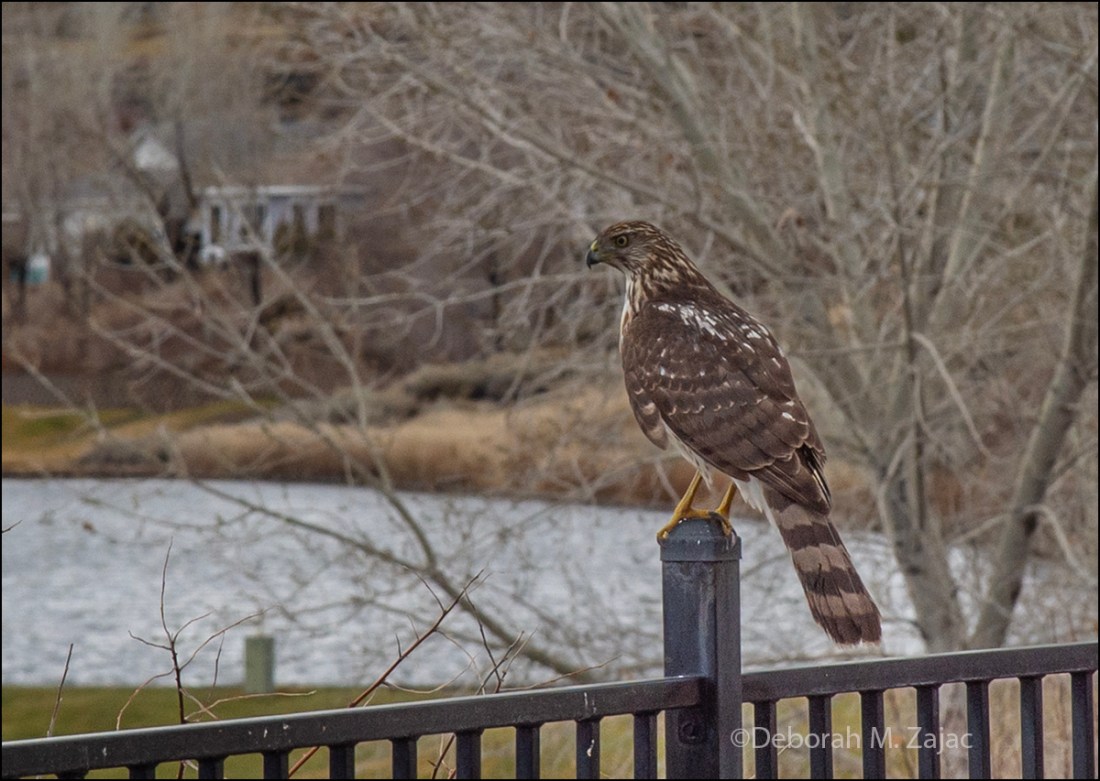
Cooper’s Hawk
This winter has started off a bit bumpy on the home-front. Our heater went out just after Christmas on a Sunday. Fortunately, we were able to have our preferred heating and air company come out that afternoon and fix it.
Then I discovered we have a leak in the garage. We had a roofer out and they found several broken tiles. Errant golf balls no doubt. Our house gets hit a lot. I wish they…the golfers would learn to hit toward their other right!
The roofers sealed up the cracks and we’re scheduled to have the tiles replaced at the end of the month. I welcome the rain and snow, but not the leaky roof.
We’ve had several storms so I haven’t been out birding, but today the weather looks cold, but sunny so I’ll be birding with the group this morning. I’ll be late getting to your blogs and comments.
Fun Facts:
- Dashing through vegetation to catch birds is a dangerous lifestyle. In a study of more than 300 Cooper’s Hawk skeletons, 23 percent showed old, healed-over fractures in the bones of the chest, especially of the furcula, or wishbone.
- A Cooper’s Hawk captures a bird with its feet and kills it by repeated squeezing. Falcons tend to kill their prey by biting it, but Cooper’s Hawks hold their catch away from the body until it dies. They’ve even been known to drown their prey, holding a bird underwater until it stopped moving.
- Once thought averse to towns and cities, Cooper’s Hawks are now fairly common urban and suburban birds. Some studies show their numbers are actually higher in towns than in their natural habitat, forests. Cities provide plenty of Rock Pigeon and Mourning Dove prey. Though one study in Arizona found a downside to the high-dove diet: Cooper’s Hawk nestlings suffered from a parasitic disease they acquired from eating dove meat.
- Life is tricky for male Cooper’s Hawks. As in most hawks, males are significantly smaller than their mates. The danger is that female Cooper’s Hawks specialize in eating medium-sized birds. Males tend to be submissive to females and to listen out for reassuring call notes the females make when they’re willing to be approached. Males build the nest, then provide nearly all the food to females and young over the next 90 days before the young fledge.
- The oldest recorded Cooper’s Hawk was a male and at least 20 years, 4 months old. He was banded in California in 1986, and found in Washington in 2006.
I wish you all a great week-end!
more to come…
 Circadianreflections Blog
Loved learning about them. I am not sure if one of the hawks we see in Portland OR is a Coopers; they compete with the crows in our studio neighborhood and sometimes are chased away, and sometimes do the chasing. We feed the birds on the top of the loading dock.
LikeLiked by 1 person
You get the Cooper’s Hawk in their Non breeding seasons so you probably have seen some. 😀
LikeLike
Awesome sighting and capture!!!
LikeLiked by 1 person
Thank you! It was a neat sighting.
LikeLiked by 1 person
What a beautiful, stately bird. Bet it had it eye on something!
LikeLiked by 1 person
It did indeed. There are Quail and Sparrows that come to feed at my and my neighbors feeders that it had its eyes on.
LikeLiked by 1 person
I enjoyed the facts – and the other day i was just remarking about how wonderul a “cold, but sunny” day can be – and hope you had fun birding
LikeLike
Thank you so much, Yvette! It was a very good birdy day. I got a few first sightings for the year. My year bird count is doing well so far. 😊
LikeLiked by 1 person
😊😊
LikeLike
This hawk is gorgeous, and you captured him perfectly!
LikeLiked by 1 person
Thank you so much, Jennie! Do you have any hawks coming to sit on the fence by your pool during the winter?
LikeLiked by 1 person
You’re welcome! Hawks soar overhead, but we have never had one perch on the pool fence. I keep a good watch at the fence during the winter. Nothing. That would be wonderful if it happened!
LikeLike
Maybe one day one will come visit. 😊
LikeLiked by 1 person
I hope so!
LikeLike
Great photo Deborah! Sorry to hear about your home repair troubles… fingers crossed for no more repair work!
Your Cooper’s Hawk photo is amazing! I see them at home and the lake. Enjoyed reading your fun facts about them. Interesting that the male does the nest building.
LikeLiked by 1 person
Thank you so much, Jill! I’m so glad you have them nearby and see them too!
LikeLiked by 1 person
A beautifully captured moment—nature’s quiet encounters remind us to pause, observe, and appreciate the small wonders around us.
LikeLiked by 1 person
Thank you, Safia! That’s so true.
LikeLiked by 1 person
Beautiful photo Deborah. I hope you are done with household repairs for the year! Looking forward to seeing you and birding
LikeLiked by 1 person
Thank you so much! I’m looking forward to seeing you too!
LikeLike
I so enjoyed reading this information about the Cooper’s Hawk, Deborah. And how fun to get the great photo. I hope you have super birding times in the new year. BTW Sacramento NWR is loaded with waterfowl this week, but Colusa is closed due to flooding…great birding in the Sacto Valley. Cheers!
LikeLiked by 1 person
I’ve been wanting to go over there! Life has kept near home though.
Thank you so much for the update on SAC and Colusa, and for your lovely comment. I wish you and Athena lots of great nature, and wildlife sightings this year as well!
LikeLiked by 1 person
Deborah, what a lovely visitor captured in this shot. I hope it indeed is a sign of a great birding 2026. Sorry about the home maintenance issues, but once they are resolved for good, there will hopefully be peace of mind. At least, that’s how I like to deal with “sticker shock” when the tab comes due. We’re investing in peace of mind, which is of great value in itself. 😊
LikeLiked by 2 people
Thank you so much, Bruce! That’s a great way to look at it for sure!
LikeLiked by 1 person
Quite a handsome guy there! Sorry about the heat and the water but glad you were able to get folks to respond. We had to put a new system in this year and the price tag was not for the faint of heart. Hope you had a good morning of birding.
LikeLiked by 1 person
No, even the tile replacement was a bit of sticker shock so I can imagine how much a new system costs these days.
It was a lovely morning of birding. Thank you! I hope you have a good week-end and make progress on your sewing project and book. 😊
LikeLiked by 1 person
gorgeous picture 💯
LikeLiked by 1 person
Thank you, Neeraj!
LikeLike
Hello Deborah,
What a lovely way to start the new year – the Cooper’s Hawk looks very dignified and majestic.
Very sorry that you had to deal with maintenance issues on short-notice, but glad you could find quality help. Have a great weekend.
LikeLiked by 1 person
Thank you so much, Takami! I hope you have a great week-end too!
LikeLiked by 1 person
You were double-lucky: to see this bird, and to find repair people on a weekend! I had a Cooper’s hawk at a previous residence; it liked to perch on the luggage rack of a resident’s car, and wait. It had a clear shot to my feeders, and fed regularly on doves. Now, I have a red-tailed, and it’s not quite so lucky. The bluejays and squirrels put up such a fuss when it’s around that the other birds have a better chance of escaping.
LikeLiked by 1 person
When I read that the chicks are dying from a parasite they get eating the Doves I was saddened. I wish they’d figure it out and quit eating Doves.
We felt lucky having the heating company come out that day. It was the coldest day of winter then. It’s colder now but that day…it was cold.
LikeLiked by 1 person
What a lovely, stately bird! We have a pair of nesting hawks (red tail?) in our neighborhood but we never see them that close.
LikeLiked by 2 people
We get a good amount of Sparrows and Quail to our feeder in the Winter and the Cooper’s and Kestrel have figure that out. I enjoy seeing them up close, but don’t mind when they fly away without getting a meal. 😊
LikeLike
Great capture of this raptor Deborah, I love the beautiful patterns in their plumage. It looks a dark and bleak day from the light in the photo which fits with winter over there. On the other side, here it is the hottest day in 8 years 43°C (109°F), and its hot !
LikeLiked by 2 people
Thank you so much, Ashley! Very good eye! It was just after a rain storm, and early in the morning so dark and bleak. I lightened it up it post processing. 109 degrees F is a hot summer and it’s just beginning really! I hope you’re getting some nice coastal breezes and maybe some fog to cool things off!
When I lived in San Jose California I used to love those summer days when the fog would finally roll over the Santa Cruz Mountains bring cool air and breaking the heat waves of summer. Nature’s air conditioning we called it.
LikeLiked by 1 person
Well today is cold after a strong southerly change brought relief last night. We have been having crazy weather like this lately. Sadly there is a strong smell of smoke from the wildfires hundreds of miles away in Victoria where several towns have been wiped out. Have a good weekend my friend
LikeLiked by 1 person
Lovely photo, Deborah! Here’s a wish for more birds and less home repairs 😏
LikeLiked by 2 people
Thank you, Belinda! Here, here! I hope that wish comes true. 😊
LikeLiked by 1 person
A lovely photo, Deborah. Great facts about the hawks too.
LikeLiked by 1 person
Cooper’s Hawks nest in our woods so I don’t even have to go far to watch them. They are much more polite than the Swainson’s Hawks that nest up the road. The adult Swainson’s Hawks dive bomb you after the juveniles have fledged. The Cooper’s don’t do that!
LikeLiked by 2 people
Oh my gosh! I wouldn’t want to be dive bombed by a Hawk…any Hawk! Our Cooper’s Hawks are quite skittish. I wish they weren’t as skittish, but they are.
LikeLike
They say if you carry an umbrella and put it up when the Hawk is heading your way that they will not swoop at you. I have not tried it. I just don’t walk down to their end of the road during that time of the year!
LikeLiked by 1 person
Sounds like a good excuse to carry an umbrella down the lane when heading to that part of the woods. 😊
LikeLiked by 1 person
Deborah, what a way to begin the year — being greeted by a Cooper’s Hawk feels like a gift, even if it comes with a sharp edge. I love how you hold both things together here. The quiet thrill of that first sighting of 2026, and the very human business of heaters, roofs, and errant golf balls. Your fun facts are fascinating (and a little sobering), a reminder that beauty and danger often travel together in the natural world.
LikeLiked by 2 people
Thank you so much, Rebecca! It is sobering isn’t it. I didn’t know that until I read it yesterday.
LikeLiked by 1 person
That’s a great shot of a lovely looking bird.
LikeLiked by 2 people
Thank you so much, Brian!
LikeLiked by 1 person
That’s a lovely shot and thank you for the supporting info, here’s hoping it is a sign of good things to come this year 🙂
LikeLiked by 2 people
Thank you so much, Brian! Here, here! Let’s hope we both have brilliant sightings of birds and nature this year. 😊
LikeLiked by 1 person
I’m sure it’s going to be a wonderful birding year for you Deborah.This picture is the first wonderful one, and there will be many to come. I was thinking of reincarnating into a Cooper Hawk, but reading about the interaction between males and females I think I choose another species. 🙂 I hope your roof will be fixed soon! And I hope you had a fine day of birding today!
LikeLiked by 1 person
LOL! Or maybe come back as a female Cooper’s Hawk. Problem solved. 😊 The roof is scheduled to be repaired on the 30th I think He-Man said. Hopefully we, don’t get hit with a deluge of rain between now and then.
We saw 34 species of birds yesterday morning. They were all so good I’m having a hard time deciding which was the bird of the day. Speaking of Bird of the Day. I have an app that helps me ID birds and it gives me a daily Bird of the Day. Sometimes I actually see what the bird is on the day. Today I’m sure I’ll see my Bird of the Day. It’s a Black-billed Magpie. I’ve a pair coming to my suet feeder daily.
LikeLiked by 1 person
Coming back as a female! I honestly never thought of that and I now wonder why. 🙂 I looked up the Black-billed Magpie, and what a gorgeous looking bird is that! Over here we do have Magpies, but they come in only black&white and are way less pretty then yours. They are known for stealing things. I even read they go in gangs when young. (Hmm, maybe an idea for a new rendition of Westside story… 🙂 )
LikeLike
🙂
LikeLiked by 1 person
Happy New Year, Deborah! Thank you for the amazing facts about the Cooper’s Hawk. One of them captured a Mourning Dove in my backyard a few weeks ago, there were feathers everywhere. Sorry about your roof, I had a leak recently too and had the entire north side of my home re-roofed. The drywall damage on the ceiling right over my bed wasn’t cheap to repair either! You’ve had some wild weather up there, Las Vegas is winding down from the first windstorm of this winter this morning.
LikeLiked by 2 people
Thank you, John! I remember your roof leak. Yours was way more extensive and I’m glad you got it fixed! I hope the weather is nice for the week-end for you.
We’re cold up here but, it’ll hit the low 30’s this afternoon so I’m planning to do another birding walk with a friend.
LikeLiked by 1 person
Enjoy your walk! The low 70s will be here in a few days but highs in the 50s for now and a freeze warning again for tonight. This is the opposite of the summer temps! Have a great weekend, Deborah. 😊
LikeLiked by 1 person
Thank you! You too! 😊
LikeLiked by 1 person
Happy New Year, Deborah! Lovely photo and very interesting info. Our resident bird looks a little like that, only I think he (she?) is a buzzard…wish you were here to inform me! Xxx Marina
LikeLiked by 2 people
Thank you so much, Marina! Wouldn’t I just love to be there seeing birds with you!!! It would be a once in a lifetime trip I’m sure.
I am always curious why you guys on that side of the pond call some of your Hawks Buzzards. It’s an interesting difference. I just looked it up. Buteo is Latin which means Hawk, but evolved through Old French to basart which morphed into buzzard in English.
Then there’s the new naming convention when explores got to North America. Some birds get called Hawks in No. America and Buzzards in other countries. Interesting stuff!
I learn something new everyday. 😊
LikeLike
Wonderful capture of the Cooper’s Hawk! What a great way to start your year of birding!
LikeLiked by 2 people
Thank you, Beth! I thought so too! Here’s to great birding this year!
LikeLiked by 1 person
That’s a wonderful photo. We have a Cooper’s Hawk visiting regularly, as evidenced by the Mourning Dove feathers remaining in the yard. We see the hawk overhead often, and he’s been in the yard. The squirrels and blue jays send out an alarm when he’s around. Thanks for the fun facts. I knew they chase things through the woods. I always wondered how they do that without getting hurt. I guess they don’t always escape unharmed.
Good luck birding. Thanks for sharing your photos.
LikeLiked by 2 people
Thank you so much, Dan! After reading that the chicks get a parasite from eating the Doves I wish they wouldn’t eat Doves!
It was a cold but, good birdy day. 34 species spotted.
LikeLiked by 1 person
Wow! That’s a big haul.
LikeLiked by 1 person
It was pretty good. 😊
LikeLiked by 1 person
The other day I commented (elsewhere) that some animal species are good at adapting to humans and others aren’t. From what you cited, Cooper’s hawks are in the good-at-adapting-to-humans group: “Once thought averse to towns and cities, Cooper’s Hawks are now fairly common urban and suburban birds. Some studies show their numbers are actually higher in towns than in their natural habitat, forests.”
LikeLiked by 2 people
Isn’t that neat that they can adapt and survive. Our area as you know is so close to the mountains and still pretty rural where I am so they haven’t had to adapt too, too much, yet.
LikeLike