Copyright ©2025 Deborah M. Zajac. ALL RIGHTS RESERVED.
PLEASE DO NOT USE MY IMAGES WITHOUT EXPRESSED WRITTEN PERMISSION.
A few weeks ago a pair of Rufous Hummingbirds returned to my backyard feeder. They’ve been chasing off the Black-chinned and having skirmishes all day everyday since their return.
I’m beginning to think I need to add another Shepard’s hook and feeder so the territorial squabbling gets better.
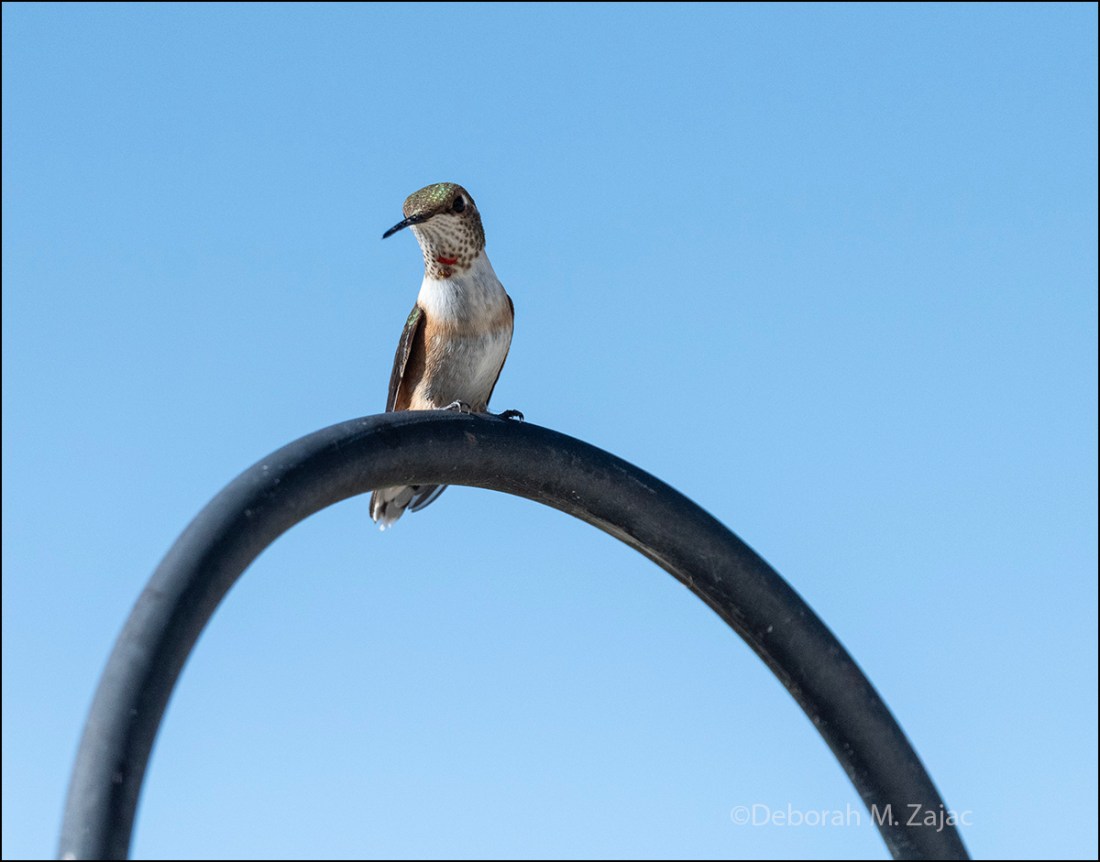
Here’s what I think is a female perched on top of the hook claiming possession. She lands here on and off all day long letting the other Hummingbirds know this is her feeder. You can see a little bit of her Gorget on her throat.
Here she is just after chasing off two other Hummingbirds. I love her tail!
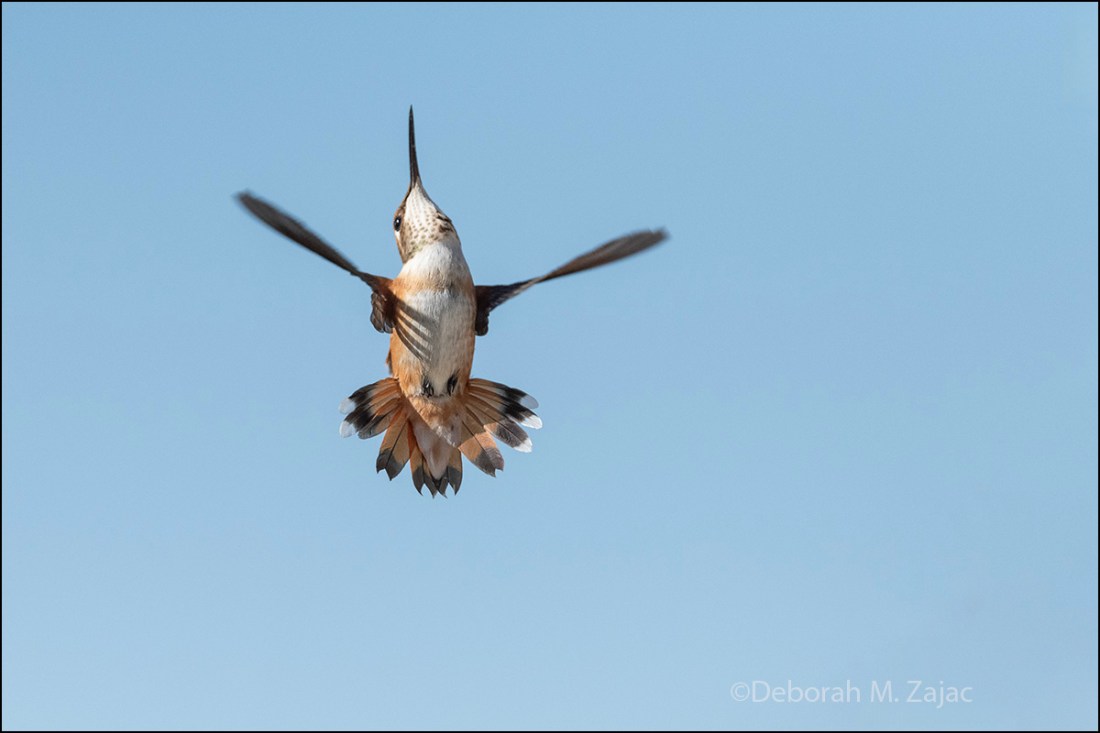
I could be wrong about her sex as it could also be an immature female/ male. If you know which it is please let me know.
Fun Facts:
- The Rufous Hummingbird is a common visitor to hummingbird feeders. It is extremely territorial at all times of year, attacking any visiting hummingbird, including much larger species. They’ve been seen chasing chipmunks away from their nests.
- The Rufous Hummingbird makes one of the longest migratory journeys of any bird in the world, as measured by body size. At just over 3 inches long, its roughly 3,900-mile movement (one-way) from Alaska to Mexico is equivalent to 78,470,000 body lengths. In comparison, the 13-inch-long Arctic Tern’s one-way flight of about 11,185 mi is only 51,430,000 body lengths. (AAB)
- During their long migrations, Rufous Hummingbirds make a clockwise circuit of western North America each year. They move up the Pacific Coast in late winter and spring, reaching Washington and British Columbia by May. As early as July they may start south again, traveling down the chain of the Rocky Mountains. People first realized this pattern after examining detailed field notes and specimens, noting the birds’ characteristic dates of arrival on each part of the circuit.
- The Rufous Hummingbird has an excellent memory for location, no doubt helping it find flowers from day to day, or even year to year. Some birds have been seen returning from migration and investigating where a feeder had been the previous year, even though it had since been moved.
- The Rufous Hummingbird breeds as far north as southeastern Alaska – the northernmost breeding range of any hummingbird in the world. Of the western hummingbirds that occasionally show up in the east, the Rufous Hummingbird is the most frequent.
- Rufous Hummingbirds, like most other hummingbirds, beat their wings extremely fast to be able to hover in place. The wingbeat frequency of Rufous Hummingbirds has been recorded at 52–62 wingbeats per second.
- The Rufous Hummingbird is not a colonially nesting species; however, there have been reports from Washington state that have 20 or more Rufous Hummingbird nests only a few yards apart in the same tree. (From the BNA)
- Hummingbirds are hard to catch, but there are records of Rufous Hummingbirds being caught by a large flycatcher (Brown-crested Flycatcher) and by a frog.
- The oldest recorded Rufous Hummingbird was a female, and at least 8 years, 11 months old when she was recaught and rereleased during banding operations in British Columbia in 2004.
I’ve been slower to your blogs this week as I’m visiting with family, and I will be for the next several days, but I’ll catch up!
Have a lovely week-end!!
Nikon D850| Nikkor 500mm| Fun Facts-https://www.allaboutbirds.org/guide/Rufous_Hummingbird/overview
more to come…


❤️
LikeLike
Lovely pics of the female Rufous hummingbird!! My favorite hummingbird to watch at the lake – the coppery red throat of the male is so vibrant. And yes, they fight with the Black-Chinned constantly! I did try putting out 2 feeders but they still fight each other! Lol
I enjoyed reading your interesting highlights about this amazing bird!!
LikeLiked by 1 person
Thank you so much, Jill! They’re still is a little squabbling but, it no where as intense as it was before I added the second feeder.
LikeLiked by 1 person
Fabulous FFF! So pretty, Deborah!
LikeLiked by 1 person
Thank you so much, Donna!
LikeLiked by 1 person
You captured the bird perfectly – great photos! Our hummingbirds are also territorial and very bossy. I wonder if all hummingbirds are that way.
LikeLiked by 1 person
Thank you so much, Denise! The Black-chinned doesn’t seem bossy or too territorial it’s the Rufous that does the chasing away here at my house.
LikeLiked by 1 person
Ah!
LikeLiked by 1 person
I’m sorry, Jennie! I was responding to comments that I had missed while on vacation and I got you and Denise mixed up.
LikeLiked by 1 person
I have done that so many times! No worries!
LikeLiked by 1 person
🥰
LikeLiked by 1 person
Great shots Deborah! We put out an extra feeder when the rufous come. 🙂
LikeLiked by 1 person
I bought another Shepard’s hook and feeder it seems to have helped some.
LikeLike
Wonderful captures of the hummingbird, Deborah! The facts about the Rufous Hummingbirds are very interesting. I had a hummingbird in my garden but haven’t seen him (assume to be him) for a while. I know it’s not ruby-throated. I had a ruby-throated hummingbird born in my garden in my California home. His parents went south in the winter but he stayed around my house all year long. I miss him.
LikeLiked by 1 person
I missed the Hummingbirds when I moved here too so I put up a feeder several years ago and firs the Black-chinned came then the Rufous. I had Anna’s Hummingbirds at my old house come feed at the feeders. Thank you so much, Mariam for the great comment.
LikeLiked by 1 person
Good to hear you have different hummingbirds visiting your garden. Deborah. I love hummingbirds. Two weeks ago, the hummingbird was behind my head for a few seconds, then moved to the left side of my face for a few seconds. The humming was so lovely. No wonder they are called hummingbirds. I’ll put at least two more feeders around.
LikeLiked by 1 person
😊How delightful!!
LikeLike
We don’t have hummingbirds here. I love to see them in your posts.
LikeLiked by 1 person
Thank you so much, Pauline! I’m surprised you haven’t any Hummingbirds there as you have so many neat birds there.
LikeLiked by 1 person
The closest we have is the eastern spinebill but it can’t hover or fly backwards. I would love to see a humming bird, I have only seen videos of them
LikeLike
They are beautiful images, and the it was good to learn more about this lovely bird!
LikeLiked by 1 person
Thank you so much!! I learned some new things about them as well. 😊
LikeLiked by 1 person
As amazing as their flights and migrations are, I was completely astounded when a friend in California posted photos of a hummingbird nest with those tiny, tiny eggs. Fueling up for migration is one thing, but can you imagine trying to keep a few babies fed and happy?
LikeLiked by 1 person
Isn’t that amazing! I’ve seen a Hummingbird nest with chicks but, never with the eggs.
LikeLike
Your 2nd photo is truly delightful 😊
LikeLiked by 1 person
Thank you so much, Belinda!
LikeLiked by 1 person
Sensational photos of this wonderful hummingbird, Deborah!!
LikeLiked by 1 person
Thank you so much, B. J.!
LikeLiked by 1 person
Interesting facts about this marvelous little bird Deborah. Nectar is precious to honeyeaters as it is here in our part of the world and birds will fight to own the territory. We often witness bullying to prevent other birds accessing nectar. Love your aerial shot, so cuuute 🙂
LikeLiked by 1 person
Thank you so much, Ashley!! It’s been interesting watching the territorial spats, but I’d rather they not have them so have added another hook and feeder which seems to helped some.
LikeLiked by 1 person
I very much like the pictures, Deborah, and indeed: the tail! The facts about this little creature are amazing! This is a superbird! I had a bald eagle read these facts and he scratched his, well bald, head in awe. ‘Is this for real?’, he asked. When I nodded, he grabbed the phone and said to some government person: ‘I don’t want to be the symbol of the US no more. I want it to be the rufous hummingbird from now on. So don’t be surprised when there are some changes in the background during official announcements. 🙂
LikeLiked by 1 person
LOL!!! I love this comment, Peter! The Rufous is a Super-bird isn’t it.
LikeLiked by 1 person
Wonderful photos of the rufous hummingbirds, Deborah, and I appreciated the narrative, too.
LikeLiked by 1 person
Thank you so much, Jet! I’m glad you enjoyed the post and images.
LikeLike
Amazing, beautiful photos! I have two hummingbird feeders in my backyard, they still battle for ownership! So fun to watch.
LikeLiked by 1 person
Thank you so much, John! I added another feeder and it has helped some.
LikeLiked by 1 person
That’s great!! Enjoy your beautiful birds. ❤️😊
LikeLiked by 1 person
Beautiful pictures!Sent from my iPad
LikeLiked by 1 person
Thank you so much, Jarlath!!
LikeLike
I’ve not heard of journeys measured in body lengths, though T.S. Eliot wrote in “The Love Song of J. Alfred Prufrock” that “I have measured out my life with coffee spoons.”
LikeLiked by 1 person
Wasn’t that interesting. I’ve heard of measuring a life in minutes, years, and even seconds, but not by body length until I read that about the Rufous Hummingbirds.
LikeLike
I have watched two or three hummingbirds at our feeder chase each other off this year and thought maybe I need a second one too. Ours have mostly green throats, but I’m amazed at them all. Nice post and enjoy your family time.
LikeLiked by 1 person
Thank you so much, Judy! Green throats…I wonder what Hummingbird you’re seeing? Maybe something that traveled a long way as well?
LikeLike
“52–62 wingbeats per second” – wow! I love that second shot with the wings and tail feathers visible. That’s a great capture. This was a fun read, Deborah.
LikeLiked by 1 person
The Rufous are raising cane here too. Beautiful images, especially love the one in flight.
LikeLiked by 2 people
Thank you so much, John!
LikeLike
They use up so much energy that they make trips to my feeder every 15-20minutes to eat. Thank you so much, Dan! It was neat seeing his tail splayed out like that.
LikeLiked by 1 person