Copyright ©2025 Deborah M. Zajac. ALL RIGHTS RESERVED.
PLEASE DO NOT USE MY IMAGES WITHOUT EXPRESSED WRITTEN PERMISSION.
While out birding with the group last Friday morning we had the pleasure of a Tundra Swan fly-by. The single Swan flew by three times actually. Probably checking out the slough and ponds to see if that was the place to land or if his partner was there. We didn’t see a another swan and after three passes we didn’t see it again.
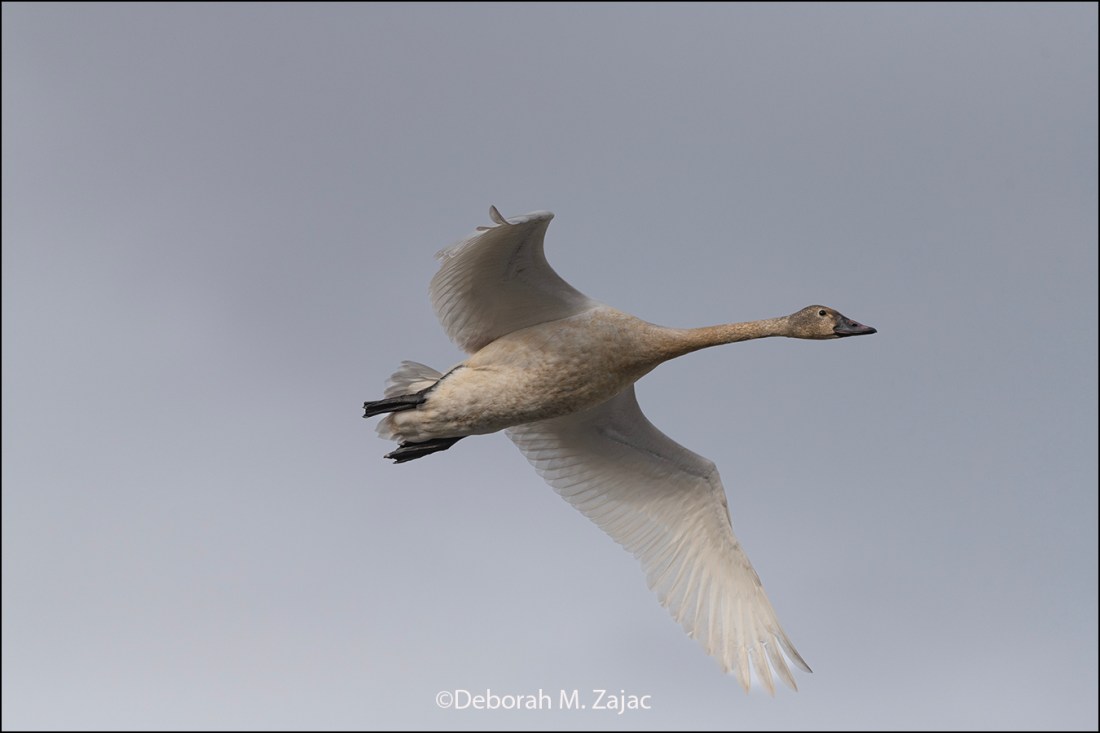
Here it was flying over my head.
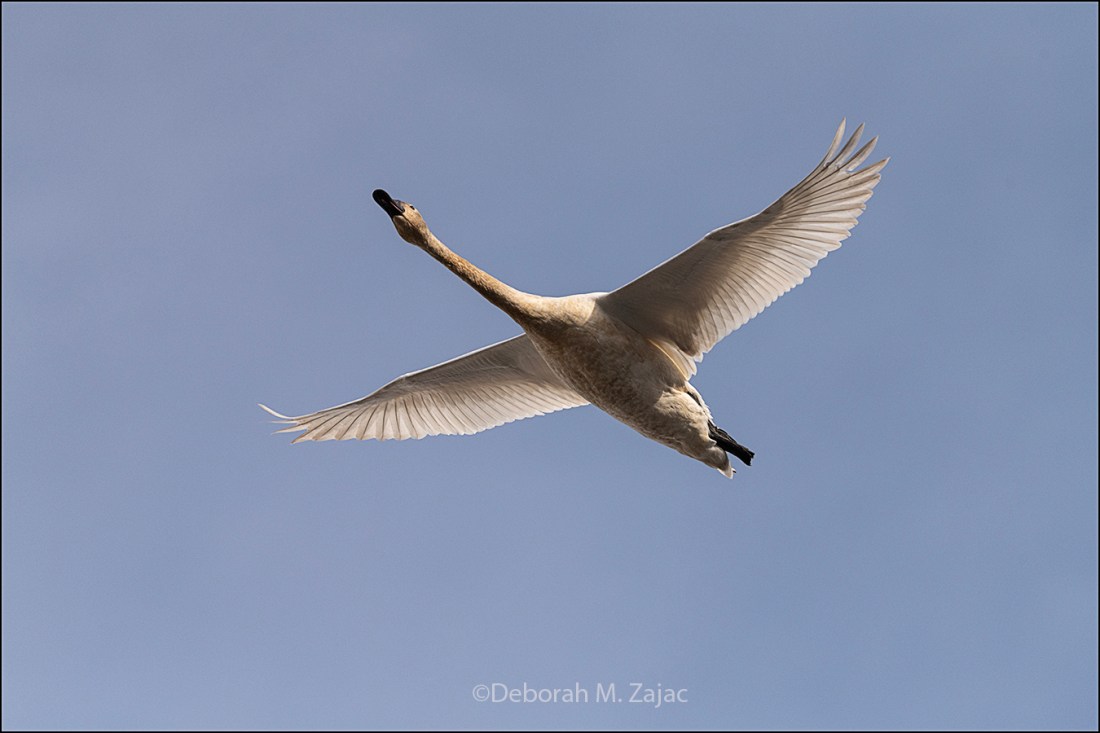
Both images are cropped a bit. It was higher in the sky than these make it look.
Fun Facts:
- Lewis and Clark provided the first written description of the Tundra Swan during their expedition to the West, where the birds’ whistle-like calls prompted Meriwether Lewis to dub them “whistling swans.”
- The whistling swan, the American race of the Tundra Swan, currently is considered the same species as the Eurasian race, the Bewick’s swan. They were considered separate species in the past, distinguished by the large yellow patches on the face of the Bewick’s swan.
- The Tundra Swan stays in flocks except when on a breeding territory. Although most swans spread out to breed, a large proportion of the population on the breeding grounds still can be found in flocks. These swans are not breeding, and may be young birds that have not yet bred, adult pairs whose breeding attempts failed, or adults that bred in the past but for some reason do not in that year.
- During the breeding season the Tundra Swan sleeps almost entirely on land, but in the winter it sleeps more often on water.
- Tundra Swans breed in the remote arctic of North America. Parents defend their nests and young against a host of predators including foxes, weasels, wolves, and bears, as well as birds such as Glaucous Gulls, Common Ravens, Parasitic Jaegers, Pomarine Jaegers, and Golden Eagles. If the parents are present, they are able to defend the nest and nestlings from these threats. Wolves, people, and bears, however, are too big to fight, and most incubating swans leave their nests while these large predators are far away. By leaving quickly when large predators approach, the parents may make the nest harder to find.
- Tundra Swans wintering in Chesapeake Bay feed almost exclusively on clams that they dislodge from the mud. But it can be challenging to enjoy a peaceful meal: often the swan has to fend off a Ring-billed, Herring, or Greater Black-backed gull that swoops in to grab a clam from the swan’s bill – a successful tactic in about half of these “kleptoparasitic” encounters.
- Swans have long been associated with ideals of romance. Added to their elegant outlines and all-white plumage is their tendency to form permanent pair bonds by the time they’re 2-3 years old. Once a pair forms, Tundra Swans feed and roost together year-round.
- Based on banding records, the oldest known Tundra Swan was a female and at least 23 years, 7 months old when she was identified by her band in the wild, in Ohio. She was originally banded in the same state.
Fun Facts gleaned from allaboutbirds.org
If the rain holds off this morning I’ll be birding so I may be late getting to your blogs, and comments.
more to come…
 Circadianreflections Blog
Fantastic inflight captures and post!!!
LikeLiked by 1 person
Thank you so much, Denise!!
LikeLiked by 1 person
Beautiful photos Deborah! Amazing how one lived to 23+ years!
LikeLiked by 1 person
Thank you so much, Jill! It did live a long time didn’t it.
LikeLiked by 1 person
It is splendid! Your reflexes were very quick to capture that shot. Hugs.
LikeLiked by 1 person
Thank you so much, Teagan!!🤗
LikeLike
Both images of of the Tundra Swan fly-by were good and I really liked the second photo for all that wing detail.
Great fun facts too and imaginging one more than 23 years old was cool to learn about
LikeLiked by 1 person
Thank you so much, Yvette! It was seeing fly over my head as well. They have a great wing span.
LikeLiked by 1 person
incredible wing span indeed
LikeLike
Thank you so much, Yvette! ☺️
LikeLiked by 1 person
🙂🙂🙂
LikeLike
What a wonderful sighting! The Tundra Swan looks so majestic in flight, and your photos capture it beautifully. I always enjoy the fun facts you share—it’s fascinating how they form lifelong pair bonds. Also, I’m subscribed to your blog, but I’m not sure why I didn’t receive the email about this beautiful post! I’ll have to double-check that. Looking forward to your next birding adventure!
LikeLiked by 1 person
Thank you so much, Ilze! It was a fun sighting and not one I see too often. I’ve been having issues leaving comments for weeks on WP blogs. I have to go to the reader to leave them. It’s a pain but, doable. I hope you get subscribed again I enjoy our conversations and your visits to my blog.
LikeLiked by 1 person
That sounds frustrating about the WP comments; I’ve had similar issues before. I really appreciate you going through the extra steps to leave a comment! I bookmarked your blog in my browser to make sure I’ll check once in a week 🙂
LikeLiked by 1 person
😊
LikeLiked by 1 person
Fantastic images, Deborah. Love both and the first has a dreamy quality to it. 🙂
LikeLiked by 1 person
Thank you so much, Jane!
LikeLiked by 1 person
Those are wonderful in-flight photos, Deborah. The second one is my favorite, but they’re both great.
LikeLiked by 1 person
Thank you so much, Dan! It was pretty cool when it flew over my head. I wished it landed and stayed awhile though.
LikeLiked by 1 person
Your photos are wonderful. I didn’t know about Lewis and Clark *discovering* them. Even though I live in Ohio I rarely see any swans.
Like
Thank you, Ally! That was new to me too. As I said to Jennie I only think of them discovering and surveying the West.
LikeLiked by 1 person
Just wow! The swan photos are outstanding, and the facts are very interesting. Lewis and Clark, who knew?
LikeLiked by 1 person
I know right! I never think of them exploring or being anywhere else but out here in the west. 😊
LikeLiked by 1 person
Exactly!
LikeLiked by 1 person
😊
LikeLiked by 1 person
Great pics! I did a commissioned painting of swans years ago. Such beautiful birds!
LikeLiked by 1 person
Thank you so much, Kendall! They are indeed.
LikeLike
Awesome to see and great shots, Deborah! 💙🦢💙
LikeLiked by 1 person
Thank you so much, Donna! 🥰
LikeLiked by 1 person
How fun to see this Tundra Swan fly over you. Great captures.
LikeLiked by 1 person
Thank you so much, Sheila!!
LikeLike
Wonderful images, Deborah!
LikeLiked by 1 person
Thank you so much, Belinda!
LikeLiked by 1 person
Handsome dude with an amazing history. Hope the rain holds off.
LikeLiked by 1 person
The roads were icy and it was pretty cold from the storm that blew in overnight so no birding on Friday for me. Swans are so pretty aren’t they.
LikeLiked by 1 person
What beautiful flight shots Deborah. Thanks also for the interesting facts about this amazing bird we never see down here, some of our migrating birds spend time on the Tundra but we thankfully don’t.
LikeLiked by 1 person
Thank you so much, Ashley! Do you have any Swans there in Australia?
LikeLiked by 1 person
Yes we have our unique and beautiful Black Swan which I have featured occasionally in my posts
LikeLiked by 1 person
I’ve only seen the Black Swans in captivity.
LikeLiked by 1 person
These birds breed well and are now found all over Australia and the surrounding islands. They were originally in WA the Swan River was named after them in Perth WA
LikeLiked by 1 person
Terrific swan facts and delightful photos
LikeLiked by 1 person
Thank you so much, John!!
LikeLike
They’re graceful and beautiful, but don’t cross a swan! They can be very aggressive and with their size, beware. 🙂 Lovely photos.
LikeLiked by 1 person
I hear if they land in a pond and make home they chase every other water bird out of the pond. That’s not good. Thank you so much, Janet! 😊
LikeLike
Wonderful pictures Deborah! I fine view of the aerodynamics of the bird. Like an arrow! Swans are quite fierce animals but, yes, there are enemies to large for them. Or – almost – to cunning, like those gulls. (Over here they tend to snatch fries or other snacks out your hand while bringing it to your mouth, whoosh! 🙂 ) I hope you had a good time birding today!
LikeLiked by 1 person
Thank you so much, Peter! Birding was cancelled. We had a big storm last night bringing high winds, and icy roads with snow on and off this morning so, it was cancelled to be rescheduled hopefully and better day weatherwise with no icy roads.
LikeLiked by 1 person
So are you singing “Way up upon the Swanny Tundra”?
LikeLiked by 1 person
LOL! I didn’t have that in my head until I read your comment. Now it’s on repeat! I need the next line! 😂
LikeLike
Way up upon the Swanny Tundra
Gladly I roam,
With fine feathered fun dra-
wing me from home.
LikeLiked by 1 person
LOL! That’s good, Steve!!
LikeLike
Somehow I had the idea that Tundra Swans live exclusively on far-away tundra. It’s wonderful that you were able to see this one. I still have seen only one swan in my life — and that was a black one that showed up in a marina. We figured it was an escapee from ‘somewhere.’
LikeLiked by 1 person
They’re only here for non-breeding season…winter. Since moving here I’ve seen a few each winter up in Washoe Co. I’ve never seen a wild black one only ones kept in captivity on ponds in a zoo, or private pond.
LikeLiked by 1 person
What graceful birds
LikeLiked by 1 person
They are! Thank you, Sheree!
LikeLiked by 1 person