Copyright ©2024 Deborah M. Zajac. ALL RIGHTS RESERVED.
PLEASE DO NOT USE MY IMAGES WITHOUT EXPRESSED WRITTEN PERMISSION.
I don’t want the week to go by without a post so here we have me posting on a rare Saturday.
This little Kinglet is so cute, but very flitty normally but, on this day earlier this month I was able to get quite a few good looks at this one.

They’re a small bird being only 3.5-4.3 inches in length, and weigh 0.2-0.3 ounces.
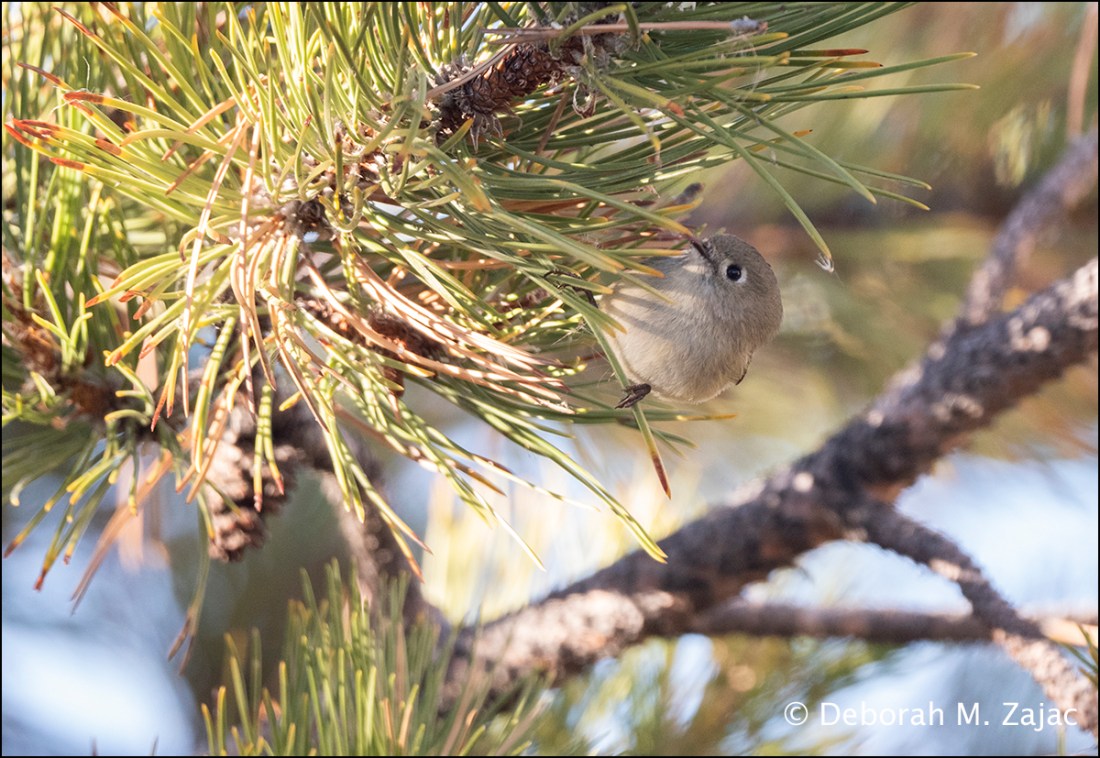
I have yet to see it flared, but here’s a look at the top of its head showing the Ruby spot.
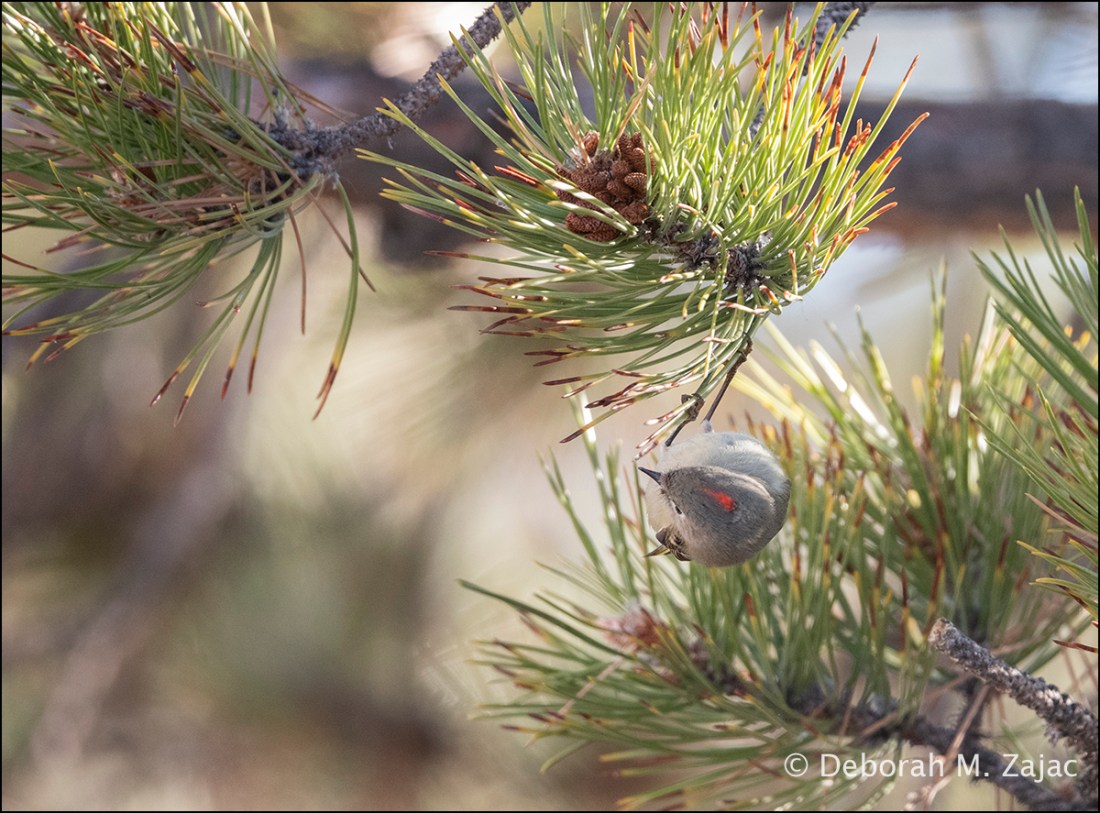
This one is busy being an acrobat which afforded me a good look at its Ruby Spot which was a treat. Just look at how light they are it’s holding onto those pine needles and they aren’t bending!
Fun Facts:
- The Ruby-crowned Kinglet is a tiny bird that lays a very large clutch of eggs—there can be up to 12 in a single nest. Although the eggs themselves weigh only about a fiftieth of an ounce, an entire clutch can weigh as much as the female herself.
- Ruby-crowned Kinglets seem nervous as they flit through the foliage, flicking their wings nearly constantly. Keeping an eye out for this habit can be a useful aid to identifying kinglets.
- Metabolic studies on Ruby-crowned Kinglets suggest that these tiny birds use only about 10 calories (technically, kilocalories) per day.
- The oldest known Ruby-crowned Kinglet was a female, and at least 8 years, 8 months old, when she was recaptured and rereleased during banding operations in Texas in 2017. She was banded in the same state in 2008.
Fun facts gleaned from allaboutbirds.orghttps://www.allaboutbirds.org/guide/Ruby-crowned_Kinglet/overview
I hope you all have a great week-end!
Nikon D810| Nikkor 500mm PF-e| PS CC 25.3.1
more to come…
 Circadianreflections Blog
so CUTE! Love the shots.
LikeLiked by 2 people
Thank you so much!!
LikeLiked by 1 person
What a cutie! Love how you got a photo of its ruby crown!
LikeLiked by 1 person
Thank you so much, Jill! It is a cutie indeed. 😀
LikeLiked by 1 person
What a handsome little guy, and you got a couple of really good photos. I had never heard of him so thank you for sharing. I really could improve my bird knowledge. 🙂
LikeLiked by 3 people
Thank you so much, Judy! I’m still working on my bird knowledge. I think it’s a life long thing…with me anyway. 😀
LikeLiked by 1 person
All the details are amazingly crisp and clear. Lovely shots, Deborah. Hugs.
LikeLiked by 1 person
Thank you so much, Teagan! 🤗
LikeLike
These are an amazing little birds on the tree. Anita
LikeLiked by 1 person
They are. Thank you so much, Anita!
LikeLiked by 1 person
Lovely photos of this small bird. I like the little patch of red on his head. (Suzanne)
LikeLike
Thank you so much, Susanne! I do too. 😀
LikeLike
I love these little birds. Good job getting and image showing the ruby spot on top of the head.
LikeLiked by 1 person
Thank you so much, Robert! I’m glad it was so cooperative and showed me its head. 😀
LikeLike
You captured the ruby spot! The Kinglet is adorable. Thank you, Deborah.
LikeLiked by 1 person
I did! I was happy to have seen it this well. Thank you so much, Jennie!
LikeLiked by 1 person
I know you were thrilled! You’re welcome, Deborah.
LikeLiked by 1 person
☺😀
LikeLiked by 1 person
Great photos! Such a beautiful bird!
LikeLiked by 1 person
Thank you so much, Kendall!
LikeLike
What a cute little bird! It’s wonderful that you were able to get such nice images of it. Is the ruby ‘crown’ a mark of breeding season, or is it there all year round? It tickles me that birds sometimes keep their little bits of distinctive color hidden; this is a great example. Another one that comes to mind is the yellow-rumped warbler. It’s especially fun that the oldest ruby-crowned kinglet was banded in Texas. I’ve never taken part in any of the banding events in my area, but I know there are quite a few.
LikeLiked by 2 people
Thank you so much, Linda! As far as I know they do have their ruby all year. I’ve only seen it this good once before. I’ve never done any banding either.
LikeLiked by 2 people
I don’t know how you spotted it because it’s so small and seeing the ruby spot on its crown is more amazing, Great catch!!
LikeLiked by 2 people
Thank you so much, Gordon! Something dark flitting inside the pine tree caught my eye.😊 I am so glad it did!
LikeLiked by 2 people
Gorgeous little bird Deborah, on par with our Thornbill
LikeLiked by 2 people
Isn’t it adorable! I’ll look up your Thornbill to see the similarities.😊
LikeLiked by 2 people
These are wonderful shots of this kinglet, Deborah, so so happy for you to capture that ruby crown too. Bonus shot!! 🤗💃😊
LikeLiked by 2 people
Thank you so much, Donna! Seeing their crown was a treat as I rarely get to see it.😊
LikeLiked by 2 people
What a tiny little bird. A real treat to see, Deborah 😊
LikeLiked by 2 people
It was! Thank you so much, Belinda!😊
LikeLiked by 2 people
This post makes you the queen of kinglets.
LikeLiked by 2 people
lol! I like it!😊
LikeLiked by 1 person
If anyone suggests it’s too grandiose a title, you can make it the queenlet of kinglets.
LikeLiked by 2 people
😂
LikeLiked by 1 person
Perfect shot of its gem studded crown, Deborah. Nice!
LikeLiked by 2 people
Thank you so much , Cheryl!
LikeLiked by 2 people
Terrific shots of this pretty little bird. Thank you, Deborah it was great seeing them.
LikeLiked by 2 people
Thank you so much, John!
LikeLiked by 2 people
😁
LikeLiked by 1 person
Dang, that’s a cute little bird. I’m surprised you could get good photos of it. The idea of that bird having that many eggs is amazing. I was wondering if I had missed your post. I was so busy this week, blog notifications piled up. I’m glad I didn’t.
LikeLiked by 2 people
Thank you so much, Dan! This one was foraging in a pine tree right along the trail and was in no hurry to give it up because I or anyone came by or stopped to look. That made for a nice change, and good photo ops.
Can you imagine how busy they must be after the clutch hatches feeding that many! Exhausting I’m sure.
I wanted to share this yesterday, but I wasn’t home most the day so today worked out better.
LikeLiked by 2 people
I watch the House Wren that uses our bird house feeding two, and I think she’s going to wear herself out.
LikeLiked by 2 people
I think they must from what I’ve seen it’s almost not stop feeding the chicks. They are amazing!
LikeLiked by 2 people
What cute little things, Deborah, and wonderful pictures of this one. The red (or ruby – sounds better) spot makes them kind of distinguished. 10 Kcal per day? And always flapping their tiny wings? There must be efficiency in that! I don’t think we have them over here in the Netherlands, and I envy you for having them!
LikeLiked by 2 people
Thank you so much, Peter! They’re only here for breeding season and passing through so it’s a treat to see them. 😀
LikeLiked by 2 people