Copyright ©2024 Deborah M. Zajac. ALL RIGHTS RESERVED.
PLEASE DO NOT USE MY IMAGES WITHOUT EXPRESSED WRITTEN PERMISSION.
I saw these in early January and since we’re on the very edge of their migration path I feel very lucky to have seen them.
The male has lovely dark coloring and a wonderful hood. During the courting season he continuously tilts his head all the way to his back and up again and back again with his hood raised as it is in this image while he swims very near the female trying to capture her as a mate. It’s called Head Throwing. He also gives her a hoarse croak. It’s pretty neat to see them courting.

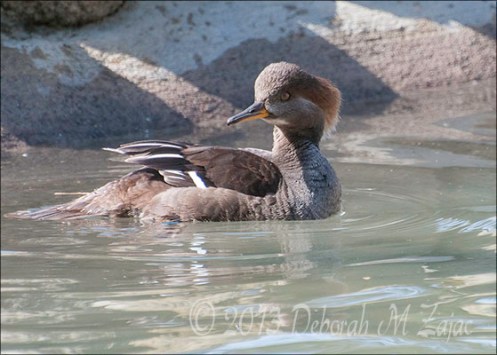
The female looks rather dull compared to the male but, her crown or hood is lovely too. I liked the way the sunlight lit up her hood.
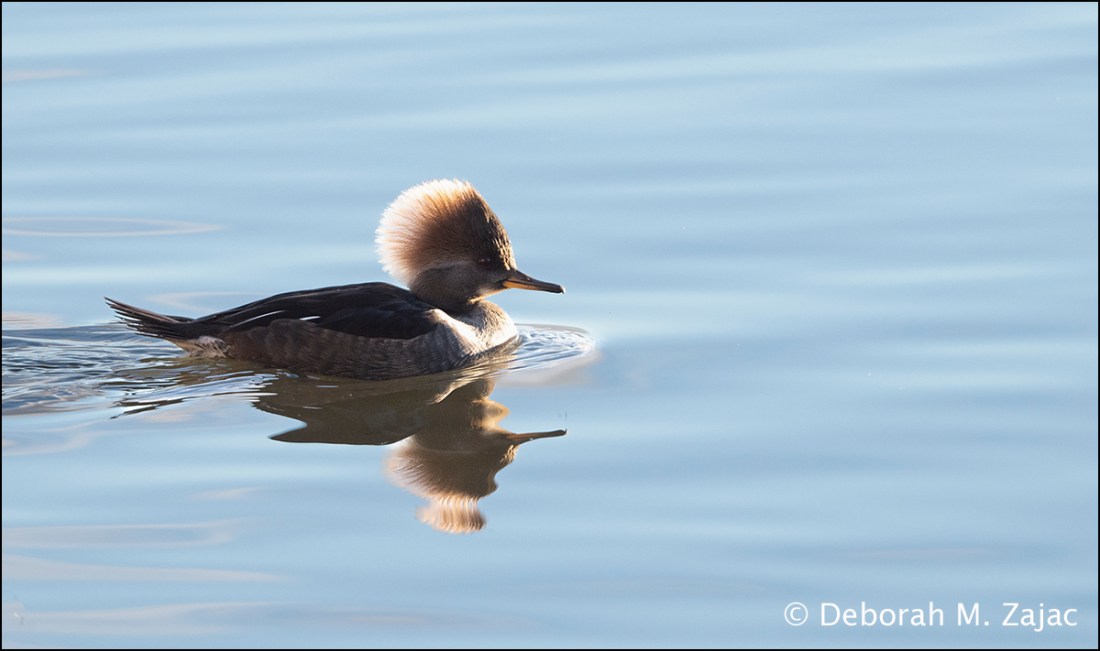
They were swimming somewhat far apart from each other on this morning and not interested in courting, but luckily their hoods were up.
Fun Facts:
- Similar to other cavity-nesting ducks such as Wood Ducks, Common Mergansers, and Common Goldeneyes, Hooded Mergansers often lay eggs in nests of other ducks, both their own species and others. This is called “brood parasitism” and is similar to the practice of Brown-headed Cowbirds. In turn, other cavity-nesting duck species will parasitize Hooded Merganser nests. Female Hooded Mergansers can lay up to about 13 eggs in a clutch, but nests have been found with up to 44 eggs in them.
- Hooded Mergansers find their prey underwater by sight. They can actually change the refractive properties of their eyes to improve their underwater vision. In addition, they have an extra eyelid, called a “nictitating membrane,” which is transparent and helps protect the eye during swimming, like a pair of goggles.
- Hooded Merganser ducklings leave their nest cavity within 24 hours of hatching. First, their mother checks the area around the nest and calls to the nestlings from ground level. From inside the nest, the little fluffballs scramble up to the entrance hole and then flutter to the ground, which may be 50 feet or more below them. In some cases they have to walk half a mile or more with their mother to the nearest body of water.
- On the bird family tree, Hooded Mergansers (genus Lophodytes) lie between goldeneyes (Bucephala) and the other North American mergansers (Mergus). They share many courtship behaviors and calls with both of those groups.
- The Hooded Merganser is the second-smallest of the six living species of mergansers (only the Smew of Eurasia is smaller) and is the only one restricted to North America.
- The oldest recorded Hooded Merganser was a male and at least 14 years, 6 months old when he was shot in Mississippi in 2009. He was originally banded in Minnesota in 1995.
Fun Facts gleaned from allaboutbirds.org
Nikon D810| Nikkor 500mm| PS CC 24.4
I hope you all have a great week-end. If the weather permits I’ll be birding this morning and will respond when I get home. If the weather is poor I’ll be here!😀
more to come…

 Circadianreflections Blog
You must be logged in to post a comment.