“TRULY IT IS A SERMON IN STONE.”~ St Dominics Catholic Church

During my visit to San Francisco last week with my friend Dali we were fortunate enough to visit St. Dominics Catholic Church. I think of it as a Cathedral. It reminds me of the great Gothic cathedrals of France that I’ve visited.

History:

In 1863, the Dominican order paid $6,000 for the city block bounded by Steiner, Bush, Pierce and Pine Streets. During 1872 and 1873, Fr. Vilarrasa and the Provincial Council approved the expenditure of $25,000 to build a priory and a church. The first Saint Dominic’s, a small church at the corner of Bush and Steiner Streets, was blessed on June 29, 1873. The Priory of Saint Dominic was formally established in 1876.

By 1880, it was apparent that the church was too small for its rapidly growing congregation. Plans were drawn for a much larger church to be built of brick on the same site. The first church was moved to a location on Pine Street where it served as a parish hall. Although the cornerstone of the second church was laid in 1883, years of financial hardship followed and the church did not open until 1887 and was not completed for several years after. It served the parish until April 18, 1906.

During the months following the great earthquake, parishioners gathered for Mass outdoors until, in October 1906, a wooden church opened on the Pierce Street side of the block. This “temporary” Saint Dominic’s was to remain in use as a church until 1928 and as a parish hall until the 1960’s when it was finally torn down.

Work did not begin on the fourth Saint Dominic’s until 1923. Archbishop Hanna blessed the new church after construction was finished in 1928. Even then, work continued for many years as the building we know now was brought to completion at the time of Saint Dominic’s centennial celebration in 1973.

The Loma Prieta earthquake of 1989 destroyed the beautiful “lantern” of Saint Dominic’s tower. The tower itself was severely damaged, but was repaired and strengthened during the two months the church was closed. Much of the decorative work on the ceiling beams of the church fell during the quake and the remainder was removed for the safety of the parishioners.~ St Dominics Catholic Church

The Nave and Main Altar:

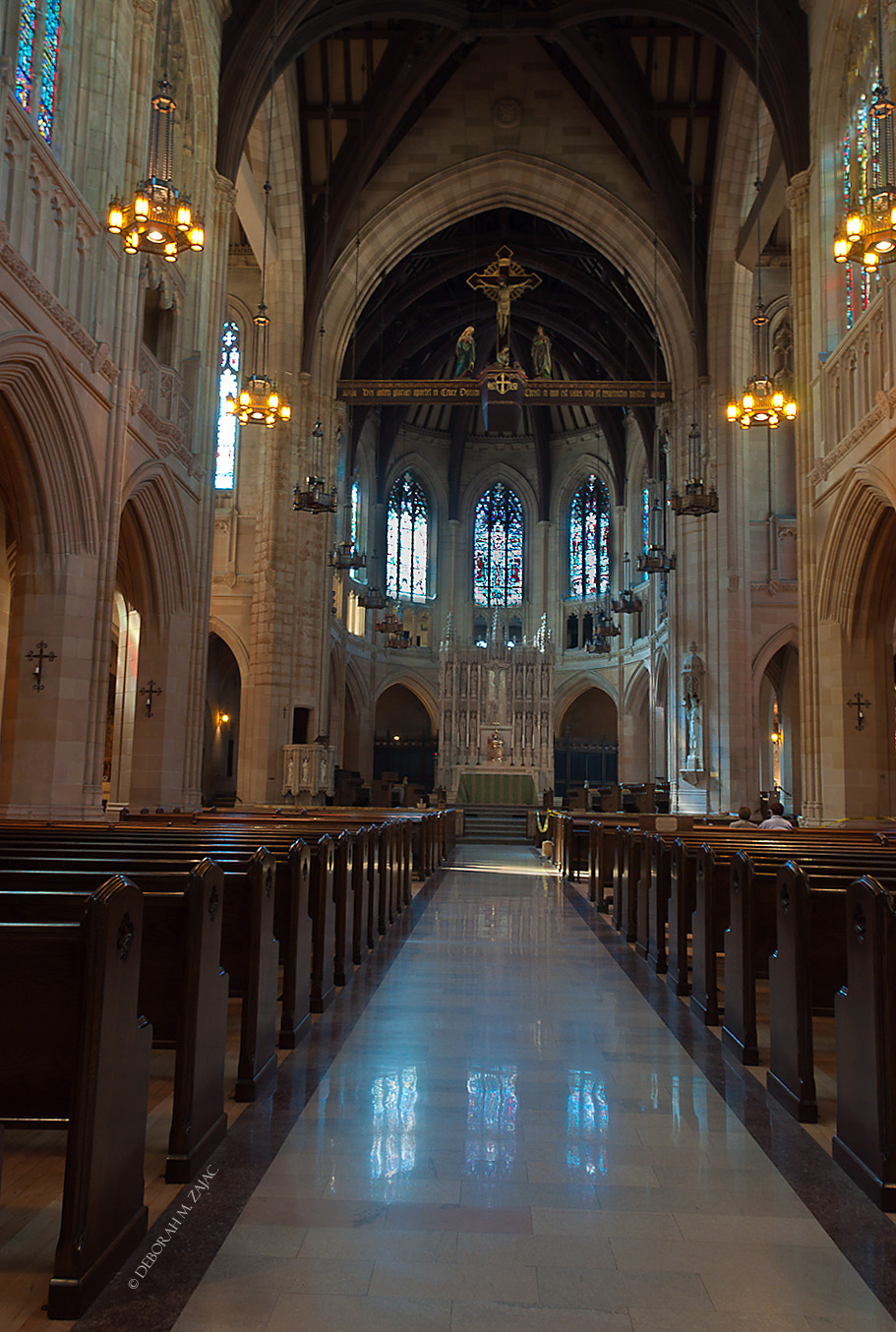
I like the light reflecting on the floor, and warm woods, and stone walls with their creamy colors of white and blush so soft and soothing.  The crucifix group running across the Nave is really quite beautiful, it survived the 1906 Earthquake, and was placed in this chapel in 1928.
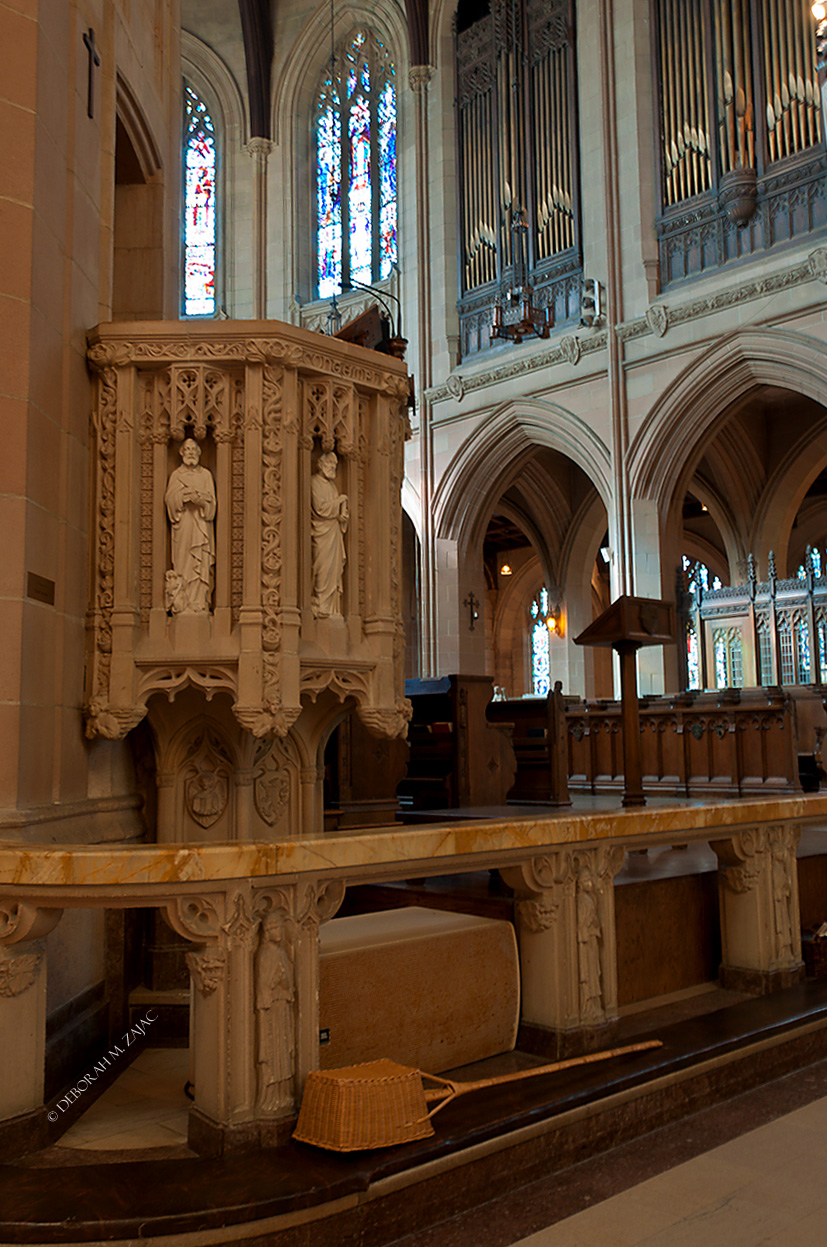
The Pulpit and Organ Pipes:

The Pulpit Carvings-  Left to Right: St. Matthew, St. Mark, (not shown Christ, St. Luke, St. John)

“The pipe organ was built in Boston, Massachusetts in 1909 and was housed in the temporary church on Pierce Street before being moved into the current structure. The organ is registered with the Organ Historical Society as one of the most important, historical instruments in the country.”~ St. Dominic Catholic Church
Some of the Altars:

“The Edmund Schmid Woodcarving Studio of Oberammergau, Germany, carved the oak altars and shrines and the confessionals.”~ St. Dominic Catholic Church

Pieta
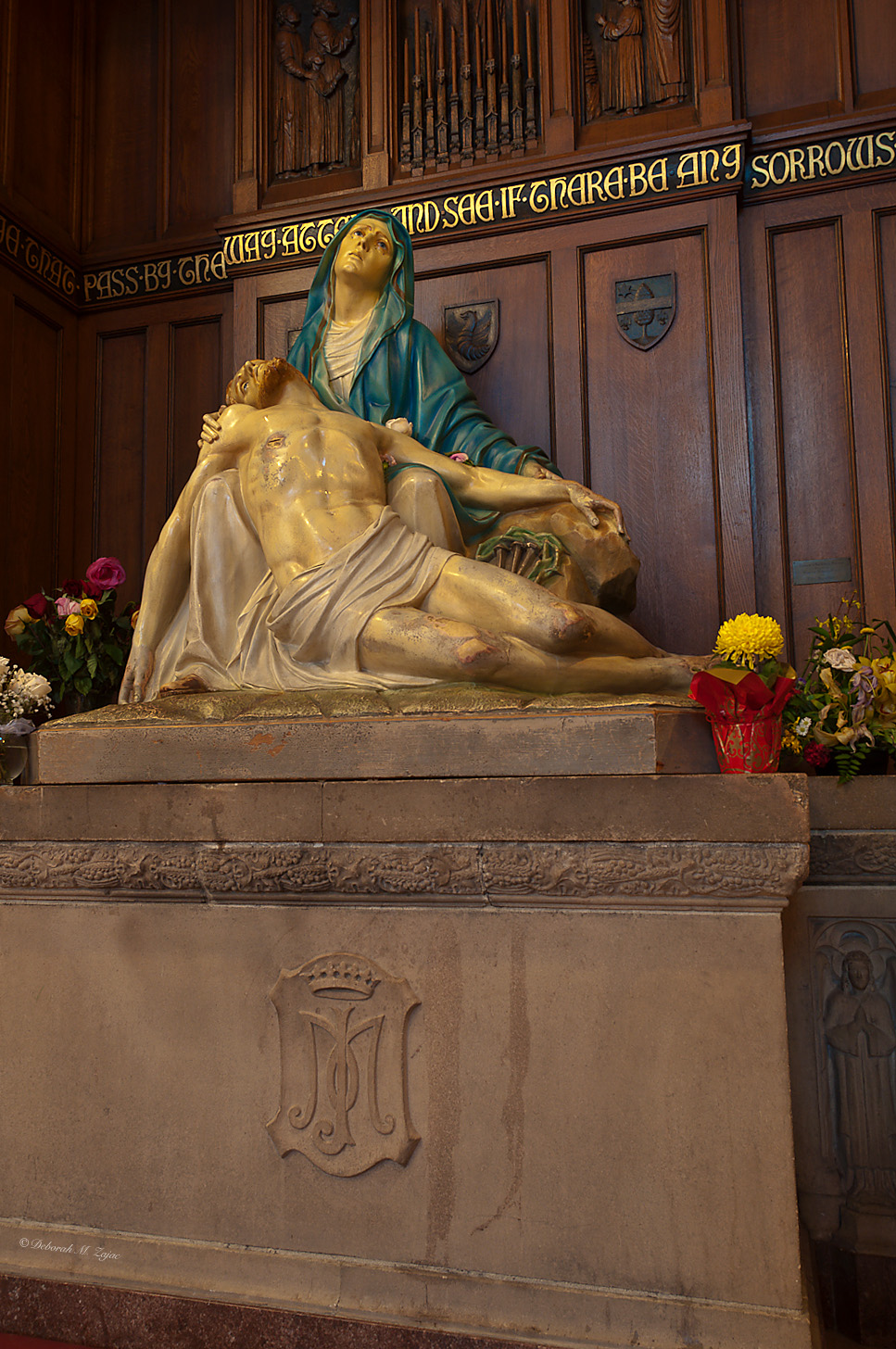
Our Lady of Purgatory

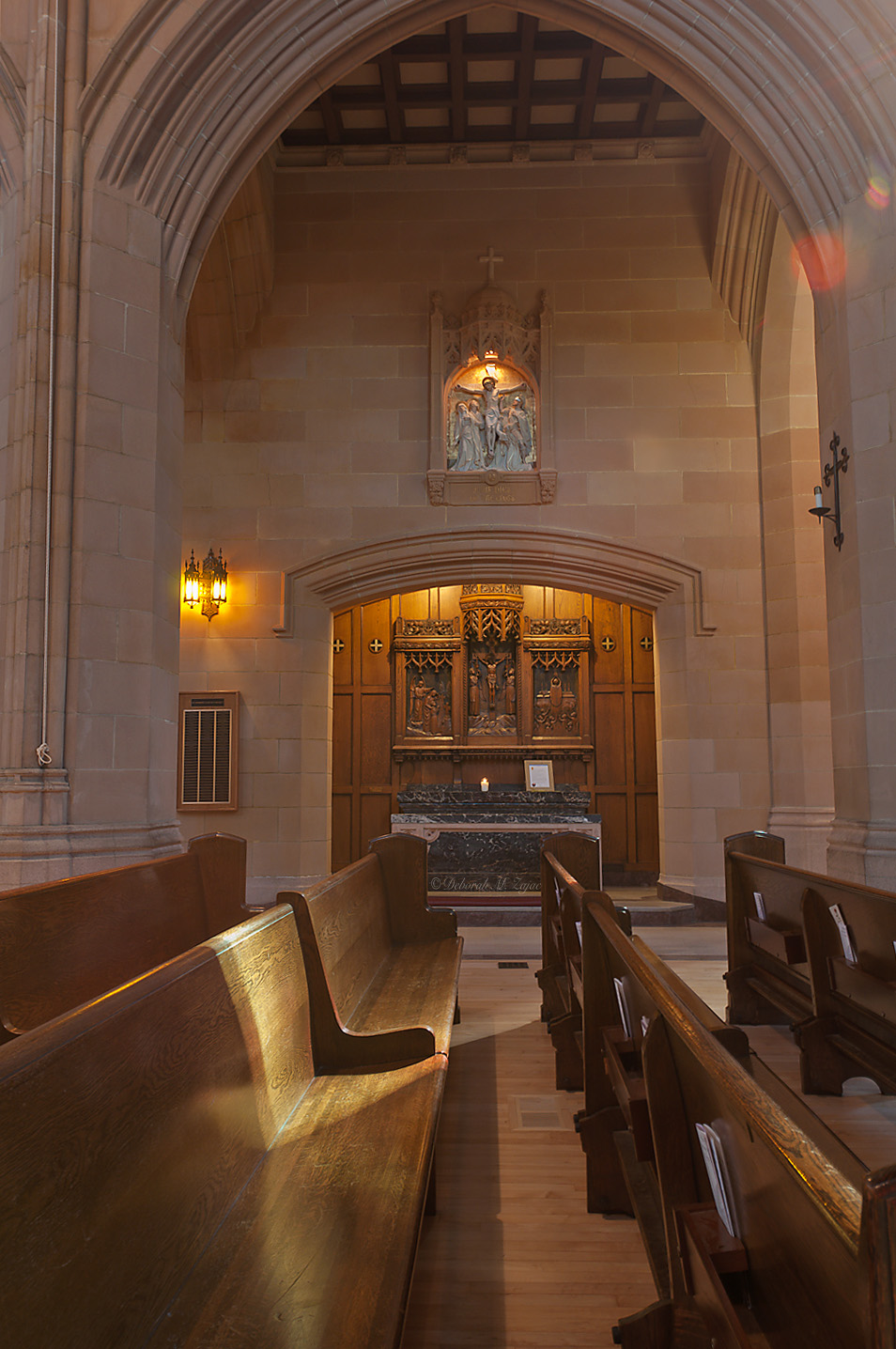
This view shows the lovely warm wood of the pews, and the beautiful color of the stone walls. With sun streaming down on the pews from above there are some nice shadows, and I got a little flare too.
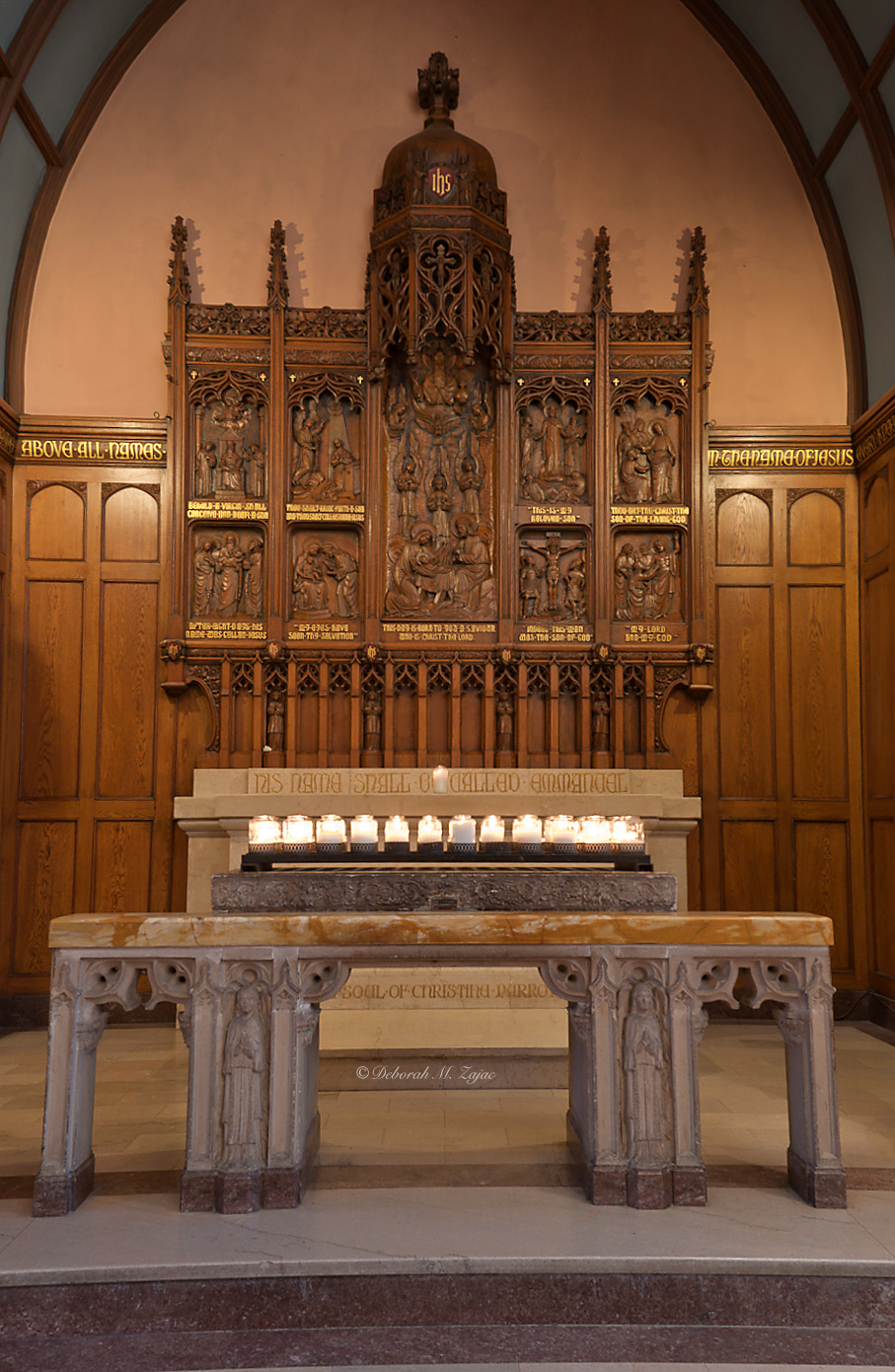
Altar of the Holy Name

When the church was first established they were part of the Society of the Holy Name, but I’m told by the staff they aren’t anymore.

Correction: From Maria Vickroy-Peralta the Development Director at St. Dominic’s emails- “Actually, the Dominicans who established and continue to staff St. Dominic’s belong to the Province of the Most Holy Name of Jesus (more commonly known as the Western Dominican Province ).  Thus, the Holy Name Altar reflects their Provincial affiliation, which continues to this day.”
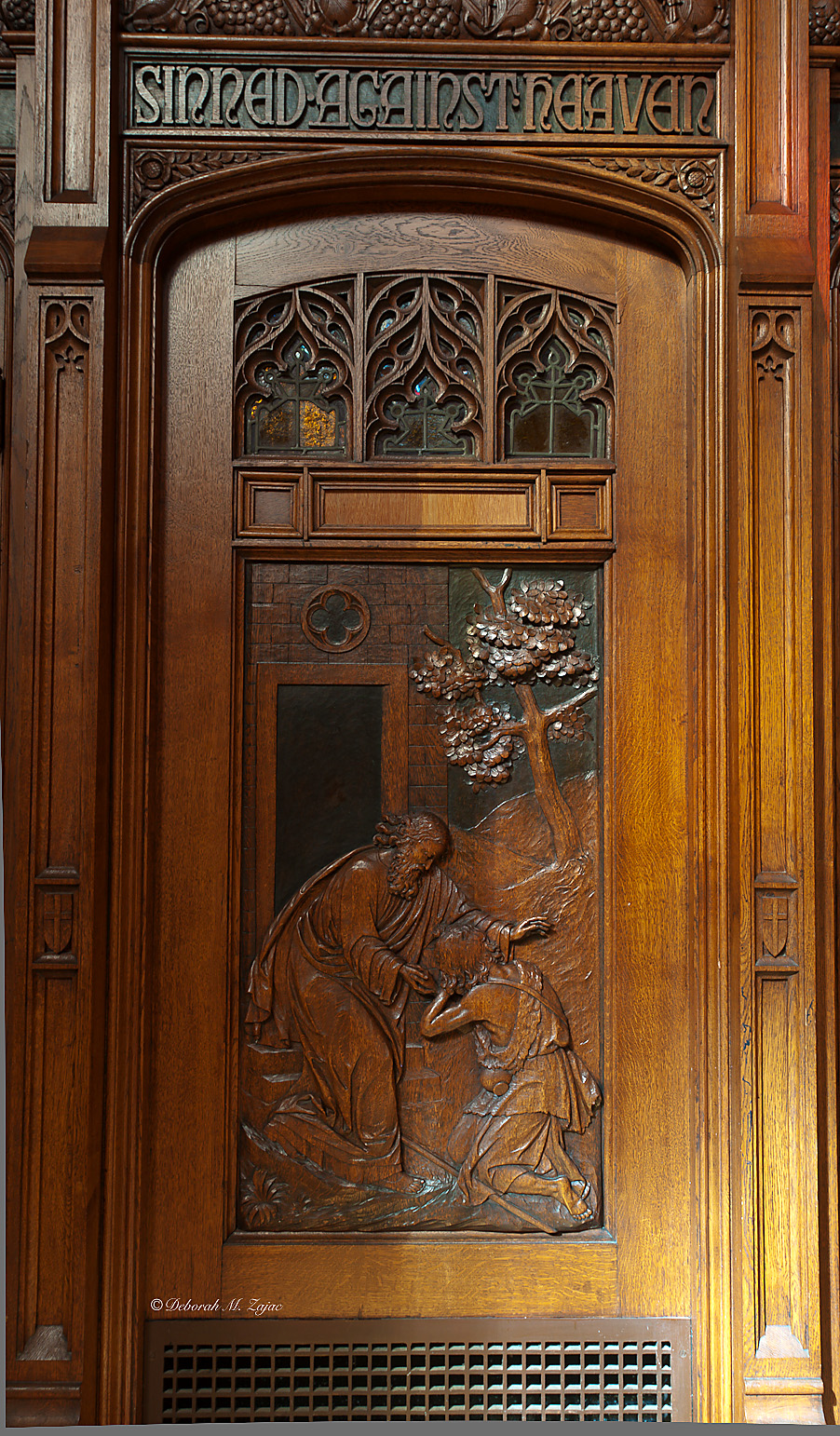
The Confessionals line both outer walls of the chapel. Their doors are intricately carved in oak and depict scenes of  Christ’s mercy and humankind’s war for reconciliation  from the parables of the New Testament.
Lady Chapel:

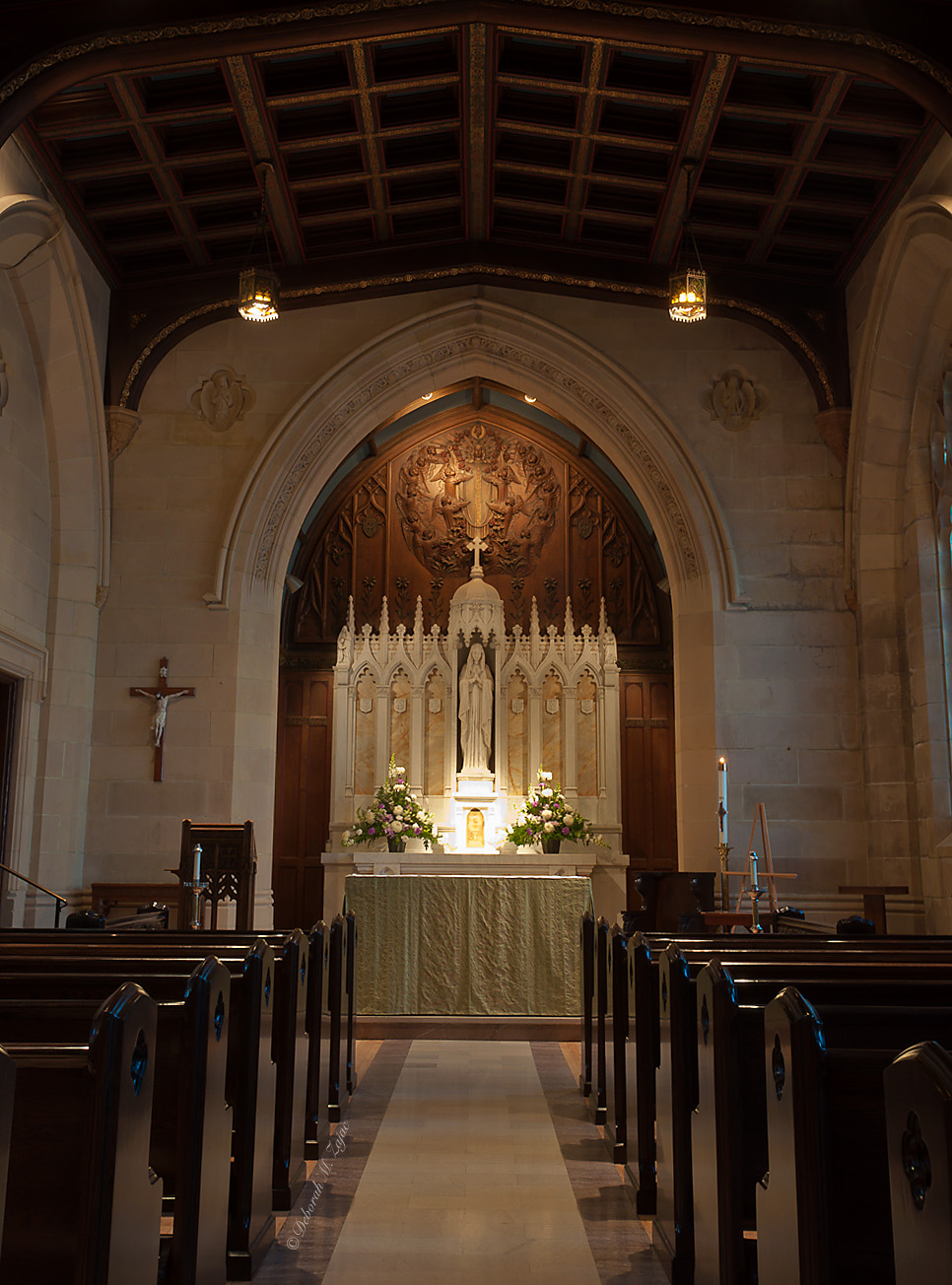
The Lady Chapel in St. Dominic’s Catholic Cathedral . I felt very comfortable in here. The warm woods with the soft white stone walls, and the white altar are just lovely. This would be a wonderful little chapel for a wedding.
The carving over the altar is Mary, but I’ve not found any information about it. The carvings in the stone on either side of the altar are left- St. Anne, and right- St. Joachim.

Addendum: Maria from the Development and restoration department of the church returned my call the other day. She told me after they did the power-wash in this chapel they discovered this never seen before gilding on the ceiling beams and around the alter.  It was a thrilling and beautiful surprise to them all.  Thank you so much Maria for your time and for answering my questions. I appreciate it immensely!

The balcony and stained glass windows:

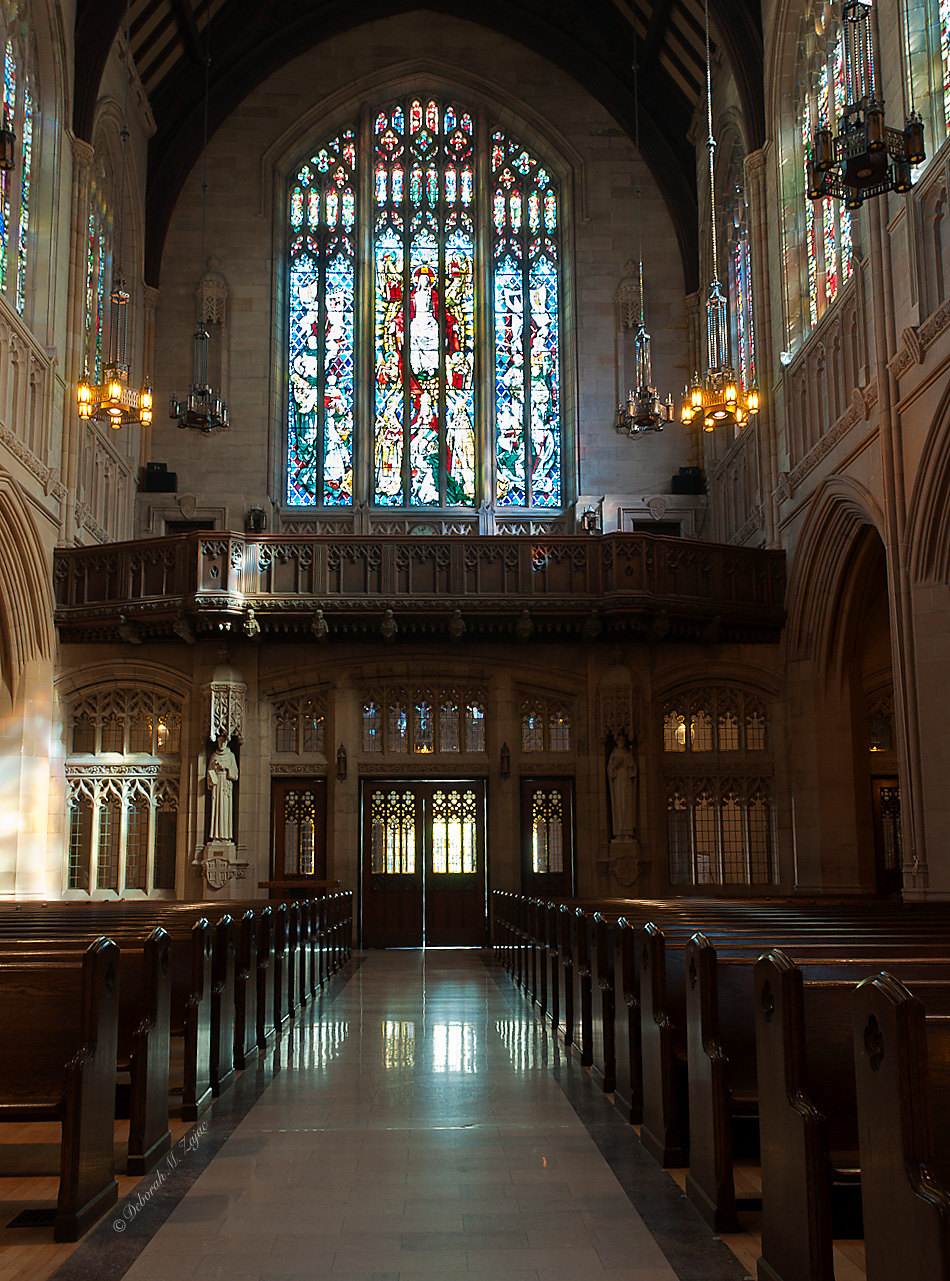
Over the balcony the stained glass window depicts Christ triumphant over death.

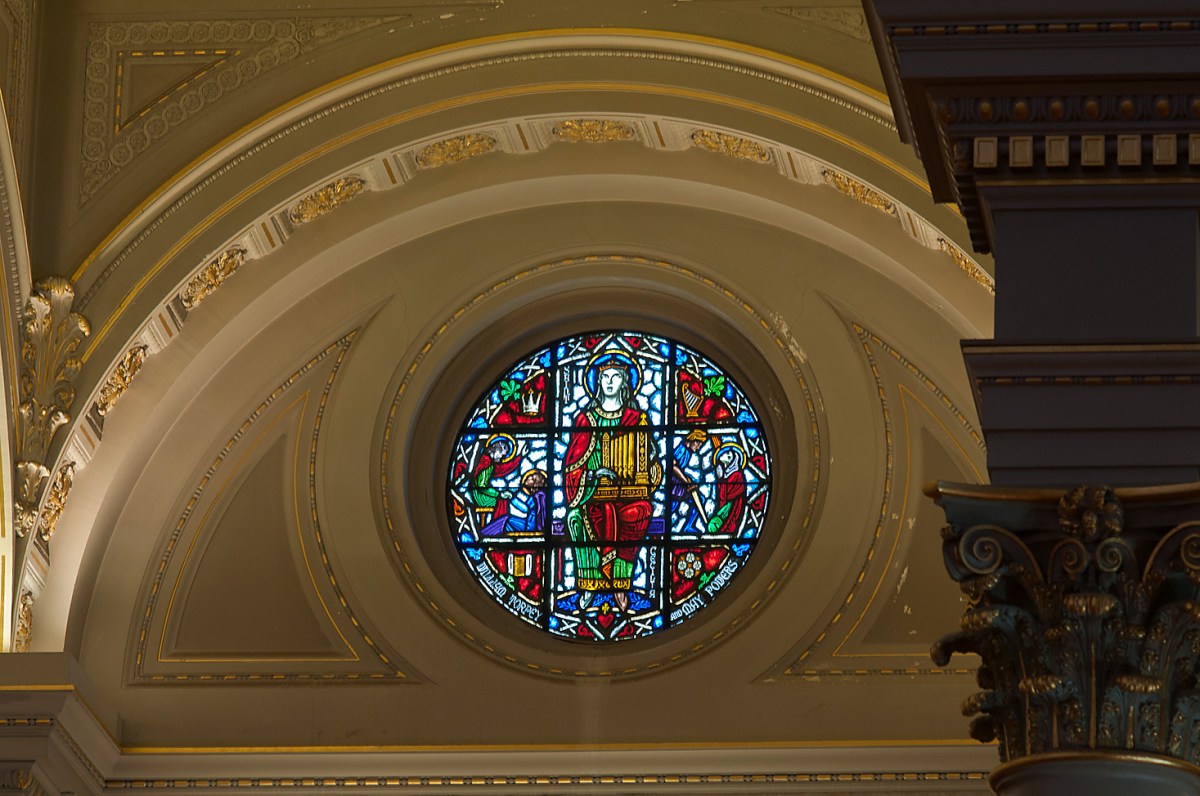
“The stained glass windows in the apse, the Lady Chapel, the sides of the transepts and most of the small windows in St. Dominic’s are by Charles J. Connick of Boston, whose signature appears on several. The last of these windows was installed in 1936 by the Cummings Studios of San Francisco, who also made at least one of the windows. Max Ingrand of Paris created the windows that line the nave as well as the large west window and those on the north and south sides of the transepts and the suite of small windows in the sacristy. These were installed between 1964 and 1973.”~ St. Dominic’s Catholic Church
There is a lot construction going on in both the interior and exterior of the church. The stained glass is getting new lead, the floors are being refinished, and they are installing a new heating system, and there is much going on with scaffolding around the buttresses on the exterior. The next time I come I hope to photograph more of the interior that I missed today, and much of the exterior as well. I wonder what it would take to get up on the balcony to take a photo of the Nave and Main altar? That would be something!

Well time to go… there’s time to visit another Cathedral!

Thank you Dottie of St. Dominic’s who was so gracious, and generously answered so many of my questions regarding the altars, and repairs that are going on.

All photos taken with a Nikon D90 & Nikkor 17-35mm f2.8lens

© Copyright Deborah M. Zajac.  All Rights Reserved
A Visit to St. Ignatius Cathedral- San Francisco,CA

Last month when several friends and I went up to the city for a day of photography we finished our day shooting St. Ignatius Cathedral. It’s such a beautiful building all lit up at night that I suspected it would be just as lovely inside. I had mentioned that night wanting to come back to shoot the interior. My friend Alex also wanting to shoot the interior of this building, and  also of others sent us a couple of photos he found on the internet of the interior which peaked our interest even more.

Yesterday, Dali emailed me wondering if I was free to go out shooting. Fortunately I was.  I thought we might go to the zoo, or the Japanese Tea Garden, but he had other ideas. When he said, “how about the churches.” I was in!

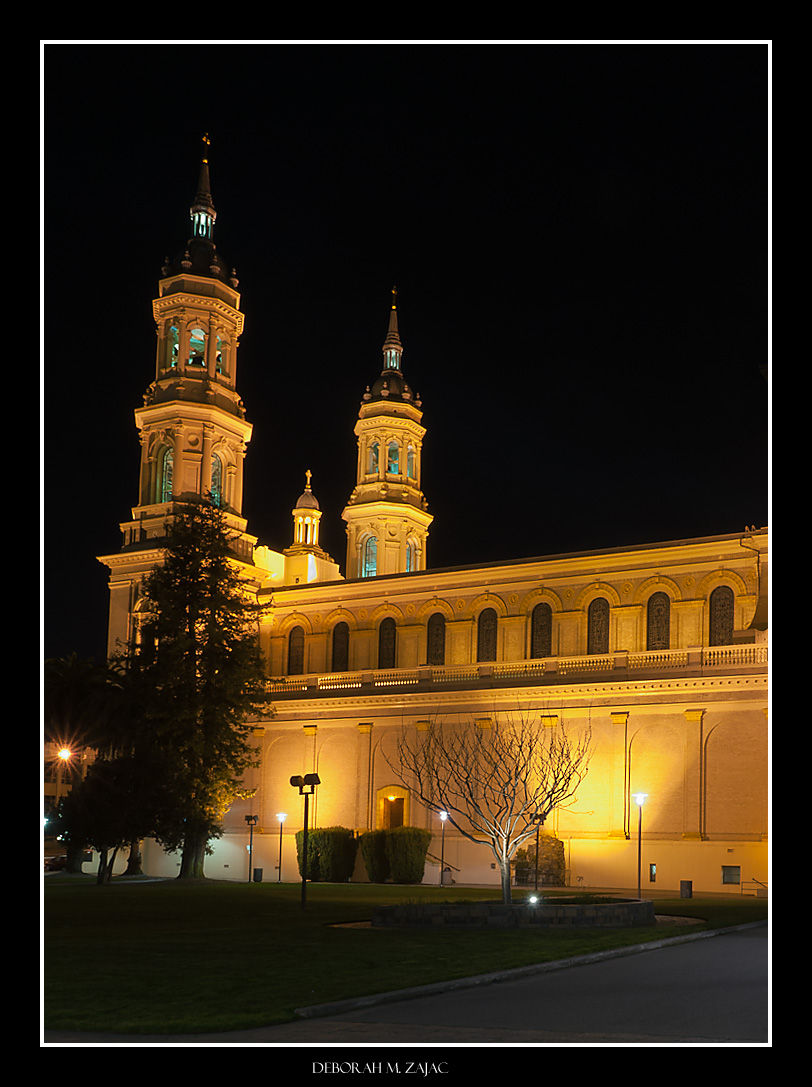
Here’s a night shot from my visit in January:

This is the 5th such church to be built in San Francisco. This present day church was built in 1912 and dedicated in 1914. It is located on the campus of University of San Francisco.
The present church’s architecture is a mix of Italian Renaissance and Baroque elements, and its floor-plan follows that of ancient Roman basilicas. Though Saint Ignatius Church survived the 1989 Loma Prieta earthquake unscathed, it was recently renovated and seismically reinforced. One of the city’s largest churches, its location on a hilltop as well as its twin spires and dome makes it a prominent San Francisco landmark.
~Wikipedia

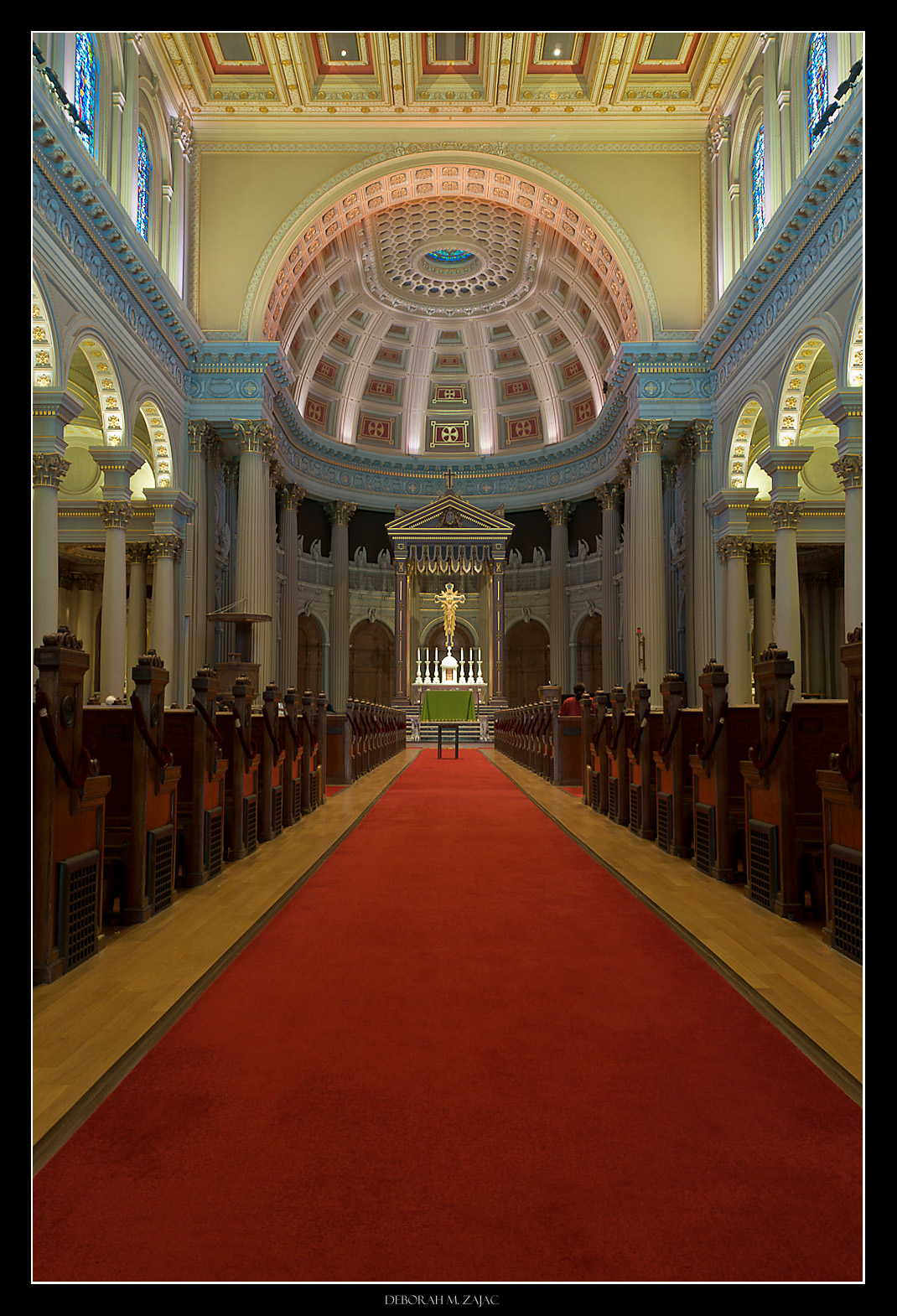
The Nave:

The general layout of the nave is based on the ancient Roman basilica, or law court building. The focus of the nave is the sanctuary, which here takes the form of a semicircular, semi-domed space, or apse, often seen in the Roman basilica. This space is separated from the nave by the chancel arch springing from grouped free-standing columns. The elaborately coffered half-dome ceiling contains a central stained glass panel representing the Holy Spirit descending toward the assembly below, and on either side wall is an elaborately framed plaster relief representing the Madonna and Child. The centerpiece of the sanctuary, the polychrome white oak baldacchino or canopy over the former High Altar, was added in 1949, as was the altar itself, along with the marble floor and communion rail.
~University of San Francisco

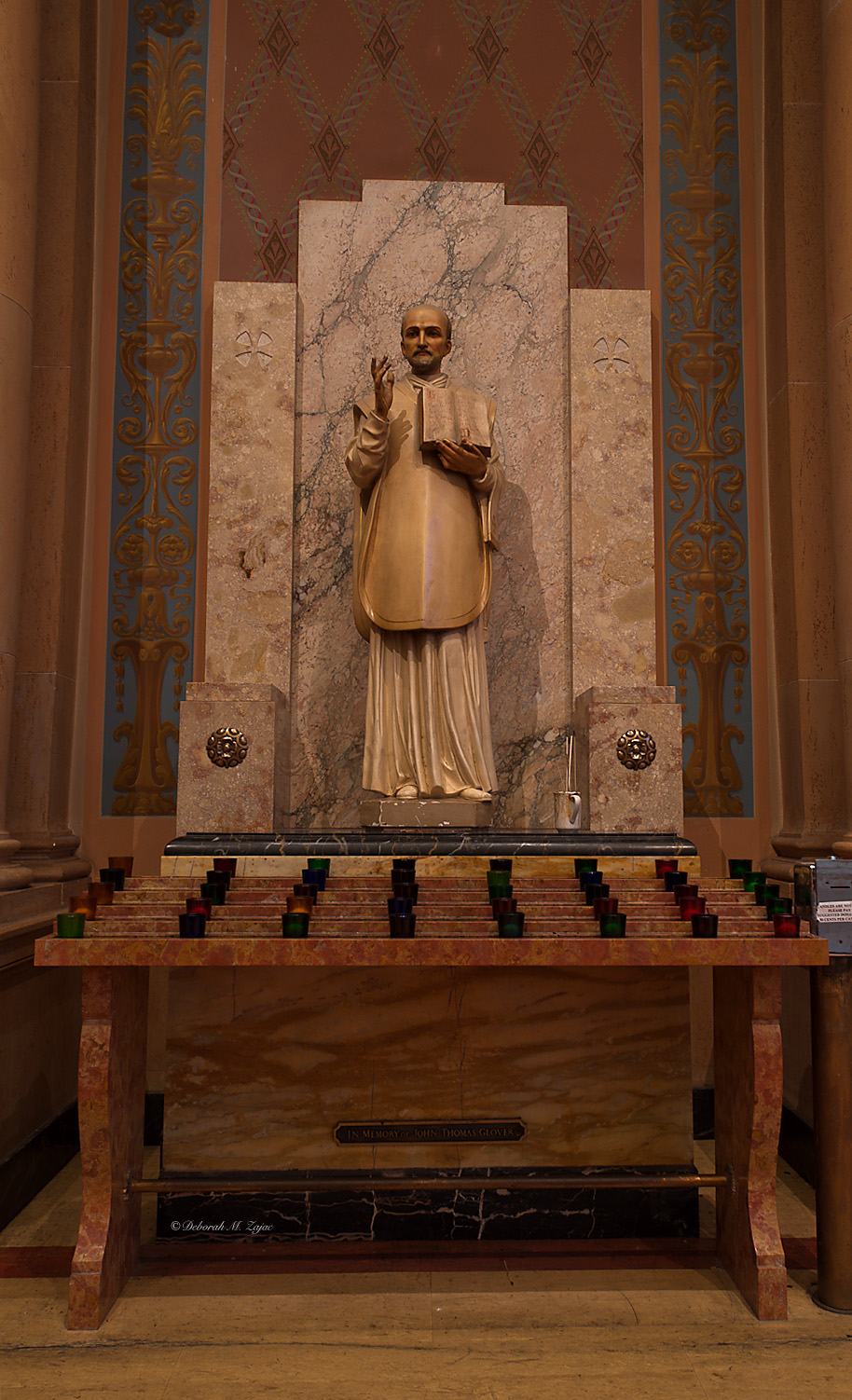
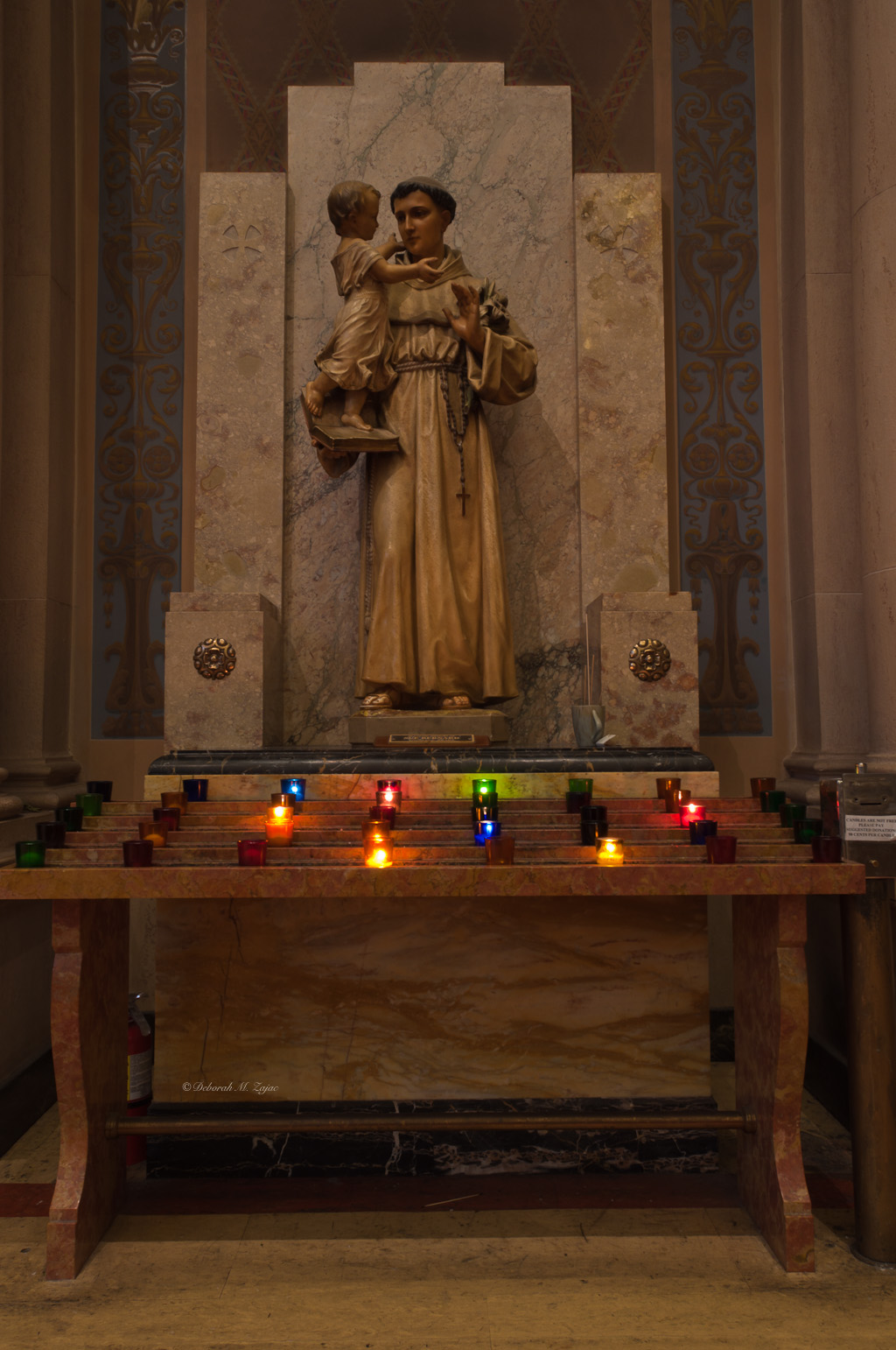
A couple of Altars:

…and

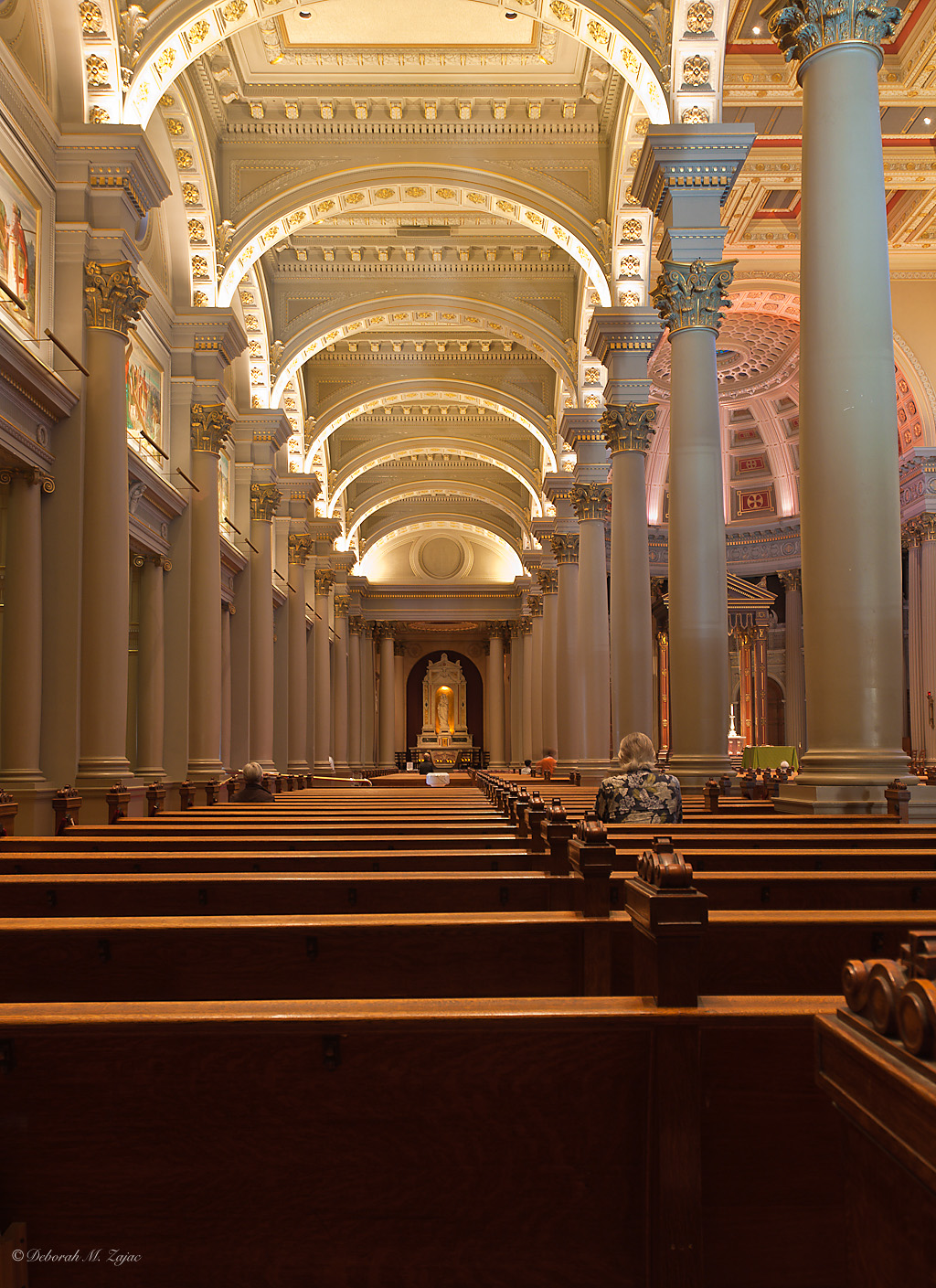
A Side Aisle:

The Interior
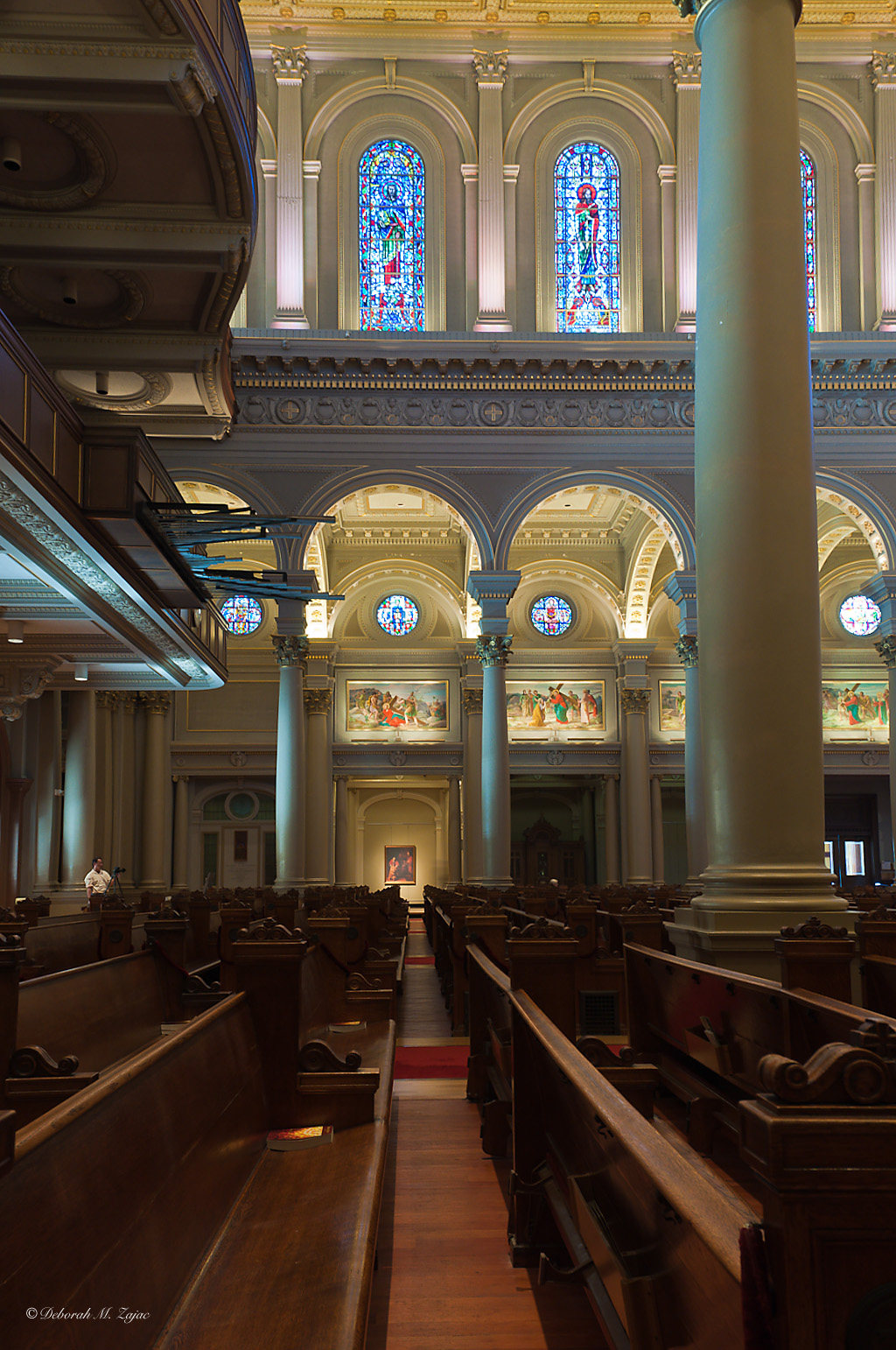
Entering the church from Fulton Street, on each side, freestanding Corinthian columns support nine arches carrying a deep ornamental entablature. Above this, the clerestory wall rises to the ceiling and is divided into a corresponding nine bays by Corinthian pilasters framing arched windows. The deeply coffered ceiling offers a rhythmic counterpoint to the divisions of the bays below. The profusion of columns and arches produces striking and ever-changing perspectives as one moves through the space. Beyond the side aisles are individual chapels, each with a domed ceiling and central skylight.
~University of San Francisco

Art, Iconography, and the Stained Glass Windows:

To either side of the sanctuary, at the ends of the side aisles, are the Mary and Joseph chapels, each with a graceful carved reredos bearing a Carrara marble statue of the saint carved in Italy.
The framed oil paintings above the entrances to the side chapels depict the Stations of the Cross and are the work of Pietro Ridolfi of Rome. Other paintings in the chapels that were completed according to the original decorative scheme (the first three on either side) show scenes from Jesuit history. The side chapels demonstrate techniques of decorative painting used on plaster to resemble stone or wood, a practice often found in the buildings of this period. These chapels also illustrate the importance of the painted and carved human figure in humanizing and bringing a sense of intimacy to even very large buildings. At the same time, they reflect Jesuit spirituality, which places great emphasis on the use of concrete imagery in spiritual reflection.
~University of San Francisco

We spent nearly an hour in the chapel. We would have spent more time, but mass was going to start so we went to lunch then went onto another Cathedral in the city.  I felt very comfortable here. It’s a gorgeous chapel and if you’re in the city worth a visit! I wouldn’t mind going again.

‘I thought the earth remembered me, she took me back so tenderly, arranging her dark skirts, her pockets full of lichens and seeds.”~ Mary Oliver

Copyright © 2011 Deborah M. Zajac. All Rights Reserved.

Click the photo to view it large.

The falls, and creeks were so low the rich mossy rocks and lush creek-sides were farther away from the actual water flow.
This was one of the best running falls of the day. It wasn’t very deep here at all. I was standing in the water with my feet, boots and all in the water. I love these hiking boots! I had my feet completely immersed a couple of times on this day and my feet were dry and warm.

My new Induro CF tripod seems to be holding up to the abuse I’ve been giving it this last month too.
(knock on wood!)

Here’s the whole poem by Mary Oliver. She is one of my all time favorite poets.

Sleeping in the Forest
I thought the earth remembered me,
she took me back so tenderly,
arranging her dark skirts, her pockets
full of lichens and seeds.
I slept as never before, a stone on the river bed, nothing between me and the white fire of the stars but my thoughts, and they floated light as moths
among the branches of the perfect trees.
All night I heard the small kingdoms
breathing around me, the insects,
and the birds who do their work in the darkness.
All night I rose and fell, as if in water,
grappling with a luminous doom. By morning I had vanished at least a dozen times into something better.
~Mary Oliver

Nikon D90| Nikkor 17-35mm @30mm| f8| 2.5 seconds| ISO 200| Manual Mode| Remote Release Cable| B+W 3 Stop ND filter|
Uvas Canyon; Santa Clara County; California; Waterfall; Basin Falls

Swanson Creek Uvas Canyon

Copyright © 2011 Deborah M. Zajac. All Rights Reserved.

To see it large click the photo.

I spent a couple of hours with friends Dali, and Alex in Uvas Canyon shooting waterfalls, and hoping to see a lot of Ladybugs. Unfortunately, there weren’t too many Ladybugs today, and the waterfalls weren’t running as full as we found them last year. I think we were here too early this year.
If time allows I’d like to return in a few weeks.

I liked the way this little fall cascaded over the fallen log then down the rocks, and the tree roots, and boulders covered in moss gave the scene some great color, and texture.

Nikon D90| Nikkor 17-35mm @ 35mm| f8| 3.0 sec| ISO 200| On a tripod| B+W 3 Stop ND Filter| Long Exposure| Silky Water| Orton Effect

“San Francisco itself is art, above all literary art. Every block is a short story, every hill a novel. Every home a poem, every dweller within immortal. That is the whole truth.” ~ William Saroyan

Copyright © 2011 Deborah M. Zajac. All Rights Reserved.

Oh, it’s rather compressed in this view. Click anywhere in the photo to see it Large. It really does look better larger-
To see it on black click the photo once more after being redirected.

After my friends and I shot the sunset in Pacifica we drove into San Francisco to find this hill. The goal was to climb it and take night shots of the city. Our goal wasn’t quite met. There is a particular building we were hoping to see that can’t be seen from here. Disappointed, neither Tj, or DD shot from here. I alone set up and took the shot- well 3 shots. It was a bit foggy and looking through my lens I thought this was going to be horribly out of focus. I’m glad it was only fog and not my eye sight! I’d love to come back up here when the moon is up and the sky is clear. Another shot for the bucket list. My list grows instead of shrinks.

Nikon D300s| Nikkor 17-35mm @@25mm| f16| 50.0 sec| Manual Mode| On a Tripod| Triggered with Remote Release cable

San Francisco, Buena Vista Park; California; Night Photography

Did I see a Hawk!?!

Warbler, originally uploaded by dmzajac2004-.

Copyright © 2011 Deborah M. Zajac. All Rights Reserved.

To see the photo large click anywhere in the photo.

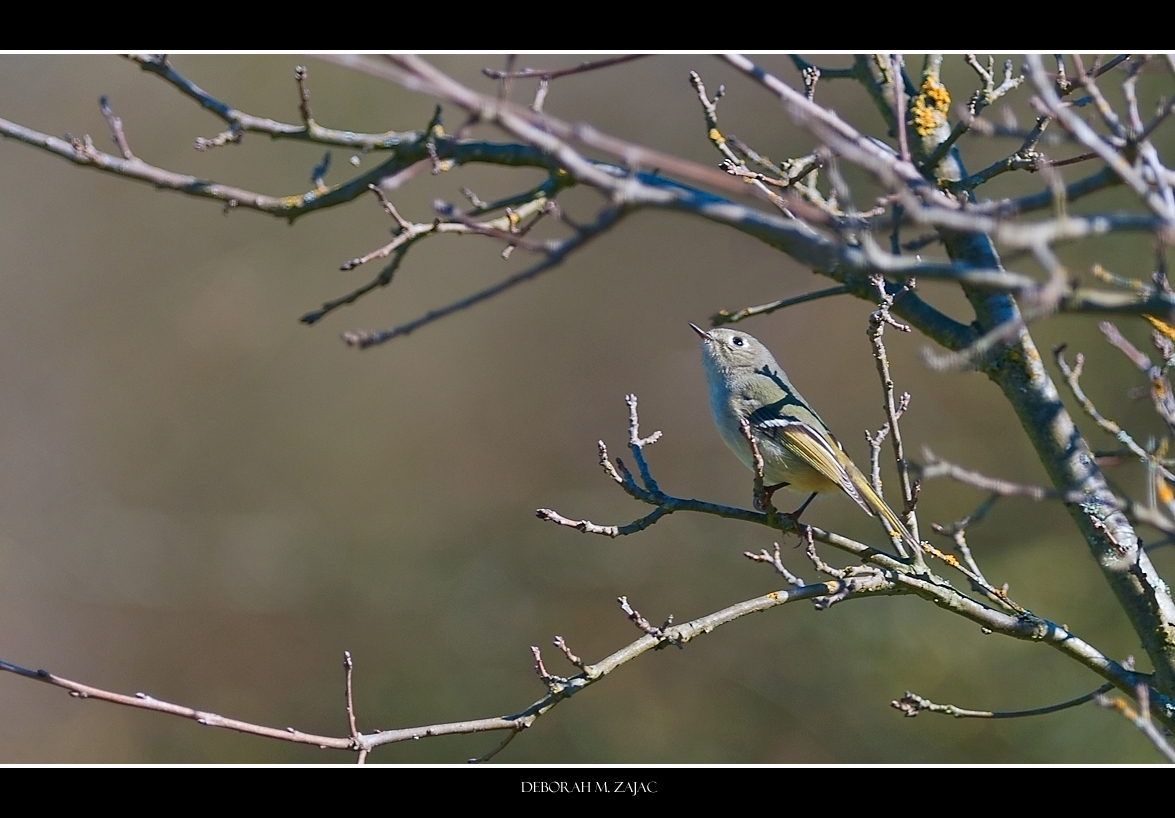
DD and I went out to Cosumnes and Woodbridge Preserves to see if we could spot and photograph Sandhill Cranes yesterday. While walking along the river walk at Cosumnes this little one was flitting about in the trees lining the path. I haven’t added a Warbler to my list of birds photographed so I stopped to try to get this one.

I’m not sure which type of Warbler this is. Is it a Yellow Rumped Warbler or something else altogether?

Nikon D300s| Nikkor 300mm f4@| f4| 1/320 sec| ISO 500| Manual Mode| On a Tripod

Yellow Rumped Warbler, California, Birding; San Disk Ultra II Digital Film; CS5

Sandhill Crane

Sandhill Crane, originally uploaded by dmzajac2004-.

Copyright © 2011 Deborah M. Zajac. All Rights Reserved.

To see the photo larger click anywhere in the photo.

We were headed back to town after spending a lovely afternoon with B who is a local resident of Chico and who very kindly offered to take us out on some back roads to look for Snow Geese and other birds when B who was driving the lead car slowed down then stopped.
Alex wondered what they saw and off to the left behind some tall bushes I saw two big blue birds. I asked, “Are those Herons?”
Alex said, “”Those aren’t Herons, they’re cranes!” I think we all realized it at the same time because no sooner had he finished that sentence I had my camera out, the car door open and so did everyone in B’s car with Alex quickly following me out of the car.

There were two Sandhill Cranes standing here, but I have cropped one out since it had its back to me with his face turned away.
What a thrill! Finally one that was sort of close to the road! You recall me telling you how I missed them last year and really hoped to see them this year so you know I was excited. I didn’t think my photo would turn out. I took three before they got skittish and flew off. Two were awful this is the best one of the 3 shots I took.
They flew to a back corner and there in the corner were several more!

In just a few weeks these wonderful birds will start leaving for more Northern climates. I would like to get out to the marshlands once more before they do.

Nikon D300s| Nikkor 300mm f4@ f5| 1/160 sec| ISO 500| Manual Mode| Hand-held

Nelson Road; Butte County; Oroville, California; Sandisk Ultra II Digital Film; CS5