On Radio Road

Copyright © 2011 Deborah M. Zajac. All Rights Reserved.

These birds make me smile! They have such a friendly face, but their walk is awkward…. and….stilted. Probably because they’re trying not to disturb the water as they hunt for food.
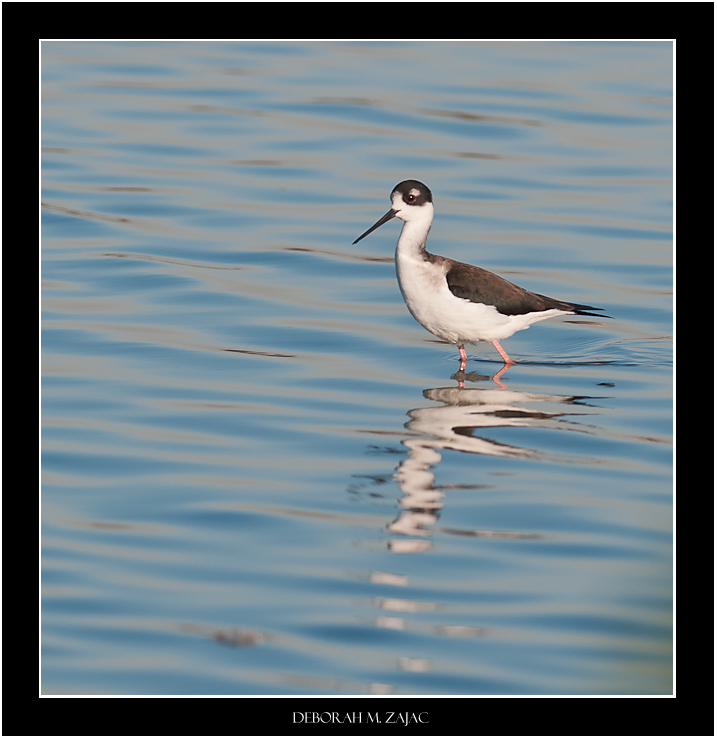
“The Black-necked Stilt forages by probing and gleaning primarily in mudflats and lakeshores, but also in very shallow waters near shores; it seeks out a range of aquatic invertebrates – mainly crustaceans and other arthropods, and mollusks – and small fish, tadpoles and very rarely plant seeds. Its mainstay food varies according to availability; inland birds usually feed mainly on aquatic insects and their larvae, while coastal populations mostly eat other aquatic invertebrates. For feeding areas they prefer coastal estuaries, salt ponds, lakeshores, alkali flats and even flooded fields. For roosting and resting needs, this bird selects alkali flats (even flooded ones), lake shores, and islands surrounded by shallow water.” ~ Wikipedia

For this shoot I met photographer, and friend Marianne Bush out at Radio Road which is part of Redwood Shores Reserves. After we shot around the lagoon for a while we walked over to a channel that feeds the lagoon where Marianne had spied a Bufflehead while we were driving in. An aquatic bird in the Sea Duck family that has been on my list for sometime. The Bufflehead was no longer there, but we did see this little duck below. Both Marianne and I were very excited because neither one of us had seen this bird before. Marianne being the much more experienced birder had an idea of what breed it might be. When we left we were both anxious to get into our bird books to see if we could identify it.

Marianne was able to ID it faster than I did. She wrote to tell me we had seen a Blue Winged Teal! Very uncommon on the West Coast. You can image how thrilled we both were. A month later looking at this photo I can still feel that thrill of excitement one gets when seeing a new species for the first time.

Nikon D300s| Nikkor 300mm f4 @ f5.6| 1/800 sec| ISO 200| Manual Mode| On a Tripod
Empty Nest

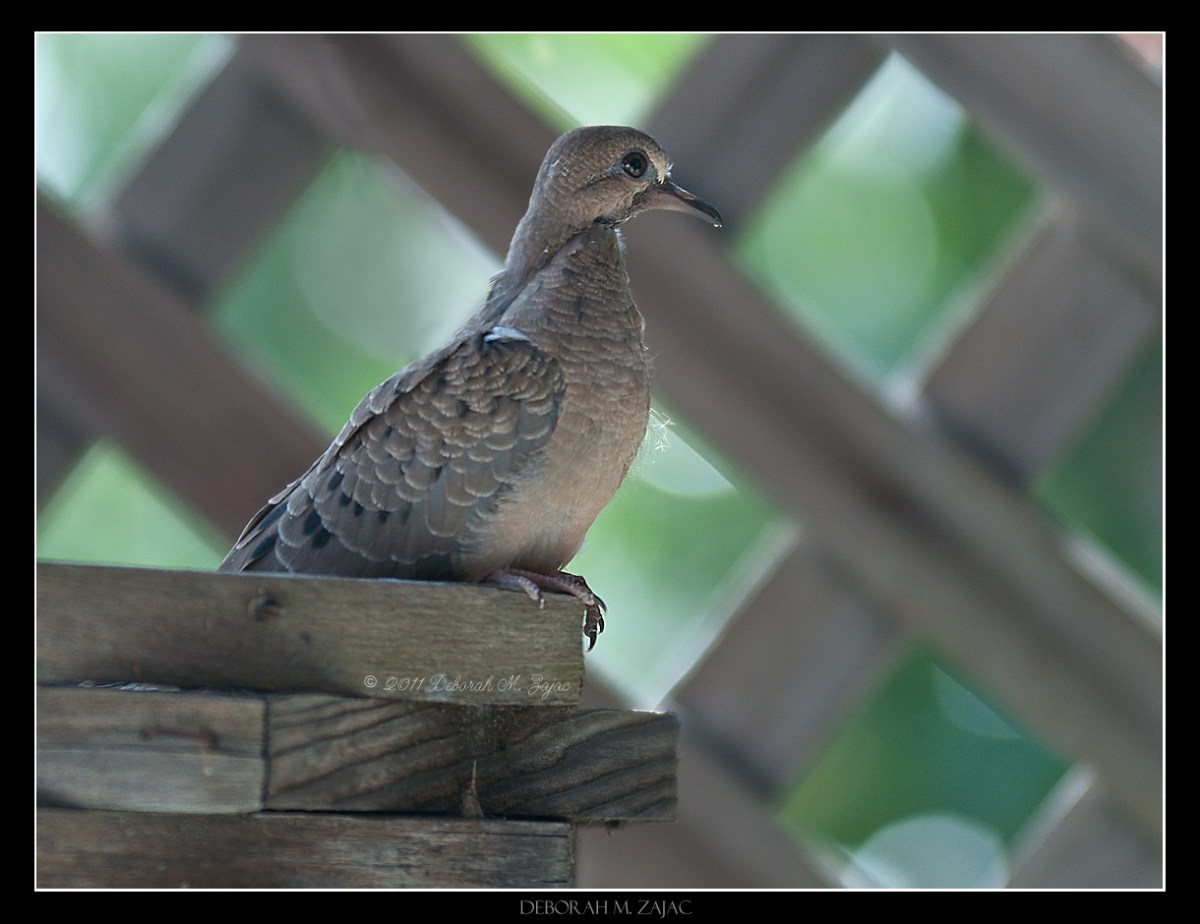
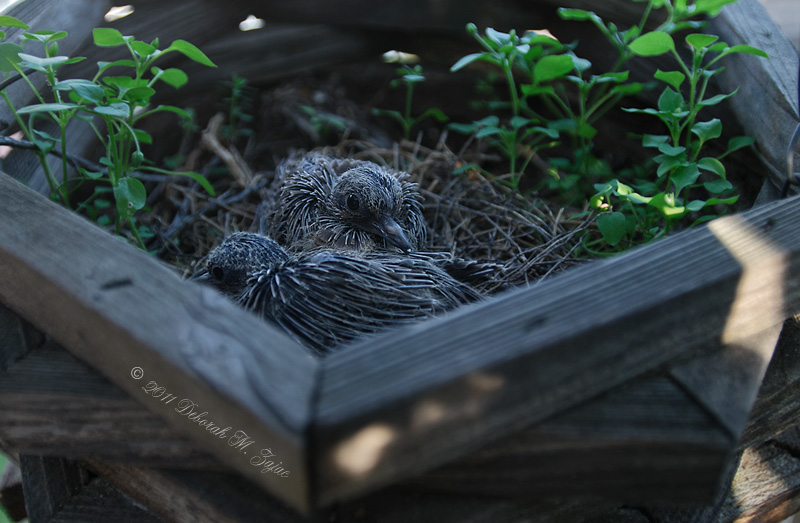
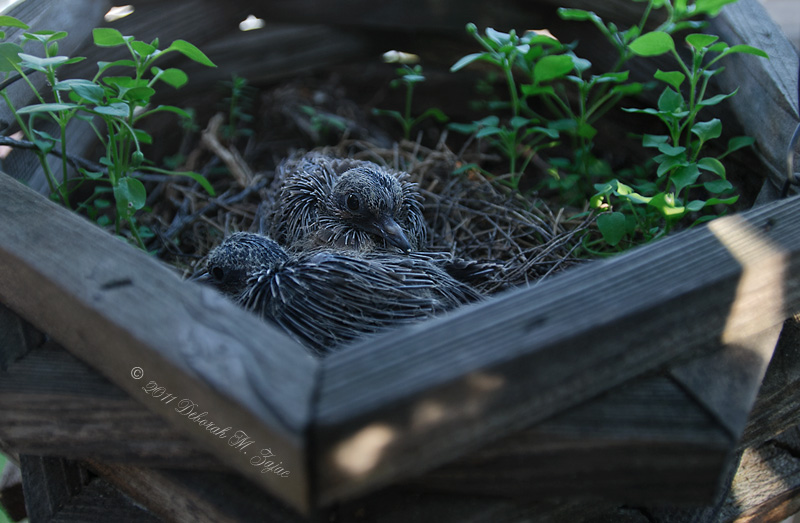
The chicks turned into Fledglings over night! I misjudged their age by a week it seems. That “crop milk” is indeed very rich and nutritious for they grew from their tiny new-born, blind, and naked size to this in a week!

I’m sure they could see me by this time (Mar. 11, 2011), or their hearing and sense of smell was awfully good.

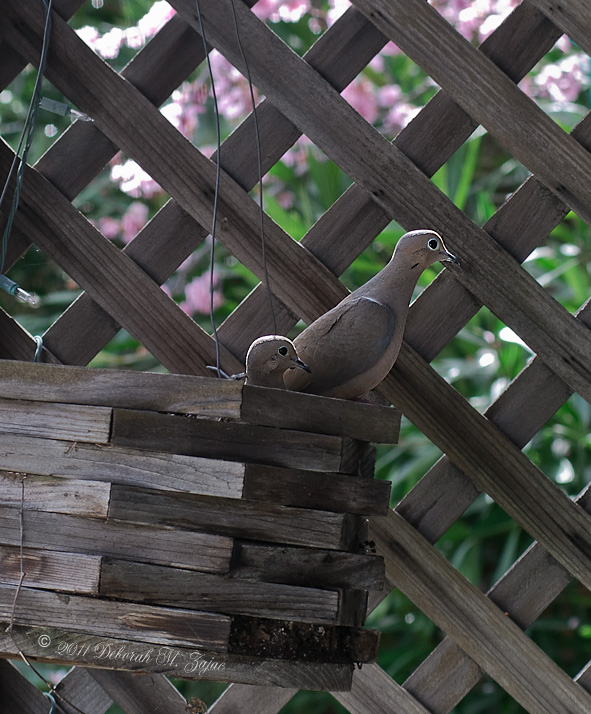
March 17, 2011 – Passing the window in the living on my way to the kitchen I saw one of the chicks was standing on the edge of the hanging basket. Yes! Standing there and his/her size was enormous. Nearly as big as its mother. I reversed course to grab my camera to record the moment. A milestone in a Mourning Dove’s life.

Not a chick anymore, but a fledgling now soon to be an adult on his own.  I wondered if the other chick had already flown away. I went outside to get a little closer to see if I could spy another head in the basket.

The other fledgling was there keeping a low profile. In the distance I heard the soft cooing of the Mother. I wondered if she was calling them to join her in a tree in another yard.

My instincts told me today was the day they would leave the nest. I wanted to stay nearby with camera in hand. I might get lucky and get a shot of one taking flight, but I couldn’t stay. I had a commitment that took me away from hearth, home, and Mourning Dove leaving day. I watched as long as I could about 30 minutes. The whole time this little one stayed right there on the edge of the basket…feeling the pull to fly, and mustering up the courage to take flight.  I hated to leave. I knew they’d be gone by the time I returned later in the morning.

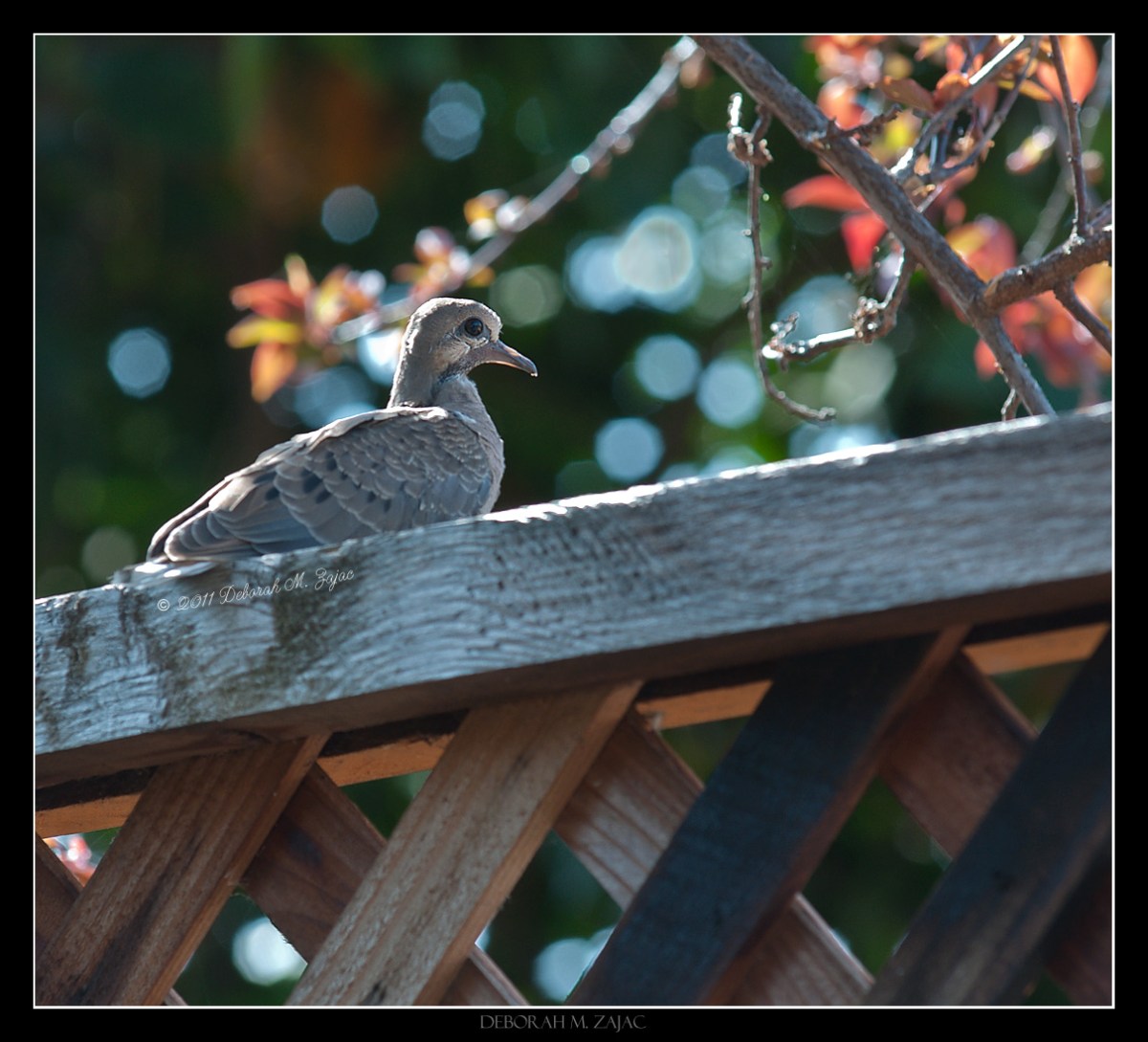
When I returned home I went straight to the nest, and as I feared the nest was empty! I immediately started to look around the yard to see if they had stayed close by. I spied one fledgling on the fence on the side of the yard I’d heard cooing earlier in the morning. Then I heard the cooing again. The Mother was in a tree calling him. I got the camera ready, and took a few shots of him on the fence.

All of a sudden there was rustling of leaves, a flutter of wings, I blinked! A squirrel jumped out of the tree landing next to the Fledgling who took flight, I snapped the shutter…

I didn’t get the shot of him in flight. He was gone.

The 7 days the two Doves were in my hanging basket were a gift. It was wonderful to watch them grow, to learn a little more about them, and feel so close to nature.

I looked at the basket now holding a few weeds, and twigs that was once was their nest and felt a little sadness. I pray they will be safe, and grow to have little chicks of their own, and perhaps, next Spring one of them might find my hanging basket.

Update- Dove Chicks!

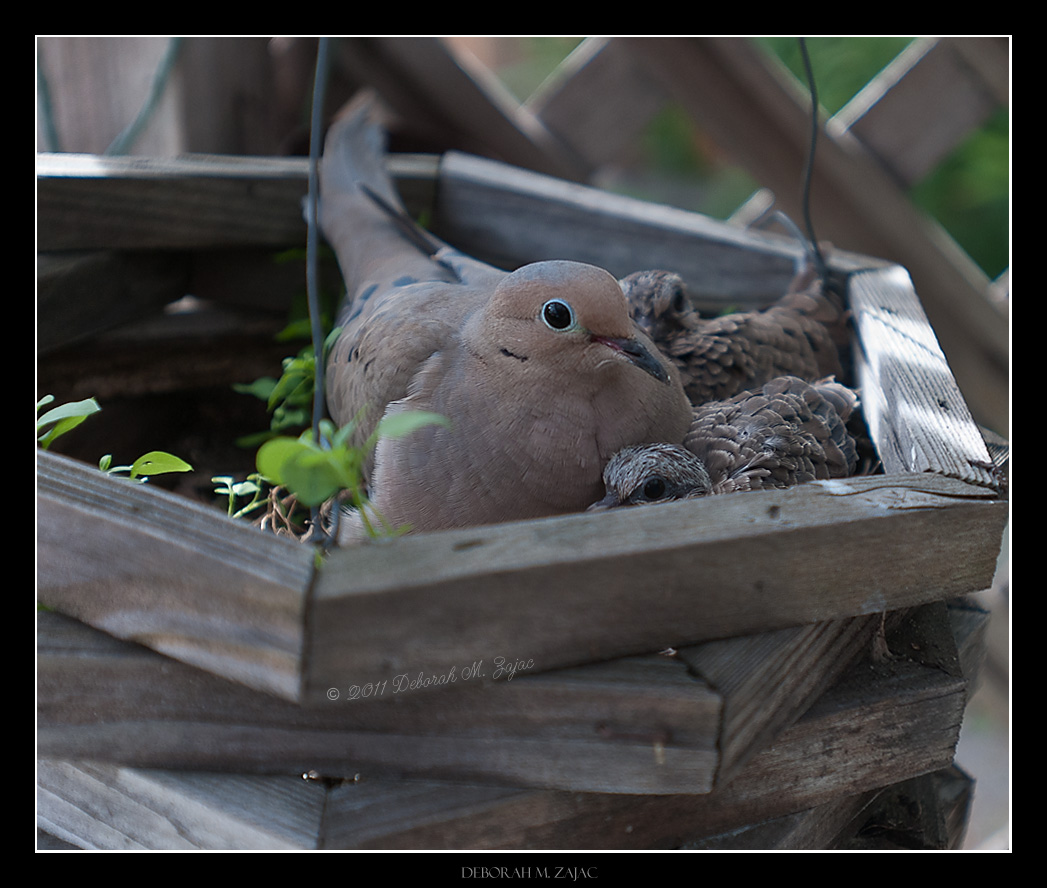
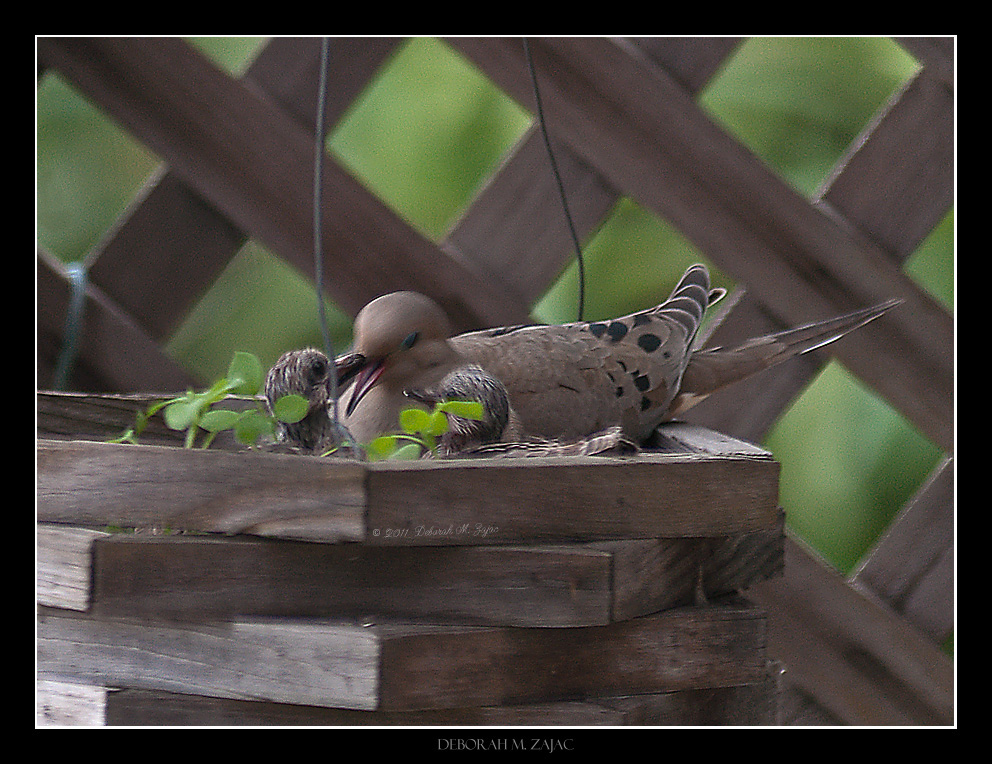
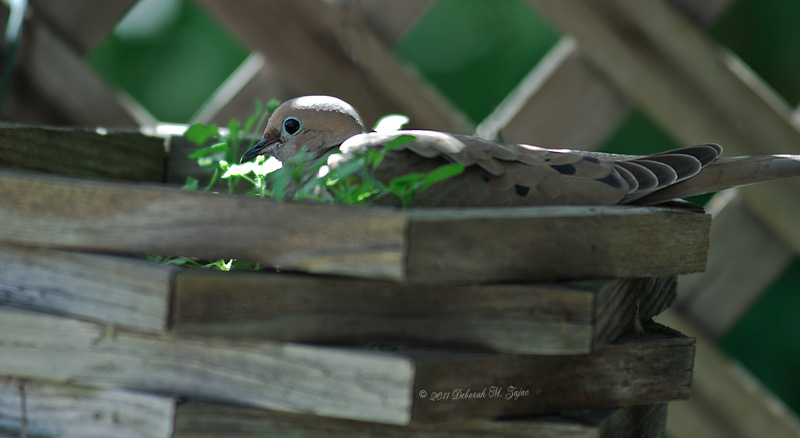
The chicks are thriving! Since my initial post about them  https://circadianreflections.wordpress.com/2011/03/11/the-mournful-oowoo-woo-woo-woo-of-my-squatters they’ve grown a lot. March 14, 2011- Mama in protective mode. She usually sits tall in the nest but, whenever I get too close she signals them to be still and quite and like good chicks they do it.

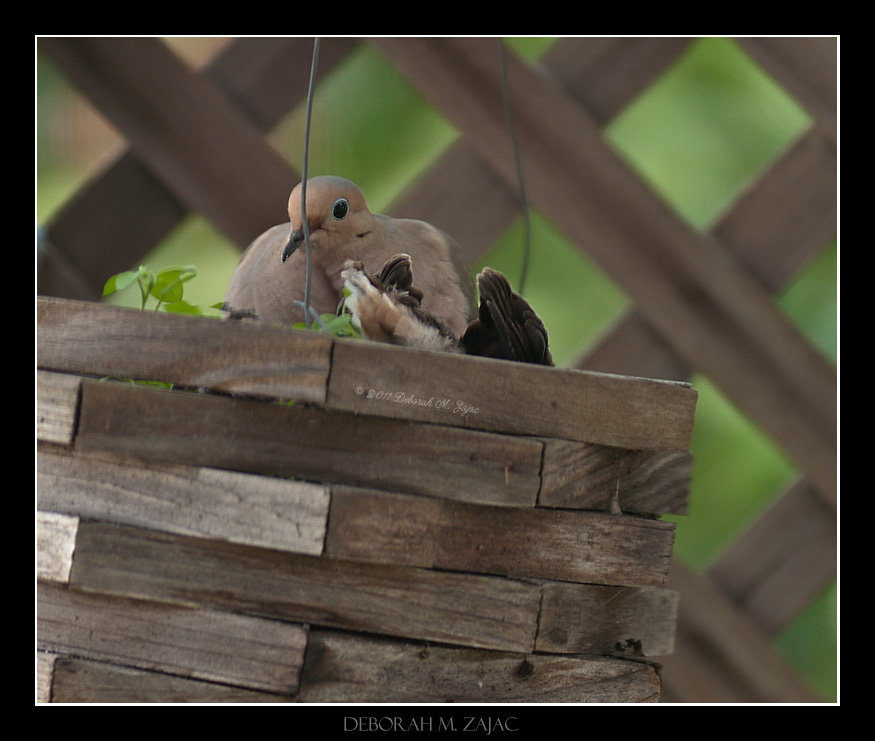
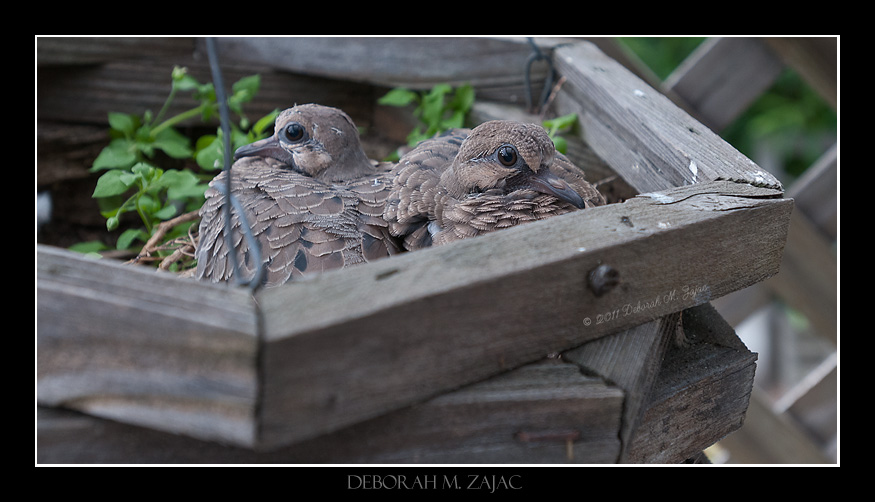
March 13 2011- The chicks are starting to be more active in the nest. Fluffing their wings and walking around a little, but I have to shoot that from a distance so they don’t get into protective mode and hunker down. This is all I can see from my vantage point at the sliding glass door.

Compound this far vantage point with them being under the cover of the patio and it was windy and rainy. The basket was moving quite a bit. Notice the motion blur on the tail. I raised the ISO to get my shutter speed up, not enough I’m afraid. I didn’t want to introduce too much noise. Between the family moving the basket, and the wind moving it has been a challenge  photographing them.

March 13, 2011- Here is the only time so far, I’ve been able to see the female feeding the chicks. It was windy, and had been raining on and off all day. Here the female is getting ready to feed her chicks “crop-milk”.  I’ve got motion blur on the females head. She’s bringing up the milk.

I’ve done a bit of research since these have come into my life about what to expect until they leave the nest. Mourning Doves don’t regurgitate worms to feed their young. They are vegetarian and  have a special pouch that their food goes into where it is turned  into a very rich, nutritious milk.  It contains more protein than cows milk. The chicks stick their head/beaks into the parents mouth and drink the milk. Another interesting fact both the male and female have this extra large crop and produce the milk. The chicks grow very quickly due to this rich milk.

March 16, 2011- Look how much they’ve grown since I first discovered them! They are nearly twice as big, and their feathers are much softer and more filled out. Addendum: They are born blind and naked!

The sitting parent( I think the female)  has been leaving the nest more often, and the male has been coming around. Both the male and female spent more than an hour on the fence away from the nest this morning. The chicks leave the nest at just 14 days old. I found these two 6 days ago, and I don’t know how old they were. They might be here another 6 -7 days.

All photos Copyright © 2011 Deborah M. Zajac. All Rights Reserved

The mournful oowoo-woo-woo-woo of my Squatters

The call of the Mourning Dove is soft, and low.  I hear it on and off all day long.  Years ago this pair flew into my backyard and tried setting up house in a hanging flower basket I have on the patio. I shooed them away the first couple of years and they set up a nest in the eaves. They are stubborn tenacious little things, and after years of trying to shoo them out of my basket I caved in a let them stay a few years ago. I never look for their return but return they do and always to this basket.

They arrived this year just before the arrival of my new camera accessory the Wimberley Sidekick(2/14/2011). When it came in I decided to get some practice with it taking the pictures of the two Squatters Doves living on my patio.

Yesterday(3/11/2011) I noticed there was only one Dove in the nest and she wasn’t making sorties. I said to myself, ” When she leaves I’ll have to look to see if there are any eggs in there.”

Late this afternoon I noticed she was gone so I grabbed a ladder and my camera to have a look.  I was thrilled to find not eggs but 2 chicks in the nest!

I have no idea how long ago they hatched.  I’ve not heard a peep! They look fairly new and I’m sure they can’t fly. The female has been gone for a few hours now. It’s getting dark and chilly. I hope she returns soon!

I’m in Mother mode now checking out the window to see if she’s returned and I’ll be watching their growth and progress now until they fly out of the nest.

“Every spring is the only spring – a perpetual astonishment. Ellis Peters”

All Photos Copyright © 2011 Deborah M. Zajac. All Rights Reserved.


Three things that make me smile- The Orange Ripe and Plump, the little Wren who sings while hunting for breakfast, and new green leaves of Nasturtiums which tell me Spring is near.

Copyright © 2011 Deborah M. Zajac. All Rights Reserved.

Nikon D300s| Nikkor 80-200mm f2.8 @ f2.8|

Did I see a Hawk!?!

Warbler, originally uploaded by dmzajac2004-.

Copyright © 2011 Deborah M. Zajac. All Rights Reserved.

To see the photo large click anywhere in the photo.

DD and I went out to Cosumnes and Woodbridge Preserves to see if we could spot and photograph Sandhill Cranes yesterday. While walking along the river walk at Cosumnes this little one was flitting about in the trees lining the path. I haven’t added a Warbler to my list of birds photographed so I stopped to try to get this one.

I’m not sure which type of Warbler this is. Is it a Yellow Rumped Warbler or something else altogether?

Nikon D300s| Nikkor 300mm f4@| f4| 1/320 sec| ISO 500| Manual Mode| On a Tripod
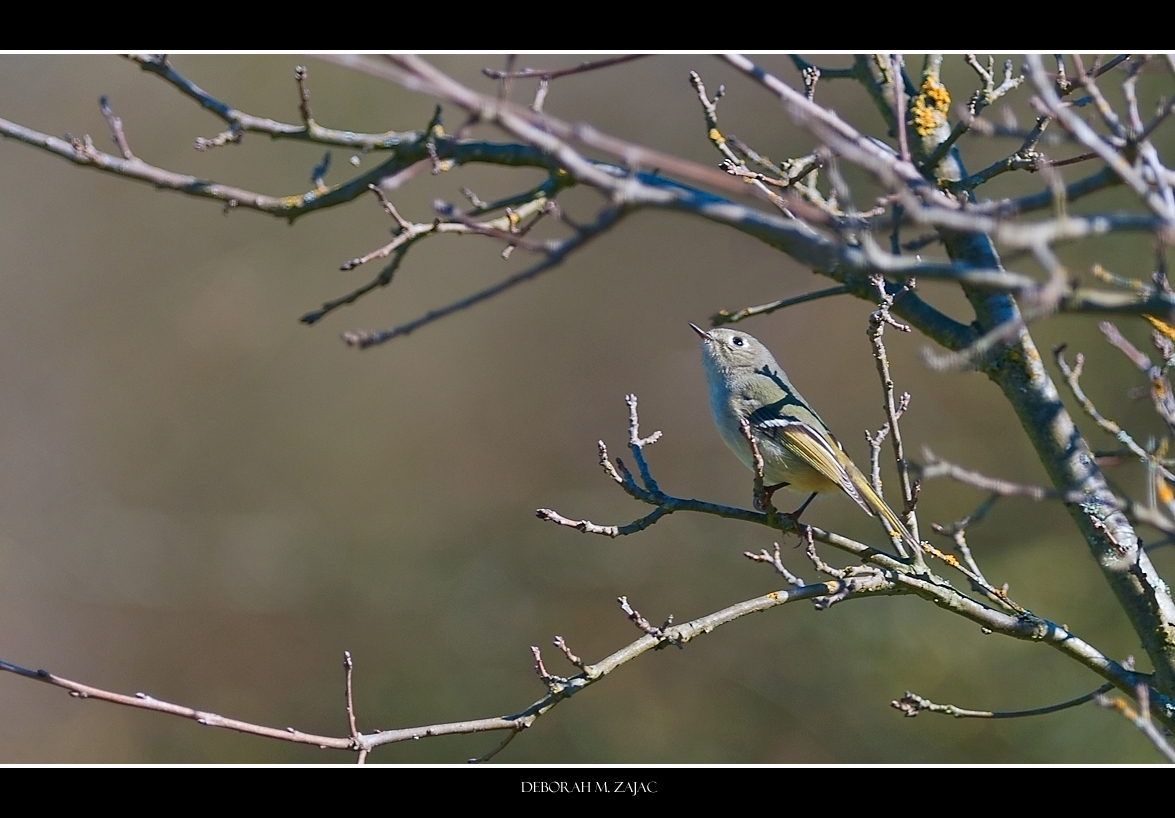
Yellow Rumped Warbler, California, Birding; San Disk Ultra II Digital Film; CS5

Sandhill Crane

Sandhill Crane, originally uploaded by dmzajac2004-.

Copyright © 2011 Deborah M. Zajac. All Rights Reserved.

To see the photo larger click anywhere in the photo.

We were headed back to town after spending a lovely afternoon with B who is a local resident of Chico and who very kindly offered to take us out on some back roads to look for Snow Geese and other birds when B who was driving the lead car slowed down then stopped.
Alex wondered what they saw and off to the left behind some tall bushes I saw two big blue birds. I asked, “Are those Herons?”
Alex said, “”Those aren’t Herons, they’re cranes!” I think we all realized it at the same time because no sooner had he finished that sentence I had my camera out, the car door open and so did everyone in B’s car with Alex quickly following me out of the car.

There were two Sandhill Cranes standing here, but I have cropped one out since it had its back to me with his face turned away.
What a thrill! Finally one that was sort of close to the road! You recall me telling you how I missed them last year and really hoped to see them this year so you know I was excited. I didn’t think my photo would turn out. I took three before they got skittish and flew off. Two were awful this is the best one of the 3 shots I took.
They flew to a back corner and there in the corner were several more!

In just a few weeks these wonderful birds will start leaving for more Northern climates. I would like to get out to the marshlands once more before they do.

Nikon D300s| Nikkor 300mm f4@ f5| 1/160 sec| ISO 500| Manual Mode| Hand-held

Nelson Road; Butte County; Oroville, California; Sandisk Ultra II Digital Film; CS5