Copyright ©2024 Deborah M. Zajac. ALL RIGHTS RESERVED.
PLEASE DO NOT USE MY IMAGES WITHOUT EXPRESSED WRITTEN PERMISSION.
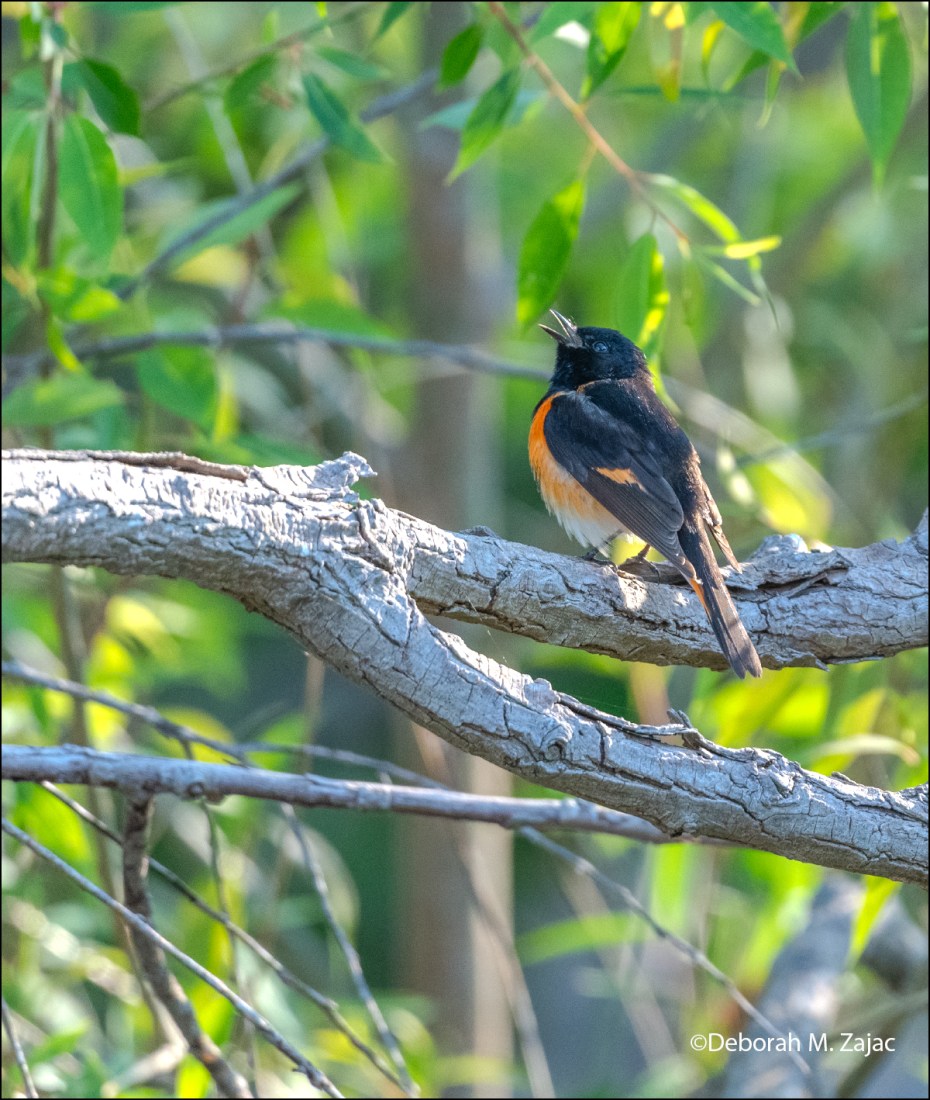
Going back to my Spring trip to Ohio for these images. The American Redstart male.
He’s a Warbler. I’m on the edge of it’s range. If only one or two would stray a bit further west I wouldn’t have needed to go to Ohio to this one. 😂

Here’s an audio clip of its song.
https://www.bird-sounds.net/american-redstart/
Fun Fact:
- Like the Painted Redstart and other “redstarts” of the Neotropics, the American Redstart flashes the bright patches in its tail and wings. This seems to startle insect prey and give the birds an opportunity to catch them. Though these birds share a common name, they are not closely related to each other. In fact, there are other unrelated birds around the world—such as the fantails of Australia and southeastern Asia, and other redstarts of Europe—that share the same foraging tricks.
- Young male American Redstarts have gray-and-yellow plumage, like females, until their second fall. Yearling males sing vigorously in the attempt to hold territories and attract mates. Some succeed, but most do not breed successfully until the following year when they develop black-and-orange breeding plumage.
- The male American Redstart sometimes has two mates at the same time. While many other polygamous bird species involve two females nesting in the same territory, the redstart holds two separate territories that can be separated by a quarter-mile. The male begins attracting a second female after the first has completed her clutch and is incubating the eggs.
- The oldest American Redstart was at least 10 years and one month old, when he was recaptured and rereleased during a banding operation in Ontario.
Fun facts gleaned from allaboutbirds.org
I may be late replying this morning as I’m starting my week-end birding a new to me area in South Lake Tahoe. I hope you all have a great day and week-end.
more to come…
 Circadianreflections Blog
Beautiful captures, I love this warbler! We have them zipping through our area, heading south now.
LikeLiked by 1 person
How exciting to see them moving through! I was so excited to see this one.
Thank you so much, Donna! It’s good to see you here again. 😊
LikeLiked by 1 person
Deborah, these are awesome images. We have had a male and female around here for a few days, but they remained high in the canopy of tall cottonwood trees. They are also not common in our area at all. The last time one was seen in our county was 2017, I believe.
LikeLiked by 2 people
Thank you so much, Robert! I’m glad you enjoyed seeing the American Redstart.
LikeLike
Excellent captures. I had never heard of this beautiful bird before so I went to the Missouri Department of Conservation to see if it is in Missouri. Turns out it is found statewide and is a favorite of the St. Louis area. It did say why it was a favorite. Even though it is found statewide, it is a migratory bird for us during two months in the spring and two months in the fall. It would appear its favored habitat doe not lend itself to being a suburban bird.
LikeLiked by 1 person
Thank you so much, David! So, you’d have to drive out to the country to try and spot it? I looked up MO Dept of Conservation as well. A Spring trip would be fun.
LikeLiked by 1 person
Beautiful, Deborah. I don’t think I have seen a Red-start for over 15 years now.
LikeLiked by 1 person
How cool that you’ve seen one though! It was a first for me.
LikeLike
They’re so sweet, Deborah.
LikeLiked by 1 person
Thank you so much, Cheryl! 😊
LikeLike
Thank you, Deborah. I love those red patches.
LikeLiked by 2 people
Thank you so much, Jennie! He is a good looking bird.
LikeLiked by 1 person
Thank goodness you take such good pictures so we can enjoy his good looks! 😍
LikeLiked by 1 person
Aww. Thank you so much!🥰
LikeLiked by 2 people
😍
LikeLiked by 1 person
What great captures!
LikeLiked by 2 people
Thank you so much, Brian!
LikeLiked by 1 person
Thanks Deborah for a very informative post. Lovely photos especially of it singing.
LikeLiked by 2 people
Thank you so much, Ashley!
LikeLiked by 1 person
One of the pleasures in life is to wake up to the sound of the morning chorus!!!
LikeLiked by 2 people
It truly is!😊
LikeLiked by 1 person
That little bird is so flipping cute! Thanks also for the Fun Facts about the two-timing Redstart 🙂
LikeLiked by 1 person
lol! I thought he must be exhausted after breeding season.
LikeLiked by 1 person
Well worth your trip to Ohio, Deborah! These are wonderful photos of this beautiful bird 😊
LikeLiked by 2 people
Thank you so much, Belinda!
LikeLiked by 1 person
Excellent photos, Deborah. I really enjoy learning about the birds you photograph. Thanks.
LikeLiked by 2 people
Thank you so much, John! This was a lifer for me so I learned a lot about it too. 😊
LikeLiked by 1 person
😊
LikeLike
Wonderful captures of this charming little bird!
LikeLiked by 2 people
Thank you so much, Denise!
LikeLike
When I saw this in my Reader, I thought, Oh wow, the redstarts have made it to the west. haha. Then I read it and saw this was an Ohio adventure. Really a treat to see this, Deborah, thanks for the great photos and info. And have fun birding in South Lake Tahoe. Yay!
LikeLiked by 2 people
Thank you so much, Jet! This was a treat to see. The female is still on my list though so I need to go back! 😊
LikeLiked by 1 person
Good luck with this weekend’s activity. These are beautiful photos. The second one almost seems like I can hear him.
LikeLiked by 2 people
Thank you so much, Dan! He has a pretty song.
This morning the highlight was a White-headed Woodpecker. I hope my images come out.
I hope you have a great week-end!
LikeLiked by 1 person
Oooh, I can’t wait to see that. I don’t think I ever have before.
LikeLiked by 2 people
I particularly enjoy photos of birds engaged in singing; this one’s lovely. I’ve heard of redstarts, but don’t remember seeing a photo of one. Like the red-winged blackbird, this one’s patches of bright color really stand out.
LikeLiked by 2 people
It looks the American Redstart is in TX for breeding and migration seasons so one day you may see one. His colors are lovely aren’t they.
LikeLiked by 1 person
The redstart is a good start to your morning birding.
LikeLiked by 2 people
Thank you so much, Steve, it is indeed! 😊
LikeLiked by 1 person