Copyright ©2024 Deborah M. Zajac. ALL RIGHTS RESERVED.
PLEASE DO NOT USE MY IMAGES WITHOUT EXPRESSED WRITTEN PERMISSION.
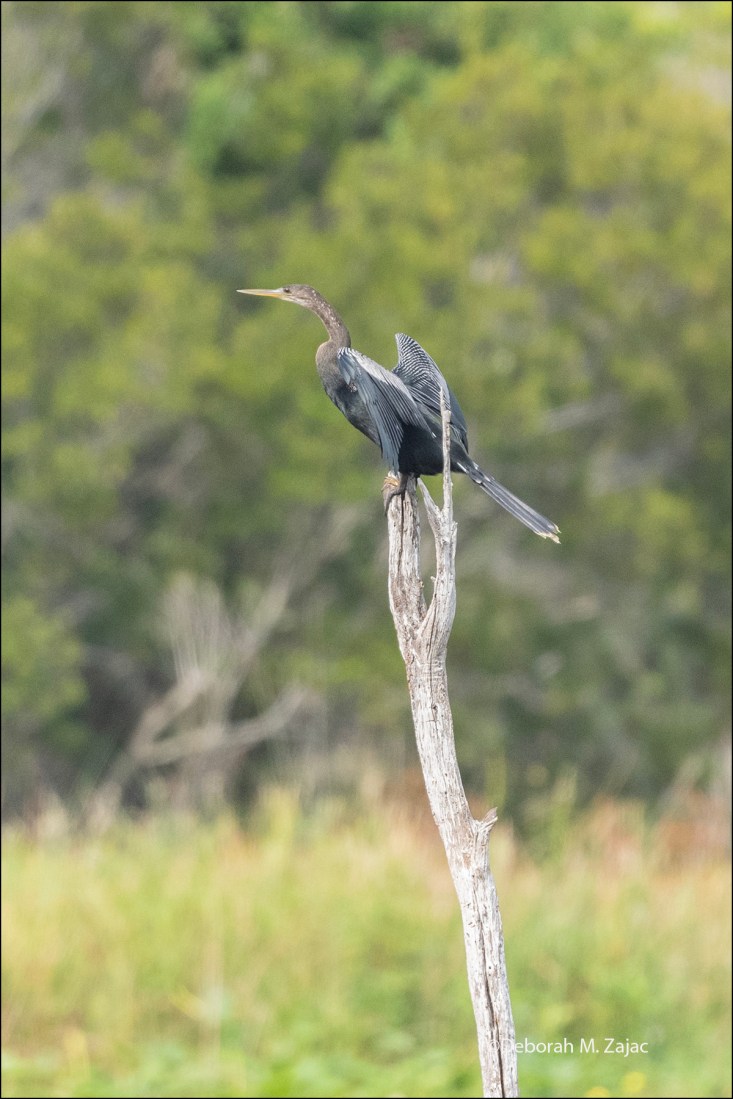
The Anhinga was one of 4 birds I really wanted to see while I was in Florida in September and I saw 3 of them! One male and two Females…I think.
It’s another pre-historic cool looking bird.
I think this is a male because his neck is black. He’s drying his wings.

Here’s the female also drying out her wings. Like Cormorants they don’t have waterproof feathers so they get on a perch or land and spread them open to dry them out.
As I crept closer to her to get a better shot I spooked her and off she flew.
Fun Facts:
- The Anhinga’s distinctive shape earned it the nickname “water turkey” for its turkeylike tail, and “snake bird” for its long snakelike neck as it slithers through the water.
- Unlike most waterbirds, the Anhinga doesn’t have waterproof feathers. While that may seem like a disadvantage for their watery lifestyle, their wet feathers and dense bones help them slowly submerge their bodies under the water so they can slyly stalk fish.
- The name Anhinga comes from the Tupi Indians in Brazil, meaning “devil bird” or “evil spirit of the woods.”
- The oldest recorded Anhinga was at least 12 years old when it was shot in Louisiana in 1948.
Fun facts gleaned from https://www.allaboutbirds.org/guide/Anhinga/overview
We may have a break from the wind and beat the rain this morning so I’m going birding with friends which means I’ll be a bit late checking out your blogs, and reading comments.
more to come…
 Circadianreflections Blog
I think they are cool too! They’re unique in looks and habits.
LikeLiked by 2 people
Thank you so much, Denise! I’m glad you think they’re cool as well.
LikeLiked by 1 person
The Anhinga was my favorite bird to photograph in Florida, Deborah! They can change their look just by turning or preening and spreading their wings or extending their necks. Beautiful.
LikeLiked by 1 person
I saw that while they did just those things! It was so cool to see them.
LikeLiked by 1 person
Like watching a ballet when they turn round in the sun.
LikeLiked by 1 person
Yes, it’s a cool looking bird. Thanks for sharing these photos!
LikeLiked by 2 people
Thank you! 😊
LikeLiked by 2 people
You’re welcome!
LikeLiked by 2 people
Those are cool looking birds, Deborah. I love that last image with the bird in the dead tree.
LikeLiked by 1 person
Wow, I don’t even think I’d heard the name of this bird. What a great sighting, great behavior pictures and fun facts too.
LikeLiked by 2 people
Thank you so much, John!
LikeLike
This is a bird I’ve seen only twice, and both times were at the Brazoria Wildlife Refuge that I visit so often. Once I caught one in flight, but the last time I saw one drying its wings. Now that I’ve seen your photos, I think the wing-dryer might have been a female. I’ll have to look more closely. When post the photos, maybe you can help. me out!
LikeLiked by 2 people
If the wing-drier has a brown neck it’s either a female or immature one. The males have a black neck. That’s really neat they hang out in the reserve you frequent often!
LikeLiked by 2 people
Hi Deborah. I hope you’re having a lovely sunny day and lots of fun birding this morning. I didn’t know the name Anhinga, but this guy does look familiar from my long ago visits to Florida. Interesting facts about them. Hugs.
LikeLiked by 2 people
Thank you so much, Teagan! As it turned out we had heavy wind before the storm came in so I didn’t go. Then it ended up cancelled so it worked out. The came raging in last night with really strong gusts of wind that blew our weighted down outdoor table and chairs across the patio! Thankfully, nothing is lost and only one of the old wine barrel flower pots was blown across the patio and smashed to smithereens, but thankfully that’s all that broke.
LikeLike
Great captures of the Anhinga! I’m glad you were able to see them on your Florida trip. I’ve seen them many times in Florida but didn’t know all of these fun facts about them. Thanks!
LikeLiked by 2 people
I think that’s so exciting that you have seen them many times. You probably have loads of great images of them too. I am glad you like the fun facts! I learn something new about the birds too when I include them in my posts. 😊
LikeLiked by 1 person
I love it when you include the Fun Facts with your gorgeous pictures! Interesting about its feathers… Mother Nature ALWAYS has her reasons, doesn’t she?
LikeLiked by 1 person
Thank you so much, Janis! I’m glad you like the fun facts. I learn something new from them too. Mother Nature is amazing.
LikeLike
Cool birds. Nice out of focus backgrounds.
LikeLiked by 1 person
Thank you so much, Robert!!
LikeLike
They are remarkable birds Deborah and swim so fast underwater. In Australia they are called the Australasian Darter.
LikeLiked by 2 people
That’s really neat that you have them there too!
LikeLiked by 1 person
Lovely shots of this unusual looking bird 😊
LikeLiked by 2 people
Thank you so much, Belinda!
LikeLike
Lovely captures, happy you saw this species while in Florida, congrats on another lifer! 🤗💃😊
LikeLiked by 1 person
Thank you, Donna!! ☺️
LikeLiked by 2 people
Wow! Incredible! How did you manage to get so close to the bird?
LikeLiked by 1 person
I LOVE going birding with you Deborah. Thank you for the link – very interesting. I learn something new every time I stop by. P.S. You have the best winged friends.
LikeLiked by 1 person
🙂Thank you so much, Rebecca!!
LikeLiked by 1 person
Another bird I hadn’t heard of before and I’m glad to get to know. They do resemble comorans, but I understand the name Snake bird. Great pics Deborah!
LikeLiked by 2 people
I’m so glad to have introduce you to this bird, Peter.
LikeLiked by 1 person
What an interesting bird! I’ve never heard of them but like knowing their history. Your photos do them justice.
LikeLiked by 2 people
Thank you so much, Ally! I wouldn’t have known about them if it weren’t for following other birders from around the world. They’re a bird we don’t have here on this side of the country.
LikeLiked by 1 person
So you batted .750 for desired birds on your Florida trip.
No matter how many times I see the name anhinga, it still always calls up the word unhinged.
LikeLiked by 2 people
My average is worse than that. I had 4 birds on my list that I had hoped to see while in Florida but only saw two. I picked up 21 new to me birds so I’m not complaining!
I was pronouncing Anhinga with the “hi” like the word unhinged but, was corrected many times by Mary with the correct pronunciation. It’s Anne-HEEN-gah. LOL!
LikeLike
The American Heritage Dictionary sides with you. Click the little speaker icon just to the right of the bold-faced word to hear how that dictionary pronounces it.
LikeLiked by 1 person
A beautiful bird! ❤️😊
LikeLiked by 2 people
Aren’t they! Thank you, John!
LikeLike