Copyright ©2024 Deborah M. Zajac. ALL RIGHTS RESERVED.
PLEASE DO NOT USE MY IMAGES WITHOUT EXPRESSED WRITTEN PERMISSION.
Last week while birding I saw so many Cedar Waxwings at 2 places I visited. There were about 120 in all! At one of the places they were gorging on ripe, plump red berries.
I was doing my happy dance to see that!
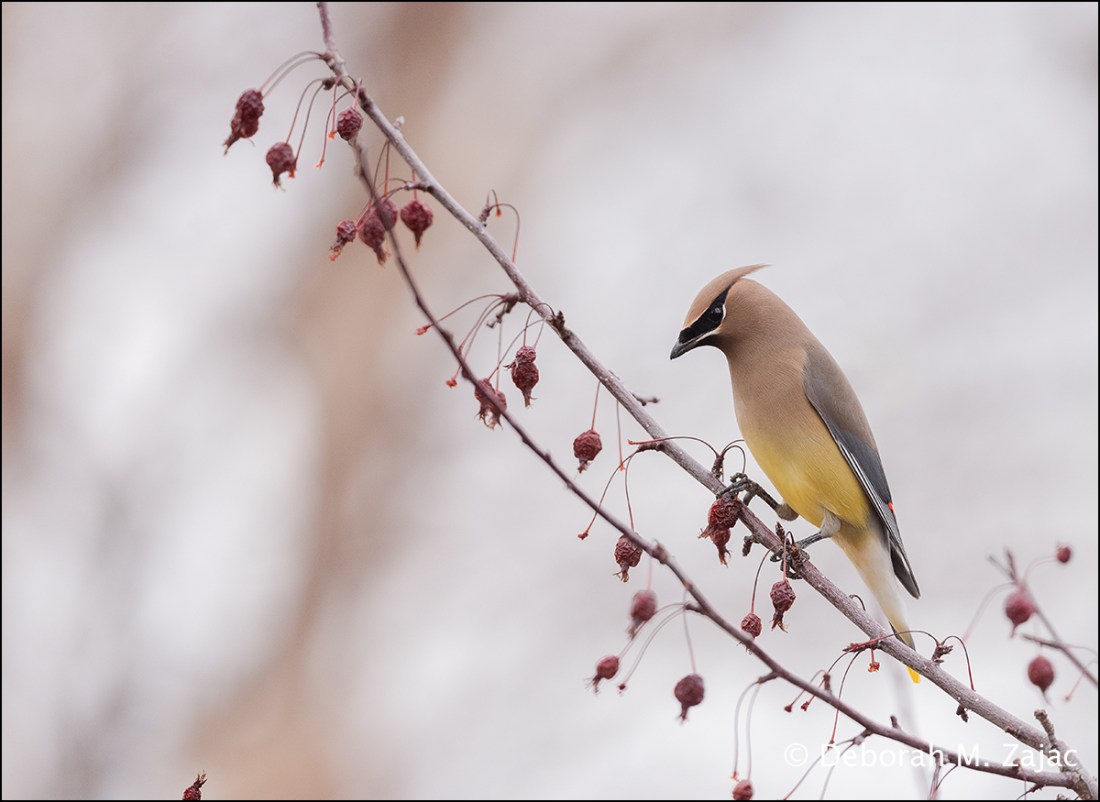

It was a great birdy day.
Fun Facts:
- The name “waxwing” comes from the waxy red secretions found on the tips of the secondaries of some birds. The exact function of these tips is not known, but they may help attract mates.
- Cedar Waxwings with orange instead of yellow tail tips began appearing in the northeastern U.S. and southeastern Canada in the 1960s. The orange color is the result of a red pigment picked up from the berries of an introduced species of honeysuckle. If a waxwing eats enough of the berries while it is growing a tail feather, the tip of the feather will be orange.
- The Cedar Waxwing is one of the few North American birds that specializes in eating fruit. It can survive on fruit alone for several months. Brown-headed Cowbirds that are raised in Cedar Waxwing nests typically don’t survive, in part because the cowbird chicks can’t develop on such a high-fruit diet.
- Many birds that eat a lot of fruit separate out the seeds and regurgitate them, but the Cedar Waxwing lets them pass right through. Scientists have used this trait to estimate how fast waxwings can digest fruits.
- Because they eat so much fruit, Cedar Waxwings occasionally become intoxicated or even die when they run across overripe berries that have started to ferment and produce alcohol.
- Building a nest takes a female Cedar Waxwing 5 to 6 days and may require more than 2,500 individual trips to the nest. They occasionally save time by taking nest materials from other birds’ nests, including nests of Eastern Kingbirds, Yellow-throated Vireos, orioles, robins, and Yellow Warblers.
- The oldest recorded Cedar Waxwing was a male and at least 7 years, 1 month old when he was recaptured and rereleased during banding operations in Maryland in 2014. He was originally banded in the same state in 2008.
Fun facts gleaned from https://www.allaboutbirds.org/guide/Cedar_Waxwing
It’s snowing as I type this but, supposed to be sunny but cold on Saturday. I hope to go out birding for a bit if that forecast holds. I hope you all have a grand week-end!
more to come…
 Circadianreflections Blog
Awesome captures of this unique looking species!
LikeLiked by 1 person
Thank you so much, Denise! Right time and place all lined up for me on that morning. 😀
LikeLike
The Cedar Waxwings are such a beautiful bird. Love your shots of them and enjoyed the facts.
LikeLiked by 1 person
Thank you so much, John! I agree they are a beautiful bird. I’m glad you enjoyed the facts too.
LikeLike
“The Cedar Waxwing is one of the few North American birds that specializes in eating fruit.”
I didn’t know this and I find it fascinating. I thought all birds ate worms or bugs. I like your photo of the little guy as he gulps the berry. Great shot.
LikeLiked by 1 person
Thank you so much, Ally! I learn something new about birds almost daily. They’re so interesting and fascinating.
LikeLiked by 1 person
Beautiful! I love Cedar Waxwings and these are great photographs of them!
LikeLiked by 1 person
Thank you so much, Kendall! They’re good looking aren’t they.
LikeLike
Lovely birds! We only occasionally get Bohemian Waxwings visit in winter.
Fancy dying through intoxication of too much ripe fruit, worse ways to go I guess!
Great captures Deborah.
LikeLiked by 1 person
Thank you so much, Brian!
LikeLike
Nice. What fun to see these beautiful birds. We have occasional flocks of them around here as well. They feed on the fruits in ornamental trees such as crabapples. Around here, every so often, if you look at individual birds in the flock of Cedar Waxwings a Bohemian Waxwing can be found.
LikeLiked by 1 person
Thank you so much, Robert! That would be icing on the cake seeing a Bohemian mixed in them, and a lifer for me!
LikeLike
I enjoyed this, Deborah. I have the Backyard Birdsong book from the Cornell Lab of Ornithology. The children love hearing the different birdsongs and seeing the pictures.
LikeLiked by 1 person
Thank you so much, Jennie! I’m glad the children like the bird’s pictures, and hearing their songs. One or more may become a birder one day. 😀
LikeLiked by 1 person
I think so! Best to you, Deborah.
LikeLiked by 1 person
A beautiful bird and amazing photo, Deborah.
LikeLiked by 1 person
Thank you so much, John!
LikeLiked by 1 person
😊
LikeLike
Beautiful shots of a handsome bird, Deborah. I can imagine the excitement you felt. Intoxicated birds. Who knew?
LikeLiked by 1 person
I know right! 😉Thank you so much, Janet!!
LikeLiked by 1 person
Love your waxwings Deborah they look like they are wax models
LikeLiked by 1 person
Thank you so much, Ashley! They’re really neat looking birds.
LikeLiked by 1 person
Awesome captures and information. I remember the flock in my area doing its annual visit to my backyard and shooting them with my “ProCap” function in my camera so you catch images in a buffer but it doesn’t record to your SD card until you fully depress your shutter release button and captured some unanticipated images; the one I got was the cedar waxwing with a berry dropping into its mouth in flight. I’ll have to look at my Flickr page to see if I have that shot.
Hope they stay around for more observations and shots!
LikeLiked by 1 person
Thank you so much, Gordon! That shot of yours sounds amazing!!! Let me know if it’s on your flickr site with a link please. I want to see that!
LikeLike
Lovely birds and photos, Deborah! I had read that some birds have been known to get pretty tipsy on fermented berries.
LikeLiked by 1 person
Thank you so much, Belinda! I saw Wrentit once drunk on Persimmon juice. It was funny, but I guess not really.
LikeLike
As long as they can sleep it off and no harm done 😏
LikeLiked by 1 person
😀
LikeLiked by 1 person
A gorgeous bird Deborah ! Thanks
LikeLiked by 2 people
I’m glad you liked the images, John. Thank you!
LikeLike
I don’t think I’ve ever seen one of these beautiful birds. I love the way their color seems to fade from one to the other. The second photo, where he’s eating the berry is amazing. Great shot.
LikeLiked by 1 person
Thank you so much, Dan!! I hope you do get to see one. Looking at their range map they’re year round up there so you’re in for a chance! 😀
LikeLiked by 1 person
I’ll have to check to see where they might be found.
LikeLiked by 1 person
Have you got an ebird.org account? I’m not sure you need one to search, but it’s free to sign up. Anyway if you go on the site and look for Explore>HotSpots. That should get you a map of the world then zoom into Hartford, CT and man oh man are there birding places! Just a quick look right now and they have been seen at a park called Spring Park with a note all year round, but that particular sighting was from last summer. Anyway you can get lost looking at the hotspots and looking at checklists to see what birds are being seen in your town.
LikeLiked by 1 person
Thank you so much. I know exactly where Spring Park is, but I’ll look into this.
LikeLiked by 1 person
I know what you mean about doing a happy dance when you watch cedar waxwings devouring fruit en masse. The little red fruits of two species of native holly here, yaupon and possumhaw, are a big draw for cedar waxwings.
LikeLiked by 1 person
It’s really neat that you know what fruits they like and probably where to find such trees/bushes too so you can see them. They’re a cool looking bird to see.
LikeLike
Right outside the window where I’m sitting at my computer now is a yaupon, and in some years I’ve managed to get cedar waxwing pictures through that window. Unfortunately last February’s ice storm damaged the tree, so there’s less fruit.
LikeLiked by 1 person
That’s awesome! When we had to replace a dead tree in our yard we wanted something with color. We put in a type of Maple that get red in Summer. I wasn’t thinking about berries! Doh! If I ever have to plant another tree in my yard it’ll be one with red berries that birds love.
LikeLike
These are one of my favorite birds, but I’ve seen them only three times. One year, they ate their way through all the fruits on the palm trees around my place; it was such fun listening to them ‘talk’ to one another — when they weren’t busy eating, of course! It was interesting to see that group with both yellow and orange tail tips, although it took me a while to figure out the color difference.
LikeLiked by 1 person
I’m not sure if I’ve ever seen one with an orange tipped tail. Wouldn’t that be neat if I had and one day going through my archives find that I had seen an orange tipped one.
I hope one day you see some again. 😀
LikeLiked by 1 person